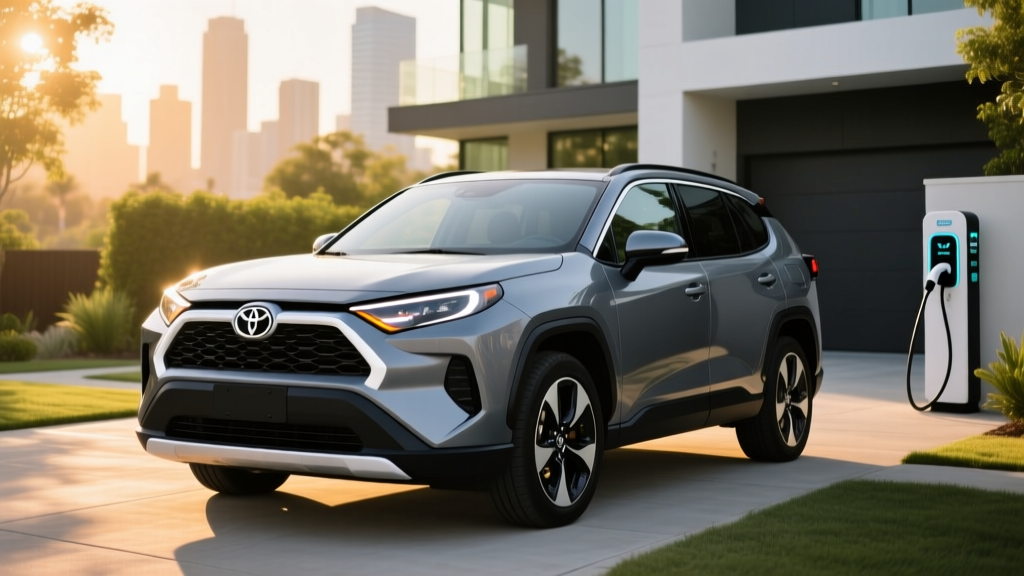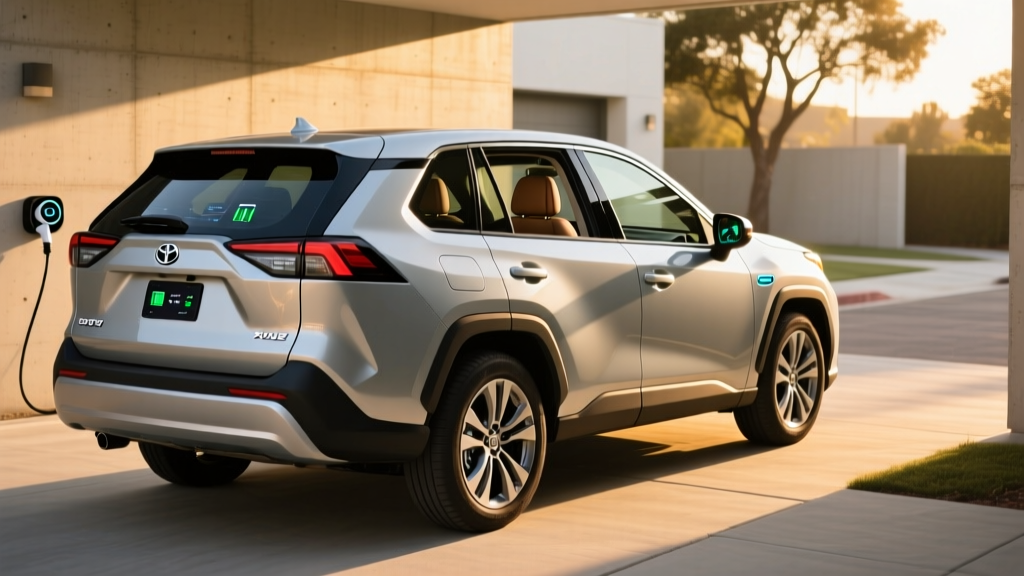
The 2023 Toyota RAV4 Hybrid XLE occupies a specific niche in the compact SUV market: a conventional hybrid (HEV) that requires no plug, no charging infrastructure, and no range-anxiety calculus. With an EPA-rated 40 MPG combined and a starting MSRP around $32,345, it targets buyers who want electrified efficiency without altering their fueling habits. Here is a data-driven look at what this trim actually delivers.
HEV vs PHEV: What the RAV4 Hybrid XLE Actually Is
Before diving into specs, it is essential to distinguish the RAV4 Hybrid from its plug-in sibling, the RAV4 Prime. The 2023 RAV4 Hybrid XLE is a conventional hybrid electric vehicle (HEV). It has no plug, no electric-only driving mode of meaningful distance, and no external charging capability. Its small battery recharges exclusively through regenerative braking and the gasoline engine.
The RAV4 Prime, by contrast, is a plug-in hybrid (PHEV) with an 18.1 kWh battery, 42 miles of EPA electric-only range, and a Level 2 charging port. The Prime starts at over $43,000 — roughly $11,000 more than the Hybrid XLE — and qualifies for different incentive structures. This review focuses entirely on the HEV variant.
| Attribute | 2023 RAV4 Hybrid XLE (HEV) | 2023 RAV4 Prime (PHEV) |
|---|---|---|
| Plug-in charging? | No | Yes (Level 2, J1772) |
| Battery capacity | ~1.6 kWh (NiMH) | 18.1 kWh (Li-ion) |
| Electric-only range | N/A (low-speed assist only) | 42 miles EPA |
| Combined horsepower | 219 hp | 302 hp |
| EPA combined fuel economy | 40 MPG (HEV) | 94 MPGe (EV mode) / 38 MPG (gas mode) |
| Base MSRP | ~$32,345 | ~$43,440 |
| Federal tax credit (§30D) | Not eligible | Eligible (up to $7,500, subject to sourcing/income rules) |
Fuel Economy: EPA Ratings and Real-World MPG
The 2023 RAV4 Hybrid XLE carries the following EPA fuel economy ratings:
| Driving Cycle | EPA Rating |
|---|---|
| City | 41 MPG |
| Highway | 38 MPG |
| Combined | 40 MPG |
Real-World MPG Expectations
Toyota's hybrid system excels in stop-and-go city driving where regenerative braking recaptures energy frequently. Many owners report 42-45 MPG in city-heavy commutes, exceeding the EPA city estimate. Highway driving at sustained 70-80 MPH typically yields 35-37 MPG, slightly below the EPA highway figure — a common pattern for hybrid SUVs where aerodynamic drag dominates at speed and the engine runs continuously without regenerative assist.
In cold weather (below 30°F), expect a 5-10% fuel economy reduction as the engine runs longer to provide cabin heat and the battery operates less efficiently. Winter MPG of 36-38 combined is typical for northern-climate owners.
With a 14.5-gallon fuel tank, the real-world total range sits between 500 and 580 miles depending on driving mix — comparable to or better than most gas-only compact SUVs, and achieved without any behavioral change from the driver.
Powertrain Specs: 219 HP with Standard AWD
The 2023 RAV4 Hybrid uses Toyota's fourth-generation hybrid system, pairing a 2.5-liter Atkinson-cycle four-cylinder engine with front and rear electric motors for electronic all-wheel drive (AWD) on every trim. There is no front-wheel-drive option on the Hybrid.
| Specification | Value |
|---|---|
| Engine | 2.5L inline-4 Atkinson cycle |
| Engine output | 176 hp / 163 lb-ft torque |
| Front electric motor | 118 hp / 149 lb-ft |
| Rear electric motor | 54 hp / 89 lb-ft |
| Net combined horsepower | 219 hp |
| Transmission | eCVT (planetary gearset) |
| Drivetrain | Electronic AWD (eAWD) standard |
| 0-60 MPH | ~7.4 seconds |
| Towing capacity | 1,750 lbs |
The eAWD system is not a traditional mechanical AWD with a driveshaft. Instead, the rear electric motor engages independently when the system detects front-wheel slip, acceleration demand, or cornering needs. This means the rear wheels are motor-driven only during specific conditions — improving traction without the parasitic loss of a full-time mechanical system.
The 7.4-second 0-60 time is respectable for the segment and notably quicker than the gas-only RAV4 LE's ~8.7-second run. The electric motor's instant torque delivery makes the Hybrid feel more responsive in everyday driving than the horsepower number alone suggests.
Battery Warranty, Lifespan, and Replacement Cost
Hybrid Battery Coverage
Toyota covers the 2023 RAV4 Hybrid's traction battery under its Hybrid Battery Warranty: 10 years or 150,000 miles (whichever comes first), transferable to subsequent owners. This applies in all 50 states — Toyota moved to the 10-year/150,000-mile standard nationwide starting with the 2020 model year, replacing the previous split between CARB and non-CARB states.
The hybrid system components (inverter, control module, battery ECU) carry the same 10-year/150,000-mile hybrid system warranty. The standard new-vehicle warranty is 3 years/36,000 miles, and powertrain coverage is 5 years/60,000 miles.
The RAV4 Hybrid uses a nickel-metal hydride (NiMH) battery pack with approximately 1.6 kWh of capacity. NiMH chemistry is less energy-dense than lithium-ion but has a long track record of durability in Toyota hybrids. Data from Toyota's Prius fleet — which uses similar NiMH technology — shows hybrid batteries routinely lasting 150,000-200,000+ miles before significant degradation requires attention.
If replacement is needed out of warranty, a new OEM hybrid battery for the RAV4 Hybrid costs approximately $3,000-$4,500 installed at a dealership. Third-party refurbished or reconditioned NiMH packs are available for $1,500-$2,500 installed. Given the 10-year/150,000-mile warranty and NiMH longevity data, most owners will never face this cost.
Pricing, Trims, and Tax Credit Eligibility
The 2023 Toyota RAV4 Hybrid XLE carries a base MSRP of approximately $32,345 (including destination charge). This positions it about $1,500-$2,000 above the gas-only RAV4 XLE AWD, a premium that typically pays back in fuel savings within 2-4 years for average drivers.
Key XLE-standard features include:
- Toyota Safety Sense 2.5+ (pre-collision, lane departure, adaptive cruise, lane tracing)
- 8-inch touchscreen with Apple CarPlay and Android Auto
- Blind Spot Monitor with Rear Cross-Traffic Alert
- Dual-zone automatic climate control
- Smart Key with push-button start
- 18-inch alloy wheels
Federal Tax Credit Status
The 2023 RAV4 Hybrid XLE does not qualify for the IRS §30D federal clean vehicle tax credit. That credit applies only to plug-in electric vehicles (BEVs and PHEVs) with batteries of at least 7 kWh. As a conventional HEV with a ~1.6 kWh NiMH battery, the RAV4 Hybrid falls outside §30D eligibility entirely.
If you want a RAV4 with federal tax credit potential, the RAV4 Prime (PHEV) may qualify for up to $7,500 under §30D, subject to:
- Buyer income caps ($150K single / $300K joint MAGI)
- Critical mineral and battery component sourcing requirements (which change annually per IRS guidance)
- Vehicle MSRP cap ($80,000 for SUVs — the Prime clears this easily)
- Point-of-sale transfer option available at participating dealers
Always verify current-year eligibility on IRS.gov before purchasing, as sourcing rules tighten annually.
Who Should Choose the RAV4 Hybrid XLE vs Alternatives
Choose the RAV4 Hybrid XLE if:
- You lack access to home or workplace charging (apartment, street parking, no garage)
- You want 40+ MPG without changing any fueling behavior
- You need AWD for snow/rain but don't want a mechanical system's efficiency penalty
- Your budget is $32K-$36K and you prioritize low operating cost over EV driving experience
- You drive 12,000-15,000 miles/year and want a 500+ mile range between fill-ups
Consider a full EV (e.g., Hyundai Ioniq 5, Tesla Model Y) if:
- You can install a Level 2 home charger and want $0.04-$0.06/mile "fuel" cost
- You want the $7,500 federal tax credit and qualify under §30D rules
- Your daily commute is under 60 miles round-trip and you rarely road-trip beyond 250 miles
- You value instant torque, one-pedal driving, and zero tailpipe emissions
Consider the RAV4 Prime (PHEV) if:
- You have home Level 2 charging and want 42 miles of daily electric commuting
- You want the option of full-electric driving for errands but gas flexibility for road trips
- The $11K price premium and potential $7,500 tax credit net out in your budget
- You want 302 hp — the Prime is the quickest RAV4 Toyota makes
Pros and Cons at a Glance
Pros
- 40 MPG combined EPA — 41 city is exceptional for an AWD SUV
- No plug required; works with existing gas-station infrastructure
- Standard eAWD on every Hybrid trim — no FWD compromise
- 10-year/150,000-mile hybrid battery warranty nationwide
- 219 hp makes it quicker than the gas RAV4 by ~1.3 seconds to 60
- Toyota Safety Sense 2.5+ standard (adaptive cruise, lane tracing)
- Strong resale value — RAV4 Hybrid retains value well per Kelley Blue Book data
Cons
- No federal tax credit eligibility (HEV, not PHEV/BEV)
- 1,750-lb towing capacity — inadequate for most boat or utility trailers
- Highway MPG drops to ~35-37 real-world at 75+ MPH
- Cargo space slightly reduced vs gas RAV4 due to battery placement (~37.5 cu ft vs 37.6 cu ft — negligible but technically less)
- eAWD rear motor only activates on demand — not a true off-road system
- Infotainment is functional but dated compared to Hyundai/Kia competitors
Frequently Asked Questions
How many MPG does the 2023 RAV4 Hybrid XLE get?
The EPA rates it at 41 city / 38 highway / 40 combined MPG. Real-world city driving often yields 42-45 MPG thanks to regenerative braking, while sustained highway driving at 70+ MPH typically returns 35-37 MPG. Cold weather reduces combined economy by roughly 5-10%.
Does the RAV4 Hybrid need to be plugged in?
No. The RAV4 Hybrid is a conventional HEV with no plug and no charging port. Its ~1.6 kWh battery recharges through regenerative braking and the gasoline engine. You fuel it exclusively at gas stations, exactly like a conventional vehicle.
Is the hybrid battery reliable and what does replacement cost?
Toyota's NiMH hybrid batteries have a strong longevity record, commonly lasting 150,000-200,000+ miles. The battery is warranted for 10 years/150,000 miles in all 50 states. Out-of-warranty OEM replacement runs $3,000-$4,500 installed; refurbished packs cost $1,500-$2,500. Most original owners will never need a replacement.
Does the 2023 RAV4 Hybrid XLE qualify for any tax credit?
It does not qualify for the federal §30D clean vehicle credit, which requires a plug-in vehicle with at least 7 kWh of battery capacity. Some states or utilities offer small rebates for hybrid purchases — check your state energy office or local utility for programs. The RAV4 Prime (PHEV) may qualify for up to $7,500 federally, subject to income, sourcing, and MSRP requirements.
How does the RAV4 Hybrid compare to a full EV for daily commuting?
If you drive 30-40 miles daily and have no home charging, the RAV4 Hybrid's 40 MPG delivers roughly $0.10-$0.12 per mile in fuel cost (at $3.50/gallon). A comparable EV charging at home at $0.15/kWh costs roughly $0.04-$0.06 per mile. The EV saves $600-$900/year in fuel for a 15,000-mile driver, but requires a $500-$1,500 Level 2 home charger installation and a higher purchase price. If charging access is uncertain, the Hybrid eliminates that variable entirely.
Is the eAWD system on the RAV4 Hybrid good in snow?
The electronic AWD engages the rear motor automatically when slip is detected, providing confident traction in rain and moderate snow. It is not a dedicated off-road or heavy-snow system — the rear motor provides up to 54 hp and 89 lb-ft on demand, not continuous torque. For most winter commuters on plowed roads, it performs well with proper winter tires. For deep snow or trail use, a mechanical AWD system (Subaru Outback, for example) offers more consistent rear-wheel engagement.