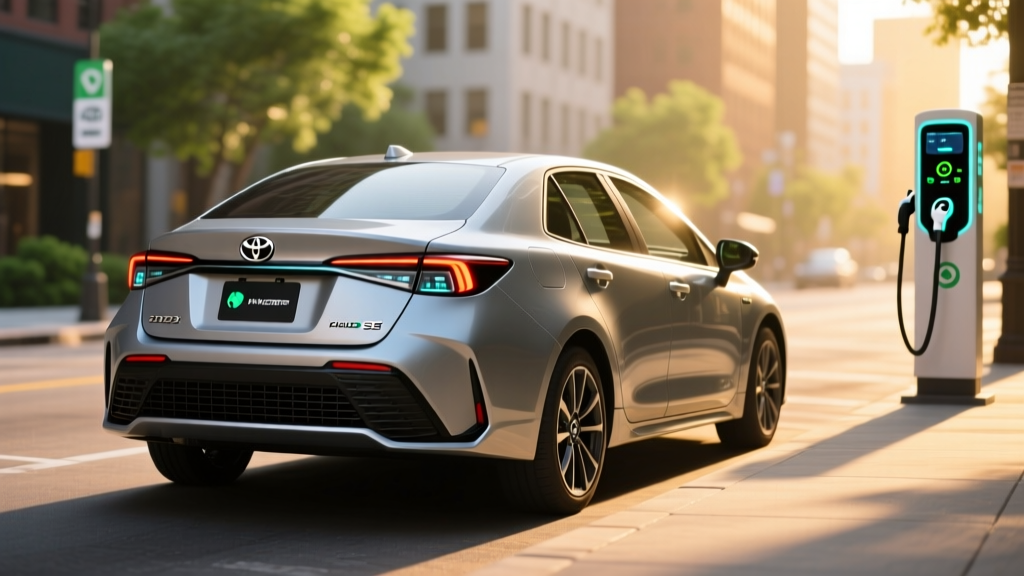
The 2023 Toyota Corolla Hybrid SE occupies a specific niche: a sport-tuned compact sedan that sips fuel without asking you to plug in. With an EPA-estimated 50 MPG combined and standard electronic all-wheel drive, it targets buyers who want EV-like efficiency at the pump without altering their fueling habits. But does the SE trim's sport suspension and paddle shifters actually make a hybrid engaging, or is it just cosmetic differentiation? We break down every spec that matters.
Quick Verdict: Who the Corolla Hybrid SE Is For
The Corolla Hybrid SE is a conventional hybrid electric vehicle (HEV) — not a plug-in. You never plug it in. The 1.1 kWh nickel-metal hydride (NiMH) traction battery charges entirely through regenerative braking and the gasoline engine. This matters because some shoppers confuse the Corolla Hybrid with the Corolla-based Prius Prime, which is a PHEV with an electric-only range and a plug.
If you want a no-compromise commuter that returns 50+ MPG in real-world city driving, costs under $25,000 to start, and carries Toyota's proven hybrid reliability record, the SE trim adds just enough sport character to keep daily driving from feeling like an appliance duty. If you need electric-only miles or federal tax credits, look to a PHEV or full BEV instead.
Fuel Economy: EPA Numbers vs. Real-World MPG
The 2023 Corolla Hybrid SE carries the same EPA ratings as the LE trim despite its sport-tuned suspension and 18-inch alloy wheels:
| Metric | EPA Estimate |
|---|---|
| City MPG | 50 |
| Highway MPG | 43 |
| Combined MPG | 47 |
| Fuel Tank Capacity | 11.4 gallons |
| Total Driving Range | ~535 miles |
Source: EPA / fueleconomy.gov
Powertrain: 138 HP with Electronic AWD
The Corolla Hybrid SE uses Toyota's fifth-generation hybrid synergy drive, pairing a 1.8-liter four-cylinder engine with two motor-generators through a planetary gearset (eCVT). For 2023, Toyota added a rear-mounted motor providing electronic all-wheel drive — a significant upgrade from the FWD-only layout of earlier model years.
| Component | Specification |
|---|---|
| Engine | 1.8L 4-cyl Atkinson-cycle (DOHC, VVT-i) |
| Engine Output | 97 hp / 105 lb-ft torque |
| Front Motor-Generator | MG2: 94 hp / 120 lb-ft |
| Rear Motor (AWD) | 40 hp / 38 lb-ft (engages under acceleration/slip) |
| Net Combined Horsepower | 138 hp |
| Traction Battery | 1.1 kWh NiMH (sealed, no plug) |
| Transmission | eCVT (planetary gearset) |
| 0–60 MPH | ~9.0 seconds (estimated) |
| Drivetrain | Electronic AWD (eAWD) |
The SE trim adds paddle shifters that simulate six stepped "gears" in the eCVT, plus a sport-tuned suspension with firmer damping and a slightly quicker steering ratio. The result is marginally sharper turn-in and less body roll than the LE, though the 138 hp output keeps acceleration decidedly relaxed. This is a car optimized for efficiency first, with the SE trim offering aesthetic and handling improvements rather than a fundamentally different driving experience.
HEV vs. PHEV vs. Full EV: Which Fits Your Commute?
The Corolla Hybrid SE is a conventional hybrid (HEV). Understanding the three electrified categories is critical before purchasing:
| Feature | HEV (Corolla Hybrid) | PHEV (e.g., Prius Prime) | BEV (e.g., Tesla Model 3) |
|---|---|---|---|
| Plug-in Required? | No | Yes (Level 1/2) | Yes (Level 1/2/DC) |
| Electric-Only Range | ~1 mile (low speed) | 25–44 miles | 250–360+ miles |
| Battery Size | 1.1 kWh | 13.6 kWh | 50–82 kWh |
| Gasoline Engine? | Yes (primary) | Yes (backup) | No |
| Federal Tax Credit (§30D) | No | Up to $7,500* | Up to $7,500* |
| Home Charging Needed? | No | Recommended | Essential |
| Best For | No home charging access | Short commute + road trips | Home charging + daily EV driving |
*Federal §30D credit eligibility depends on MSRP caps, buyer income limits, battery sourcing requirements, and point-of-sale transfer rules. See IRS.gov for current-year rules.
Choose the Corolla Hybrid (HEV) if: You don't have access to home or workplace charging, you drive 200+ miles between fill-ups, and you want maximum simplicity with no charging cables or apps to manage.
Choose a PHEV if: You can install a Level 2 charger at home, your daily commute is under 40 miles round-trip (so you drive mostly on electricity), but you still take road trips without range anxiety.
Choose a full EV (BEV) if: You have reliable home charging, want zero tailpipe emissions, and your typical trips fall within the vehicle's range — or you're comfortable planning DC fast-charging stops on road trips.
Pricing, Trims, and Tax Credit Eligibility
The 2023 Corolla Hybrid SE launched with an MSRP of approximately $25,750 (including destination charge). The Hybrid lineup for 2023 included:
- Hybrid LE: ~$23,550 — 16-inch wheels, Toyota Safety Sense 3.0, 8-inch touchscreen
- Hybrid SE: ~$25,750 — 18-inch alloy wheels, sport suspension, paddle shifters, Smart Key
- Hybrid XLE: ~$27,150 — SofTex seats, 10-way power driver seat, 7-inch digital cluster
Federal Tax Credit: The Corolla Hybrid (as a conventional HEV) does not qualify for the §30D new clean vehicle tax credit. That credit is reserved for plug-in vehicles (PHEVs and BEVs) with battery capacities of at least 7 kWh. The Corolla Hybrid's 1.1 kWh NiMH pack falls well below this threshold.
Some states and utilities offer rebates for conventional hybrids, though these are far less common than EV/PHEV incentives. Check your state energy office or utility provider for local programs. As of 2026, most hybrid-specific incentives have been phased out in favor of plug-in vehicle credits.
Battery Warranty, Lifespan, and Replacement Cost
How long do Toyota hybrid batteries actually last? Toyota's NiMH hybrid batteries have an exceptionally strong longevity record. Data from fleet operators and long-term owners shows most Gen 3 and Gen 4 Prius batteries lasting 150,000–200,000+ miles before significant degradation. The Corolla Hybrid uses the same proven NiMH chemistry in a smaller pack. Unlike full EVs where battery replacement costs $10,000–$20,000+, a Corolla Hybrid battery replacement runs approximately $2,000–$4,000 at a Toyota dealer, with refurbished options available for $1,000–$2,000 from independent hybrid specialists.
The smaller 1.1 kWh pack undergoes shallower charge/discharge cycles than a full EV battery, which significantly extends cycle life. Toyota's battery management system keeps the NiMH pack in a narrow state-of-charge window (roughly 40–80%) to minimize stress. For most owners, the hybrid battery will outlast the car's economic life.
SE Trim: What the Sport Package Actually Adds
The SE trim sits between the base LE and the luxury-oriented XLE. Here's what justifies the ~$2,200 premium over the LE:
- 18-inch graphite-colored alloy wheels with 225/40R18 all-season tires (vs. 16-inch on LE)
- Sport-tuned suspension — firmer dampers, slightly stiffer spring rates
- Paddle shifters — 6-speed simulated manual mode in the eCVT
- Smart Key System with push-button start and trunk release
- Leather-trimmed steering wheel with sport contour
- Dark chrome exterior accents and SE badging
- Blind Spot Monitor with Rear Cross-Traffic Alert (standard on SE, optional on LE)
The sport suspension does reduce ride comfort slightly over sharp impacts — the 18-inch wheels with lower-profile tires transmit more road imperfections than the LE's 16-inch setup. If your commute includes poorly maintained roads, the LE's ride quality may be preferable. The handling improvement is modest: less body roll in corners and marginally sharper steering response, but the car's fundamental character remains comfort-oriented commuting.
Pros and Cons at a Glance
✓ Pros
- 50 MPG city — real-world owners often exceed EPA
- No plug-in required — fill up at any gas station
- Standard electronic AWD for all-weather traction
- 10-year/150,000-mile hybrid battery warranty
- Toyota Safety Sense 3.0 standard (AEB, LTA, DRCC, RSA)
- Low starting price (~$25,750) for an AWD hybrid
- Strong resale value and reliability reputation
✗ Cons
- No federal tax credit (HEV, not PHEV/BEV)
- 9.0-second 0–60 time — slow by modern standards
- Modest 1.1 kWh battery — electric assist only at low speeds
- SE's 18-inch wheels firm up the ride noticeably
- Rear seat legroom is tight (35.0 inches) vs. competitors
- Cargo space reduced slightly by battery placement (13.1 cu ft)
- No Apple CarPlay/Android Auto wireless — USB-C wired only
Frequently Asked Questions
How many MPG does the 2023 Corolla Hybrid SE actually get?
The EPA rates it at 50 city / 43 highway / 47 combined MPG. In real-world driving, city commuters consistently report 50–54 MPG thanks to heavy regenerative braking. Highway cruising at 70–80 MPH typically yields 40–44 MPG. Cold weather reduces efficiency by 5–10% due to increased engine-on time for cabin heating.
Does the Corolla Hybrid need to be plugged in?
No. The Corolla Hybrid is a conventional HEV (hybrid electric vehicle). Its 1.1 kWh battery charges entirely through regenerative braking and the gasoline engine. There is no plug, no charging cable, and no charging station required. You fuel it exactly like a regular gas car.
Does the 2023 Corolla Hybrid qualify for any tax credit?
The federal §30D clean vehicle tax credit (up to $7,500) applies only to plug-in vehicles — PHEVs and BEVs with at least 7 kWh of battery capacity. The Corolla Hybrid's 1.1 kWh NiMH pack does not qualify. Some state or utility rebates may apply to conventional hybrids, but these are increasingly rare. Check your state energy office for local programs.
Is the Corolla Hybrid SE reliable long-term?
Toyota's hybrid powertrain is among the most proven in the industry, with over 25 years of continuous production since the 1997 Prius. The hybrid battery is warrantied for 10 years/150,000 miles, and real-world data shows most Toyota hybrid batteries lasting 150,000–200,000+ miles. Replacement cost is approximately $2,000–$4,000 if needed out of warranty — far less than a full EV battery replacement.
How does the SE's AWD system work?
The Corolla Hybrid uses electronic AWD (eAWD). There is no mechanical driveshaft connecting the front and rear axles. Instead, an independent rear electric motor engages automatically during hard acceleration, low-traction starts (rain, snow, gravel), and when the front wheels slip. Under steady cruising, the rear motor disengages to preserve fuel economy. It's a traction-enhancement system, not an off-road setup, but it provides meaningful confidence in winter conditions.
Should I buy the Corolla Hybrid SE or a used EV instead?
If you lack home charging access, the Corolla Hybrid is the pragmatic choice — you get 50 MPG without lifestyle changes. If you can install a Level 2 home charger and your commute is under 40 miles, a used EV (like a 2021–2023 Chevrolet Bolt or Nissan Leaf) may cost less per mile to operate and qualifies for the $4,000 used-EV tax credit. The Corolla Hybrid wins on simplicity, total range (~535 miles per tank), and zero charging infrastructure requirements.