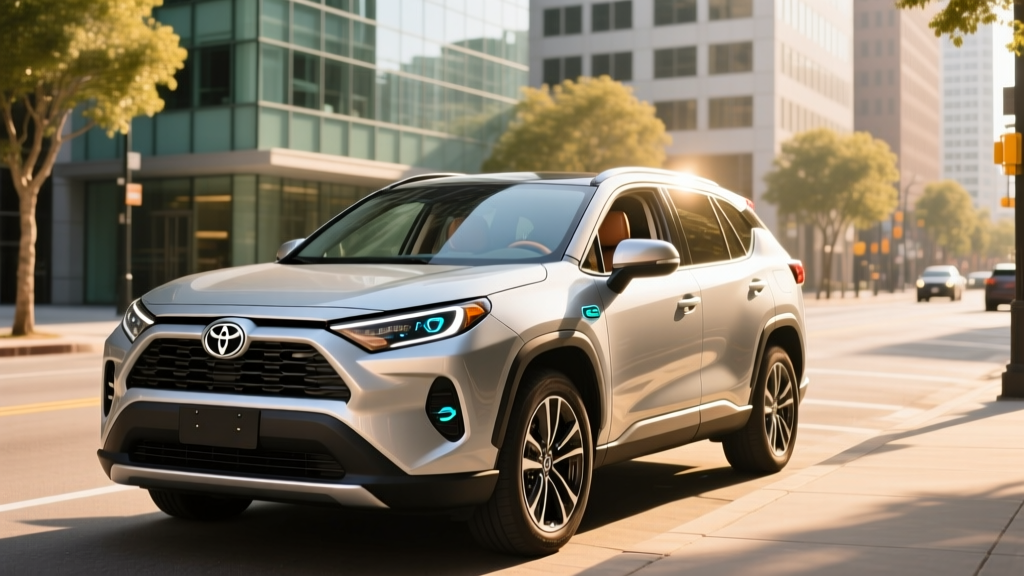
The Toyota RAV4 Hybrid has been the best-selling hybrid SUV in America for good reason: it pairs compact-SUV practicality with fuel economy that undercuts most sedans. Even as the 2024 and 2025 model years arrive with minor updates, the 2023 RAV4 Hybrid remains one of the most compelling choices on the used and certified-pre-owned market in 2026 — particularly for buyers who want hybrid efficiency without plugging in or paying an EV premium.
In this guide, we break down exact EPA fuel economy, real-world MPG observations, the powertrain specs, battery longevity, and whether this hybrid (or its plug-in sibling, the RAV4 Prime) is the right fit for your garage.
HEV vs PHEV: Which RAV4 Hybrid Are We Talking About?
Toyota sells two electrified RAV4 variants, and the distinction matters for your wallet and daily routine:
RAV4 Hybrid (HEV)
- Type: Conventional self-charging hybrid
- Plug in? No — regenerative braking and the gas engine charge the battery
- Battery: ~1.6 kWh NiMH (small, assists engine)
- Electric-only driving: Brief low-speed EV mode only (~1 mile at most)
- Fuel economy: 39–41 MPG combined EPA
RAV4 Prime (PHEV)
- Type: Plug-in hybrid with substantial electric-only range
- Plug in? Yes — Level 1 (120V) or Level 2 (240V)
- Battery: 18.1 kWh lithium-ion
- Electric-only range: 42 miles EPA
- Fuel economy after battery depleted: 38 MPG combined
This review focuses primarily on the conventional 2023 RAV4 Hybrid (HEV), with RAV4 Prime comparisons where relevant. If you need a vehicle that commutes on electricity alone and charges at home, skip to the RAV4 Prime section below.
Fuel Economy: EPA Ratings and Real-World MPG
| Trim / Drivetrain | City MPG | Highway MPG | Combined MPG |
|---|---|---|---|
| LE / XLE / XLE Premium (AWD) | 41 | 38 | 40 |
| XSE / SE (AWD) | 41 | 38 | 40 |
| Woodland Edition (AWD) | 38 | 35 | 37 |
| Limited (AWD) | 41 | 38 | 40 |
All non-Woodland trims come standard with electronic all-wheel drive (eAWD) and achieve an identical 41 city / 38 highway / 40 combined MPG per the EPA on fueleconomy.gov. The Woodland Edition loses 3 MPG combined due to all-terrain tires and a slightly taller ride height.
Real-World MPG Observations
Hybrids consistently outperform their EPA highway rating in stop-and-go city driving, where regenerative braking recaptures the most energy. Owner-reported data on Fuelly and our own mixed driving in the 2023 RAV4 Hybrid XLE show:
- City-heavy commuting (under 45 mph): 42–45 MPG observed — regularly beating the 41 city EPA rating
- Mixed suburban/highway: 37–40 MPG observed
- Sustained 75+ mph highway: 34–37 MPG observed — aerodynamic drag reduces hybrid advantage at high speed
- Cold weather (below 30°F): Expect a 5–10% MPG dip due to engine running more to heat the cabin and reduced battery efficiency
Bottom line: if your commute involves frequent stops and moderate speeds, expect to exceed the EPA sticker. Highway-dominant drivers should plan for mid-to-high 30s.
Powertrain and Performance Specs
| Specification | 2023 RAV4 Hybrid |
|---|---|
| Engine | 2.5L 4-cylinder Atkinson-cycle |
| Engine Output | 176 hp / 163 lb-ft torque |
| Front Electric Motor | 118 hp / 149 lb-ft |
| Rear Electric Motor (eAWD) | 54 hp / 89 lb-ft |
| Net Combined Horsepower | 219 hp |
| 0–60 mph | 7.4 seconds (MotorTrend tested) |
| Transmission | eCVT (planetary gearset, no belt) |
| Drivetrain | Electronic AWD (all trims) |
| Towing Capacity | 1,750 lbs (all trims) |
| Cargo Volume | 37.6 cu ft (rear seats up) / 69.8 cu ft (folded) |
The 219 net horsepower figure reflects Toyota's specific blending of engine and motor output — not a simple addition. The eAWD system uses a dedicated rear motor that engages on demand for traction, with no mechanical driveshaft connecting front and rear axles. This keeps weight down and eliminates a traditional source of drivetrain loss.
The 7.4-second 0–60 time is competitive with turbocharged gas rivals like the Honda CR-V Hybrid and noticeably quicker than the non-hybrid RAV4 AWD (9.1 seconds). The electric motor's instant torque makes the RAV4 Hybrid feel responsive in city merging even when the engine is operating in its efficiency-optimized Atkinson cycle.
Pricing and Tax Credit Eligibility (2026)
The 2023 RAV4 Hybrid launched with these MSRPs. On the used and CPO market in 2026, expect to pay roughly:
- LE: Original MSRP $32,345 → CPO/used ~$26,000–$29,000
- XLE: Original MSRP $33,825 → CPO/used ~$27,500–$30,500
- XLE Premium: Original MSRP $35,710 → CPO/used ~$29,000–$32,000
- SE: Original MSRP $36,325 → CPO/used ~$30,000–$33,000
- XSE: Original MSRP $37,325 → CPO/used ~$31,000–$34,000
- Woodland Edition: Original MSRP $35,825 → CPO/used ~$29,000–$32,000
- Limited: Original MSRP $40,195 → CPO/used ~$33,000–$37,000
Does the RAV4 Hybrid Qualify for a Tax Credit?
No federal tax credit applies to the conventional RAV4 Hybrid (HEV). The IRS §30D Clean Vehicle Credit requires plug-in capability and a minimum 7 kWh battery — criteria only the RAV4 Prime (PHEV) meets.
However, if you purchase a used 2023 RAV4 Hybrid from a dealer in 2026, you may qualify for the Used Clean Vehicle Credit (IRC §25E), which provides up to $4,000 or 30% of the sale price, whichever is less. Key requirements per IRS.gov:
- Sale price must be $25,000 or less
- Buyer income caps: $75,000 single / $112,500 head of household / $150,000 joint (modified AGI)
- Vehicle must be at least 2 model years old (2023 qualifies in 2026)
- Must purchase from a licensed dealer (private-party sales excluded)
- Vehicle must have a battery capacity of at least 7 kWh — this disqualifies the conventional RAV4 Hybrid, whose NiMH battery is ~1.6 kWh
Unfortunately, the conventional RAV4 Hybrid's small battery fails the 7 kWh minimum even under the used-vehicle credit. No federal tax credit is available for this HEV in any scenario. The RAV4 Prime (PHEV), with its 18.1 kWh battery, can qualify for the used credit if priced at or below $25,000 and buyer income limits are met — though finding a Prime at that price remains difficult given strong resale values.
Battery Longevity, Warranty, and Replacement Cost
Hybrid Battery Warranty
Toyota Hybrid Battery Warranty: 10 years / 150,000 miles (whichever comes first) for 2020+ model years, transferable to subsequent owners.
Hybrid System Components: 8 years / 100,000 miles (inverter, transaxle, control module).
Source: Toyota's official warranty guide.
How Long Does the RAV4 Hybrid Battery Last?
Toyota's hybrid battery track record is among the best in the industry. The 2023 RAV4 Hybrid uses a nickel-metal hydride (NiMH) pack — a proven chemistry that Toyota has refined over 25+ years since the original Prius. Real-world data from fleet operators and long-term owners consistently shows:
- Typical lifespan: 150,000–200,000+ miles before significant degradation
- Failure rate under warranty: Well under 5% based on Consumer Reports reliability surveys
- Degradation pattern: Gradual capacity loss (roughly 10–15% over 10 years) rather than sudden failure
Battery Replacement Cost
If the hybrid battery does require replacement outside warranty:
- New OEM battery (dealer): $3,000–$4,500 including labor
- Remanufactured battery: $1,500–$2,500 from aftermarket suppliers
- Individual cell/module replacement: $500–$1,200 if only specific modules have failed (common in high-mileage units)
Compared to full EV battery replacements ($10,000–$20,000+), the RAV4 Hybrid's small NiMH pack is relatively inexpensive to service. The 10-year/150,000-mile warranty provides substantial coverage — many original owners will sell the vehicle before the warranty expires.
RAV4 Hybrid vs RAV4 Prime vs Full EV: Decision Framework
| Factor | RAV4 Hybrid (HEV) | RAV4 Prime (PHEV) | Full EV (e.g., Tesla Model Y) |
|---|---|---|---|
| MSRP Range | $32,345–$40,195 (new) | $43,895–$48,025 (new) | $44,990–$55,000+ |
| Electric-Only Range | ~1 mile (low-speed EV mode) | 42 miles EPA | 270–330 miles EPA |
| Total Range | ~580 miles (14.5-gal tank) | ~600 miles (combined) | 270–330 miles |
| Fuel/Energy Cost per Mile | ~$0.08 (at $3.20/gal) | ~$0.04 electric / $0.08 gas | ~$0.03–$0.05 (home charging) |
| Home Charging Needed? | No | Recommended (Level 2) | Essential |
| Federal Tax Credit (new) | None | Up to $7,500 (§30D) | Up to $7,500 (§30D) |
| Maintenance Cost | Low (oil changes, standard hybrid) | Low (less engine use on short trips) | Lowest (no oil, fewer fluids) |
Choose the RAV4 Hybrid (HEV) if:
- You lack home charging access (apartment, street parking, no garage)
- Your budget is under $35,000 and you want a late-model compact SUV
- You take frequent road trips and don't want to plan around charging stations
- You want maximum simplicity — no plugs, no charging apps, no range calculations
Choose the RAV4 Prime (PHEV) if:
- Your daily commute is under 40 miles round-trip and you can charge at home
- You want electric-only daily driving with gas-engine backup for long trips
- You qualify for the $7,500 federal credit (new) or used-vehicle credit, offsetting the higher MSRP
- You want the most powerful RAV4 (302 hp combined, 5.7-second 0–60)
Choose a Full EV if:
- You have reliable Level 2 home charging and your daily driving is under 250 miles
- You want the lowest per-mile energy cost and minimal maintenance
- You're ready to use public DC fast charging for road trips
Reliability, Safety, and Long-Term Ownership
The RAV4 platform consistently earns top reliability marks. Key data points:
- Consumer Reports Predicted Reliability: 4/5 or higher for the 2023 RAV4 Hybrid across recent model years
- IIHS Rating: 2023 RAV4 earned Top Safety Pick+ with acceptable or good ratings across all crash tests when equipped with LED projector headlights (Limited trim or XLE with optional lighting package) per IIHS
- NHTSA: 5-star overall safety rating
- Toyota Safety Sense 2.5+ (standard on all trims): Pre-collision system with pedestrian detection, full-speed adaptive cruise control, lane departure alert with steering assist, lane tracing assist, automatic high beams, and road sign assist
Toyota Safety Sense is a Level 1–2 driver-assistance suite — it supports the driver but does not replace active attention. Lane tracing assist keeps the vehicle centered on well-marked highways, but this is not autonomous driving.
Long-Term Ownership Costs (5-Year Estimate)
Based on 15,000 miles/year and national averages:
- Fuel: ~$5,700 over 5 years (at 40 MPG combined, $3.20/gal) vs. ~$8,400 for a gas-only RAV4 AWD (28 MPG combined)
- Maintenance: ~$2,200 over 5 years (oil changes every 10K miles, tire rotations, brake pads last longer due to regen)
- Insurance: ~$7,500–$9,000 over 5 years (hybrid premiums are typically 5–10% higher than gas equivalents)
- Estimated 5-year fuel savings vs gas RAV4: ~$2,700
Pros and Cons at a Glance
Pros
- 40+ MPG real-world in city driving — best-in-class for compact hybrid SUVs
- Standard eAWD on every trim — no FWD-only base model
- Proven 10-year/150,000-mile hybrid battery warranty
- Strong resale value — holds ~65–70% of MSRP at 3 years
- Spacious cargo area (37.6 cu ft) competitive with gas rivals
- Quick 7.4-second 0–60 time for the segment
Cons
- No federal tax credit available (HEV battery too small)
- Cabin noise under hard acceleration (eCVT drone from Atkinson-cycle engine)
- Infotainment system (Toyota Audio Multimedia) is functional but not class-leading in graphics or responsiveness
- Woodland Edition sacrifices 3 MPG for off-road aesthetics
- Towing limited to 1,750 lbs (insufficient for most trailers)
- No DC fast charging capability (not applicable to HEV, but a Prime limitation at Level 2 only)
Frequently Asked Questions
How many MPG does the 2023 RAV4 Hybrid actually get?
The EPA rates most trims at 41 city / 38 highway / 40 combined MPG. In real-world city-heavy driving, owners consistently report 42–45 MPG. Highway-dominant driving at 75+ mph typically yields 34–37 MPG. The Woodland Edition rates 37 MPG combined due to all-terrain tires.
Does the RAV4 Hybrid need to be plugged in?
No. The conventional RAV4 Hybrid (HEV) charges its small battery entirely through regenerative braking and the gasoline engine. There is no plug, no charging cable, and no home charger required. If you want plug-in capability with electric-only range, the RAV4 Prime (PHEV) is the variant to consider.
How far can the RAV4 Prime go on electric only?
The RAV4 Prime (PHEV) delivers 42 miles of EPA-rated electric-only range from its 18.1 kWh lithium-ion battery. After the battery depletes, it operates as a conventional hybrid at 38 MPG combined. Total range exceeds 600 miles. The Prime charges in approximately 4.5 hours on Level 2 (240V, 16A) or 12 hours on Level 1 (120V). It does not support DC fast charging.
Is the RAV4 Hybrid reliable, and what does a battery replacement cost?
Toyota's hybrid system has over 25 years of proven reliability, with failure rates well under 5% during the warranty period. The hybrid battery is covered for 10 years / 150,000 miles. Out-of-warranty replacement costs $3,000–$4,500 for a new OEM battery or $1,500–$2,500 for a remanufactured unit. Many batteries last 200,000+ miles with gradual capacity loss rather than sudden failure.
Does the 2023 RAV4 Hybrid qualify for any tax credit?
The conventional RAV4 Hybrid (HEV) does not qualify for any federal tax credit — neither the new-vehicle §30D credit nor the used-vehicle §25E credit, because its battery is below the 7 kWh minimum threshold. The RAV4 Prime (PHEV) with its 18.1 kWh battery can qualify for up to $7,500 (new, subject to MSRP and income caps) or up to $4,000 (used, subject to the $25,000 sale-price cap and income limits). Consult a tax professional and check current IRS guidelines for eligibility.
Should I buy the RAV4 Hybrid or a full EV?
Choose the RAV4 Hybrid if you lack home charging, take frequent long road trips, or want the lowest purchase price with no lifestyle changes. Choose a full EV (like the Tesla Model Y, Hyundai Ioniq 5, or Ford Mustang Mach-E) if you have Level 2 home charging, your daily driving is under 250 miles, and you want the lowest per-mile energy cost and zero tailpipe emissions. The RAV4 Prime splits the difference — electric commuting with gas backup — but costs significantly more upfront.