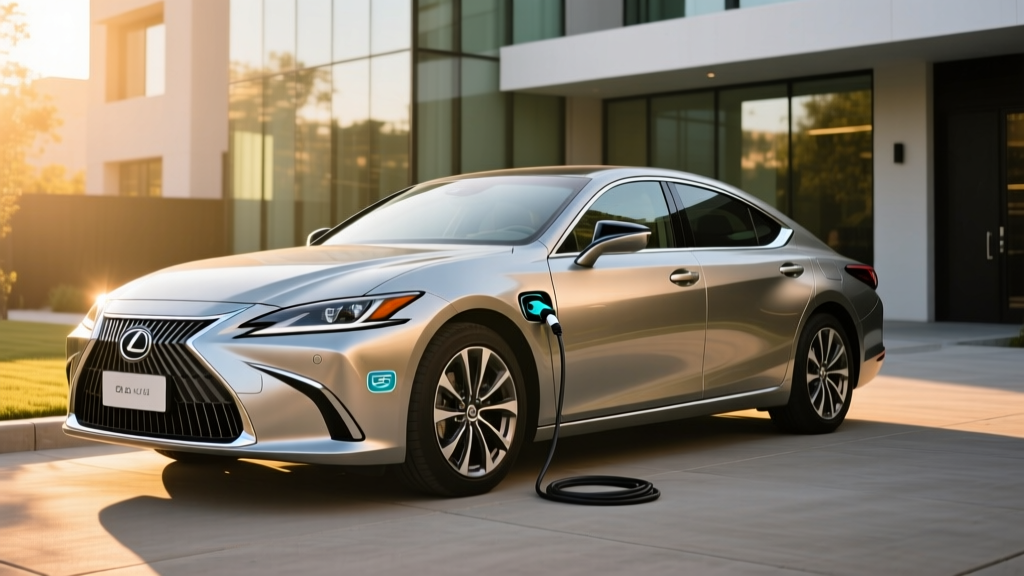
The 2023 Lexus ES Hybrid — badged as the ES 300h — occupies a specific niche: a midsize luxury sedan that prioritizes fuel efficiency, cabin quietness, and long-term reliability over outright performance. With an EPA-estimated 44 MPG combined, it sips fuel at a rate that embarrasses many compact economy cars, while delivering the refinement Lexus buyers expect. But in a market now crowded with plug-in hybrids and full battery-electric vehicles, does a conventional hybrid (HEV) still make sense?
This guide breaks down the ES 300h's powertrain specs, real-world fuel economy, battery longevity, ownership costs, and how it stacks up against PHEV and EV alternatives — so you can decide whether this sedan fits your daily driving needs.
2023 Lexus ES Hybrid Fuel Economy: EPA Numbers and Real-World Results
The ES 300h pairs a 2.5-liter four-cylinder engine with an electric motor in Toyota's fourth-generation hybrid system. The result is impressive efficiency across the board.
| Metric | EPA Estimate | Real-World Expectation |
|---|---|---|
| City MPG | 43 MPG | 44–47 MPG (hybrids excel in stop-and-go) |
| Highway MPG | 44 MPG | 40–43 MPG (aerodynamic drag at 75+ mph) |
| Combined MPG | 44 MPG | 42–45 MPG (mixed driving) |
| Fuel Tank | 13.2 gallons | — |
| Total Range | ~581 miles | ~550–590 miles depending on conditions |
One characteristic of conventional hybrids like the ES 300h is that city MPG often meets or exceeds the EPA sticker. Regenerative braking recaptures energy at low speeds, and the engine shuts off at stops — so urban commuters frequently report 45–47 MPG in warm-weather city driving. Highway efficiency drops slightly at sustained high speeds, where the electric motor contributes less and aerodynamic drag dominates.
In cold weather (below 30°F), expect a 5–10% efficiency penalty as the engine runs more frequently to heat the cabin and warm the hybrid battery. This is far less dramatic than the 20–30% range loss EVs experience in freezing temperatures, but it's worth noting for northern-climate drivers.
Powertrain and Performance Specifications
| Specification | Value |
|---|---|
| Engine | 2.5L inline-4 (Atkinson cycle) |
| Electric Motor | Permanent magnet synchronous, integrated into transaxle |
| Combined Horsepower | 215 hp |
| 0–60 mph | 8.1 seconds |
| Drivetrain | Front-wheel drive (FWD) |
| Transmission | eCVT (electronically controlled continuously variable) |
| Hybrid Battery | 1.6 kWh nickel-metal hydride (NiMH) |
| Curb Weight | ~3,865 lbs |
The ES 300h is not a performance sedan. The 8.1-second 0–60 time is adequate for merging and passing, but this car is tuned for smoothness, not acceleration. The eCVT eliminates shift shock entirely, and the transition between electric-only and engine-assisted driving is nearly imperceptible — a hallmark of Toyota/Lexus hybrid refinement.
That 1.6 kWh NiMH battery is small by modern standards, but it's intentional. Conventional hybrids don't need large packs because they recharge continuously through regenerative braking and engine power. The battery enables short electric-only bursts at low speeds (typically under 25 mph for brief distances), but the ES 300h cannot sustain electric-only driving at highway speeds or for meaningful distances. You will never plug this car in — it generates all its own electricity.
HEV vs PHEV vs EV: Which Powertrain Fits You?
Buyers cross-shopping the 2023 Lexus ES Hybrid often wonder whether a plug-in hybrid or full EV would serve them better. Here's how to think about it:
| Factor | HEV (ES 300h) | PHEV (e.g., BMW 530e) | BEV (e.g., Tesla Model S, BMW i5) |
|---|---|---|---|
| Plug in to charge? | No — self-charging | Yes — recommended for max savings | Yes — required |
| Electric-only range | ~1 mile at low speed | 20–40 miles typical | 250–400 miles |
| Home charging needed? | No | Recommended (Level 2) | Essential (Level 2) |
| Best for | No home charging access; long road trips | Short commute + road trips | Home charging + daily driving under 300 mi |
| Maintenance | Low (no plug, simple system) | Moderate (two full powertrains) | Lowest (no engine, no oil changes) |
| Fuel cost per mile | ~$0.08 (at $3.50/gal) | ~$0.04 electric / $0.09 gas | ~$0.04 (at $0.14/kWh) |
Choose the 2023 Lexus ES Hybrid (HEV) if:
- You lack access to home or workplace charging
- You drive 15,000+ miles per year and want minimal fuel cost without plug-in logistics
- You regularly take road trips exceeding 300 miles and don't want to plan charging stops
- You prioritize long-term reliability and low maintenance
Choose a PHEV or EV instead if:
- You have Level 2 home charging and a commute under 30 miles (PHEV covers it on electricity alone)
- You want zero tailpipe emissions on daily driving (EV)
- You qualify for the federal §30D tax credit, which requires a plug-in vehicle (HEVs do not qualify)
Pricing, Trims, and Tax Credit Eligibility
The 2023 Lexus ES 300h was offered in four trims at launch. Here's the original MSRP breakdown:
| Trim | 2023 MSRP |
|---|---|
| Base | $43,490 |
| Luxury | $46,660 |
| Ultra Luxury | $49,260 |
| F SPORT Design | $46,860 |
All trims include destination charge. As of 2026, pre-owned ES 300h models typically list between $30,000 and $40,000 depending on mileage and condition.
Federal tax credit: The 2023 Lexus ES 300h does not qualify for the IRS §30D Clean Vehicle Credit. That credit — up to $7,500 for new vehicles or up to $4,000 for used — applies only to plug-in electric vehicles (PHEVs and BEVs) with qualifying battery capacity. Conventional hybrids like the ES 300h have been ineligible for federal purchase incentives since the Energy Policy Act of 2005 credits expired for Toyota/Lexus vehicles years ago. Per IRS §30D guidelines, only vehicles capable of being recharged from an external source meet the definition.
State incentives: Some states offer modest hybrid rebates or HOV lane access, but these vary by jurisdiction and change frequently. Check your state's energy office or the Alternative Fuels Data Center for current local programs.
Battery Warranty, Longevity, and Replacement Cost
2023 Lexus ES 300h Hybrid Battery Warranty:
- Coverage: 10 years / 150,000 miles (whichever comes first) in CARB states; 10 years / 150,000 miles federally for 2020+ models
- What's covered: Hybrid battery pack, hybrid control module, and related components against defects and capacity loss below a defined threshold
- Capacity threshold: Lexus/Toyota typically warrants the hybrid battery to retain sufficient capacity for normal hybrid operation — not a specific percentage as EV warranties define
Toyota and Lexus hybrid batteries have an exceptional longevity track record. The NiMH pack in the ES 300h is small, lightly stressed, and never deep-cycled the way an EV battery is. Real-world data from Toyota Prius fleets and Lexus CT 200h owners shows hybrid batteries routinely lasting 150,000–200,000+ miles before any capacity concern arises. Many original Prius batteries from 2004–2009 are still in service.
If replacement is eventually needed outside warranty, a new OEM hybrid battery for the ES 300h costs approximately $3,000–$4,500 installed at a Lexus dealer. Refurbished/reconditioned packs are available from third-party shops for $1,500–$2,500. This is dramatically less than EV battery replacement, which can exceed $15,000–$25,000 for large packs.
According to Lexus official specifications, the hybrid system is designed to last the life of the vehicle with no scheduled hybrid battery maintenance.
Reliability and Safety Ratings
The Lexus ES lineage consistently ranks at or near the top of J.D. Power Vehicle Dependability Studies and Consumer Reports reliability surveys. The ES 300h's hybrid powertrain is essentially identical to the Toyota Camry Hybrid system — one of the most proven hybrid setups on the road with millions of units in service worldwide.
The 2023 ES earned top marks from the Insurance Institute for Highway Safety (IIHS), receiving a Top Safety Pick+ designation with acceptable or good ratings across all crashworthiness tests. Standard Lexus Safety System+ 2.5 includes pre-collision braking, lane departure alert with steering assist, full-speed adaptive cruise control, and lane tracing assist — all SAE Level 1 driver-assistance features that require full driver engagement at all times.
Pros and Cons of the 2023 Lexus ES Hybrid
Pros
- 44 MPG combined — exceptional for a midsize luxury sedan
- No plug-in required; works with existing gas station infrastructure
- 10-year / 150,000-mile hybrid battery warranty
- Proven Toyota/Lexus hybrid reliability with low maintenance costs
- Quiet, refined cabin with standard luxury features
- 580+ mile total range eliminates road-trip range anxiety
- Strong resale value — Lexus ES holds value well
Cons
- 8.1-second 0–60 time — leisurely acceleration
- FWD only — no AWD option for snow-belt buyers
- No federal tax credit eligibility (HEV, not plug-in)
- Infotainment system uses a touchpad interface that some find frustrating (updated to touchscreen on 2023 models, but still not class-leading)
- Rear seat doesn't fold — limited cargo flexibility
- Cannot drive on electric power alone for meaningful distances
Frequently Asked Questions
How many MPG does the 2023 Lexus ES Hybrid get?
The EPA rates the 2023 Lexus ES 300h at 43 MPG city, 44 MPG highway, and 44 MPG combined. In real-world city driving, many owners report 45–47 MPG thanks to regenerative braking. Highway driving at 75+ mph typically yields 40–43 MPG.
Do I need to plug in the Lexus ES 300h?
No. The ES 300h is a conventional hybrid (HEV), not a plug-in hybrid. It recharges its small 1.6 kWh battery through regenerative braking and the gasoline engine. You fuel it like any other car at a gas station — there is no charging port.
How far can the ES 300h drive on electric power alone?
Only about 1 mile at very low speeds (under 25 mph) in ideal conditions. The hybrid battery is too small for sustained electric-only driving. This is normal for conventional hybrids — the electric motor assists the engine for efficiency rather than providing standalone propulsion.
Is the hybrid battery reliable, and what does replacement cost?
Toyota/Lexus hybrid batteries are among the most reliable in the industry, routinely lasting 150,000–200,000+ miles. The battery is covered by a 10-year / 150,000-mile warranty. Out-of-pocket replacement runs $3,000–$4,500 for a new OEM pack, or $1,500–$2,500 for a refurbished unit.
Does the 2023 Lexus ES Hybrid qualify for any tax credit?
No. The federal §30D Clean Vehicle Credit applies only to plug-in vehicles (PHEVs and BEVs). The ES 300h is a conventional hybrid and does not qualify. Some states may offer minor incentives for hybrids — check your local programs.
How does the ES 300h compare to a PHEV like the BMW 530e?
The BMW 530e offers about 35 miles of electric-only range and qualifies for partial federal tax credits, but requires home charging to realize its efficiency benefits. If you can charge at home and commute under 35 miles, the PHEV saves more on fuel. If you lack charging access or take frequent long trips, the ES 300h's simplicity and 580-mile range are advantages.
Should I buy the ES 300h or a full EV like the Tesla Model 3?
Choose the ES 300h if you can't charge at home, regularly drive 400+ miles in a day, or prefer a traditional luxury sedan experience. Choose an EV if you have reliable Level 2 home charging, want the lowest per-mile fuel cost (~$0.04/mile vs ~$0.08/mile for the ES 300h), and your daily driving stays under 250 miles.