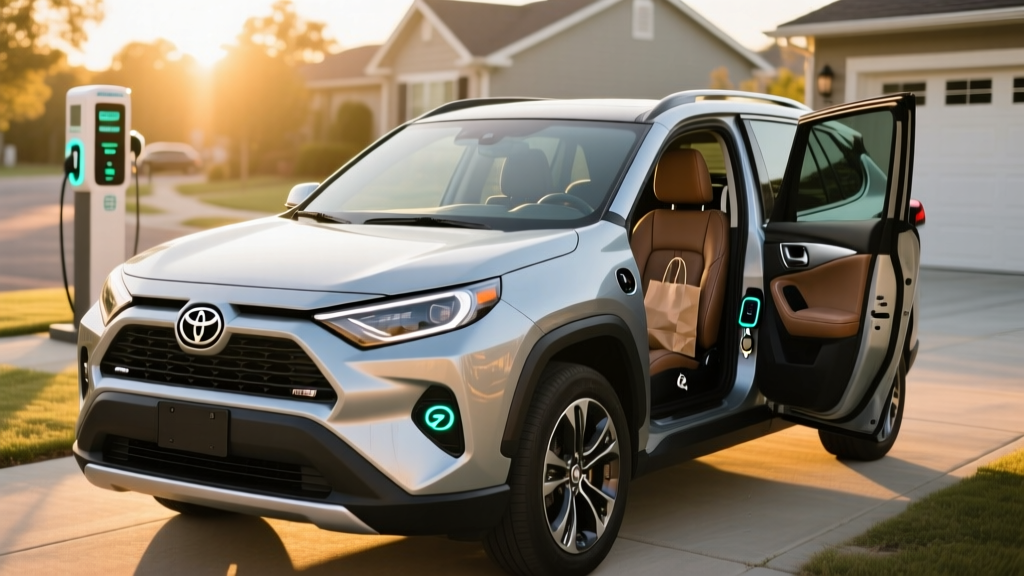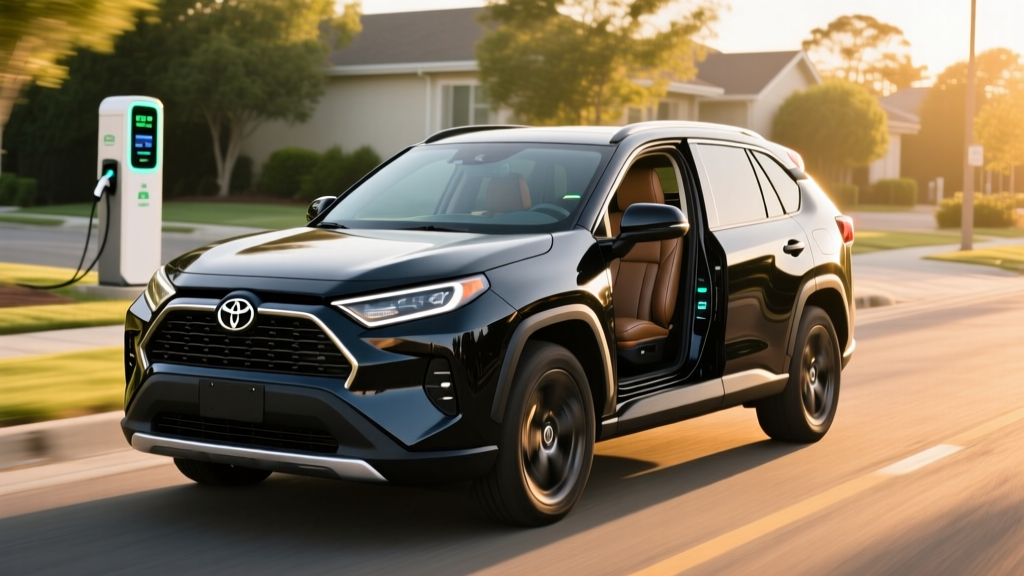
The 2022 Toyota RAV4 Hybrid SE occupies a narrow but appealing lane in the compact SUV segment: it pairs Toyota's proven hybrid synergy drive with sport-tuned suspension, a blacked-out exterior, and standard electronic all-wheel drive. For buyers in 2026 evaluating the used hybrid market, the SE trim delivers the same stellar fuel economy as other RAV4 Hybrid models while adding visual and handling differentiation. Here is everything you need to know about its efficiency, powertrain, reliability, and ownership economics before signing on the dotted line.
HEV vs PHEV: Where the RAV4 Hybrid SE Fits
Before diving into specs, it is essential to distinguish what the 2022 RAV4 Hybrid SE is — and what it is not.
Conventional Hybrid (HEV) — RAV4 Hybrid SE
The RAV4 Hybrid SE is a self-charging hybrid. It uses a small battery recharged by regenerative braking and the gasoline engine. You never plug it in. It cannot drive on electric power alone for meaningful distances. Its job is to maximize miles per gallon from every drop of fuel.
Plug-In Hybrid (PHEV) — RAV4 Prime
Toyota sold the RAV4 Prime alongside the standard RAV4 Hybrid in 2022. The Prime is a plug-in hybrid with an 18.1 kWh battery, 42 miles of EPA electric-only range, and a combined 302 hp. It qualifies for different incentive structures and costs significantly more. The Prime is a separate model line, not a trim of the RAV4 Hybrid.
If you are searching for a RAV4 you never need to plug in, the Hybrid SE is the right target. If you want electric-only commuting, you want the RAV4 Prime instead.
Fuel Economy: EPA Ratings and Real-World MPG
| Metric | EPA Estimate | Real-World Expectation |
|---|---|---|
| City | 41 MPG | 42–45 MPG (hybrids excel in stop-and-go) |
| Highway | 38 MPG | 34–37 MPG (sustained 70+ mph reduces regen benefit) |
| Combined | 40 MPG | 37–42 MPG depending on driving mix |
The 2022 RAV4 Hybrid SE carries the same EPA ratings as every other RAV4 Hybrid trim: 41 city / 38 highway / 40 combined. These figures come from the EPA's fueleconomy.gov database for the AWD configuration, which is standard on all RAV4 Hybrid models.
In real-world driving, Toyota's hybrid system rewards city and suburban use. Regenerative braking recaptures energy at every stoplight, and the engine shuts off frequently at low speeds. Owners who drive predominantly in urban environments often report exceeding the EPA combined figure, sometimes hitting 43–45 MPG on mixed suburban routes. Highway-heavy commuters should expect a dip to the mid-to-upper 30s, as aerodynamic drag at 75 mph overwhelms the hybrid system's efficiency advantages.
Cold weather also matters. In sub-freezing temperatures, expect a 5–10% fuel economy reduction as the engine runs more frequently to provide cabin heat and maintain battery temperature. This is normal hybrid behavior, not a defect.
Powertrain and Performance Specs
| Specification | 2022 RAV4 Hybrid SE |
|---|---|
| Engine | 2.5L 4-cylinder Atkinson-cycle |
| Electric Motors | Front motor + rear motor (AWD-i) |
| Combined System Horsepower | 219 hp |
| Transmission | eCVT (planetary gearset) |
| Drivetrain | Electronic AWD (AWD-i), standard |
| 0–60 mph | ~7.4 seconds |
| Hybrid Battery | ~1.6 kWh, nickel-metal hydride (NiMH) |
| Towing Capacity | 1,750 lbs |
| Cargo Volume | 37.6 cu ft (rear seats up) / 69.8 cu ft (folded) |
The 219 hp combined output comes from a 176 hp / 163 lb-ft gasoline engine paired with a 118 hp front electric motor and a 54 hp rear motor that activates for all-wheel-drive traction. The rear motor is independent — there is no mechanical driveshaft connecting the front and rear axles. This "AWD-i" system engages the rear wheels during acceleration, slippery conditions, and low-speed maneuvers.
The SE trim adds a sport-tuned suspension with stiffer dampers and a slightly lower ride height compared to LE and XLE trims. The result is marginally sharper cornering and reduced body roll, though the trade-off is a firmer ride over rough pavement. The 18-inch black alloy wheels are unique to the SE and contribute to its more aggressive stance.
Battery Warranty, Lifespan, and Replacement Cost
Toyota Hybrid Battery Warranty
Coverage: 10 years / 150,000 miles (whichever comes first), transferable to subsequent owners.
What it covers: Failure of the hybrid battery pack or loss of capacity below a functional threshold that triggers a diagnostic trouble code.
Source: Toyota's official warranty guide.
Toyota extended its hybrid battery warranty to 10 years / 150,000 miles starting with 2020 model-year vehicles, and the 2022 RAV4 Hybrid SE benefits from this policy. This is one of the strongest hybrid battery warranties in the industry.
Regarding lifespan: Toyota's NiMH hybrid batteries have a long track record of durability. Data from Prius fleets and high-mileage RAV4 Hybrids shows that these packs routinely last 150,000–200,000+ miles before significant degradation. The hybrid system's battery management software keeps the pack in a narrow state-of-charge window (roughly 40–80%), which minimizes stress on the cells. Unlike a full EV battery, the RAV4 Hybrid's small 1.6 kWh pack is never deeply discharged or fully charged during normal operation.
If replacement is needed out of warranty, a new OEM hybrid battery pack from Toyota typically costs between $2,000 and $4,000 including labor. Third-party reconditioned packs are available for $1,000–$2,500. Individual module replacement (only the failed cells) can bring costs down further to $500–$1,500 at a specialist shop.
Pricing, Used Market Value, and Tax Credit Eligibility
The 2022 RAV4 Hybrid SE had a base MSRP of approximately $33,260 (including destination charge). With popular options like the Technology Package (panoramic view monitor, front and rear parking assist with automatic braking) and premium audio, well-equipped examples stickered near $36,000–$37,000.
In the 2026 used market, expect to pay roughly $25,000–$31,000 depending on mileage, condition, and regional demand. RAV4 Hybrids hold their value well due to strong reliability reputations and high fuel prices.
Does the 2022 RAV4 Hybrid SE Qualify for a Tax Credit?
Under current IRS §30D rules, conventional hybrids (HEVs) do not qualify for the federal clean vehicle tax credit. The §30D credit applies only to battery electric vehicles (BEVs) and plug-in hybrids (PHEVs) with battery packs of at least 7 kWh. The RAV4 Hybrid SE's ~1.6 kWh NiMH battery falls far short of this threshold.
If you are buying used, the separate §25E used clean vehicle credit (up to $4,000 or 30% of the sale price, whichever is less) also requires the vehicle to be a qualifying BEV or PHEV. The standard RAV4 Hybrid is excluded.
The RAV4 Prime (PHEV variant) may qualify for certain incentives, but it is a different vehicle. For the Hybrid SE, you are paying full price with no federal tax offset. Some states offer hybrid-specific rebates or HOV lane access — check your state's energy office or DMV for current programs.
SE Trim: What You Get and What You Give Up
Pros
- 40 MPG combined EPA — real-world city driving often exceeds this
- Standard AWD-i with no fuel economy penalty vs FWD competitors
- 10-year / 150,000-mile hybrid battery warranty, transferable
- Sport-tuned suspension for sharper handling than typical compact SUVs
- Strong resale value and Toyota reliability track record
- No plug-in required — works with existing gas station infrastructure
Cons
- No federal tax credit eligibility (HEV, not PHEV)
- Firmer ride quality from sport suspension may bother some buyers
- 1,750-lb towing limit is low for the segment
- No electric-only driving mode for zero-emission short trips
- Rear-seat legroom is average for the class
- Used market prices remain elevated due to high demand
The SE's visual upgrades — gloss-black wheels, black roof rails, dark badging, and a unique front grille — give it a more aggressive look than the LE or XLE. Inside, you get SofTex synthetic leather seats with red stitching, an 8-inch touchscreen with Apple CarPlay and Android Auto, and Toyota Safety Sense 2.0 (adaptive cruise control, lane-keeping assist, automatic emergency braking, and automatic high beams).
What the SE lacks compared to higher trims: no panoramic sunroof (that is reserved for the Limited or the Technology Package on XLE), no JBL premium audio as standard, and no ventilated seats. The SE is positioned as a sport-appearance value trim, not a luxury one.
Hybrid vs PHEV vs EV: Which RAV4 Is Right for You?
Toyota offered three powertrains for the RAV4 in 2022: gas-only, hybrid (HEV), and plug-in hybrid (Prime). In 2026, the decision framework remains the same whether buying new or used:
Choose the RAV4 Hybrid (HEV) if:
- You cannot charge at home or work (no garage, no outlet access)
- You want maximum MPG with zero behavior change — just fill up with gas
- Your budget is under $32,000 on the used market
- You drive a mix of city and highway and want 37–42 real-world MPG
Choose the RAV4 Prime (PHEV) if:
- You can install a Level 2 charger at home
- Your daily commute is under 42 miles round-trip (the Prime's EPA electric range)
- You want to drive mostly on electricity but need gas flexibility for road trips
- You can absorb the higher purchase price ($40,000+ used) and potentially qualify for incentives
Choose a full EV (e.g., Tesla Model Y, Hyundai Ioniq 5) if:
- You have reliable home or workplace charging
- You want the lowest per-mile fuel cost and zero tailpipe emissions
- You want to qualify for the §30D federal tax credit (up to $7,500 for new, $4,000 for used qualifying BEVs)
- You are comfortable with 250–330 miles of range and DC fast charging for road trips
The RAV4 Hybrid SE is the pragmatic middle ground. It requires no charging infrastructure, delivers excellent fuel economy, and costs significantly less than a PHEV or EV. The trade-off is that you will always buy gasoline, and you miss out on federal incentives reserved for plug-in vehicles.
Frequently Asked Questions
How many MPG does the 2022 RAV4 Hybrid SE get?
The EPA rates it at 41 city / 38 highway / 40 combined. Real-world results typically range from 37 to 45 MPG depending on driving conditions. City-heavy drivers often beat the EPA estimate; highway-heavy drivers fall slightly below.
Do I need to plug in the RAV4 Hybrid SE?
No. The 2022 RAV4 Hybrid SE is a conventional hybrid (HEV). Its small battery recharges through regenerative braking and the gasoline engine. You fuel it like any other gas car.
Is the hybrid battery reliable, and what does replacement cost?
Toyota's hybrid batteries are among the most reliable in the industry, routinely lasting 150,000–200,000+ miles. The 2022 model carries a 10-year / 150,000-mile warranty. Out-of-warranty replacement costs $2,000–$4,000 for a new OEM pack, or $1,000–$2,500 for a reconditioned unit.
Does the RAV4 Hybrid SE qualify for any federal tax credit?
No. Under IRS §30D rules, only plug-in hybrids (PHEVs) and battery electric vehicles (BEVs) qualify for the federal clean vehicle credit. The RAV4 Hybrid is a conventional HEV and is not eligible. Some states may offer separate hybrid incentives — check your local programs.
How does the SE trim differ from the XLE or Limited?
The SE adds sport-tuned suspension, unique 18-inch black alloy wheels, black exterior accents, SofTex seats with red stitching, and a more aggressive front grille. It sacrifices some comfort features (no standard panoramic roof, no JBL audio) for a sportier look and feel. Fuel economy is identical across all RAV4 Hybrid trims.
Can the RAV4 Hybrid SE tow?
Yes, but modestly. The maximum towing capacity is 1,750 pounds — enough for a small utility trailer or a pair of dirt bikes, but not a boat or camper. If you need more towing capacity, the gas-only RAV4 Adventure or TRD Off-Road trims are rated for 3,500 pounds, though at significantly lower fuel economy.
What is the difference between the RAV4 Hybrid and the RAV4 Prime?
The RAV4 Hybrid (including the SE) is a conventional HEV with a ~1.6 kWh battery, 219 hp, and 40 MPG combined. You never plug it in. The RAV4 Prime is a PHEV with an 18.1 kWh battery, 302 hp, 42 miles of electric-only range, and 38 MPG combined once the battery is depleted. The Prime costs more but offers electric commuting and potential tax credit eligibility.