Quick Verdict: The NX 450h+ Bridges Two Worlds
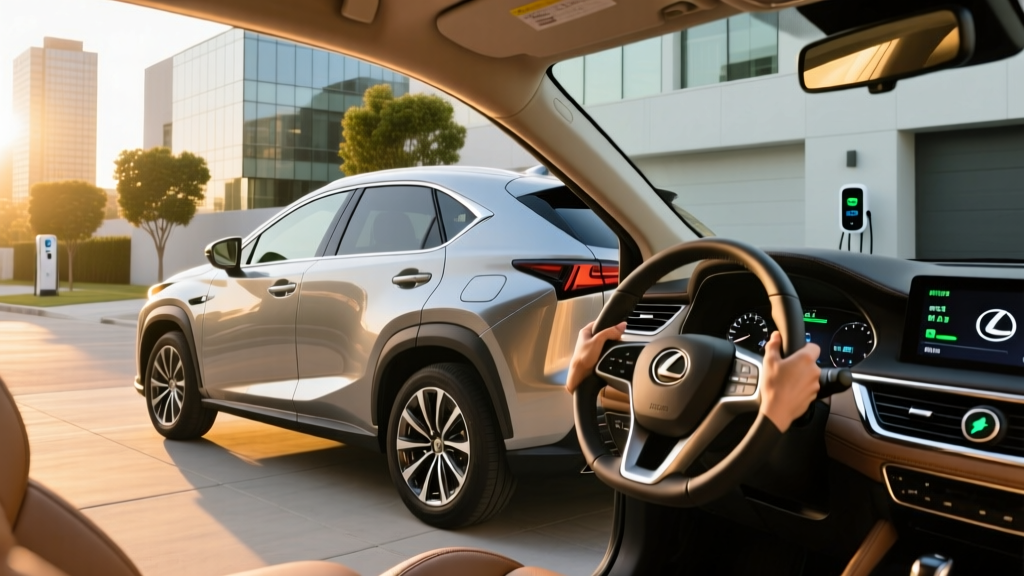
The 2022 Lexus NX plug-in hybrid — badged the NX 450h+ — arrived as the first plug-in hybrid in the NX lineup, pairing a 2.5-liter four-cylinder engine with a pair of electric motors and an 18.1 kWh lithium-ion battery. The result is a luxury compact SUV that can handle most daily commutes on electricity alone while eliminating range anxiety on longer trips. For buyers who want EV-like daily driving without committing to full electrification, the NX 450h+ makes a compelling case — though its premium pricing and limited DC fast-charging capability demand a closer look.
| Spec | NX 450h+ (PHEV) | NX 350h (HEV) |
|---|---|---|
| Powertrain | 2.5L I4 + 2 electric motors | 2.5L I4 + 2 electric motors |
| Combined Horsepower | 304 hp | 240 hp |
| Battery (usable) | 18.1 kWh lithium-ion | 1.6 kWh NiMH |
| EPA Electric-Only Range | 37 miles | N/A |
| EPA MPGe (combined) | 84 MPGe | N/A |
| EPA MPG (gas only) | 36 combined | 39 combined |
| Total Combined Range | ~550 miles | ~555 miles |
| 0–60 mph | 6.0 seconds | 7.2 seconds |
| Drivetrain | AWD (eAWD) | AWD (eAWD) |
| Level 2 Charge Time (0–100%) | ~4.5 hours (3.3 kW onboard) | N/A |
| DC Fast Charging | Not available | N/A |
| Base MSRP (2022) | $56,650 | $42,150 |
HEV vs PHEV: Understanding the Two NX Hybrids
Lexus offers the NX with two distinct hybrid powertrains, and the distinction matters for your daily routine and wallet:
| Factor | NX 350h (Conventional Hybrid) | NX 450h+ (Plug-In Hybrid) |
|---|---|---|
| Needs to plug in? | No — regenerates internally | Yes — for electric-only range |
| Electric-only driving | Minimal (~1 mi at low speed) | 37 miles EPA at full charge |
| Fuel economy | 39 MPG combined always | 84 MPGe on charge; 36 MPG after depletion |
| Upfront cost | ~$14,500 less | Premium pricing |
| Home charging needed? | No | Strongly recommended for value |
| Best for | No garage/outlet access; high mileage | Short commute + home Level 2 |
The conventional NX 350h operates exactly like a traditional hybrid: it charges its small battery through regenerative braking and engine power. You never plug it in. The NX 450h+, by contrast, carries a much larger 18.1 kWh battery that you charge from a wall outlet or Level 2 home charger. When that battery is full, you drive up to 37 miles without burning a drop of gasoline. Once the battery depletes, it reverts to hybrid operation at 36 MPG combined.
Fuel Economy: EPA Numbers and Real-World Results
The EPA rates the 2022 NX 450h+ at 84 MPGe combined when operating in electric mode, and 36 MPG combined (35 city / 37 highway) once the battery is depleted. The conventional NX 350h achieves 41 city / 37 highway / 39 combined MPG, per fueleconomy.gov.
| Mode | City | Highway | Combined |
|---|---|---|---|
| NX 450h+ (electric, MPGe) | 88 MPGe | 81 MPGe | 84 MPGe |
| NX 450h+ (gas only, MPG) | 35 | 37 | 36 |
| NX 350h (HEV, MPG) | 41 | 37 | 39 |
Real-world note: Plug-in hybrids reward city driving and short commutes. Owners who charge nightly and commute under 35 miles may go weeks without visiting a gas station, effectively achieving well over 100 MPGe in mixed use. On a long highway road trip with a depleted battery, expect the NX 450h+ to deliver around 33–35 MPG at 70–75 mph — slightly below its EPA highway figure due to the added weight of the larger battery. The NX 350h, lighter and tuned for hybrid efficiency, often exceeds its EPA city rating in stop-and-go traffic, with owners commonly reporting 42–44 MPG in urban driving.
Electric-Only Range, Charging, and Battery Specs
The NX 450h+ stores energy in an 18.1 kWh lithium-ion battery pack mounted beneath the rear seat. The EPA rates it at 37 miles of electric-only range. In real-world conditions — mild weather, moderate speeds, flat terrain — expect 32–36 miles. In cold weather (below 30°F), that figure can drop to 25–28 miles as the battery's chemical efficiency decreases and cabin heating draws additional power.
Real-world expectation: 30–36 miles (mild weather); 25–28 miles (cold weather)
Total combined range (gas + electric): ~550 miles
Charging the NX 450h+:
- Level 1 (120V household outlet): ~10–12 hours from empty to full using the included charging cable. Practical for overnight topping off if your daily drive is short.
- Level 2 (240V, home or public): ~4.5 hours from empty to full. The onboard charger is limited to 3.3 kW, which is modest by 2026 PHEV standards. Even on a 48-amp Level 2 home charger, the car cannot accept more than 3.3 kW.
- DC fast charging: Not available. The NX 450h+ does not have a DC fast-charge port. This is a notable limitation — competitors like the Toyota RAV4 Prime (which shares this powertrain) also lack DC fast charging, while some newer PHEVs like the Jeep Wrangler 4xe offer optional DC capability.
The 3.3 kW onboard charger means the NX 450h+ is designed for home charging, not public fast-charging stops. Plan accordingly: plug in overnight, wake up to a full battery, and use the gasoline engine for longer trips.
Powertrain and Performance
The NX 450h+ combines a 2.5-liter Atkinson-cycle four-cylinder engine with two electric motors — one driving the front axle and one driving the rear — for a combined system output of 304 horsepower. This makes it the most powerful NX variant available for the 2022 model year, outpacing the turbocharged NX 350 (275 hp) and the conventional NX 350h hybrid (240 hp).
The electric all-wheel-drive system (eAWD) provides instant torque from the rear motor without a mechanical driveshaft, delivering confident acceleration and sure-footed traction in rain and light snow. The 0–60 mph time of 6.0 seconds is brisk for a compact luxury hybrid SUV and noticeably quicker than the NX 350h's 7.2-second sprint.
Driving modes include EV (electric-only), HV (hybrid), and Auto EV/HV, which lets the system decide when to engage the engine. There's also a CHARGE mode that uses the engine to recharge the battery while driving — useful if you want to save electric range for a zero-emission zone later in your trip, though this sacrifices fuel economy in the short term.
Pricing, Trims, and Tax Credit Eligibility
The 2022 Lexus NX 450h+ launched in a single trim — NX 450h+ Luxury — with a base MSRP of $56,650 (including destination). Well-optioned examples with the Mark Levinson audio system, head-up display, panoramic moonroof, and Advanced Park package can push the price above $63,000.
For comparison, the conventional NX 350h starts at approximately $42,150, making the plug-in premium roughly $14,500 before incentives.
- The 2022 NX 450h+ was eligible for a partial federal tax credit (up to $6,843 based on its battery capacity) at the time of its release, but Toyota/Lexus had reached the manufacturer cap phase-out under the pre-2023 rules. Under current IRS §30D rules (post-Inflation Reduction Act), new PHEV eligibility depends on battery sourcing, critical minerals requirements, MSRP caps ($80,000 for SUVs), and buyer income limits ($300K joint / $150K single MAGI).
- As a 2022 model purchased new, original buyers should verify their specific credit amount with a tax professional and reference IRS.gov §30D guidelines.
- Used EV credit (§25E): If purchasing a pre-owned NX 450h+ in 2026, the used clean vehicle credit offers up to $4,000 or 30% of the sale price (whichever is less), subject to income caps ($150K joint / $75K single) and a sale price cap of $25,000. Given the NX 450h+'s residual values, qualifying may be difficult — check dealer pricing.
- State incentives vary widely. California, Colorado, and other states may offer additional rebates. Consult your state's energy office for current programs.
Reliability, Battery Warranty, and Replacement Costs
Lexus consistently ranks at or near the top of J.D. Power and Consumer Reports reliability surveys, and the NX 450h+'s powertrain benefits from Toyota's decades of hybrid engineering. The 2.5L Atkinson-cycle engine is under-stressed and proven across millions of Toyota/Lexus hybrids. The eAWD system has no mechanical driveshaft, transfer case, or rear differential to maintain — reducing long-term failure points.
• 10 years / 150,000 miles (whichever comes first) on the hybrid battery and all hybrid-system components
• 8 years / 100,000 miles on emissions-related components
• Coverage includes the traction battery, inverter, electric motors, and associated control modules
• Warranty is fully transferable to subsequent owners
Battery degradation reality: Toyota/Lexus PHEV batteries are engineered with conservative state-of-charge buffers — the system never fully charges or fully depletes the pack, which significantly extends cycle life. Based on data from Toyota's Prius Prime and RAV4 Prime (which share similar battery architecture), owners typically see 5–10% capacity loss over the first 100,000 miles. A 2022 NX 450h+ in 2026 with moderate mileage should still deliver close to its original electric range.
Battery replacement cost: If the hybrid battery fails outside of warranty, a replacement pack for the NX 450h+ currently runs between $4,000 and $6,500 including labor at a Lexus dealer. Independent hybrid specialists may offer refurbished packs for $2,500–$4,000. However, outright battery failure before 150,000 miles is statistically rare based on Toyota/Lexus hybrid track records.
Who Should Choose the NX 450h+ vs. a Full EV or Gas Car?
- Your daily round-trip commute is under 35 miles and you can charge at home
- You want electric daily driving but frequently take road trips beyond 300 miles
- You live in a region with harsh winters where EV range loss is a concern
- You lack reliable public DC fast-charging infrastructure near your routes
- You value Lexus reliability and luxury without going full electric
- You have home Level 2 charging and rarely drive more than 250 miles in a day
- You want zero tailpipe emissions and minimal maintenance (no oil, no engine)
- You want access to DC fast charging for road trips (150–250 kW capable)
- You want to maximize fuel savings and your electricity rates are low
- You cannot charge at home (apartment, street parking, no garage outlet)
- You want hybrid efficiency without any plug-in behavior change
- Your budget is closer to $42K–$50K and the PHEV premium isn't justified
- You drive high annual mileage where the PHEV's electric range is a small fraction
- You drive very few miles annually (under 5,000) — the hybrid premium won't pay back
- You tow regularly (the NX is not a strong tow vehicle in any configuration — 2,000 lbs max)
Pros and Cons at a Glance
- 37 miles of electric range covers most commutes
- 304 hp makes it the quickest NX variant
- Excellent Lexus reliability and 10-year hybrid warranty
- 36 MPG after battery depletion is strong for a 304-hp AWD SUV
- Premium, quiet cabin with Lexus Safety System+ 3.0
- No range anxiety — gas engine covers long trips seamlessly
- $56,650+ base price is steep; PHEV premium over NX 350h is ~$14,500
- 3.3 kW onboard charger is slow; no DC fast charging
- 37-mile EV range is less than some newer PHEV competitors
- Federal tax credit eligibility is complex and may be limited
- Heavier than NX 350h — slightly lower gas-only MPG
- Rear cargo space marginally reduced by battery placement
Frequently Asked Questions
How many MPG does the 2022 Lexus NX plug-in hybrid get?
The NX 450h+ achieves 84 MPGe combined when running on its charged battery, and 36 MPG combined (35 city / 37 highway) after the battery depletes and the gasoline engine takes over. In real-world mixed use with nightly charging, many owners effectively operate at well over 80 MPGe for daily driving, using gasoline only on longer trips.
How far can the NX 450h+ go on electric only?
The EPA rates the NX 450h+ at 37 miles of electric-only range. Real-world results typically fall between 30 and 36 miles in mild conditions, dropping to 25–28 miles in freezing temperatures. This is sufficient for most daily commutes but shorter than some newer PHEVs like the Toyota RAV4 Prime (42 miles) or the Hyundai Tucson PHEV (33 miles).
Is the NX 450h+ reliable, and what does battery replacement cost?
Lexus is among the most reliable luxury brands, and the NX 450h+'s hybrid system is proven across Toyota's lineup. The hybrid battery is warranted for 10 years / 150,000 miles. Out-of-warranty replacement costs range from $4,000 to $6,500 at a dealer, but catastrophic battery failure before 150,000 miles is rare based on Toyota/Lexus historical data.
Does the 2022 NX 450h+ qualify for a federal tax credit?
Tax credit eligibility is complex and depends on when you purchased, your income, and current IRS rules. Under pre-2023 rules, Toyota/Lexus had exceeded the manufacturer cap, which limited credits for new purchases. Under current §30D rules (post-IRA), battery sourcing and critical mineral requirements further affect eligibility. Consult IRS.gov or a tax professional for your specific situation. If buying used, the §25E credit (up to $4,000) may apply if the sale price is under $25,000.
Can the NX 450h+ use DC fast chargers?
No. The NX 450h+ does not support DC fast charging. It is limited to Level 1 (120V) and Level 2 (240V) AC charging, with a maximum onboard charge rate of 3.3 kW. A full Level 2 charge takes approximately 4.5 hours. This is a deliberate design choice shared with the RAV4 Prime and reflects Toyota's view that PHEVs are primarily home-charged overnight.
What's the difference between the NX 450h+ and NX 350h?
The NX 450h+ is a plug-in hybrid (PHEV) with a large 18.1 kWh battery, 304 hp, 37 miles of electric-only range, and a plug. The NX 350h is a conventional hybrid (HEV) with a small 1.6 kWh battery, 240 hp, no plug, and a constant 39 MPG combined. The 450h+ costs roughly $14,500 more but offers electric daily driving and significantly more power.
Should I buy the NX PHEV or a full EV?
If you have reliable home charging, a commute under 35 miles, and frequently take trips over 300 miles — or live in an area with sparse DC fast-charging infrastructure — the NX 450h+ offers the best of both worlds. If you rarely drive long distances, want minimal maintenance, and have access to home and public fast charging, a full EV like the Tesla Model Y or Hyundai Ioniq 5 will deliver lower operating costs and zero tailpipe emissions.