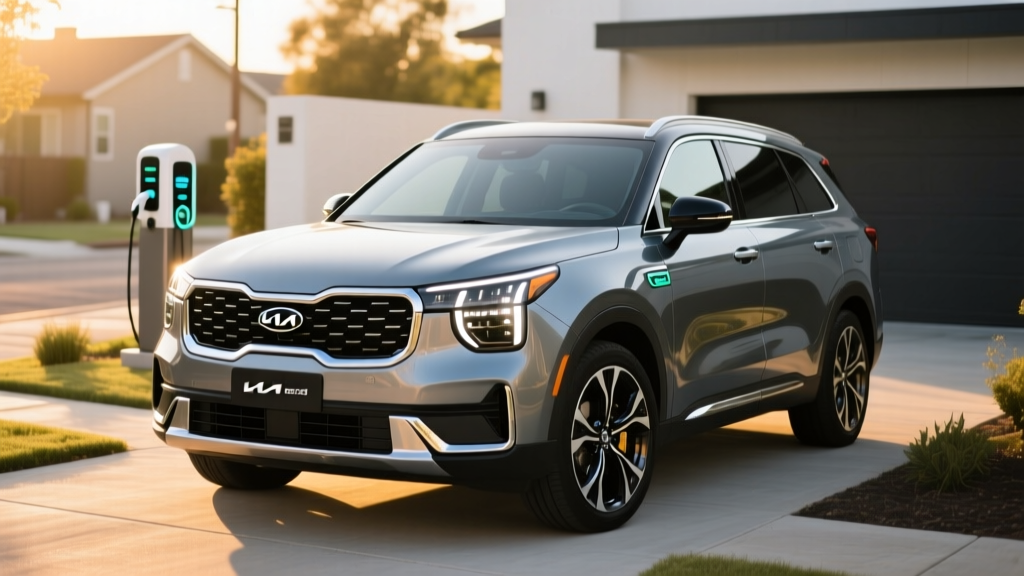
If you need three rows of seating but aren't ready to commit to a full battery-electric vehicle, the 2022 Kia Sorento Hybrid occupies a practical middle ground. It pairs a turbocharged engine with an electric motor for genuine fuel savings without range anxiety, plug-in logistics, or the premium pricing of a fully electric SUV. As a used vehicle in 2026, it also opens the door to the federal used clean vehicle credit — something gas-only Sorentos can't offer.
This guide breaks down the 2022 Kia Sorento Hybrid's real-world fuel economy, powertrain specs, battery longevity, ownership costs, and whether it still makes sense against newer hybrids and plug-in alternatives.
2022 Kia Sorento Hybrid Powertrain: Turbo Meets Electric
The 2022 Sorento Hybrid (HEV) uses a 1.6-liter turbocharged four-cylinder engine paired with a 44 kW (approximately 59 horsepower) electric motor integrated into a 6-speed automatic transmission. Unlike many hybrids that use a CVT, Kia's conventional automatic gives the Sorento Hybrid a more natural driving feel under acceleration.
| Specification | Value |
|---|---|
| Engine | 1.6L turbocharged 4-cylinder (Smartstream G1.6 T-GDi) |
| Engine output | 178 hp / 195 lb-ft torque |
| Electric motor | 44 kW permanent magnet synchronous |
| Motor output | 59 hp / 195 lb-ft torque |
| Combined system output | 261 hp / 258 lb-ft torque |
| Transmission | 6-speed automatic (no CVT) |
| Drivetrain | AWD (standard on all trims) |
| Battery | 1.49 kWh lithium-ion polymer (self-charging, no plug) |
| 0–60 mph | ~7.8 seconds |
The 1.49 kWh battery is small by EV standards — and that's intentional. This is a conventional hybrid (HEV), not a plug-in. The battery charges itself through regenerative braking and the engine; you never plug it in. It stores enough energy to assist acceleration and enable brief low-speed electric-only driving (typically under 1 mile at parking-lot speeds), but it cannot sustain highway travel on electric power alone.
Fuel Economy: EPA Ratings vs. Real-World MPG
The EPA rates the 2022 Kia Sorento Hybrid AWD at 39 city / 35 highway / 37 combined MPG across all trims (S, EX, EX Prestige, SX Prestige). That combined figure represents a roughly 45% improvement over the non-hybrid turbo AWD Sorento, which earns 24 MPG combined.
| Driving Cycle | EPA Rating | Real-World Expectation |
|---|---|---|
| City | 39 MPG | 38–42 MPG (hybrids excel in stop-and-go) |
| Highway | 35 MPG | 32–35 MPG (less regen benefit at steady speed) |
| Combined | 37 MPG | 34–38 MPG depending on driving mix |
Real-world results vary predictably with driving conditions. In city and suburban driving with frequent stops, the Sorento Hybrid often meets or exceeds its EPA city estimate — regenerative braking recaptures energy at every light, and the electric motor handles low-speed launches. On sustained highway runs above 70 mph, expect the figure to dip toward the low-to-mid 30s, as aerodynamic drag dominates and the turbo engine carries most of the load.
Cold weather reduces fuel economy by roughly 5–10% due to cabin heating demands and reduced battery efficiency. Owners in northern climates should budget for winter combined MPG in the low-to-mid 30s. With a 17.7-gallon fuel tank, real-world total range sits between 550 and 650 miles per fill-up.
HEV vs. PHEV: Understanding the Sorento Hybrid Lineup
Kia sold the 2022 Sorento in three powertrain variants: a conventional gas model, the Sorento Hybrid (HEV), and the Sorento Plug-in Hybrid (PHEV). The HEV and PHEV share the same 1.6L turbo engine and AWD layout, but their battery systems and operating logic differ significantly.
| Attribute | Sorento Hybrid (HEV) | Sorento Plug-In Hybrid (PHEV) |
|---|---|---|
| Battery capacity | 1.49 kWh | 13.8 kWh |
| Plug-in charging | No — self-charging only | Yes — Level 1 (120V) or Level 2 (240V) |
| Electric-only range | N/A (brief low-speed only) | 32 miles (EPA) |
| Combined system HP | 261 hp | 261 hp |
| EPA combined MPG | 37 MPG | 79 MPGe (charge-depleting) / 34 MPG (gas-only) |
| Level 2 charge time (0–100%) | N/A | ~3 hours 25 minutes at 7.2 kW |
| DC fast charging | N/A | No DC fast charge capability |
| Federal tax credit (new, 2022) | None | Up to $7,500 (§30D, subject to eligibility) |
| Base MSRP (2022) | $36,690 (S trim) | $50,890 (SX Prestige) |
The HEV is the simpler ownership proposition: no charging infrastructure needed, lower purchase price, and straightforward fuel savings. The PHEV rewards owners who can charge at home daily — the 32-mile electric-only range covers most commutes without the engine starting — but it costs significantly more upfront and requires a Level 2 home charger to maximize value. The PHEV cannot DC fast charge; Level 2 is the fastest option.
Pricing, Trims, and Used-EV Tax Credit Eligibility
The 2022 Sorento Hybrid launched with four trims. Original MSRP ranged from $36,690 (S) to $45,090 (SX Prestige), including destination. As a used vehicle in 2026, expect market prices between roughly $24,000 and $36,000 depending on mileage, trim, and condition.
| Trim | 2022 MSRP | Notable Features |
|---|---|---|
| S | $36,690 | Wireless Apple CarPlay/Android Auto, 8" touchscreen, Smart Key |
| EX | $39,490 | 10.25" touchscreen, navigation, leatherette seats, wireless charging pad |
| EX Prestige | $41,690 | Panoramic sunroof, Bose premium audio, heated/ventilated front seats |
| SX Prestige | $45,090 | Full LED headlights, Nappa leather, surround-view monitor, Highway Driving Assist |
- Sale price must be $25,000 or less
- Buyer income caps: $75,000 (single) / $112,500 (head of household) / $150,000 (joint)
- Vehicle must be at least 2 model years old (2022 qualifies in 2026)
- Must purchase from a licensed dealer (private sales excluded)
- Credit is non-refundable and can only be claimed once per vehicle (check history)
Because the HEV battery is small (1.49 kWh), it does not meet the 7 kWh minimum battery capacity required for the new-vehicle §30D credit or the used-vehicle §25E credit. Only the Sorento PHEV (13.8 kWh battery) qualifies. Confirm eligibility with a tax professional before purchasing.
Battery Longevity, Warranty, and Replacement Cost
Hybrid battery degradation is the single most common concern among hybrid buyers — and it's the area where the 2022 Sorento Hybrid offers the strongest reassurance. The 1.49 kWh lithium-ion polymer battery operates within a narrow state-of-charge window (roughly 40%–80%), which dramatically reduces stress and extends cycle life compared to full EV batteries that regularly cycle between 10% and 90%+.
- 10 years / 100,000 miles (whichever comes first) for the hybrid battery pack
- 5 years / 60,000 miles basic bumper-to-bumper warranty
- 10 years / 100,000 miles powertrain warranty (engine, transmission, hybrid motor)
- Coverage includes battery capacity loss below Kia's defined threshold
- Warranty is transferable to subsequent owners on Kia's original warranty terms
Source: Kia America Warranty Information
In practice, the Sorento Hybrid's small battery rarely requires replacement. The system's conservative charge management means the battery sees far fewer deep cycles than an EV pack. Industry data from high-mileage Hyundai/Kia hybrid platforms (which share the same TMED hybrid architecture) shows minimal measurable degradation at 150,000+ miles. If a replacement were ever needed out of warranty, the cost for a Sorento Hybrid battery pack typically falls in the $2,000–$4,000 range (parts and labor) — substantially less than full EV battery replacements, which can exceed $10,000–$20,000.
The conventional 12V auxiliary battery (which powers electronics and starts the hybrid system) is a separate maintenance item, typically lasting 3–5 years and costing $150–$300 to replace — standard for any vehicle.
Reliability and Safety Ratings
The 2022 Kia Sorento Hybrid earned strong safety credentials. The IIHS named it a Top Safety Pick when equipped with specific headlights (available on EX and above). Standard driver-assistance features include forward collision-avoidance assist with pedestrian detection, lane-keeping assist, blind-spot collision warning, and rear cross-traffic collision-avoidance assist.
On reliability, Kia's hybrid powertrain has proven robust in fleet and owner data. The 1.6L turbo engine is shared across multiple Hyundai/Kia models with millions of units in service. The 6-speed automatic (versus a CVT) eliminates a common hybrid reliability concern — CVT belt or chain wear. J.D. Power and Consumer Reports have rated Kia's hybrid systems as average to above-average in long-term dependability.
One noted concern: some owners report a slight hesitation or "clunk" during the transition from electric-only to engine-assisted driving at low speeds. This is characteristic of the TMED clutch-based hybrid system and is generally considered normal, not a defect.
Who Should Buy the 2022 Sorento Hybrid (and Who Shouldn't)
✓ Choose the Sorento Hybrid If:
- You need 3-row seating for up to 7 passengers
- You want AWD and 37 MPG combined without plugging in
- You lack access to home or workplace charging
- You drive a mix of city and highway miles
- You want lower used pricing with remaining factory warranty
- You prioritize fuel savings without EV range planning
✗ Look Elsewhere If:
- You want electric-only commuting (consider the Sorento PHEV or a full EV)
- You need maximum cargo space (hybrid battery slightly reduces under-floor storage)
- You want the newest tech (2024+ Sorento Hybrid has a redesigned interior)
- You tow frequently (rated at 2,000 lbs — adequate for light trailers, not boats)
- You prioritize 0–60 performance over efficiency (7.8 sec is adequate, not quick)
2022 Sorento Hybrid vs. Competitors
In the 3-row hybrid SUV segment, the Sorento Hybrid competes primarily with the Toyota Highlander Hybrid and the Hyundai Santa Fe Hybrid. The Highlander Hybrid offers slightly better fuel economy (35–36 MPG combined) but less power (243 hp vs. 261 hp) and a CVT. The Santa Fe Hybrid shares the Sorento's powertrain but only seats 5 — it's a better fit for smaller families. The Sorento's combination of turbo hybrid power, a real automatic transmission, and genuine third-row seating remains distinctive in this class.
Frequently Asked Questions
How many MPG does the 2022 Kia Sorento Hybrid get?
The EPA rates it at 39 city / 35 highway / 37 combined MPG. Real-world results typically range from 34–42 MPG depending on driving conditions. City-heavy driving tends to yield the best results due to regenerative braking.
Does the Sorento Hybrid need to be plugged in?
No. The 2022 Sorento Hybrid (HEV) is a conventional hybrid that charges its 1.49 kWh battery through regenerative braking and the gasoline engine. You fuel it like any other car. If you want plug-in capability, the separate Sorento PHEV model offers 32 miles of electric-only range.
Is the 2022 Sorento Hybrid reliable?
Yes. Kia's hybrid system has a strong track record, backed by a 10-year/100,000-mile hybrid battery and powertrain warranty. The 6-speed automatic avoids CVT-related concerns, and the 1.6L turbo engine is widely used across the Hyundai/Kia lineup.
What does it cost to replace the hybrid battery?
If replacement is ever needed out of warranty, expect $2,000–$4,000 for parts and labor. However, Kia's conservative battery management (keeping SoC between ~40%–80%) means most Sorento Hybrid batteries last the life of the vehicle. The 10-year/100,000-mile warranty provides extensive coverage.
Does the 2022 Sorento Hybrid qualify for any tax credit?
As a new vehicle, the HEV did not qualify for the federal §30D credit (battery too small). As a used purchase in 2026, the HEV still does not qualify for the §25E used clean vehicle credit because its 1.49 kWh battery falls below the 7 kWh minimum. Only the Sorento PHEV (13.8 kWh) qualifies for used-vehicle tax credits. Always verify current rules at IRS.gov.
How does it compare to a full EV?
A full EV like the Kia EV6 or Hyundai Ioniq 5 offers lower per-mile energy costs (~$0.04–$0.06/mile vs. ~$0.10–$0.12/mile for the hybrid at $3.50/gallon), zero tailpipe emissions, and minimal drivetrain maintenance. However, EVs require home charging access, cost more upfront, and involve range planning on long trips. The Sorento Hybrid eliminates all of those barriers while still cutting fuel costs by ~40% versus the gas-only Sorento.