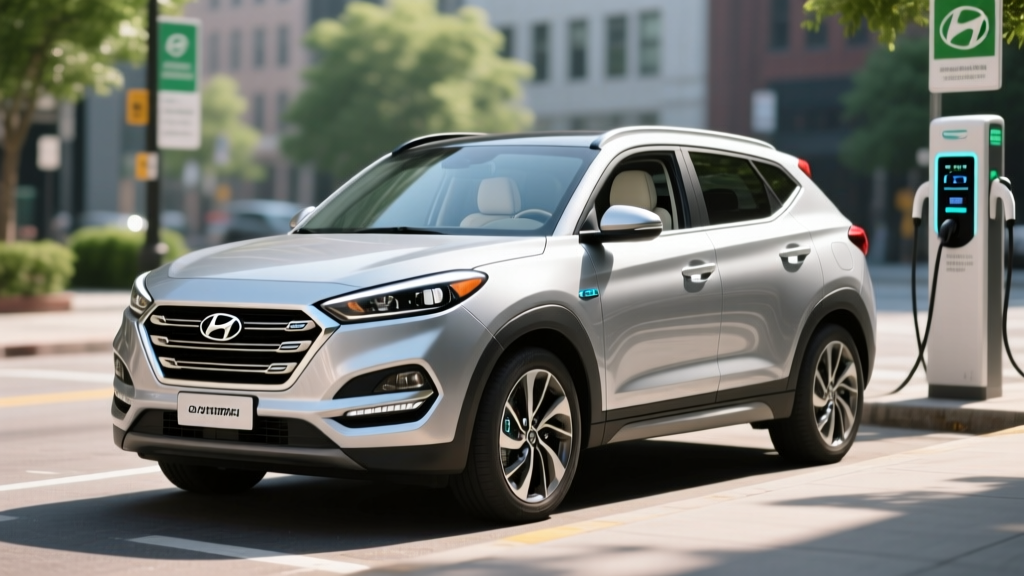
The 2022 Hyundai Tucson Hybrid SEL Convenience occupies a specific niche: buyers who want SUV practicality and electrified efficiency without ever plugging in. As a conventional hybrid (HEV), it recovers energy through regenerative braking and engine optimization — no charging cable required. With the SEL Convenience trim sitting in the middle of the lineup, it bundles premium features like a panoramic sunroof and power liftgate at a price point that undercuts many competitors. Here's a data-driven look at what this SUV actually delivers in fuel economy, powertrain performance, and long-term ownership costs.
HEV vs PHEV: Which Tucson Hybrid Are We Talking About?
Hyundai offered the 2022 Tucson in three powertrain variants: a conventional 2.5L gas model, a conventional hybrid (HEV), and a plug-in hybrid (PHEV). This review focuses on the Tucson Hybrid (HEV), specifically the SEL Convenience trim. Understanding the distinction matters because the ownership experience differs substantially.
| Attribute | Tucson Hybrid (HEV) | Tucson Plug-In Hybrid (PHEV) |
|---|---|---|
| Plug-in charging required? | No — self-charging via regen | Yes — 13.8 kWh battery, Level 2 recommended |
| EPA combined fuel economy | 38 MPG (Blue trim) / 37 MPG (SEL Convenience AWD) | 80 MPGe combined (electric + gas) / 35 MPG gas-only |
| Electric-only range | N/A (no EV-only mode beyond low-speed creep) | 33 miles EPA electric-only |
| Combined horsepower | 226 hp | 261 hp |
| Battery capacity | 1.49 kWh (small buffer for assist) | 13.8 kWh (usable ~10.5 kWh) |
| Federal §30D tax credit (new) | Not eligible | Up to $7,500 (subject to sourcing/income rules when new) |
| Drivetrain | AWD standard | AWD standard |
If you're reading this in 2026, you're likely evaluating a used 2022 Tucson Hybrid SEL Convenience. The federal §30D new-vehicle credit no longer applies to this model year at purchase. However, the used clean vehicle credit (up to $4,000 or 30% of sale price, whichever is lower) may apply if you buy from a licensed dealer and meet income thresholds. We cover that in detail below.
Fuel Economy: EPA Numbers vs Real-World MPG
The EPA rates the 2022 Tucson Hybrid SEL Convenience (AWD, 19-inch wheels) at:
| Driving Cycle | EPA MPG |
|---|---|
| City | 37 MPG |
| Highway | 36 MPG |
| Combined | 37 MPG |
Note: The base Blue trim with 17-inch wheels achieves a slightly higher 38 MPG combined, but the SEL Convenience's larger wheels, panoramic sunroof (added weight), and standard AWD system reduce efficiency by roughly 1 MPG. Data sourced from fueleconomy.gov.
- City/suburban driving: 36–40 MPG — hybrids excel here because regenerative braking recovers energy at every stop. Many owners report exceeding EPA city estimates in stop-and-go traffic.
- Highway cruising (70–80 mph): 32–35 MPG — the turbocharged 1.6L engine works harder at sustained speed, and the hybrid advantage diminishes.
- Cold weather (below 30°F): 30–33 MPG combined — engine runs more frequently for cabin heat and battery warmup.
- Mixed driving annual average: Most owners report 35–38 MPG combined over a full tank cycle.
With a 13.7-gallon fuel tank, expect roughly 460–500 miles per tank in mixed driving — a meaningful advantage over the non-hybrid Tucson (rated 26–29 MPG combined) and competitive with the Toyota RAV4 Hybrid (39–41 MPG depending on trim).
Powertrain Specs: Engine, Motor, and Combined Output
| Specification | Value |
|---|---|
| Engine | 1.6L turbocharged 4-cylinder GDI |
| Engine output | 178 hp / 195 lb-ft torque |
| Electric motor | 44.2 kW (59 hp) permanent-magnet synchronous |
| Combined system output | 226 hp / 258 lb-ft torque |
| Transmission | 6-speed automatic (torque-converter, not CVT) |
| Drivetrain | HTRAC AWD (standard on all Hybrid trims) |
| 0–60 mph | ~7.1 seconds (manufacturer estimate) |
| Towing capacity | 2,000 lbs (braked) |
| Hybrid battery | 1.49 kWh lithium-ion polymer (located under rear seat) |
| Curb weight | ~3,843 lbs |
Hyundai's decision to use a conventional 6-speed automatic rather than a CVT is a deliberate choice that affects driving feel. Acceleration is linear and confident, without the rubber-band sensation common in Toyota and Honda hybrids. The tradeoff is marginally lower efficiency at part-throttle — but the 226 hp combined output makes this one of the quicker compact hybrid SUVs in its class.
The 1.49 kWh battery is small by design. It serves as a buffer for regenerative energy capture and electric-motor assist during acceleration — it does not provide meaningful electric-only driving range. This is the defining characteristic of a conventional hybrid: the battery assists the engine, never replaces it for extended distances.
SEL Convenience Trim: What You Get for the Money
The SEL Convenience sat above the SEL and below the Limited in the 2022 Tucson Hybrid lineup. Its original MSRP was $33,350 (including destination). Key equipment includes:
- Panoramic sunroof with power sunshade
- Power liftgate with hands-free smart open
- Leatherette (H-Tex) seating surfaces
- Heated front seats and heated steering wheel
- 10.25-inch touchscreen with navigation, wireless Apple CarPlay/Android Auto
- Bose premium audio (8 speakers)
- Digital key (NFC-based, Samsung compatible)
- Highway Driving Assist (HDA) — adaptive cruise + lane centering
- Blind-spot collision-avoidance assist with rear cross-traffic alert
- 19-inch alloy wheels
For used buyers in 2026, expect pricing in the $22,000–$27,000 range depending on mileage, condition, and region. Certified pre-owned (CPO) examples from Hyundai dealerships command a premium but include an extended warranty.
Battery Warranty, Lifespan, and Replacement Cost
Hybrid battery longevity is the number-one concern for used hybrid buyers. Hyundai addresses this with one of the strongest warranty packages in the industry:
- Hybrid battery: 10 years / 100,000 miles (original owner); 10 years / 100,000 miles for subsequent owners in most states (verify with Hyundai — some states reduce second-owner coverage)
- Hybrid system components (inverter, motor, controller): 10 years / 100,000 miles
- Powertrain (engine, transmission): 10 years / 100,000 miles
- New-vehicle limited warranty: 5 years / 60,000 miles (may be expired on a 2022 model by 2026)
Real-world degradation data: The 1.49 kWh battery in the Tucson Hybrid operates in a narrow state-of-charge window (roughly 40–60% SoC) to maximize cycle life. Hyundai's lithium-ion polymer cells in this generation have demonstrated minimal capacity loss — most owners report no noticeable efficiency degradation within the first 80,000–100,000 miles. This is consistent with data from Hyundai's earlier Ioniq Hybrid and Kia Niro Hybrid platforms, which share similar battery architecture.
Replacement cost if out of warranty: A new hybrid battery pack for the Tucson Hybrid typically runs $2,500–$4,000 including labor at a Hyundai dealer. Independent hybrid specialists may offer refurbished packs for $1,500–$2,500. Given the 10-year/100,000-mile warranty, most 2022 models will remain covered through 2032 if mileage stays under the cap — a significant advantage for used buyers.
Tax Credit Eligibility for Used Buyers (2026 Rules)
The 2022 Tucson Hybrid (HEV) was never eligible for the §30D new clean vehicle credit — that credit applies only to plug-in vehicles with battery capacity ≥7 kWh. The Tucson Hybrid's 1.49 kWh pack falls far short.
However, as a used purchase in 2026, you may qualify for the Previously-Owned Clean Vehicle Credit under IRC §25E — but only if you buy the PHEV variant, not the conventional HEV. The used credit provides up to $4,000 or 30% of the sale price (whichever is lower) and applies to plug-in hybrids and full EVs with a sale price under $25,000. Income caps apply ($75,000 single / $150,000 married filing jointly). See IRS §25E guidance for current eligibility rules.
- 2022 Tucson Hybrid (HEV): Not eligible for any federal tax credit (new or used) — battery too small
- 2022 Tucson Plug-In Hybrid (PHEV): May qualify for up to $4,000 used-vehicle credit if purchased from a dealer for under $25,000 and buyer meets income caps
- State incentives: Vary by jurisdiction — some states (CA, CO, MA, NY) offer rebates for used hybrids or PHEVs. Check your state energy office or DMV for current programs.
Who Should Choose the Tucson Hybrid vs a PHEV or Full EV?
Choose the Tucson Hybrid (HEV) if:
- You lack access to home or workplace charging (apartment, street parking, no garage)
- You want a lower purchase price and simpler ownership (no charging equipment to install)
- Your driving is mostly city/suburban where hybrid efficiency shines (37+ MPG)
- You want AWD capability for snow/rain without the weight penalty of a large battery
- You plan to keep the vehicle 8–10 years under the hybrid warranty
Choose the Tucson Plug-In Hybrid (PHEV) if:
- You can install a Level 2 charger at home and want 33 miles of daily electric-only commuting
- Your round-trip commute is under 30 miles — you may rarely use gas on weekdays
- You want the 261 hp combined output (the PHEV is noticeably quicker)
- You want to potentially claim the used clean vehicle credit
Choose a full EV (e.g., Hyundai Ioniq 5, Tesla Model Y) if:
- You have reliable home Level 2 charging and your daily driving is under 250 miles
- You want zero tailpipe emissions and minimal maintenance (no oil changes, no engine)
- You want the lowest per-mile fuel cost (electricity at $0.12/kWh ≈ $0.04/mile vs. gas at $3.50/gal ≈ $0.10/mile for the hybrid)
- You qualify for the full §30D credit on a new EV (up to $7,500) or the $4,000 used credit
Reliability, Safety Ratings, and Known Issues
The 2022 Tucson Hybrid earned strong safety marks: the IIHS named it a Top Safety Pick+ (with specific headlight trims), and NHTSA awarded it a 5-star overall rating.
On reliability, the 1.6L turbo engine and 6-speed hybrid automatic have proven durable in Hyundai's fleet. Common owner-reported concerns are minor:
- Infotainment screen lag on cold starts (improved with software updates)
- Wind noise at highway speeds from the panoramic sunroof seal area
- Occasional 12V auxiliary battery drain if the vehicle sits unused for 2+ weeks (the hybrid system does not automatically maintain the 12V battery during extended parking)
No widespread reports of hybrid battery failure, inverter issues, or motor defects have surfaced through 2026 for this generation — a positive indicator for used buyers.
Pros
- 37 MPG combined with AWD — strong for the segment
- 10-year/100,000-mile hybrid battery warranty transfers to second owner in most states
- SEL Convenience trim is well-equipped (Bose, pano roof, HDA)
- Conventional 6-speed automatic feels more natural than a CVT
- 226 hp is brisk for a compact hybrid SUV
- No plug-in charging needed — zero lifestyle adjustment from a gas car
Cons
- 1 MPG penalty vs. Blue trim due to 19-inch wheels and sunroof weight
- Not eligible for any federal tax credit (HEV battery too small)
- Highway MPG drops to 32–35 in real-world 75+ mph driving
- Panoramic sunroof adds weight and potential wind-noise issue
- No DC fast charging capability (not applicable — this is an HEV)
- Towing limited to 2,000 lbs (PHEV and gas models tow up to 2,000 lbs as well)
Frequently Asked Questions
How many MPG does the 2022 Tucson Hybrid SEL Convenience actually get?
The EPA rates it at 37 city / 36 highway / 37 combined MPG. In real-world driving, most owners average 35–38 MPG combined, with city-heavy routes sometimes yielding 40+ MPG thanks to regenerative braking. Highway-only driving at 75+ mph typically returns 32–35 MPG.
Does the Tucson Hybrid need to be plugged in?
No. The 2022 Tucson Hybrid (HEV) is a conventional, self-charging hybrid. It generates electricity through regenerative braking and the gasoline engine. You never plug it in. If you want plug-in capability with electric-only range, look at the Tucson Plug-In Hybrid (PHEV), which offers 33 miles of electric-only driving on a full charge.
Is the hybrid battery reliable and what does replacement cost?
Hyundai's 1.49 kWh hybrid battery has demonstrated strong reliability with no widespread failure reports through 2026. The battery is covered by a 10-year/100,000-mile warranty that generally transfers to second owners. Out-of-warranty replacement costs $2,500–$4,000 at a dealer, or $1,500–$2,500 through independent hybrid specialists.
Does the 2022 Tucson Hybrid qualify for any tax credit?
The conventional Tucson Hybrid (HEV) does not qualify for any federal tax credit — new or used — because its battery is too small (1.49 kWh). The Tucson Plug-In Hybrid (PHEV) may qualify for up to $4,000 under the used clean vehicle credit (§25E) if purchased from a dealer for under $25,000 and the buyer meets income limits. Check IRS guidelines for current rules.
How does the Tucson Hybrid compare to the Toyota RAV4 Hybrid?
The RAV4 Hybrid (LE/XLE) achieves 41/38/40 MPG EPA — about 3 MPG better than the Tucson Hybrid — and starts at a similar used price point. However, the Tucson Hybrid offers more standard horsepower (226 vs. 219), a conventional 6-speed automatic (vs. Toyota's eCVT), and Hyundai's longer 10-year hybrid warranty (Toyota also offers 10 years/150,000 miles on the hybrid battery). The RAV4 Hybrid is the efficiency leader; the Tucson Hybrid offers a more engaging driving experience and richer standard features at the SEL Convenience level.
What's the difference between the SEL Convenience and the Limited trim?
The 2022 Tucson Hybrid Limited (MSRP $36,690) adds ventilated front seats, leather (not leatherette) upholstery, a surround-view monitor, remote smart parking assist, and a head-up display. The SEL Convenience ($33,350) represents the value sweet spot — you get the panoramic sunroof, Bose audio, and Highway Driving Assist without paying the Limited premium.
The 2022 Hyundai Tucson Hybrid SEL Convenience remains a compelling used purchase in 2026 for buyers who want hybrid efficiency, AWD, and a well-appointed cabin without the complexity or infrastructure demands of a plug-in vehicle. Its 37 MPG EPA rating holds up in real-world mixed driving, the hybrid battery warranty provides long-term peace of mind, and the SEL Convenience trim delivers features that punch above its original price class. If you can charge at home and want electric-only commuting, the PHEV variant or a full EV may serve you better — but for plug-free electrified efficiency, this Tucson Hybrid is among the strongest options on the used market.