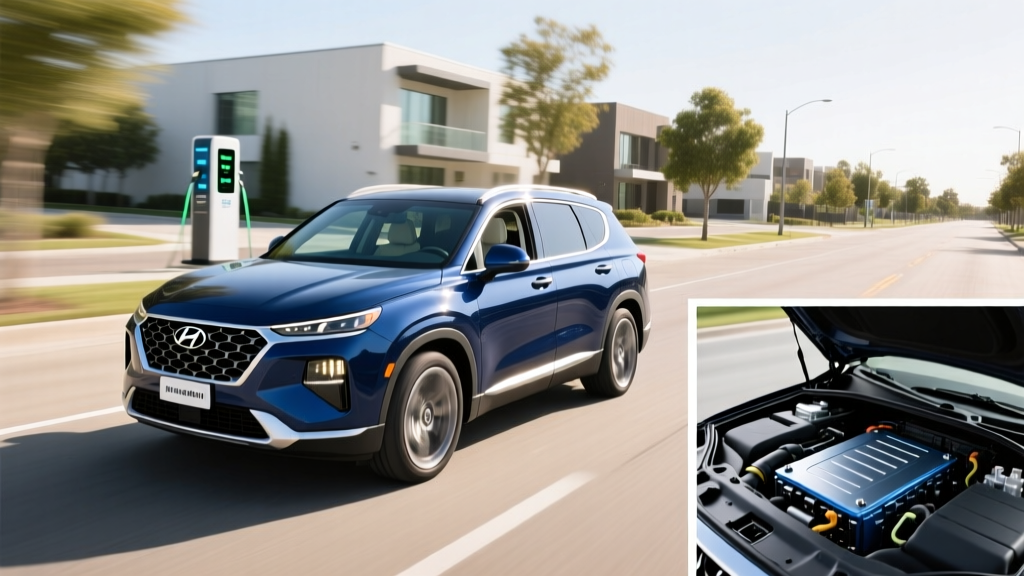
The 2022 Hyundai Santa Fe Hybrid occupies a practical sweet spot: midsize SUV space, standard all-wheel drive, and fuel economy that undercuts most gas-only competitors by 30–40%. Now that these models are hitting the used market in meaningful volume in 2026, buyers are asking the right questions — how does real-world MPG stack up against the EPA sticker, is the hybrid battery a liability, and does the plug-in hybrid (PHEV) variant make more sense than the conventional hybrid (HEV)?
This guide breaks down every spec that matters, from the 1.6-liter turbocharged powertrain to battery warranty coverage, and gives you a clear framework for whether the Santa Fe Hybrid, the Santa Fe Plug-In Hybrid, or a full battery-electric vehicle (BEV) is the right call for your driveway.
HEV vs PHEV: Which Santa Fe Hybrid Are We Talking About?
Hyundai sold the 2022 Santa Fe in two distinct electrified flavors, and confusing them is the single most common mistake buyers make. They share a platform and a 1.6-liter turbocharged four-cylinder engine, but their operating principles are fundamentally different.
| Attribute | Santa Fe Hybrid (HEV) | Santa Fe Plug-In Hybrid (PHEV) |
|---|---|---|
| Plug-in required? | No — charges via engine & regen | Yes — plug in to access EV range |
| Battery capacity | 1.49 kWh (lithium-ion polymer) | 12.4 kWh usable (lithium-ion polymer) |
| Electric-only driving | Brief low-speed assist only | EPA-est. 31 miles EV-only |
| Combined system output | 226 hp / 258 lb-ft torque | 261 hp / 258 lb-ft torque |
| Drivetrain | AWD (standard) | AWD (standard) |
| DC fast charging | N/A | No — Level 2 AC only |
The bottom line: The HEV is a self-charging hybrid — you fuel it with gas and the system handles the rest. The PHEV gives you roughly 31 miles of pure electric commuting before the gas engine takes over, but you need access to a plug (home or work) to unlock that benefit. If you can't charge regularly, the PHEV becomes a heavier, more expensive HEV.
Fuel Economy: EPA Ratings and Real-World MPG
The conventional Santa Fe Hybrid is rated by the EPA at 33 MPG city / 30 MPG highway / 33 MPG combined for the Blue and SEL Premium trims. The Limited trim, due to added weight from luxury equipment, drops slightly to 32/29/31 MPG combined, according to fueleconomy.gov.
| Trim | City | Highway | Combined | Fuel Tank | Est. Total Range |
|---|---|---|---|---|---|
| Blue / SEL Premium (HEV) | 33 MPG | 30 MPG | 33 MPG | 17.7 gal | ~584 miles |
| Limited (HEV) | 32 MPG | 29 MPG | 31 MPG | 17.7 gal | ~549 miles |
| PHEV (all trims, charge-depleting) | 79 MPGe | — | 79 MPGe | 15.9 gal | 31 mi EV + ~410 mi gas |
| PHEV (gas-only, battery depleted) | 30 MPG | 28 MPG | 29 MPG | 15.9 gal | ~461 miles |
Real-World MPG vs. the EPA Sticker
Hyundai's hybrid system, which pairs the 1.6L turbo with a 44.2 kW (59 hp) electric motor through a 6-speed automatic transmission, tends to perform close to or slightly above its EPA city rating in stop-and-go traffic — that's where regenerative braking and engine-off coasting do the most work. In our experience and consistent with owner reports, expect 31–35 MPG in mixed real-world driving for the HEV, with city-heavy commuters occasionally touching 36 MPG in warm weather.
Highway-only trips at 75+ mph will pull numbers down to the 28–30 MPG range, because aerodynamic drag rises exponentially and the hybrid system has less opportunity to recapture energy. Cold weather (below 30°F) typically shaves 2–4 MPG off combined figures due to engine warm-up cycles and cabin heating demand.
For the PHEV, the 31-mile EV range is realistic for suburban commutes at moderate speeds. Highway driving at 70 mph will reduce that to roughly 24–27 miles before the engine engages. Once the battery is depleted, the PHEV operates as a conventional hybrid but carries roughly 300 extra pounds of battery mass, which is why its gas-only MPG (29 combined) trails the HEV.
Powertrain and Performance Specs
| Specification | Santa Fe Hybrid (HEV) | Santa Fe Plug-In Hybrid (PHEV) |
|---|---|---|
| Engine | 1.6L turbocharged GDI 4-cyl | 1.6L turbocharged GDI 4-cyl |
| Engine output | 178 hp / 195 lb-ft | 178 hp / 195 lb-ft |
| Electric motor | 44.2 kW (59 hp) / 195 lb-ft | 66.9 kW (90 hp) / 195 lb-ft |
| Combined system output | 226 hp / 258 lb-ft | 261 hp / 258 lb-ft |
| Transmission | 6-speed automatic | 6-speed automatic |
| 0–60 mph (est.) | ~7.4 seconds | ~7.0 seconds |
| Drivetrain | HTRAC AWD | HTRAC AWD |
| Towing capacity | 2,000 lbs | 2,000 lbs |
| Cargo volume (behind 2nd row) | 36.4 cu ft | 35.7 cu ft |
The PHEV's larger motor gives it a perceptible advantage in passing acceleration and low-speed responsiveness, especially in EV mode where torque delivery is instant. The HEV is no slouch — 226 hp moves the ~4,100-lb curb weight competently — but you'll notice the turbo lag at lower RPMs before the electric motor fills in the torque curve.
PHEV Charging: What You Need to Know
The Santa Fe PHEV's 12.4 kWh battery charges exclusively via AC power. There is no DC fast-charging capability — a common limitation among PHEVs in this class.
| Charging Method | Power | 0–100% Time | Notes |
|---|---|---|---|
| Level 1 (120V household outlet) | ~1.4 kW | ~9 hours | Works overnight; no electrician needed |
| Level 2 (240V home charger) | ~3.3 kW (onboard charger max) | ~3 hours 45 min | Requires 240V outlet or hardwired station |
The onboard charger is limited to 3.3 kW, so even a 48-amp Level 2 station won't charge the PHEV any faster than a basic 16-amp unit. For most PHEV owners, a standard Level 1 outlet is sufficient to replenish the battery overnight — 9 hours covers a typical sleep cycle with margin to spare.
If you're considering a Level 2 installation for the PHEV (or a future BEV), expect to spend $500–$2,200 total depending on whether your electrical panel needs an upgrade. A licensed electrician should evaluate your panel capacity before committing to a 240V circuit.
Battery Warranty, Reliability, and Replacement Costs
Hyundai Hybrid/PHEV Battery Warranty (2022 model year):
- Original owner: Lifetime coverage on the hybrid battery and all hybrid-system components (engine, motor, inverter, etc.) for as long as you own the vehicle, with no mileage limit.
- Second and subsequent owners: 10 years / 100,000 miles from the vehicle's original in-service date.
This is one of the strongest hybrid battery warranties in the industry and a key reason the Santa Fe Hybrid appeals to long-term ownership planners. Source: Hyundai USA Warranty.
Real-World Reliability
The 2022 Santa Fe Hybrid uses Hyundai's TMED (Transmission-Mounted Electric Device) architecture, which has been in production since 2011 across the Sonata, Tucson, and Ioniq lines. Failure rates on the hybrid battery pack and power electronics have been low in owner surveys. The lithium-ion polymer cells are passively cooled and managed conservatively — Hyundai limits the usable state-of-charge window to reduce degradation.
For context, the conventional 12V auxiliary battery is more likely to need replacement (every 4–6 years, ~$200–$350) than the high-voltage hybrid pack. Full hybrid battery replacement, if needed outside warranty, runs approximately $2,500–$4,000 at a Hyundai dealer for the HEV and $5,000–$7,500 for the PHEV's larger pack. However, given Hyundai's lifetime/10-year coverage and the conservative battery management, out-of-pocket replacement is uncommon before 150,000+ miles.
Pricing, Trims, and Tax Credit Eligibility
The 2022 Santa Fe Hybrid was offered in three trims. Original MSRP figures (before destination):
| Trim | Original MSRP | Typical 2026 Used Price (est.) |
|---|---|---|
| Blue | $34,810 | $22,000–$26,000 |
| SEL Premium | $37,410 | $24,000–$28,500 |
| Limited | $40,760 | $27,000–$32,000 |
| PHEV SEL Convenience | $42,270 | $27,000–$32,000 |
| PHEV Limited | $46,820 | $31,000–$36,500 |
Does the 2022 Santa Fe Hybrid Qualify for Tax Credits?
New purchase (no longer applicable): When sold new, the Santa Fe PHEV qualified for a $6,587 federal tax credit under the pre-2023 IRS rules. The conventional HEV never qualified for a federal credit.
Used purchase in 2026 — §25E Previously-Owned Clean Vehicle Credit: If you buy a qualifying used PHEV from a dealer, you may be eligible for the IRS §25E credit, which is worth 30% of the sale price, up to $4,000. Requirements include:
- Sale price must be $25,000 or less
- Buyer adjusted gross income: ≤$75,000 single / ≤$112,500 head of household / ≤$150,000 married filing jointly
- Vehicle must be at least 2 model years old (2022 qualifies in 2026)
- You haven't claimed this credit in the prior 3 years
- Must purchase from a licensed dealer (private-party sales don't qualify)
At typical 2026 used prices, the PHEV Limited will likely exceed the $25,000 price cap, but a Blue or SEL Convenience PHEV purchased at or below $25,000 could net a $4,000 credit (30% of $25,000 = $7,500, capped at $4,000). The conventional HEV does not qualify for §25E because it is not a plug-in vehicle. Always confirm eligibility with a tax professional — IRS rules are subject to change.
Who Should Choose the Santa Fe Hybrid vs. a Full EV?
Choose the Santa Fe Hybrid (HEV) if:
- You don't have reliable access to a plug at home or work
- You want maximum simplicity — no charging routines, no range planning
- Your annual mileage is moderate (10,000–15,000 miles) and fuel savings matter but aren't make-or-break
- You frequently take long road trips and don't want to plan around DC fast-charging stations
Choose the Santa Fe Plug-In Hybrid (PHEV) if:
- You can charge at home (even a 120V outlet works overnight)
- Your daily commute is under 30 miles round-trip — you'll drive almost entirely on electricity
- You want EV-like daily costs but need gas flexibility for weekend road trips
- You can find one under $25,000 to maximize the §25E used-EV tax credit
Choose a full BEV (e.g., Hyundai Ioniq 5, Tesla Model Y) if:
- You have Level 2 home charging and your daily driving is under 250 miles
- You want the lowest per-mile energy cost (~$0.04–$0.06/mile on home electricity vs. ~$0.12–$0.16/mile for the HEV on gas)
- You want to eliminate oil changes, transmission fluid, and exhaust-system maintenance entirely
- You're willing to plan charging stops on road trips (300+ mile routes)
Pros and Cons at a Glance
Pros
- 33 MPG combined EPA — strong for an AWD midsize SUV
- Lifetime hybrid battery warranty for original owners
- Standard HTRAC AWD across all trims
- PHEV variant offers 31 miles EV-only for gas-free commuting
- Comfortable ride quality and spacious second row
- Competitive used-market pricing in 2026
Cons
- Turbo lag noticeable at low RPMs in the HEV
- PHEV lacks DC fast charging — Level 2 only
- Cargo space slightly reduced in PHEV (35.7 vs 36.4 cu ft)
- Infotainment system feels dated compared to 2024+ Hyundai models
- Towing limited to 2,000 lbs (below some gas-powered competitors)
- PHEV gas-only MPG (29 combined) trails the lighter HEV
Frequently Asked Questions
How many MPG does the 2022 Hyundai Santa Fe Hybrid get?
The EPA rates the Blue and SEL Premium trims at 33 MPG city / 30 MPG highway / 33 MPG combined. The Limited trim is rated at 32/29/31. In real-world mixed driving, owners typically see 31–35 MPG, with city-heavy routes occasionally exceeding the EPA sticker and sustained highway driving falling to 28–30 MPG.
How far can the Santa Fe PHEV go on electric only?
The EPA-estimated electric-only range is 31 miles. In real-world conditions — highway speeds, cold weather, or aggressive acceleration — expect 24–28 miles before the gasoline engine engages. For most suburban commutes, that's enough to cover a full day of driving without burning gas.
Is the 2022 Santa Fe Hybrid reliable, and what does a battery replacement cost?
Hyundai's TMED hybrid system has a strong reliability track record across multiple model lines. The hybrid battery is covered by a lifetime warranty for original owners and 10 years/100,000 miles for subsequent owners. Out-of-warranty replacement costs are approximately $2,500–$4,000 for the HEV and $5,000–$7,500 for the PHEV, though premature failure is rare.
Does the 2022 Santa Fe Hybrid qualify for any tax credit?
The conventional HEV does not qualify for any federal tax credit. The PHEV, when purchased used from a dealer at $25,000 or less, may qualify for the IRS §25E Previously-Owned Clean Vehicle Credit — worth up to $4,000 (30% of sale price). Income caps apply. Consult a tax professional and review current rules at irs.gov.
Do I need to plug in the Santa Fe Hybrid (HEV)?
No. The conventional HEV charges its small 1.49 kWh battery through regenerative braking and the gasoline engine. You never plug it in — just fill up at the gas station like any other vehicle. Only the PHEV variant requires plugging in to access its electric-only range.
How does the Santa Fe Hybrid compare to the Toyota RAV4 Hybrid?
The 2022 RAV4 Hybrid is rated at 41/38/40 MPG combined — significantly higher than the Santa Fe Hybrid's 33 MPG combined. However, the Santa Fe offers a more upscale interior, a smoother ride, and Hyundai's lifetime hybrid battery warranty (vs. Toyota's 10-year/150,000-mile coverage). If fuel economy is the top priority, the RAV4 Hybrid wins. If comfort, warranty, and PHEV availability matter more, the Santa Fe is the stronger pick.