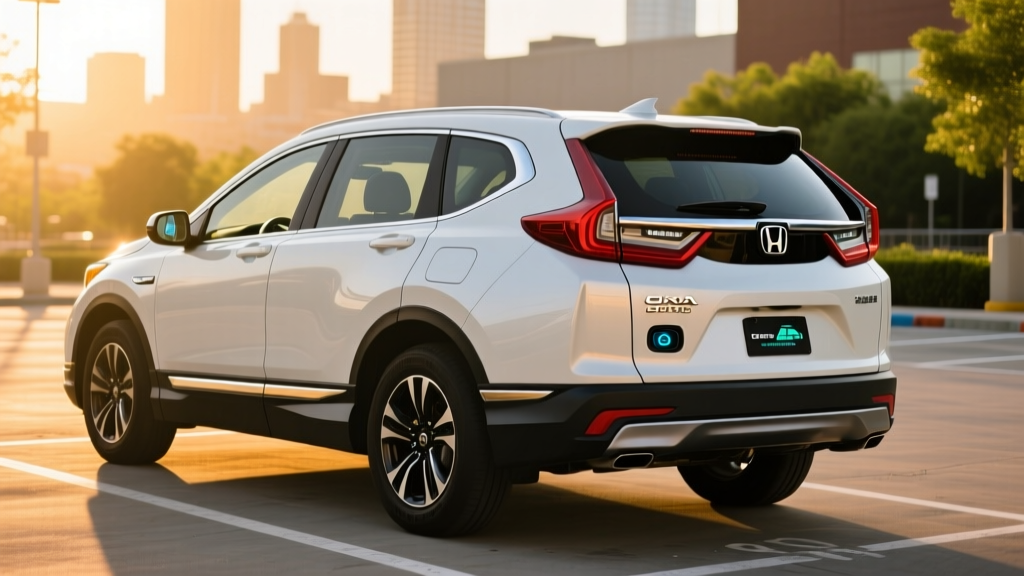
The 2022 Honda CR-V Hybrid represents a specific moment in Honda's electrification strategy — a conventional hybrid electric vehicle (HEV) that requires no plug, no charging cable, and no behavioral change from a standard gasoline car. For buyers researching this model on the used market or comparing it against newer alternatives, understanding exactly what this powertrain delivers — and where it falls short — is critical before signing any paperwork.
This guide breaks down the 2022 CR-V Hybrid's EPA fuel economy, real-world MPG expectations, powertrain architecture, battery longevity, tax credit eligibility, and how it stacks up against plug-in hybrids and full battery-electric vehicles (BEVs) in 2026.
HEV vs PHEV: What the 2022 CR-V Hybrid Actually Is
Conventional Hybrid (HEV) — The 2022 Honda CR-V Hybrid is a self-charging hybrid. Its small lithium-ion battery (approximately 1.2 kWh usable) is recharged exclusively through regenerative braking and the gasoline engine. You never plug it in. There is no electric-only driving range to speak of — the electric motor assists the gas engine but cannot propel the vehicle independently for meaningful distances.
Plug-in Hybrid (PHEV) — A PHEV like the Toyota RAV4 Prime or Honda's newer CR-V e:PHEV (available in other markets) carries a much larger battery (15–20 kWh), offers 30–45 miles of electric-only range, and can be plugged into a Level 1 or Level 2 charger. The 2022 CR-V Hybrid sold in the U.S. is not a PHEV.
This distinction matters because many shoppers conflate the two. The 2022 CR-V Hybrid will not appear on any electric-only range chart, will not qualify for federal EV tax credits, and will not let you commute on electricity alone. What it will do is deliver substantially better fuel economy than the gas-only CR-V with zero lifestyle adjustment.
Fuel Economy: EPA Ratings and Real-World MPG
| Configuration | City MPG | Highway MPG | Combined MPG |
|---|---|---|---|
| 2022 CR-V Hybrid AWD (EPA) | 40 | 35 | 38 |
| 2022 CR-V Hybrid FWD (EPA) | 40 | 35 | 38 |
| 2022 CR-V Gas AWD (EPA) | 27 | 32 | 29 |
| Real-world mixed driving (AWD) | ~36–42 MPG (varies by conditions) | ||
The EPA rates the 2022 CR-V Hybrid at 40 city / 35 highway / 38 combined MPG across both front-wheel-drive and all-wheel-drive trims, per fueleconomy.gov. This is a significant 9 MPG combined improvement over the gas-only AWD CR-V.
Real-world results tell a more nuanced story. Honda's two-motor hybrid system excels in stop-and-go city traffic where regenerative braking and electric-motor assist do the heavy lifting. Owners consistently report 40–44 MPG in city driving, sometimes exceeding the EPA city estimate. Highway driving at sustained speeds above 70 mph, however, often yields 32–35 MPG because the gasoline engine bears more of the load and aerodynamic drag increases exponentially.
In cold weather (below 30°F), expect a 3–5 MPG drop across the board. The engine runs more frequently to provide cabin heat and maintain operating temperature, reducing the hybrid system's efficiency advantage. This is normal for all hybrids and is less severe than the 20–30% range loss a full BEV experiences in winter.
Powertrain Specs: Engine, Motors, and Combined Output
| Specification | Detail |
|---|---|
| Engine | 2.0L Atkinson-cycle inline-4 |
| Engine output | 143 hp / 129 lb-ft torque |
| Drive motors | Dual-motor hybrid system |
| Primary drive motor | 181 hp / 232 lb-ft torque |
| Combined system output | 212 hp |
| Transmission | Electronic CVT (e-CVT, no fixed gears) |
| Battery type | Lithium-ion (approx. 1.2 kWh usable) |
| Drivetrain | FWD or AWD (AWD uses mechanical rear driveshaft) |
| 0–60 mph | ~7.5 seconds (AWD) |
| Towing capacity | 1,000 lbs (not rated for heavy towing) |
Honda's two-motor hybrid system operates differently from Toyota's planetary-gear Hybrid Synergy Drive. At low speeds, the CR-V Hybrid drives primarily on its electric traction motor, with the gasoline engine acting as a generator to feed electricity. At highway cruising speeds, a lock-up clutch mechanically connects the engine directly to the front wheels for improved efficiency. This series-parallel architecture gives the CR-V Hybrid a smooth, EV-like feel around town while maintaining highway competence.
The AWD system uses a conventional mechanical driveshaft to the rear axle — not a dedicated rear electric motor as found in some competitors. This means AWD engagement is slightly less instantaneous than electric-axle systems, but it's effective in rain and light snow and avoids the efficiency penalty of constantly powering a second motor.
Reliability and Hybrid Battery Longevity
Honda Hybrid Battery Warranty: 8 years / 100,000 miles (10 years / 150,000 miles in California and states adopting CARB emissions standards). This covers battery capacity degradation below a defined threshold and defects.
Hybrid System Warranty: 8 years / 100,000 miles on hybrid-specific components including the e-CVT, power control unit, and electric motors.
The 2022 CR-V Hybrid's lithium-ion traction battery is small and lightly stressed compared to a full EV's pack. Because it never undergoes deep discharge cycles (the system maintains a state-of-charge buffer, typically using only the middle 40–60% of capacity), degradation is minimal. Honda's hybrid batteries routinely last well beyond the warranty period — 150,000+ miles without replacement is the norm based on owner data from earlier Honda hybrid models.
If replacement is eventually needed out of warranty, a refurbished Honda hybrid battery typically costs $2,000–$4,000 including labor at an independent hybrid specialist. A new OEM battery from a Honda dealer runs $4,000–$6,000. For context, this is a fraction of a full EV battery replacement, which can exceed $10,000–$20,000.
The 2022 CR-V earned strong reliability marks. Consumer Reports rated it above average for the model year, and the hybrid powertrain has fewer wear items than a conventional automatic transmission — no torque converter, no traditional gear sets, no clutch packs to replace.
Pricing, Trims, and Tax Credit Eligibility
When new, the 2022 Honda CR-V Hybrid was offered in three trims:
- EX AWD: ~$31,585 MSRP (including destination)
- EX-L AWD: ~$34,195 MSRP
- Touring AWD: ~$37,395 MSRP
On the used market in 2026, expect to pay $22,000–$32,000 depending on mileage, condition, and trim.
Federal Tax Credit (§30D): The 2022 Honda CR-V Hybrid does NOT qualify for the federal EV tax credit. IRS §30D credits apply only to plug-in electric vehicles (BEVs and PHEVs) with battery capacity ≥7 kWh. The CR-V Hybrid's ~1.2 kWh battery is far below this threshold. There is no federal hybrid-specific tax credit.
State incentives: A small number of states offer rebates or HOV-lane access for conventional hybrids, but these are increasingly rare as incentive programs shift toward plug-in vehicles. Check your state's energy office or DMV for current programs.
CR-V Hybrid vs PHEV vs Full EV: Which Is Right for You?
Choose the 2022 CR-V Hybrid (HEV) if:
- You have no access to home or workplace charging
- You want better fuel economy with zero behavioral change
- You drive 12,000–15,000 miles/year and want to reduce fuel costs by ~$500–$800/year vs the gas CR-V
- You live in an apartment or street-park and cannot install a charger
- Your budget is under $35,000 and you want proven reliability
Choose a PHEV (e.g., Toyota RAV4 Prime) if:
- You can charge at home (even a standard 120V outlet works overnight)
- Your daily commute is under 40 miles and you want electric-only driving most days
- You still want gas-engine flexibility for road trips
- You want to qualify for partial state EV incentives
Choose a full BEV (e.g., Tesla Model Y, Hyundai Ioniq 5) if:
- You have reliable home Level 2 charging
- You want the lowest per-mile energy cost (~$0.04–$0.06/mile on home electricity vs ~$0.12–$0.15/mile on gas)
- You want to qualify for the up-to-$7,500 federal §30D tax credit
- You want zero tailpipe emissions and minimal maintenance (no oil changes, no spark plugs)
The hybrid's advantage is universality — it works for everyone regardless of charging access. Its disadvantage is that it still burns gasoline for every mile driven, meaning you'll never see the per-mile cost savings or environmental benefit of electric-only operation.
Ownership Costs: 5-Year Estimate
| Cost Category | CR-V Hybrid AWD | CR-V Gas AWD |
|---|---|---|
| Fuel (60,000 mi @ $3.50/gal) | ~$5,526 | ~$7,241 |
| Maintenance (5 years) | ~$2,800 | ~$3,200 |
| Insurance (avg) | ~$6,500 | ~$6,200 |
| Depreciation (est.) | ~$12,000 | ~$13,500 |
| Total 5-year est. | ~$26,826 | ~$30,141 |
Over five years and 60,000 miles, the CR-V Hybrid saves roughly $3,300 in combined fuel and maintenance costs compared to the gas-only model, based on AAA fuel pricing averages and Honda maintenance schedules. The hybrid's regenerative braking system reduces brake pad wear, often allowing original pads to last 60,000–80,000 miles.
Pros and Cons
Pros
- 38 MPG combined EPA; 40+ MPG achievable in real city driving
- No plug, no charging infrastructure needed
- Smooth, EV-like low-speed driving feel
- Proven Honda reliability with strong hybrid battery warranty
- Spacious cargo area (33.7 cu ft behind rear seats)
- Competitive used-market pricing in 2026
Cons
- No electric-only driving range — always burns gasoline
- No federal tax credit eligibility
- Highway MPG drops to 32–35 at sustained 75+ mph
- Only 1,000-lb towing capacity
- Cabin noise under hard acceleration (e-CVT drone)
- Outdated infotainment compared to 2023+ redesigned CR-V
Frequently Asked Questions
How many MPG does the 2022 Honda CR-V Hybrid actually get?
The EPA rates it at 40 city / 35 highway / 38 combined. In real-world city driving, many owners achieve 40–44 MPG. Highway cruising at 75+ mph typically yields 32–35 MPG. Cold weather reduces efficiency by roughly 3–5 MPG across the board.
Does the 2022 CR-V Hybrid need to be plugged in?
No. This is a conventional hybrid (HEV), not a plug-in hybrid (PHEV). The battery recharges through regenerative braking and the gasoline engine. You fuel it exclusively at gas stations, exactly like a conventional car.
How far can the 2022 CR-V Hybrid drive on electric power alone?
Effectively zero miles. The electric motor assists the gasoline engine but cannot independently propel the vehicle at meaningful speeds or distances. If electric-only commuting is a priority, you need a PHEV (like the Toyota RAV4 Prime with 42 miles electric range) or a full BEV.
Is the hybrid battery reliable, and what does replacement cost?
Honda's hybrid batteries are among the most reliable in the industry. The battery is warrantied for 8 years/100,000 miles (10/150,000 in CARB states). Real-world data shows these batteries routinely last 150,000+ miles. Out-of-warranty replacement costs $2,000–$4,000 (refurbished) or $4,000–$6,000 (new OEM).
Does the 2022 Honda CR-V Hybrid qualify for any tax credit?
No federal tax credit. The IRS §30D credit requires a plug-in vehicle with ≥7 kWh of battery capacity. The CR-V Hybrid's ~1.2 kWh battery does not qualify. Some states may offer minor hybrid incentives, but most have shifted incentive programs toward plug-in vehicles. Consult a tax professional for your specific situation.
How does the 2022 CR-V Hybrid compare to the 2023+ redesigned CR-V Hybrid?
The 2023+ CR-V Hybrid uses Honda's fourth-generation two-motor system with slightly improved refinement and a newer infotainment platform. Fuel economy is similar (37–40 combined depending on trim). If buying used, the 2022 model offers better value, but the 2023+ generation provides a more modern interior and updated tech.
Is the 2022 CR-V Hybrid good in snow?
The available AWD system provides competent light-snow and wet-road traction. The hybrid system's instant electric torque gives smooth low-speed launches. For severe winter conditions, dedicated winter tires make a larger difference than the AWD system alone. The hybrid's slightly heavier curb weight (~3,600 lbs AWD) aids stability.