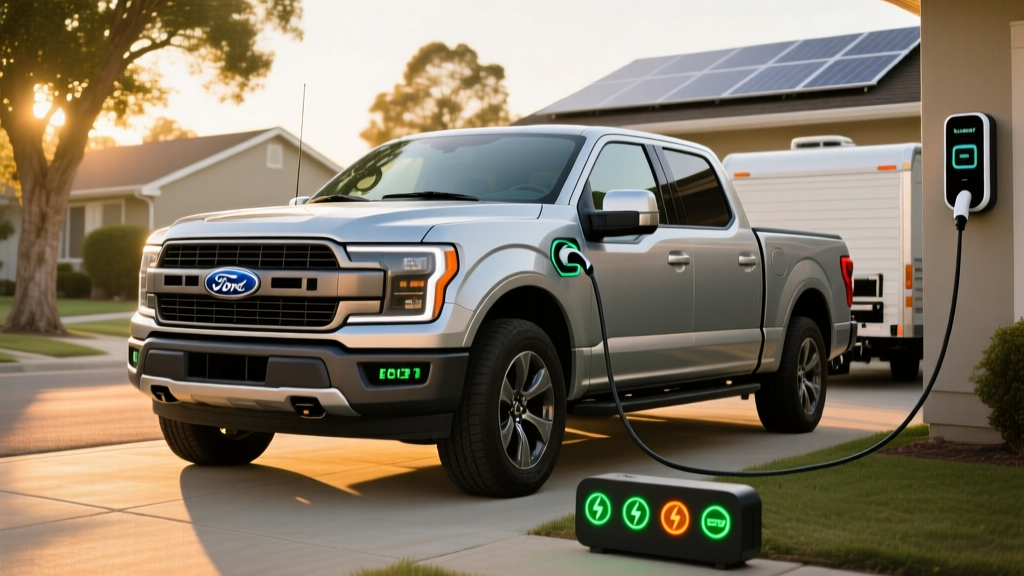
The full-size pickup segment isn't known for fuel efficiency, but the 2025 Ford F-150 Hybrid — officially the F-150 PowerBoost — proves that a body-on-frame work truck can return mid-20s MPG without sacrificing capability. With 430 horsepower, 570 lb-ft of torque, and a maximum 7,200-pound tow rating, the PowerBoost occupies a narrow but compelling lane: it's a conventional hybrid (HEV) that needs no plug, yet delivers more torque than Ford's 5.0L V8 while sipping fuel like a midsize sedan in city driving.
This guide covers everything a buyer needs to know — EPA fuel economy, real-world MPG expectations, powertrain specs, pricing across trims, the federal tax credit question, and long-term battery reliability — so you can decide whether the F-150 PowerBoost is the right electrified truck for your driveway.
2025 Ford F-150 PowerBoost: Core Specs at a Glance
| Spec | 2025 F-150 PowerBoost Hybrid |
|---|---|
| Powertrain | 3.5L twin-turbo V6 + 47 HP electric motor (integrated in 10-speed auto) |
| Combined Output | 430 HP / 570 lb-ft torque |
| EPA Fuel Economy (4x2) | 25 city / 26 hwy / 25 combined MPG |
| EPA Fuel Economy (4x4) | 23 city / 24 hwy / 24 combined MPG |
| Hybrid Battery | 1.5 kWh lithium-ion (self-charging HEV — no plug) |
| Max Towing (properly equipped) | 7,200 lbs |
| Max Payload | ~2,120 lbs (varies by config) |
| 0-60 MPH | ~5.8 seconds (4x4, est.) |
| Pro Power Onboard | Standard 2.0 kW or optional 7.2 kW |
| Hybrid Battery Warranty | 8 years / 100,000 miles |
| Starting MSRP (PowerBoost trim) | ~$56,000 – $80,000+ depending on trim |
Source: fueleconomy.gov (EPA estimates) and Ford Motor Company official specifications.
HEV vs. PHEV vs. EV: Where the F-150 PowerBoost Fits
Conventional Hybrid (HEV) — This Truck
The F-150 PowerBoost is a conventional hybrid. It has a small 1.5 kWh battery that recharges exclusively through regenerative braking and the gasoline engine. You never plug it in. The electric motor assists the 3.5L V6 during acceleration, enables brief electric-only crawling at low speeds, and allows engine-off coasting. The result is meaningful fuel savings — especially in stop-and-go driving — with zero change to your fueling routine.
Plug-In Hybrid (PHEV) — Different Category
A PHEV like the Toyota RAV4 Prime or Jeep Wrangler 4xe carries a much larger battery (typically 15–25 kWh), offers 25–42 miles of electric-only range, and requires plug-in charging to realize its efficiency advantage. Ford does not currently offer the F-150 as a PHEV. If you want electric-only commuting in a Ford truck, the all-electric F-150 Lightning is the alternative.
Full Battery EV — F-150 Lightning
The F-150 Lightning delivers 230–320 miles of EPA range, zero tailpipe emissions, and a frunk, but requires home or public charging infrastructure, costs more upfront, and tows less efficiently over long highway distances. The PowerBoost sits between these worlds: electric-motor torque at low speeds, unlimited range from the gas tank, and no charging cord to manage.
Fuel Economy: EPA Numbers and Real-World MPG
| Drivetrain | City MPG | Highway MPG | Combined MPG |
|---|---|---|---|
| F-150 PowerBoost 4x2 | 25 | 26 | 25 |
| F-150 PowerBoost 4x4 | 23 | 24 | 24 |
| F-150 3.5L EcoBoost V6 (non-hybrid, 4x4) | 18 | 23 | 20 |
| F-150 5.0L V8 (4x4) | 16 | 22 | 19 |
How Many MPG Does the F-150 Hybrid Actually Get?
The EPA rates the 4x4 PowerBoost at 23 city / 24 highway / 24 combined MPG. In real-world driving, hybrid trucks tend to exceed their EPA city estimate because regenerative braking recovers more energy in heavy traffic. Owners who drive predominantly in urban or suburban conditions frequently report 25–27 MPG on the 4x2 model and 23–25 MPG on the 4x4.
Highway driving tells a different story. At sustained 75–80 MPH speeds, the electric motor contributes less, and the 3.5L V6 does most of the work pushing a 5,500+ pound truck through the air. Expect highway-only trips to return 21–23 MPG in the 4x4 — slightly below the EPA sticker. Cold weather (below 30°F) further reduces efficiency by 2–4 MPG due to increased engine idling for cabin heat and reduced battery efficiency.
The practical takeaway: if your driving mix skews toward city and suburban errands, the PowerBoost's advantage over the non-hybrid 3.5L EcoBoost (24 vs. 20 combined) translates to roughly 50–60 extra miles per 26-gallon tank, or about 200 fewer gallons per year at 15,000 annual miles. At $3.30/gallon, that's approximately $660 in annual fuel savings over the non-hybrid V6.
Powertrain Deep Dive: 430 HP, 570 lb-ft, and How the Hybrid System Works
The PowerBoost pairs Ford's 3.5L twin-turbocharged EcoBoost V6 with a 47-horsepower (35 kW) electric motor sandwiched between the engine and the 10-speed automatic transmission. Combined output is 430 horsepower and a massive 570 lb-ft of torque — figures that surpass the 5.0L Coyote V8 (400 HP / 410 lb-ft) and rival some heavy-duty diesel trucks in torque delivery.
The electric motor fills the torque gap at low RPM before the turbochargers spool up, which gives the PowerBoost a distinctive, immediate shove off the line. Ford's e-motor also enables two features the gas-only F-150 lacks:
- Electric-only low-speed creep: In parking lots or drive-thru lines, the truck can move short distances on battery power alone, engine off.
- Pro Power Onboard: The hybrid system's battery and inverter supply up to 7.2 kW of continuous 120V/240V AC power through bed-mounted outlets — enough to run a job-site table saw, a welder, or power your home during an outage via a transfer switch.
The 1.5 kWh lithium-ion hybrid battery is mounted under the rear seat, preserving bed length and interior space. It's small by EV standards — by design. Its job is power buffering, not energy storage for range. The battery charges via regenerative braking (converting kinetic energy during deceleration) and from the engine during cruising. You will never see a charge port on a PowerBoost.
Towing and Payload: What Hybrid Efficiency Costs
The PowerBoost's max tow rating of 7,200 pounds (with the Max Trailer Tow Package on select configurations) trails the non-hybrid 3.5L EcoBoost, which can tow up to 14,000 pounds when properly equipped. The hybrid system adds approximately 200 pounds of weight, and Ford limits the PowerBoost's tow rating to account for the battery and thermal constraints during sustained heavy hauling.
If you regularly tow a 10,000-pound boat or camper, the PowerBoost is not the right configuration — the 3.5L EcoBoost with Max Tow or the 5.0L V8 are better choices. But for a 5,000-pound utility trailer, a pair of dirt bikes, or a small camper, the PowerBoost handles the load while still delivering its efficiency advantage during unloaded daily driving.
Pricing, Trims, and the Tax Credit Question
The PowerBoost hybrid powertrain is available across several F-150 trims for 2025, typically as a $2,500–$4,000 upcharge over the equivalent 3.5L EcoBoost V6. Approximate starting MSRPs by trim (with PowerBoost):
- XLT: ~$56,000
- Lariat: ~$64,000
- King Ranch: ~$72,000
- Platinum: ~$74,000
- Limited: ~$82,000+
Does the 2025 F-150 Hybrid Qualify for a Federal Tax Credit?
Short answer: No. The F-150 PowerBoost is a conventional hybrid (HEV), not a plug-in electric vehicle. The federal §30D Clean Vehicle Credit applies only to battery electric vehicles (BEVs) and plug-in hybrids (PHEVs) with a battery capacity of at least 7 kWh and a charge port. The PowerBoost's 1.5 kWh battery and lack of a plug make it ineligible.
Some states offer their own incentives for conventional hybrids, but these vary widely by jurisdiction and change frequently. Check your state's energy office or department of revenue for current programs. The all-electric F-150 Lightning may qualify for up to $7,500 under §30D (subject to MSRP caps, buyer income limits, and battery-sourcing requirements — consult a tax professional).
Battery Warranty, Reliability, and Long-Term Costs
Ford Hybrid Battery Warranty: 8 years or 100,000 miles (whichever comes first), covering defects and capacity loss below a defined threshold. In states that follow California Air Resources Board (CARB) standards — including CA, NY, MA, WA, CO, and others — the hybrid battery warranty extends to 10 years or 150,000 miles.
Is the F-150 Hybrid Reliable?
Ford's PowerBoost system has been in production since the 2021 model year, giving it a multi-year track record. The 3.5L EcoBoost V6 is one of Ford's most widely deployed engines (also found in the Explorer, Expedition, and Raptor), and the hybrid-specific components — the e-motor, inverter, and 1.5 kWh battery — are relatively simple compared to a full EV powertrain.
The most commonly reported issues in early PowerBoost models (2021–2022) involved software glitches in the hybrid control module and occasional rough transitions between engine and electric drive modes. Ford addressed most of these through over-the-air updates and service campaigns. For 2025, the system is in its fourth model year with incremental refinements.
What Does a Hybrid Battery Replacement Cost?
Out-of-warranty replacement of the F-150 PowerBoost's 1.5 kWh hybrid battery currently runs approximately $2,500–$4,000 including parts and labor at a Ford dealer. This is dramatically less than an EV traction battery replacement ($10,000–$20,000+) because the PowerBoost battery is small and modular. Given the 8–10 year warranty coverage and the fact that hybrid batteries in Toyota and Ford applications routinely last 150,000–200,000+ miles before significant degradation, most owners will never face this cost.
The 10-speed automatic transmission and standard drivetrain components carry Ford's standard 5-year / 60,000-mile powertrain warranty.
Who Should Buy the F-150 PowerBoost — and Who Shouldn't
Choose the F-150 PowerBoost If:
- You drive a mix of city and highway miles and want 4–5 MPG better than a V8 without plugging in
- You need Pro Power Onboard (2.0 kW or 7.2 kW) for job-site tools or home backup power
- You want immediate low-RPM torque for light towing, trailering, or off-road crawling
- You don't have access to home or workplace EV charging
- You want a truck that works identically to a gas truck at the fuel pump — no behavior change required
Skip the PowerBoost and Consider Alternatives If:
- You regularly tow over 7,200 lbs — the non-hybrid 3.5L EcoBoost with Max Tow handles up to 14,000 lbs
- You want electric-only commuting — look at the F-150 Lightning (BEV) or a PHEV SUV like the Wrangler 4xe
- You're seeking a federal tax credit — only BEVs and PHEVs qualify under §30D
- Most of your driving is highway-only at 80 MPH — the hybrid advantage shrinks to 1–2 MPG over the EcoBoost
- You need maximum payload — the hybrid system's added weight slightly reduces payload capacity
Real-World Ownership: What to Expect in the Driveway
The PowerBoost requires zero infrastructure investment. You fuel it at any gas station, and Ford recommends 87-octane regular unleaded. Oil changes follow the standard F-150 interval of approximately 7,500–10,000 miles using the Intelligent Oil-Life Monitor. The hybrid system adds no routine maintenance items — there's no hybrid-specific fluid to change, and the regenerative braking system actually extends the life of the friction brake pads (many hybrid owners report original brake pads at 80,000+ miles).
One ownership nuance: the PowerBoost's stop-start system is more aggressive than a conventional F-150's. The engine shuts off at stops and restarts seamlessly via the electric motor. Some drivers find this disconcerting initially, but it's core to how the hybrid achieves its city MPG advantage.
Insurance costs for the PowerBoost run 5–10% higher than the equivalent gas-only F-150, primarily due to the higher replacement cost of hybrid components. Get a quote from your insurer before purchasing — the premium difference varies significantly by carrier and state.
Frequently Asked Questions
How many MPG does the 2025 Ford F-150 Hybrid get?
The EPA rates the 4x4 PowerBoost at 23 city / 24 highway / 24 combined MPG. The 4x2 model achieves 25/26/25. Real-world city driving often exceeds these estimates by 1–3 MPG thanks to regenerative braking, while sustained highway driving at high speeds may fall 1–2 MPG below the sticker.
Does the F-150 PowerBoost need to be plugged in?
No. The PowerBoost is a conventional hybrid (HEV). Its 1.5 kWh battery charges through regenerative braking and the gasoline engine. There is no charge port and no plug-in capability.
How far can the F-150 Hybrid drive on electric power alone?
Only very short distances at low speeds — think parking lot maneuvers or drive-thru creep. The 1.5 kWh battery is not designed for electric-only range. If you need meaningful electric-only miles, you want a PHEV or a full EV like the F-150 Lightning.
Is the F-150 PowerBoost eligible for the $7,500 federal EV tax credit?
No. The IRS §30D Clean Vehicle Credit applies only to plug-in vehicles (BEVs and PHEVs). The PowerBoost is a conventional hybrid with no plug, so it does not qualify. Check your state's incentive programs for any hybrid-specific rebates.
What is the hybrid battery warranty on the F-150 PowerBoost?
Ford covers the hybrid battery for 8 years / 100,000 miles nationwide. In CARB-adopting states (CA, NY, MA, WA, CO, and others), coverage extends to 10 years / 150,000 miles.
How much does it cost to replace the F-150 hybrid battery?
Out-of-warranty replacement runs approximately $2,500–$4,000 at a Ford dealer. Given the warranty coverage and the longevity track record of Ford hybrid batteries, most original owners will never face this expense.
Can the F-150 PowerBoost power my house?
With the optional 7.2 kW Pro Power Onboard system and a properly installed home transfer switch, the PowerBoost can supply backup power to essential circuits during an outage. At 7.2 kW, it can run a refrigerator, furnace blower, lights, and outlets simultaneously — comparable to a large portable generator, but with less noise and no separate fuel storage.