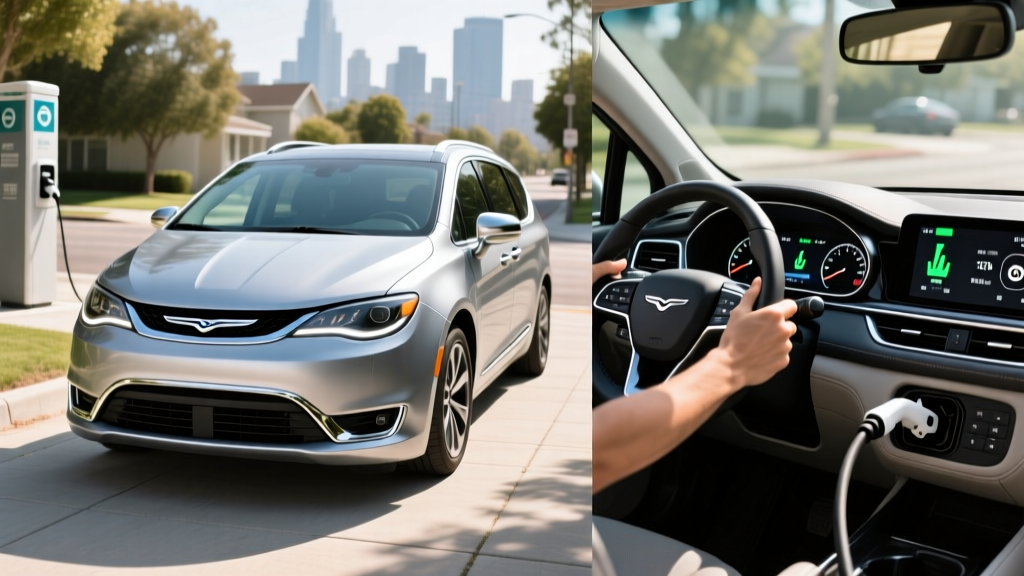
The minivan segment has exactly one plug-in hybrid option: the Chrysler Pacifica Hybrid. For the 2021 model year, Chrysler refined the formula with a refreshed interior, standard advanced safety features, and the same 16-kWh battery pack that enables genuine electric-only school-run commuting. If you need three rows, AWD (gas model only — PHEV is FWD), and the ability to do most daily driving on electricity while keeping a gas engine for road trips, the 2021 Pacifica Hybrid remains a compelling used-market find in 2026.
This guide breaks down the exact EPA numbers, real-world efficiency expectations, battery longevity, and whether this PHEV still makes financial sense five years after its launch.
PHEV vs Conventional Hybrid: What the Pacifica Actually Is
Before diving into specs, it's critical to distinguish what you're buying. The Chrysler Pacifica Hybrid is a plug-in hybrid (PHEV), not a conventional hybrid (HEV) like the Toyota Sienna Hybrid.
| Feature | PHEV (Pacifica Hybrid) | HEV (Toyota Sienna Hybrid) |
|---|---|---|
| Plug-in charging | Yes — plug in to unlock EV range | No — charges via regenerative braking |
| Electric-only range | 32 miles (EPA) | 0 miles — always uses gas engine |
| Battery size | 16 kWh lithium-ion | ~1.9 kWh nickel-metal hydride |
| EV-mode driving | Yes, up to 65 mph in EV mode | Brief low-speed EV assist only |
| Gas engine | 3.6L V6 + dual electric motors | 2.5L 4-cyl + electric motors |
| Drivetrain | FWD only | FWD or AWD available |
The practical difference: if you can plug in at home overnight, the Pacifica Hybrid lets you run most errands, school drop-offs, and commutes on pure electricity — burning zero gas on typical days. If you never plug it in, it functions as a heavy hybrid and loses most of its efficiency advantage.
Fuel Economy and Electric-Only Range
The EPA rates the 2021 Pacifica Hybrid at 82 MPGe combined when operating in electric mode, and 30 MPG combined when running on gasoline alone after the battery is depleted.
| Mode | City | Highway | Combined |
|---|---|---|---|
| Electric (MPGe) | 82 | 82 | 82 |
| Gas-only (MPG) | 29 | 30 | 30 |
Electric-only range: The EPA rates the Pacifica Hybrid at 32 miles on a full charge. In real-world testing, expect 28–30 miles in mild weather with moderate driving. In cold weather (below 32°F), that figure drops to roughly 22–25 miles as the battery's usable capacity shrinks and cabin heating draws additional power.
Real-World Range Expectations:
- EPA rated: 32 miles electric-only
- Mild weather, city/suburban: 28–31 miles (regen braking helps)
- Highway (70+ mph): 24–27 miles (higher speed = faster drain)
- Cold weather (below 32°F): 22–25 miles
- Total combined range (gas + electric): ~440 miles
On the gas side, the 30 MPG combined figure is realistic for mixed driving. Many owners report 31–33 MPG in suburban driving where regenerative braking recaptures energy, while sustained highway driving at 75+ mph yields 27–29 MPG. For a 4,800-pound minivan, these are strong numbers — the non-hybrid Pacifica AWD manages just 20 MPG combined.
Powertrain, Battery, and Charging Specs
| Specification | 2021 Chrysler Pacifica Hybrid |
|---|---|
| Engine | 3.6L Pentastar V6 (Atkinson cycle) |
| Electric motors | Dual integrated motors (via eFlite EVT) |
| Combined system output | 260 hp |
| Battery capacity | 16 kWh lithium-ion (NMC chemistry) |
| Drivetrain | Front-wheel drive |
| 0–60 mph | ~7.5 seconds (Car and Driver tested) |
| Cargo (behind 3rd row) | 32.3 cu ft |
| Stow 'n Go seating | 3rd row only (2nd row does not fold into floor) |
| Towing capacity | Not rated (FWD PHEV only) |
The powertrain uses Chrysler's eFlite electrically variable transmission, which blends the V6 and two electric motors seamlessly. Acceleration is adequate for a loaded minivan — the 260 hp figure doesn't feel sluggish thanks to instant electric torque at low speeds. Highway merging is confident, though the V6 does get vocal under hard acceleration when the battery is depleted.
Charging: Level 1 and Level 2 Only
The 2021 Pacifica Hybrid does not support DC fast charging. This is typical for PHEVs with smaller battery packs — the 16 kWh battery charges quickly enough on Level 2 that DC fast-charging hardware wasn't deemed necessary.
| Charging Level | Power | 0–100% Time | Notes |
|---|---|---|---|
| Level 1 (120V household) | ~1.4 kW | ~14 hours | Included cord; overnight is tight |
| Level 2 (240V, 32A) | ~7.7 kW | ~2 hours | Requires purchased or installed L2 charger |
With a Level 2 home charger (240V), a full charge takes roughly two hours — meaning you could theoretically charge mid-day and get another 32 electric miles for afternoon errands. On standard 120V (Level 1), plan for 14 hours, which means overnight charging will replenish the pack but leaves little margin if you start from near-empty.
Who Should Choose the Pacifica Hybrid vs a Full EV or Gas Minivan
Choose the 2021 Pacifica Hybrid if:
- You need three rows and want to minimize daily fuel costs
- You can charge at home (garage or driveway with 240V access)
- Your daily driving is under 30–35 miles round-trip
- You take occasional road trips and don't want charging-planning hassle
- You're buying used and want a PHEV at a depreciated price
Choose a full BEV (e.g., used Tesla Model X, upcoming electric minivans) if:
- You want zero tailpipe emissions and minimal maintenance
- You have reliable home AND public fast-charging access
- Your daily range needs are within 200+ miles
Choose a gas or conventional hybrid minivan (Toyota Sienna Hybrid) if:
- You cannot plug in at home
- You need AWD (Pacifica Hybrid is FWD only; Sienna Hybrid offers AWD)
- You want Stow 'n Go second-row seating (Pacifica Hybrid's battery eliminates 2nd-row floor storage)
The Pacifica Hybrid's biggest trade-off is the loss of second-row Stow 'n Go seating. The battery pack lives under the floor where those seats would fold, so second-row captain's chairs must be manually removed for a flat load floor. Third-row Stow 'n Go remains. If maximum cargo flexibility is non-negotiable, this is a genuine limitation.
Tax Credit Eligibility for Used Buyers in 2026
When new, the 2021 Pacifica Hybrid qualified for the full $7,500 federal tax credit under the pre-2023 rules. That original credit is gone — it was claimed by the first buyer.
However, as a used vehicle purchased from a dealer in 2026, the Pacifica Hybrid may qualify for the federal used clean vehicle credit under IRS §25E:
- Credit amount: 30% of sale price, up to a maximum of $4,000
- Vehicle price cap: Sale price must be $25,000 or less
- Buyer income limits: AGI must not exceed $75,000 (single), $112,500 (head of household), or $150,000 (married filing jointly)
- Vehicle requirements: Must be at least 2 model years old (2021 qualifies in 2026), purchased from a licensed dealer
- Point-of-sale transfer: Credit can be applied at purchase, reducing your out-of-pocket cost immediately
At typical 2026 used prices of $22,000–$28,000 depending on mileage and condition, many Pacifica Hybrids will fall under the $25,000 cap — making the $4,000 credit available to income-eligible buyers. Always verify current eligibility with a tax professional and check the IRS official guidance, as rules can shift.
Battery Warranty, Reliability, and Replacement Cost
Hybrid Battery Warranty:
- Original coverage: 10 years / 100,000 miles (whichever comes first) for the high-voltage battery pack
- Capacity retention threshold: Stellantis warrants the battery against failure to hold a minimum charge capacity (typically ~70% of original)
- Remaining coverage in 2026: A 2021 model with under 100,000 miles still has factory battery warranty through model year 2031
- Transferability: The hybrid battery warranty transfers to subsequent owners
The Pacifica Hybrid's powertrain has proven generally reliable, though it's worth noting some context. The 3.6L Pentastar V6 is one of Stellantis's most proven engines, and the eFlite transmission has been in service since the Pacifica Hybrid's 2017 launch. Early model years (2017–2018) saw some battery-related recalls for potential fire risk, but these were addressed via software updates and, in some cases, battery pack replacements. By 2021, most of these issues had been resolved.
Battery replacement cost: If the high-voltage battery needs replacement outside of warranty, expect a dealer-installed pack to cost between $5,500 and $7,500 including labor. Independent hybrid specialists may offer refurbished packs for $3,500–$5,000. However, PHEV batteries in minivans tend to experience less stress than in smaller vehicles because the pack is relatively large (16 kWh) for the daily cycling demands — most owners use only 25–30 miles of range per day, meaning shallow discharge cycles that prolong battery life.
For reliability data, the NHTSA recall database shows fewer active recalls for the 2021 model year compared to earlier Pacifica Hybrid years. Check the specific VIN before purchasing to confirm all recall work has been completed.
Real-World Ownership: What to Expect Day to Day
Living with the 2021 Pacifica Hybrid means establishing a plug-in routine. Owners who charge nightly report routinely completing 80–100% of their local driving on electricity, visiting gas stations only for road trips. The Pacifica Hybrid's dashboard clearly displays electric miles driven versus gas miles, making it easy to track your electrified driving percentage.
Charging cost vs. gas cost: At the national average electricity rate of ~$0.16/kWh, fully charging the 16 kWh pack costs roughly $2.56 for 32 miles of range — about $0.08 per mile. At $3.50/gallon and 30 MPG on gas, that's $0.12 per mile. Over 12,000 miles of annual driving with 70% electric operation, annual fuel cost drops to roughly $950 versus $1,400 on gas alone — a savings of about $450 per year. The savings widen in states with cheaper electricity or if you have solar panels.
Insurance costs for the Pacifica Hybrid run slightly higher than the gas model due to the high-voltage system, but the gap has narrowed as PHEVs have become more common. Expect premiums 5–10% above the gas Pacifica.
Pros and Cons at a Glance
Pros
- Only PHEV minivan on the market — no direct competitor
- 32 miles electric range covers most daily family driving
- 440+ mile total range eliminates road-trip range anxiety
- Smooth, quiet EV-mode operation around town
- Used §25E tax credit may save up to $4,000 for eligible buyers
- 10-year/100,000-mile battery warranty still active on 2021 models
Cons
- FWD only — no AWD option (gas Pacifica and Sienna Hybrid offer AWD)
- 2nd-row Stow 'n Go eliminated by battery placement
- No DC fast charging (Level 2 only)
- 30 MPG gas-only is good but trails Toyota Sienna Hybrid's 36 MPG combined
- Used prices remain elevated; $25K credit cap limits eligibility
- Cold-weather EV range drops to ~22–25 miles
Frequently Asked Questions
How many MPG does the 2021 Pacifica Hybrid get?
The EPA rates it at 82 MPGe in electric mode and 30 MPG combined (29 city / 30 highway) on gasoline after the battery is depleted. Real-world gas-only driving often yields 31–33 MPG in suburban conditions and 27–29 MPG at sustained highway speeds.
How far can the 2021 Pacifica Hybrid go on electric only?
The EPA rates 32 miles of electric-only range. Real-world results are typically 28–31 miles in mild weather and 22–25 miles in freezing temperatures. The vehicle can operate in EV mode at speeds up to 65 mph before the gas engine engages.
Does the 2021 Pacifica Hybrid qualify for any tax credit in 2026?
The original $7,500 new-vehicle credit has been claimed. However, used buyers purchasing from a dealer may qualify for the §25E used clean vehicle credit — up to $4,000 (30% of sale price) if the vehicle sells for $25,000 or less and the buyer meets income limits ($75K single / $150K married filing jointly).
Is the Pacifica Hybrid reliable, and what does battery replacement cost?
The 2021 model year resolved most early-generation issues. The hybrid battery carries a 10-year/100,000-mile warranty that remains active through 2031. Out-of-warranty battery replacement costs $5,500–$7,500 at a dealer or $3,500–$5,000 from independent hybrid shops. The 3.6L V6 and eFlite transmission have proven durable.
Should I get the Pacifica Hybrid or a full EV?
Choose the Pacifica Hybrid if you need three rows, take road trips, and can charge at home but don't want to depend on public charging infrastructure. A full EV (like a used Tesla Model X) makes more sense if you want zero maintenance on an engine, have reliable charging access, and your daily range needs are within 200+ miles. For buyers who can't plug in at home, the Toyota Sienna Hybrid (conventional HEV, 36 MPG, AWD available) is the better choice.
Can the Pacifica Hybrid charge on DC fast chargers?
No. The 2021 Pacifica Hybrid supports only Level 1 (120V) and Level 2 (240V) AC charging. Level 2 fully replenishes the 16 kWh battery in about 2 hours. DC fast charging is not available on this model.
Does the Pacifica Hybrid have Stow 'n Go seating?
Only in the third row. The second-row seats cannot fold into the floor because the high-voltage battery occupies that space. Second-row captain's chairs must be physically removed for a flat cargo floor — a notable trade-off versus the gas Pacifica.