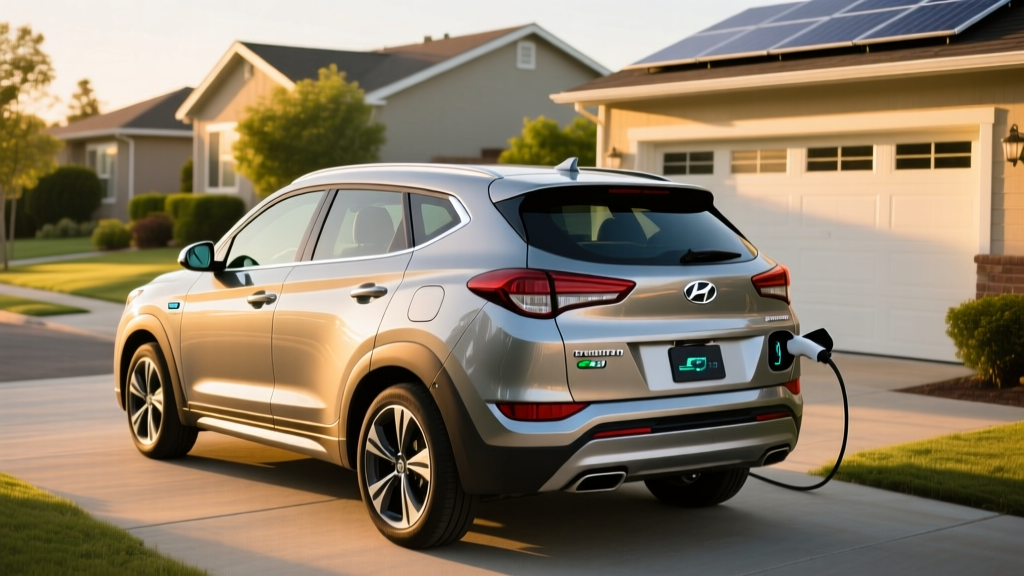
The 2021 Hyundai Tucson Hybrid arrived as a strong value proposition in the compact SUV segment, pairing a turbocharged engine with an electric motor for impressive fuel economy without any plug-in requirement. Now that this model is firmly on the used market in 2026, buyers want hard numbers: Does it actually hit its EPA estimates? How reliable is the hybrid battery? What will ownership cost? This guide answers those questions with real data.
2021 Hyundai Tucson Hybrid at a Glance
| Specification | Detail |
|---|---|
| Powertrain | 1.6L turbocharged 4-cylinder + electric motor |
| Combined Horsepower | 226 hp |
| Combined Torque | 258 lb-ft |
| Transmission | 6-speed automatic |
| Drivetrain | AWD (standard on all trims) |
| Hybrid Battery | 1.49 kWh lithium-ion polymer |
| EPA Fuel Economy (Combined) | 38 MPG |
| EPA City / Highway | 38 city / 38 highway |
| 0-60 mph | ~7.1 seconds |
| Cargo Volume (behind rear seats) | 38.7 cu ft |
| Original MSRP (Blue trim) | $28,250 |
| Hybrid Battery Warranty | 10 years / 100,000 miles |
HEV vs. PHEV: What the 2021 Tucson Hybrid Actually Is
The 2021 Tucson Hybrid is a conventional hybrid (HEV), not a plug-in hybrid. This distinction matters for ownership expectations:
Conventional Hybrid (HEV) — This Model
- No plug required — the battery charges via regenerative braking and the engine
- Small 1.49 kWh battery acts as a buffer, not a primary energy source
- No electric-only driving range — the motor assists the engine continuously
- Fuel economy benefit comes from optimized engine operation and regen
Plug-In Hybrid (PHEV) — Tucson PHEV (Separate Model)
- Requires Level 2 plug-in charging for full benefit
- Larger 13.8 kWh battery enables ~33 miles electric-only range
- Can operate as a pure EV for short commutes before the engine engages
- Eligible for partial federal tax credit under §30D (when new, subject to sourcing rules)
If you're comparing the 2021 Tucson Hybrid against the Tucson PHEV, the HEV is the simpler choice: no charging infrastructure needed, lower purchase price, and strong MPG without lifestyle changes. The PHEV makes sense only if you have reliable home charging and a short commute.
Fuel Economy: EPA Ratings vs. Real-World MPG
The EPA rates the 2021 Hyundai Tucson Hybrid at 38 MPG combined (38 city / 38 highway), according to fueleconomy.gov. The equal city and highway figures reflect how hybrids recapture energy in stop-and-go driving that offsets the efficiency penalty of higher speeds.
| Driving Scenario | EPA Estimate | Real-World Expectation |
|---|---|---|
| City (stop-and-go) | 38 MPG | 37-41 MPG (regen-heavy routes can exceed EPA) |
| Highway (70+ mph) | 38 MPG | 34-37 MPG (aero drag reduces hybrid advantage) |
| Combined | 38 MPG | 35-39 MPG |
| Cold weather (below 32°F) | N/A | 30-34 MPG (engine runs more for cabin heat) |
Hybrids frequently exceed their EPA city estimates on routes with heavy braking and low average speeds, because regenerative braking recaptures kinetic energy that a gas-only car wastes as heat. However, sustained highway driving at 75+ mph and cold-weather operation reduce the Tucson Hybrid's advantage. In winter, the engine must run more frequently to provide cabin heat, reducing MPG by 10-15%.
Powertrain and Performance
The 2021 Tucson Hybrid pairs a 1.6-liter turbocharged GDI 4-cylinder engine (178 hp, 195 lb-ft) with a 44 kW electric motor integrated into the 6-speed automatic transmission. Combined output is 226 hp and 258 lb-ft of torque.
The electric motor provides instant low-end torque, which gives the Tucson Hybrid a responsive feel off the line that the non-hybrid Tucson (181 hp) cannot match. The 0-60 mph time of roughly 7.1 seconds is competitive with turbocharged rivals. Standard HTRAC all-wheel drive uses the electric motor to power the rear axle, eliminating a mechanical driveshaft and improving packaging efficiency.
One characteristic worth noting: the 6-speed automatic can feel less seamless than the e-CVT transmissions in Toyota or Honda hybrids. You'll feel distinct gear shifts under hard acceleration, which some drivers prefer for its natural feel but others find less refined than the continuous-ratio experience of a planetary-gear hybrid system.
Battery Longevity, Warranty, and Replacement Cost
Hybrid Battery Warranty
10 years / 100,000 miles — Hyundai covers the high-voltage lithium-ion polymer battery against defects and capacity loss below a specified threshold for the original owner. For subsequent owners, coverage typically drops to 5 years / 60,000 miles unless state-specific emissions warranty extensions apply (e.g., California and states adopting CARB standards may extend this).
The 2021 Tucson Hybrid's 1.49 kWh battery is small and operates within a narrow state-of-charge window (roughly 40-80% SoC), which minimizes degradation stress. Hyundai's lithium-polymer chemistry has proven durable in the Ioniq Hybrid and Sonata Hybrid, with many examples exceeding 150,000 miles without significant capacity loss.
If replacement is needed out of warranty, expect a cost between $2,000 and $4,000 for the battery pack, plus labor. This is significantly less than a full EV battery replacement because the pack is small and modular. Third-party refurbishers and salvage options may reduce this further as the vehicle ages.
Pricing, Tax Credits, and Used-Market Value in 2026
The 2021 Tucson Hybrid originally started at $28,250 for the Blue trim and ranged up to approximately $35,090 for the Limited trim, including destination. In the 2026 used market, expect to pay between $19,000 and $28,000 depending on mileage, condition, and trim level.
Tax credit status: The conventional 2021 Tucson Hybrid (HEV) does not qualify for the federal §30D Clean Vehicle Credit, which applies only to plug-in electric vehicles (BEVs and PHEVs) meeting battery sourcing, MSRP, and buyer income requirements per IRS guidelines. Some states offer separate incentives for hybrids, but these vary widely by jurisdiction — check your state's energy office or DMV for current programs.
If you purchased this vehicle used from a dealer in 2026, it also does not qualify for the up-to-$4,000 used clean vehicle credit, as that credit is restricted to qualifying BEVs and PHEVs under §25E.
Reliability and Safety
The 2021 Tucson Hybrid earned strong safety marks. The NHTSA awarded it a 5-star overall safety rating, and the IIHS designated it a Top Safety Pick when equipped with specific headlights, per IIHS ratings. Standard Hyundai SmartSense includes forward collision-avoidance assist, lane-keeping assist, blind-spot monitoring, and rear cross-traffic collision-avoidance assist.
On reliability, the 1.6L turbocharged engine and 6-speed automatic are proven components shared across Hyundai's lineup. The hybrid system adds complexity but has shown low failure rates in Hyundai's earlier hybrid applications. Common owner-reported concerns are minor: occasional infotainment glitches and a firm ride quality on the base 17-inch wheels with higher-profile tires.
Who Should Choose the 2021 Tucson Hybrid?
Pros
- 38 MPG combined with no plug-in requirement
- Standard AWD on all trims
- 226 hp provides confident acceleration
- Generous 10-year / 100,000-mile hybrid battery warranty (original owner)
- Competitive cargo space at 38.7 cu ft
- Lower used-market pricing than comparable RAV4 Hybrid
Cons
- Highway MPG drops noticeably above 70 mph
- 6-speed automatic feels less refined than e-CVT competitors
- No electric-only driving mode
- Cold-weather MPG reduction of 10-15%
- No federal tax credit eligibility
- Used battery warranty may reduce to 5yr/60k for second owners
Hybrid vs. PHEV vs. Full EV: Which Fits Your Needs?
Choosing between a conventional hybrid like the 2021 Tucson Hybrid, a plug-in hybrid, or a full battery-electric vehicle depends on your charging access, commute pattern, and budget:
- Choose the Tucson Hybrid (HEV) if: You lack reliable home or workplace charging, drive a mix of city and highway, want strong MPG without behavioral changes, and prefer a lower upfront cost.
- Choose a PHEV if: You have Level 2 charging at home, your daily commute is under 35 miles (covering most trips on electricity), and you want the option of longer gas-powered road trips without range concern.
- Choose a full EV (like the Ioniq 5) if: You have home charging, your daily driving is under 250 miles, you want to eliminate gas entirely, and you can benefit from the §30D federal tax credit (up to $7,500, subject to income caps of $150K single / $300K joint, MSRP caps, and battery sourcing rules).
The Tucson Hybrid occupies a practical middle ground: it delivers 35-40% better fuel economy than the gas-only Tucson without requiring any infrastructure investment or range planning. For buyers in apartments or homes without garage charging access, it remains the most pragmatic path to lower fuel costs.
Frequently Asked Questions
How many MPG does the 2021 Hyundai Tucson Hybrid get?
The EPA rates it at 38 MPG combined (38 city / 38 highway). Real-world results typically range from 35-39 MPG in moderate conditions, with city-heavy routes sometimes exceeding 40 MPG and sustained highway driving dropping to 34-37 MPG.
Does the 2021 Tucson Hybrid need to be plugged in?
No. This is a conventional hybrid (HEV) that charges its small battery through regenerative braking and the gasoline engine. You never plug it in. If you want plug-in capability, look at the Tucson Plug-In Hybrid (PHEV), which is a separate model with ~33 miles of electric-only range.
Is the 2021 Tucson Hybrid reliable?
Yes. Hyundai's hybrid powertrain has demonstrated strong durability across the Ioniq and Sonata Hybrid lineups. The 1.6L turbo engine and 6-speed automatic are proven components. The hybrid battery carries a 10-year/100,000-mile warranty for the original owner.
What does a Tucson Hybrid battery replacement cost?
Out of warranty, expect $2,000-$4,000 for the battery pack plus labor. This is modest compared to full EV battery replacements because the pack is only 1.49 kWh. Most owners will never need a replacement within the vehicle's typical lifespan.
Does the 2021 Tucson Hybrid qualify for any tax credit?
No. The conventional hybrid (HEV) does not qualify for the federal §30D Clean Vehicle Credit, which is limited to plug-in vehicles (BEVs and PHEVs). Some state-level incentives may apply — check your state energy office for current programs.
How does the Tucson Hybrid compare to the RAV4 Hybrid?
The Toyota RAV4 Hybrid is rated at 40 MPG combined vs. the Tucson Hybrid's 38 MPG. The RAV4 uses an e-CVT for smoother acceleration, while the Tucson's 6-speed automatic feels more traditional but less seamless. The Tucson Hybrid typically costs $1,000-$3,000 less on the used market and offers more standard horsepower (226 vs. 219).