Quick Verdict: The 2020 Escape Titanium Hybrid at a Glance
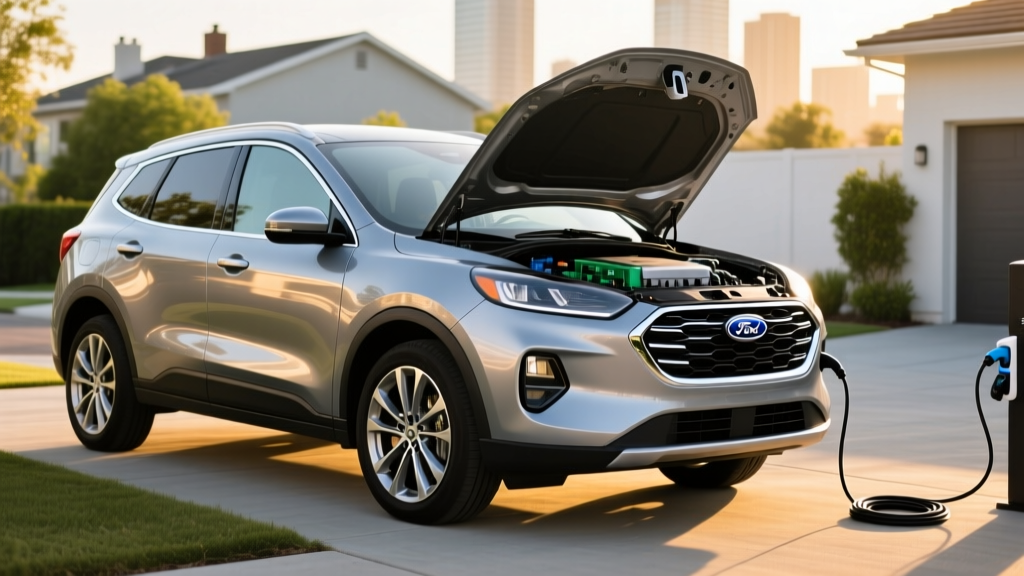
The 2020 Ford Escape Titanium Hybrid pairs a 2.5-liter Atkinson-cycle four-cylinder with an electric motor for a combined 200 horsepower and an EPA-estimated 41 MPG combined. As a conventional hybrid (HEV), it never needs plugging in — it regenerates energy through braking and engine operation. Now firmly in the used market, the Titanium Hybrid trim represents a compelling mid-price SUV for buyers who want electric-like city efficiency without charging infrastructure or range anxiety.
The Titanium was the top-tier trim for the 2020 Escape Hybrid, adding leather-trimmed seats, a 10-speaker B&O audio system, wireless charging pad, and Ford Co-Pilot360 Assist+ (including adaptive cruise control with stop-and-go and evasive steering assist). On the used market in early 2026, well-maintained examples typically list between $18,000 and $23,000 depending on mileage and condition.
| Specification | Value |
|---|---|
| Powertrain | 2.5L I4 Atkinson + electric motor (HEV) |
| Combined Horsepower | 200 HP |
| EPA MPG (City / Hwy / Combined) | 44 / 37 / 41 |
| Drivetrain | FWD (eCVT); AWD available on SEL Hybrid only in 2020 |
| Fuel Tank Capacity | 11.1 gallons |
| Total Range | ~455 miles (EPA combined) |
| 0-60 mph (est.) | ~7.5 seconds |
| Cargo Volume (behind rear seats) | 34.4 cu ft |
| Hybrid Battery Warranty | 8 years / 100,000 miles |
| Original MSRP (Titanium Hybrid) | $36,875 (before options) |
| Typical Used Price (2026) | $18,000–$23,000 |
How Many MPG Does the 2020 Escape Titanium Hybrid Get?
| Driving Cycle | EPA Estimate |
|---|---|
| City | 44 MPG |
| Highway | 37 MPG |
| Combined | 41 MPG |
Source: U.S. EPA / fueleconomy.gov
Real-World MPG vs. EPA Sticker
Hybrids like the Escape typically exceed their EPA city rating in stop-and-go traffic because the electric motor handles low-speed propulsion and regenerative braking recaptures energy that a gas car wastes as heat. Owner-reported data on Fuelly and similar platforms consistently shows real-world combined figures in the 39–43 MPG range, with city-heavy commuters occasionally hitting 45+ MPG in warm weather.
Highway driving is where hybrids lose their advantage. At sustained 70-80 MPH speeds, the gasoline engine does most of the work, and aerodynamic drag dominates. Expect 34–37 MPG on the highway — right around or slightly below the EPA highway estimate. Cold weather (below 35°F) can reduce combined economy by 3–5 MPG due to reduced battery efficiency, longer engine warm-up cycles, and increased cabin heating load.
HEV vs. PHEV vs. EV: Where Does the Escape Hybrid Fit?
The 2020 Escape lineup included a conventional hybrid (HEV) and a plug-in hybrid (PHEV) variant, but the Titanium trim was only offered as a conventional HEV in 2020. The PHEV was limited to the SE Sport Hybrid trim. Understanding the difference is essential for buyers cross-shopping these powertrains.
| Factor | HEV (Escape Hybrid) | PHEV (Escape PHEV) | Full EV (e.g., Mustang Mach-E) |
|---|---|---|---|
| Plug-in Required? | No | Yes (for EV range) | Yes |
| Electric-Only Range | ~1 mile at low speed | 37 miles (EPA) | 230–314 miles |
| Total Range | ~455 miles | ~520 miles combined | 230–314 miles |
| Home Charging Needed? | No | Recommended (Level 1 or 2) | Yes (Level 2 strongly recommended) |
| Federal Tax Credit (new) | None | Up to $7,500 (when eligible) | Up to $7,500 (§30D rules apply) |
| Best For | No home charging access; long highway commutes | Short commute + home charging; occasional road trips | Home charging available; daily driving under 250 mi |
| Used Price Range (2026) | $18,000–$23,000 | $20,000–$26,000 | $22,000–$35,000 |
- You cannot install a home charger (apartment, street parking, no 240V access)
- Your commute is mostly highway or exceeds 40 miles round-trip
- You want minimal behavioral change from a gas car — just fill up and drive
- You value the Titanium's premium features (leather, B&O audio, Co-Pilot360 Assist+)
- You have home charging and a short daily commute (under 30 miles) — a PHEV's EV mode covers most trips
- You want to eliminate gas entirely and have reliable charging access
- You qualify for federal or state EV incentives that narrow the price gap
Powertrain Deep Dive: 200 HP Hybrid System
The 2020 Escape Hybrid uses Ford's fourth-generation hybrid powertrain, combining:
- 2.5L Atkinson-cycle inline-4 engine: Produces approximately 155 HP and 155 lb-ft of torque on its own. The Atkinson cycle sacrifices low-RPM torque for higher thermal efficiency — the electric motor compensates for this.
- Permanent-magnet electric motor: Integrated into the transaxle, contributing up to ~118 HP (the combined system output is rated at 200 HP because the engine and motor peak outputs don't occur simultaneously).
- eCVT (electronic continuously variable transmission):strong> Uses a planetary gearset rather than a belt-and-pulley CVT. This is a proven, durable design shared with earlier Ford Fusion Hybrids.
- 1.1 kWh lithium-ion battery pack: Located under the rear cargo floor. This small pack stores energy from regenerative braking and engine-generated electricity. It is not plug-in chargeable.
The result is smooth, responsive acceleration in city driving where the electric motor's instant torque shines. At highway speeds, the engine is the primary motivator, and passing power is adequate but not thrilling — the ~7.5-second 0-60 time is competitive with rivals like the Toyota RAV4 Hybrid (7.4 seconds) but noticeably slower than turbocharged gas SUVs.
Battery Warranty, Lifespan, and Replacement Cost
How Long Will the Hybrid Battery Last?
Ford's hybrid battery packs have demonstrated strong longevity in real-world use. The 1.1 kWh pack in the 2020 Escape is conservatively sized and operates within a narrow state-of-charge window (roughly 40–80%), which minimizes degradation. Based on data from high-mileage Ford Fusion Hybrid and Escape Hybrid owners, these batteries routinely reach 150,000–200,000+ miles without significant capacity loss.
Unlike full EV batteries, the Escape Hybrid's small pack doesn't undergo deep charge/discharge cycles. The vehicle's battery management system (BMS) buffers the pack aggressively, meaning you'll never fully deplete or fully charge it during normal operation. This design choice trades some electric-only capability for dramatically extended lifespan.
Battery Replacement Cost
If the hybrid battery does fail outside of warranty, replacement costs for the 2020 Escape Hybrid typically fall between $2,500 and $4,000 for a new OEM pack, including labor. Refurbished or aftermarket packs may be available for $1,500–$2,500 as the vehicle ages and the aftermarket matures. Given the battery's demonstrated longevity, this is a low-probability expense for most buyers — but it's a number worth budgeting for if you're purchasing a high-mileage example (100,000+ miles) near the end of its warranty coverage.
Pricing, Tax Credits, and Used-Market Value
The 2020 Ford Escape Titanium Hybrid originally started at $36,875 MSRP (including destination charge). Common option packages — such as the Titanium Elite Package ($2,995) and panoramic sunroof ($1,395) — could push a well-equipped example above $41,000 when new.
Federal Tax Credit Status
As a conventional hybrid (HEV), the 2020 Escape Hybrid has never qualified for the federal §30D clean vehicle tax credit. That credit applies only to plug-in electric vehicles (PHEVs and BEVs) meeting specific battery capacity, critical mineral sourcing, and MSRP/income thresholds. Some states and municipalities have offered separate incentives for conventional hybrids, but these are typically modest ($250–$1,000) and vary by jurisdiction. Check your state's energy office or AFDC state incentive database for current programs.
Used Market Pricing in 2026
On the used market as of early 2026, the 2020 Escape Titanium Hybrid typically trades between $18,000 and $23,000, depending on:
- Mileage: Examples under 40,000 miles command $21,000+; those above 80,000 miles may drop below $19,000.
- Condition and history: Clean Carfax, dealer-certified, and single-owner vehicles sit at the top of the range.
- Remaining warranty: Vehicles still within the 8-year/100,000-mile powertrain and hybrid battery warranty (valid through 2028 for a 2020 model year) carry a premium.
- Regional demand: Prices run higher in fuel-cost-sensitive markets (California, Pacific Northwest) and lower in regions with cheap gas and less hybrid adoption.
For buyers, the sweet spot is often a 40,000–60,000-mile example: depreciated enough to offer value, but still well within the hybrid battery warranty window.
Reliability, Safety, and Ownership Costs
Reliability Track Record
The 2020 Escape Hybrid's powertrain benefits from Ford's extensive hybrid experience (the Fusion Hybrid ran from 2010–2020 with the same fundamental architecture). NHTSA records show few powertrain-related complaints. The eCVT planetary gearset is mechanically simpler than a conventional automatic transmission, with no clutch packs or torque converter to wear out. Consumer Reports has historically rated Ford's hybrid systems as average to above-average in reliability.
Common issues reported by owners are generally non-powertrain: SYNC infotainment glitches, minor interior rattles, and occasional 12V battery drain if the vehicle sits unused for extended periods. None of these are unique to the hybrid variant.
Safety Ratings
The 2020 Escape earned a 5-star overall safety rating from NHTSA and was an IIHS Top Safety Pick when equipped with specific headlights. The Titanium trim's standard Co-Pilot360 Assist+ includes:
- Adaptive cruise control with stop-and-go
- Lane centering assist
- Evasive steering assist
- Automatic emergency braking with pedestrian detection
- Blind-spot monitoring with cross-traffic alert
These are Level 1–2 driver-assistance features per SAE automation definitions. The driver must remain fully engaged at all times — this is not autonomous or self-driving capability.
Five-Year Ownership Cost Estimate
| Category | Estimated Cost |
|---|---|
| Purchase Price (avg.) | $20,500 |
| Fuel (12,000 mi/yr at 41 MPG, $3.40/gal avg.) | $4,976 |
| Insurance (avg. $1,400/yr) | $7,000 |
| Maintenance (oil, tires, brakes — hybrid regen reduces brake wear) | $2,800 |
| Estimated Depreciation (5 yrs from used purchase) | $6,500 |
| Total 5-Year Cost | ~$41,776 |
For comparison, a similarly priced used 2020 gas-only Escape Titanium (26 MPG combined) would cost approximately $7,800 in fuel over the same period — nearly $2,800 more. The hybrid's fuel savings meaningfully offset its slightly higher purchase price within 3–4 years of typical driving.
Pros and Cons
Pros
- 44 MPG city — among the best in the compact SUV class
- No plug-in charging required; zero behavioral change from gas cars
- Titanium trim features premium: leather, B&O audio, wireless charging, advanced ADAS
- Proven hybrid powertrain with strong longevity data
- Hybrid battery warranty still active on most 2020 examples (through 2028)
- Strong cargo space (34.4 cu ft) with no battery intrusion
Cons
- Highway MPG (37) less impressive than city — gas-only rivals close the gap at 70+ MPH
- AWD not available on Titanium Hybrid in 2020 (AWD Hybrid was SEL-only)
- No federal tax credit eligibility (HEV)
- eCVT drone under hard acceleration — typical of planetary hybrid systems
- Infotainment (SYNC 3) feels dated vs. 2024+ competitors
- 200 HP is adequate, not quick — 0-60 in ~7.5 seconds
Frequently Asked Questions
Does the 2020 Ford Escape Titanium Hybrid need to be plugged in?
No. The Escape Titanium Hybrid is a conventional hybrid (HEV). Its small 1.1 kWh battery charges entirely through regenerative braking and the gasoline engine. You fuel it like any other car — just at fewer fill-ups thanks to 41 MPG combined.
How far can the 2020 Escape Hybrid drive on electric power alone?
As a conventional HEV, the Escape Hybrid can travel roughly 0.5–1 mile at very low speeds (under 25 MPH) on electric-only power before the engine engages. This is normal for non-plug-in hybrids. If you need meaningful electric-only range, look at the 2020 Escape PHEV (SE Sport Hybrid trim), which offers 37 miles of EPA-rated electric range from its 14.4 kWh battery.
Is the hybrid battery expensive to replace?
Replacement runs $2,500–$4,000 for a new OEM pack. However, Ford's hybrid batteries have demonstrated excellent longevity, routinely reaching 150,000+ miles. Most 2020 examples are still under the 8-year/100,000-mile hybrid battery warranty (valid through 2028). CARB-state owners get 10 years/150,000 miles of coverage.
Does the 2020 Escape Hybrid qualify for any tax credit?
Not at the federal level. The IRS §30D clean vehicle credit applies only to plug-in vehicles (PHEVs and BEVs). As a conventional hybrid, the Escape HEV has never been eligible. Some state or local utility programs have offered small rebates for hybrids — check AFDC's state incentive database for your area.
How does the Escape Hybrid compare to the Toyota RAV4 Hybrid?
The 2020 RAV4 Hybrid (41 MPG combined, 219 HP, AWD standard) is the segment benchmark. The Escape Titanium Hybrid matches its MPG but offers less power (200 vs. 219 HP) and no AWD on the Titanium trim. Where the Escape wins: the Titanium's premium interior features (leather, B&O audio) are not available on the RAV4 Hybrid at comparable pricing, and the Escape's cargo floor is lower and more practical. If AWD is essential, the RAV4 Hybrid is the clear pick.
What is the best model year for a used Escape Hybrid?
The 2020 model year was the first of the fourth-generation Escape, so it lacks some refinements added in 2023–2025 updates (larger SYNC 4 screen, revised interior materials). However, the hybrid powertrain itself is proven and carries over. If budget allows, a 2023+ model offers a more modern cabin, but the 2020 Titanium Hybrid remains strong on value — especially with remaining warranty coverage.