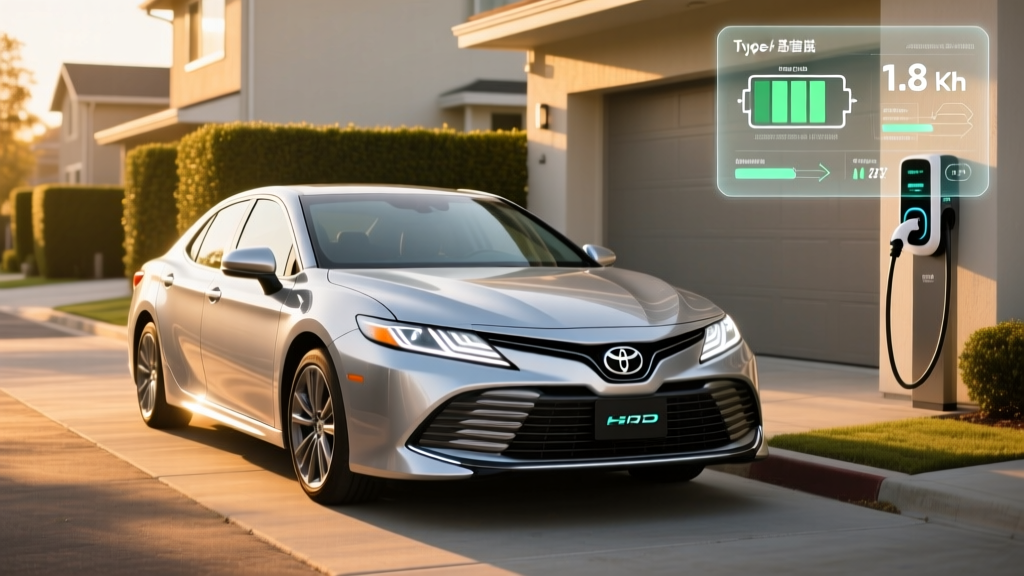
The 2019 Toyota Camry Hybrid remains one of the most efficient midsize sedans you can buy on the used market in 2026. With an EPA-rated 52 MPG combined (in LE trim), a proven hybrid powertrain, and Toyota's long-standing reliability reputation, it's a compelling option for buyers who want serious fuel savings without plugging in. This guide covers everything you need to know about the 2019 Camry Hybrid — from real-world MPG to battery longevity, ownership costs, and how it stacks up against plug-in hybrids and full EVs.
HEV vs PHEV: Where the 2019 Camry Hybrid Fits
Before diving into specs, it's important to clarify what the 2019 Camry Hybrid actually is. It is a conventional hybrid (HEV), not a plug-in hybrid (PHEV). That distinction matters for ownership, charging, and expectations.
| Feature | 2019 Camry Hybrid (HEV) | Typical PHEV (e.g., RAV4 Prime) | Battery EV (e.g., Model 3) |
|---|---|---|---|
| Plugs in to charge? | No — self-charging via regenerative braking and engine | Yes — Level 1/Level 2 | Yes — Level 1/2/DC fast |
| Electric-only range | ~1 mile at low speed (EV mode) | 25–42 miles typical | 250–350+ miles (full battery) |
| Primary fuel | Gasoline (electric motor assists) | Gasoline + grid electricity | Grid electricity only |
| Battery size | 1.6 kWh (NiMH, LE) / 4.0 kWh (Li-ion, SE/XLE) | 13–18 kWh | 50–100 kWh |
| Federal tax credit (new) | Not eligible | Up to $7,500 (if eligible) | Up to $7,500 (if eligible) |
The 2019 Camry Hybrid charges its own battery through regenerative braking and the gasoline engine. You never plug it in. This makes it ideal for drivers who lack access to home or workplace charging but still want significantly better fuel economy than a conventional gas car.
Fuel Economy: EPA Ratings and Real-World MPG
The 2019 Camry Hybrid's headline number is its EPA-rated fuel economy, which varies slightly by trim due to battery chemistry and wheel size differences.
| Trim | City MPG | Highway MPG | Combined MPG | Battery Type |
|---|---|---|---|---|
| LE | 51 | 53 | 52 | NiMH (1.6 kWh) |
| SE | 44 | 47 | 46 | Li-ion (4.0 kWh) |
| XLE | 44 | 47 | 46 | Li-ion (4.0 kWh) |
Source: EPA Fuel Economy Guide
Real-World MPG: What Owners Actually See
Hybrids like the Camry often exceed their EPA ratings in city driving, where regenerative braking recaptures the most energy. On the highway, where the electric motor plays a smaller role, real-world MPG tends to dip closer to or slightly below the sticker number.
Based on owner-reported data from Fuelly and real-world testing, here's what to expect:
- City / stop-and-go: 48–56 MPG (LE trim; some drivers report 55+ with careful hypermiling)
- Highway (70–75 mph): 42–48 MPG
- Cold weather (below 30°F): Expect a 5–10% reduction — roughly 44–48 MPG combined for the LE
- Combined mixed driving: 47–52 MPG for the LE, 42–46 MPG for SE/XLE
The LE trim's higher MPG comes from its smaller, lighter NiMH battery and 16-inch wheels. The SE and XLE use larger 18-inch wheels and a heavier Li-ion pack, trading a few MPG for sportier handling and more electric assist. If maximum fuel economy is your priority, the LE is the clear choice.
Powertrain Specs: Engine, Motor, and Combined Output
The 2019 Camry Hybrid pairs a 2.5-liter inline-4 Atkinson-cycle engine with Toyota's Hybrid Synergy Drive system. Here are the key numbers:
| Specification | Detail |
|---|---|
| Engine | 2.5L 4-cylinder Atkinson-cycle |
| Engine horsepower | 176 hp @ 5,700 rpm |
| Electric motor output | 118 hp (88 kW) |
| Net combined system horsepower | 208 hp |
| Transmission | eCVT (electronically controlled continuously variable) |
| Drivetrain | Front-wheel drive |
| 0–60 mph | ~7.5 seconds |
| Curb weight | 3,472–3,572 lbs (varies by trim) |
| Fuel tank capacity | 13.2 gallons |
| Total driving range | ~630–685 miles (LE trim at EPA combined) |
The 208 combined horsepower is competitive with the non-hybrid Camry's 203-hp 4-cylinder, and the hybrid delivers its torque more smoothly thanks to electric motor assist off the line. The eCVT is not a traditional belt-driven CVT — it uses a planetary gearset that's virtually bulletproof in long-term use, with no belt to wear or replace.
Battery Longevity, Warranty, and Replacement Cost
2019 Camry Hybrid Battery Warranty
- Hybrid battery warranty: 8 years / 100,000 miles (10 years / 150,000 miles in California and states adopting CARB emissions standards)
- Hybrid system components: 8 years / 100,000 miles
- Capacity retention threshold: Toyota does not publish a specific % degradation threshold; warranty covers defects and failure
How Long Do Camry Hybrid Batteries Actually Last?
This is the top concern for used hybrid buyers, and the data is reassuring. Toyota's hybrid battery packs — both the NiMH in the LE and the Li-ion in the SE/XLE — have an excellent track record. Based on long-term owner reports and fleet data:
- Typical lifespan: 150,000–200,000+ miles before significant degradation or failure
- Failure rate: Low — the vast majority of Camry Hybrids reach 100,000 miles on the original battery without issue
- Degradation pattern: Gradual capacity loss over time, not sudden failure. You'll notice slightly reduced EV-mode range and marginally lower MPG before complete failure
Battery Replacement Cost
If the hybrid battery does fail outside of warranty, here's what to expect in 2026:
- New OEM battery (Toyota dealer): $3,000–$4,000 including labor
- Refurbished/remanufactured battery: $1,500–$2,500 including labor
- Individual cell/module replacement: $500–$1,200 (available from independent hybrid specialists; not all shops offer this)
For a 2019 model, most examples on the used market in 2026 will have 60,000–120,000 miles. If you're buying one with under 100,000 miles, there's a strong chance the original hybrid battery warranty is still partially in effect (the 8-year/100,000-mile warranty extends through 2027 for most 2019 models). In CARB states like California, New York, and Massachusetts, the 10-year/150,000-mile warranty provides coverage through 2029.
2019 Camry Hybrid Pricing in 2026 and Tax Credit Eligibility
The 2019 Camry Hybrid was originally sold in three trims with the following MSRPs:
- LE: $28,150
- SE: $30,200
- XLE: $32,600
Used Market Pricing (2026 Estimates)
As of early 2026, used 2019 Camry Hybrid prices typically range from $18,000 to $26,000 depending on mileage, condition, and trim. Low-mileage LE examples with clean history command a premium due to their superior fuel economy.
Federal Tax Credit: Not Eligible
The 2019 Camry Hybrid does not qualify for the federal §30D clean vehicle tax credit — now or when it was sold new. Under current IRS rules, the §30D credit applies only to plug-in electric vehicles (BEVs and PHEVs) that meet battery capacity, critical mineral sourcing, and MSRP caps. Conventional hybrids like the Camry Hybrid are excluded.
However, the used EV credit (§25E) also does not apply, as it covers only plug-in vehicles. Your fuel savings come from the pump, not from tax incentives — but at 52 MPG combined, those savings are substantial.
Annual Fuel Cost Estimate
At 15,000 miles per year and $3.30/gallon (2026 national average), a 2019 Camry Hybrid LE costs approximately $950/year in fuel. A comparable non-hybrid 2019 Camry (32 MPG combined) would cost roughly $1,545/year — a difference of about $595 annually in the hybrid's favor.
Who Should Choose the 2019 Camry Hybrid vs a PHEV or Full EV?
Pros
- 52 MPG combined (LE) — among the best of any midsize sedan
- No plug-in charging required — ideal for apartment dwellers or those without garage access
- Proven reliability with low battery failure rates
- 630+ mile total range per tank
- Smooth, quiet powertrain with adequate 208 hp
- Lower purchase price than PHEVs and EVs on the used market
- Toyota Safety Sense-P standard (AEB, lane departure alert, auto high beams, full-speed adaptive cruise)
Cons
- No meaningful electric-only driving (EV mode limited to ~1 mile at low speed)
- SE/XLE trims drop to 46 MPG combined
- No federal or state tax credit eligibility
- eCVT lacks the sporty feel of a geared automatic (though it's very smooth)
- Rear seat doesn't fold flat in all trims due to battery placement
- Infotainment system feels dated by 2026 standards (no wireless CarPlay/Android Auto)
Decision Framework
Choose the 2019 Camry Hybrid if:
- You don't have access to home or workplace charging (apartment, street parking, no 240V outlet)
- You want maximum MPG with zero behavior change — just fill up and drive
- Your budget is under $25,000 and you want a reliable, efficient daily driver
- You drive a mix of city and highway and want strong fuel savings in both
Consider a PHEV (like a RAV4 Prime or Prius Prime) if:
- You can charge at home and want 25–42 miles of electric-only commuting
- Your daily commute is under 40 miles round-trip (you'd rarely burn gas)
- You want the option of electric driving but need gas flexibility for road trips
Consider a full EV (like a used Model 3 or Ioniq 5) if:
- You have reliable home Level 2 charging
- You want to eliminate gasoline entirely and reduce maintenance (no oil changes, fewer brake replacements)
- Your daily driving is under 250 miles and you're comfortable with public DC fast charging for road trips
Reliability and Safety Ratings
The 2019 Camry Hybrid benefits from Toyota's strong reliability reputation and the proven Hybrid Synergy Drive system, which has been refined over two decades since the original Prius. Key reliability notes:
- eCVT transmission: Extremely durable — uses a planetary gearset with no wear items like belts or clutches. Failures are rare.
- Brake wear: Regenerative braking significantly reduces pad wear. Many owners report 80,000–100,000+ miles on original brake pads.
- Common complaints: Minor infotainment glitches, occasional 12V battery drain if the car sits unused for extended periods (a common issue in all hybrids and EVs, not specific to the Camry)
Safety ratings are excellent. The NHTSA gave the 2019 Camry a 5-star overall safety rating. The IIHS named it a Top Safety Pick+ when equipped with specific headlights, with "Good" ratings in all crashworthiness tests.
Ownership Costs: 5-Year Breakdown
Here's a realistic 5-year ownership estimate for a 2019 Camry Hybrid LE purchased used in 2026, assuming 15,000 miles/year:
| Category | Estimated 5-Year Cost | Notes |
|---|---|---|
| Purchase price (used LE) | $20,000–$23,000 | Varies by mileage and condition |
| Fuel (75,000 miles @ 52 MPG) | $4,750 | At $3.30/gal average |
| Insurance | $5,500–$7,500 | Varies by state, age, driving record |
| Maintenance | $2,000–$3,000 | Oil changes, tires, filters, fluids |
| Repairs | $500–$1,500 | Low for Toyota; hybrid battery likely still under warranty |
| Depreciation (5 years) | $5,000–$7,000 | Camry Hybrids hold value well |
| Total estimated 5-year cost | $37,750–$46,750 | Including purchase price |
Fuel costs are the standout: at $4,750 over five years, you're spending roughly $950/year on gas. That's roughly $3,000 less than a comparable non-hybrid Camry over the same period.
Frequently Asked Questions
How many MPG does the 2019 Camry Hybrid get?
The 2019 Camry Hybrid LE achieves an EPA-rated 51 city / 53 highway / 52 combined MPG. The SE and XLE trims are rated at 44 city / 47 highway / 46 combined due to larger wheels and a different battery. In real-world driving, many owners meet or exceed these numbers in city traffic thanks to regenerative braking.
Does the 2019 Camry Hybrid need to be plugged in?
No. The 2019 Camry Hybrid is a conventional hybrid (HEV), not a plug-in hybrid. It charges its battery through regenerative braking and the gasoline engine. You never plug it in — just fill the gas tank as you would with any other car.
Is the 2019 Camry Hybrid reliable, and what does a battery replacement cost?
Yes, it is highly reliable. Toyota's Hybrid Synergy Drive system has been refined over 20+ years, and the eCVT transmission has virtually no wear items. Hybrid battery failure before 150,000 miles is uncommon. If replacement is needed, expect $3,000–$4,000 for a new OEM battery or $1,500–$2,500 for a refurbished unit. Most 2019 models still have partial hybrid battery warranty coverage in 2026.
Does the 2019 Camry Hybrid qualify for any tax credit?
No. The Camry Hybrid is a conventional hybrid and does not qualify for the federal §30D clean vehicle credit or the §25E used EV credit. These credits apply only to plug-in vehicles (BEVs and PHEVs). Some states may offer minor incentives for hybrids, but no significant federal tax benefit applies. Check your state's energy office for any local programs.
How does the 2019 Camry Hybrid compare to a full EV for daily commuting?
If you have home charging, a full EV will cost less per mile to "fuel" and eliminate oil changes. However, the Camry Hybrid requires no charging infrastructure, has 630+ miles of total range, and costs significantly less to purchase used. For drivers without reliable charging access, the Camry Hybrid delivers excellent efficiency with zero lifestyle compromise.
What's the difference between the LE, SE, and XLE trims?
The LE prioritizes fuel economy (52 MPG combined) with 16-inch wheels and a lighter NiMH battery. The SE adds sport-tuned suspension, 18-inch wheels, and a Li-ion battery, dropping to 46 MPG combined. The XLE adds luxury features like leather-trimmed seats, a premium audio system, and ambient lighting, also at 46 MPG combined. If MPG is your top priority, the LE is the clear winner.