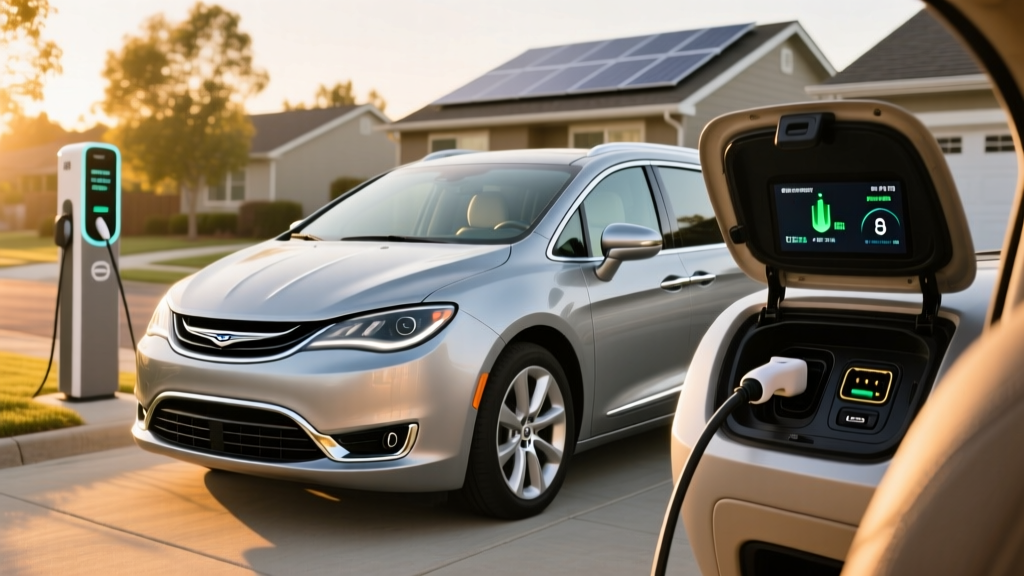
The 2018 Chrysler Pacifica Hybrid remains one of the only plug-in hybrid minivans ever sold in the United States, and in 2026 it continues to attract families who want electric-only school runs without sacrificing road-trip range. Built on the same platform as the gas-only Pacifica, the PHEV variant pairs a 3.6-liter V6 with a dual-motor electric drive and a 16 kWh lithium-ion battery pack. The result is a minivan that can cover short trips on electricity alone while retaining the flexibility of a gasoline engine for longer hauls.
If you're shopping the used market for a hybrid Pacifica 2018 model, this guide covers every number that matters: EPA range and MPGe, real-world efficiency, battery health expectations, charging logistics, and whether this PHEV still makes financial sense nearly a decade after its debut.
HEV vs PHEV: Where the Pacifica Hybrid Fits
Before diving into specs, it's worth clarifying terminology, because Chrysler's marketing has caused confusion. The Pacifica Hybrid is a plug-in hybrid (PHEV), not a conventional hybrid (HEV) like a Toyota Prius. Here's the difference:
| Feature | Conventional Hybrid (HEV) | Plug-In Hybrid (PHEV) |
|---|---|---|
| Battery size | 1–2 kWh | 8–25 kWh (Pacifica: 16 kWh) |
| Plug-in charging | No — charges via regen/engine | Yes — Level 1 or Level 2 |
| Electric-only driving | Minimal (low-speed assist) | 20–50 miles typical |
| Gas engine | Always available | Engages after EV range depletes |
| Federal tax credit (new) | None | Up to $7,500 (when eligible) |
The Pacifica Hybrid can be plugged in to recharge its battery, enabling roughly 32 miles of electric-only driving. Once the battery is depleted, it operates as a conventional hybrid, blending engine and electric motor power. You never have to plug it in — the gas engine will take over seamlessly — but you'll miss the efficiency and cost benefits if you don't.
EPA Range, MPGe, and Fuel Economy
| Metric | 2018 Pacifica Hybrid (EPA) |
|---|---|
| Electric-only range | 32 miles |
| Combined MPGe (electric + gas) | 84 MPGe |
| Gas-only combined MPG | 32 MPG |
| City MPG (gas-only) | 32 MPG |
| Highway MPG (gas-only) | 31 MPG |
| Total combined range | ~566 miles |
| Fuel tank capacity | 14.0 gallons |
According to fueleconomy.gov, the 2018 Pacifica Hybrid achieves 84 MPGe when operating in blended electric-gas mode and 32 MPG combined once the battery is depleted. Those are strong numbers for a 5,000-pound minivan.
Powertrain and Performance Specs
| Specification | Detail |
|---|---|
| Engine | 3.6L Pentastar V6 (Atkinson cycle) |
| Electric motors | Dual-motor eFlite EVT (2 motors) |
| Combined system horsepower | 260 hp |
| Battery pack | 16 kWh lithium-ion (NMC chemistry) |
| Usable battery capacity | ~13 kWh |
| Transmission | Electrically variable transmission (eVT) |
| Drivetrain | Front-wheel drive |
| 0–60 mph | ~7.1 seconds |
| Towing capacity | Not rated (PHEV); gas Pacifica: 3,600 lbs |
The Pacifica Hybrid uses a version of Chrysler's well-known 3.6L V6 converted to the more efficient Atkinson cycle, paired with two electric motors integrated into a specialized transmission. Combined output is 260 horsepower — adequate for a loaded minivan, though not sporty. Acceleration from a stop feels responsive thanks to instant electric torque, but highway passing requires the engine to kick in with some audible strain.
One important note: the PHEV model sacrifices the Stow 'n Go second-row seating that the gas Pacifica offers. The battery pack lives under the floor where those seats would fold, so the second-row captain's chairs are fixed. Cargo volume is also slightly reduced compared to the gas version.
Charging: Level 1, Level 2, and DC Fast Charging
| Charging Level | Power | Time (0–100%) | Connector |
|---|---|---|---|
| Level 1 (120V household) | ~1.4 kW | ~14 hours | |
| Level 2 (240V, 30A) | ~6.6 kW | ~2 hours | |
| DC Fast Charging | Not supported | N/A | |
The 2018 Pacifica Hybrid accepts up to 6.6 kW on Level 2 AC charging via its J1772 port. A full charge from empty takes roughly two hours on a 240V Level 2 station — practical for overnight home charging or topping up during a workday. On a standard 120V household outlet (Level 1), a full charge takes about 14 hours, which is slow but workable if you plug in every evening.
DC fast charging is not available on any Pacifica Hybrid model year. This is common for PHEVs with smaller battery packs — the 16 kWh battery simply doesn't justify the cost and weight of DC fast-charge hardware. For daily use, Level 2 overnight charging is all most owners need to wake up with a full battery every morning.
If you're installing a Level 2 home charger, expect to pay $500–$1,200 for the charger hardware and $800–$2,500 for professional electrical installation, depending on whether your panel needs an upgrade. A licensed electrician should assess your 200-amp panel capacity before committing to a 30-amp or 40-amp circuit.
Battery Health, Warranty, and Replacement Cost
For a 2018 model in 2026, the original factory battery warranty is either nearing expiration or already expired depending on your state and mileage. This is a critical consideration for used buyers.
Real-world battery degradation: Owner reports and fleet data suggest the Pacifica Hybrid's NMC battery holds up reasonably well, with most vehicles retaining 85–92% of original capacity after 6–8 years and 80,000–100,000 miles. However, some owners have reported more significant degradation, particularly in hot climates where the battery lacks active liquid cooling for the traction pack.
Battery replacement cost: If the battery fails outside warranty, expect a dealer replacement to cost between $5,800 and $8,500 including parts and labor. Independent EV shops may offer refurbished packs for $3,500–$5,000. Before purchasing a used 2018 Pacifica Hybrid, have the battery's State of Health (SoH) checked using an OBD-II scanner with PHEV-capable software, or request a dealer battery health report.
Pricing, Tax Credits, and Used Market Value
When new, the 2018 Pacifica Hybrid started at approximately $42,130 (Touring L trim) and climbed to around $46,130 for the Limited trim, before destination charges. The original federal §30D tax credit of $7,500 was available to eligible buyers, effectively bringing the net price into the mid-$30,000s.
In 2026's used market, a 2018 Pacifica Hybrid with 70,000–100,000 miles typically sells for $17,000–$24,000 depending on condition, trim, and battery health. Under the current IRS used clean vehicle credit (IRC §25E), buyers purchasing from a dealer may qualify for up to $4,000 or 30% of the sale price (whichever is less) if the vehicle sells for $25,000 or less and the buyer meets income requirements ($75,000 single / $150,000 joint AGI). This can make a well-maintained example significantly more affordable.
- Sale price must be $25,000 or less (from a licensed dealer)
- Buyer AGI: ≤$75,000 single / ≤$112,500 head of household / ≤$150,000 joint
- Vehicle must be at least 2 model years old (2018 qualifies in 2026)
- Credit is 30% of sale price, capped at $4,000
- Credit is non-refundable — you must have tax liability to claim it
- Verify eligibility with a tax professional before purchase
Who Should Buy the 2018 Pacifica Hybrid?
Pros
- Only PHEV minivan available — no direct competitor
- 32 miles EV range covers most school/activity runs
- 32 MPG gas-only beats conventional minivans by 8–10 MPG
- Smooth, quiet electric driving around town
- Comfortable ride quality and spacious interior
- Eligible for up to $4,000 used-EV tax credit in 2026
Cons
- No DC fast charging
- Fixed second-row seats (no Stow 'n Go)
- Reduced cargo space vs gas Pacifica
- Not rated for towing
- Battery warranty may be expired on 2018 models
- No all-wheel-drive option
Choose the 2018 Pacifica Hybrid if:
- You need a minivan and want to minimize fuel costs on daily short trips
- You have access to Level 2 home charging (a garage or driveway with a 240V outlet)
- Your typical daily driving is under 35 miles, keeping you mostly on electric
- You want the flexibility of a gas engine for road trips without range anxiety
Consider a full EV (like a used Tesla Model X or Kia EV9) if:
- Your daily driving exceeds 50 miles and you want maximum per-mile savings
- You have reliable DC fast charging nearby for road trips
- You want lower maintenance costs (no oil changes, fewer moving parts)
Stick with the gas Pacifica if:
- You need Stow 'n Go seating flexibility or towing capability
- You cannot install or access Level 2 charging at home
- You're on a tighter budget — gas models are $3,000–$5,000 cheaper used
Frequently Asked Questions
How many MPG does the 2018 Pacifica Hybrid get?
The EPA rates it at 84 MPGe in blended electric-gas operation and 32 MPG combined (32 city / 31 highway) once the battery is depleted. In real-world city driving, owners frequently report 33–36 MPG gas-only because regenerative braking is most effective at lower speeds. Highway-only driving may return 27–29 MPG.
How far can the 2018 Pacifica Hybrid go on electric only?
The EPA rates it at 32 miles of electric-only range. Real-world results vary: expect 28–32 miles in mild weather around town, 22–27 miles on the highway, and 18–22 miles in freezing temperatures. The battery's usable capacity is approximately 13 kWh of its 16 kWh total.
Is the 2018 Pacifica Hybrid reliable?
Mechanically, the 3.6L Pentastar V6 is one of Chrysler's most proven engines. The electric drive system has been generally dependable, though some owners have reported issues with the power inverter module and onboard charger. The biggest reliability variable in 2026 is battery health — degradation is gradual but inevitable, and replacement is costly. A pre-purchase battery health check is strongly recommended.
What does a Pacifica Hybrid battery replacement cost?
Dealer replacement runs $5,800–$8,500. Independent shops may offer refurbished battery packs for $3,500–$5,000. Given the vehicle's used market value of $17,000–$24,000, a battery replacement represents a significant percentage of the car's worth — factor this into your purchase decision and negotiate accordingly.
Does the 2018 Pacifica Hybrid qualify for a tax credit in 2026?
It no longer qualifies for the new-vehicle §30D credit. However, under the IRS §25E used clean vehicle credit, buyers purchasing from a licensed dealer for $25,000 or less may qualify for up to $4,000 (30% of sale price), subject to income limits. Consult a tax professional to confirm your eligibility before purchasing.
Can I charge the Pacifica Hybrid at a public DC fast charger?
No. The Pacifica Hybrid does not support DC fast charging. It can only charge via AC Level 1 (120V) or Level 2 (240V) using its J1772 connector. Public Level 2 chargers at shopping centers or workplaces are compatible, but Tesla Superchargers, Electrify America DC stalls, and other fast-charging networks will not work.
Does the Pacifica Hybrid have all-wheel drive?
No. The 2018 Pacifica Hybrid is front-wheel drive only. Chrysler did not offer AWD on the Pacifica Hybrid until the 2021 model year. If AWD is essential, look at the 2021+ Pacifica Hybrid AWD or the gas Pacifica AWD.