Quick Verdict: The 2018 Malibu Hybrid in 2026
The 2018 Chevrolet Malibu Hybrid is a conventional hybrid electric vehicle (HEV) — not a plug-in. It pairs a 1.8-liter four-cylinder engine with a two-motor electric drive unit to deliver an EPA-rated 49 MPG city / 43 MPG highway / 46 MPG combined. With no plug required, a proven powertrain shared with the Volt's hybrid architecture, and used prices now ranging from $11,000 to $17,000 depending on mileage and condition, it remains one of the most fuel-efficient midsize sedans available on the secondhand market in 2026.
But before you buy, you need to understand the battery's age, warranty status, and what real-world fuel economy actually looks like eight years after this car rolled off the line. Let's break down every number that matters.
HEV vs PHEV vs EV: Where the Malibu Hybrid Fits
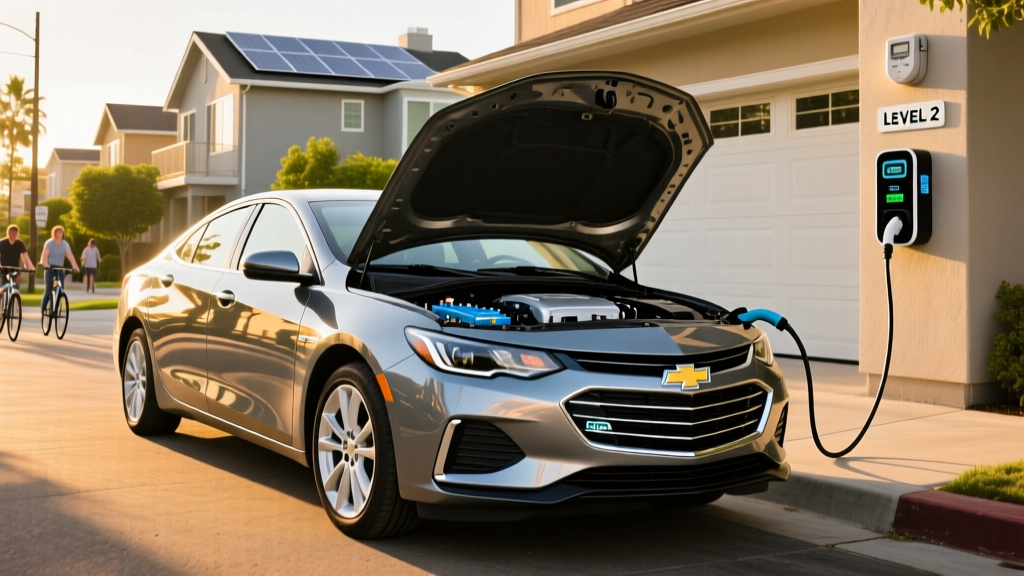
The 2018 Malibu Hybrid is a conventional hybrid (HEV). It charges its small battery exclusively through regenerative braking and the gasoline engine — you never plug it in. There was never a plug-in hybrid (PHEV) version of the Malibu. If you want a Chevy with a plug, the 2018 Volt (now discontinued) offered 53 miles of electric-only range on a 18.4 kWh battery, but that's an entirely different vehicle.
| Factor | HEV (Malibu Hybrid) | PHEV (e.g., Prius Prime) | BEV (e.g., Tesla Model 3) |
|---|---|---|---|
| Plug required? | No | Yes (optional but recommended) | Yes (mandatory) |
| Electric-only range | 0 miles (motor assists engine) | 25–45 miles typical | 250–360 miles typical |
| Battery size | 1.5 kWh | 13–18 kWh | 50–82 kWh |
| Fuel/energy cost | Gas only (~$0.09/mi) | Gas + electricity (~$0.04–0.09/mi) | Electricity only (~$0.03–0.05/mi) |
| Home charging needed? | No | Recommended (Level 2) | Yes (Level 2 strongly recommended) |
| Federal tax credit (new) | None | Up to $7,500 (§30D) | Up to $7,500 (§30D) |
| Best for | No home charging access, budget buyers | Short commutes + road trip flexibility | Home charging, lowest running costs |
Bottom line: The Malibu Hybrid is the right call if you lack access to home or workplace charging and want maximum fuel efficiency without any behavioral change. If you do have a garage and a short commute, a PHEV or BEV will save you more money per mile in 2026.
Fuel Economy: EPA Ratings vs Real-World MPG
The EPA rates the 2018 Malibu Hybrid at 49 MPG city / 43 MPG highway / 46 MPG combined, per fueleconomy.gov. That city-dominant split is typical of conventional hybrids: the electric motor handles low-speed driving where gasoline engines are least efficient, while highway cruising relies more heavily on the engine.
| Cycle | EPA Rating | Real-World Expectation |
|---|---|---|
| City | 49 MPG | 47–52 MPG (hybrids often exceed EPA in stop-and-go) |
| Highway | 43 MPG | 39–44 MPG (depends on speed; above 70 mph drops efficiency) |
| Combined | 46 MPG | 43–48 MPG |
Real-world note: Owner-reported data on Fuelly and similar platforms clusters around 42–47 MPG combined over tens of thousands of miles. Drivers who do heavy city driving with frequent stops (where regen braking recaptures energy) often see 48+ MPG. Sustained 80-mph highway driving in cold weather can drop the number into the high 30s. At 46 MPG combined and a national average gas price of ~$3.10/gallon in early 2026, you're spending roughly $0.067 per mile on fuel — about half what a comparable 26-MPG gas-only midsize sedan costs.
Powertrain Specs: Engine, Motors, and Horsepower
The 2018 Malibu Hybrid uses a powertrain derived from the second-generation Chevrolet Volt's Voltec architecture, adapted for a parallel-hybrid (non-plug-in) configuration.
| Engine | 1.8L direct-injected 4-cylinder (122 hp / 129 lb-ft) |
| Electric drive unit | Two-motor generator system (integrated into transmission) |
| Combined system output | 182 hp |
| Transmission | Continuously variable (eCVT — planetary gearset, not belt-driven) |
| Battery | 1.5 kWh lithium-ion (80-cell, air-cooled) |
| 0–60 mph | ~7.5 seconds |
| Drivetrain | Front-wheel drive |
| Curb weight | ~3,465 lbs |
The eCVT here is not the rubber-band-style CVT found in some competitors. GM uses a planetary gearset that blends engine and motor power smoothly — it's the same fundamental architecture Toyota uses in its Hybrid Synergy Drive. The result is responsive, linear acceleration without the droning sensation some drivers associate with CVTs.
The 1.5 kWh battery is small by any electrified-vehicle standard. Its job isn't to drive the car on electricity alone for meaningful distances — it's to enable engine-off coasting, low-speed electric assist, and stop/start functionality. You'll notice the engine shut off at stoplights and during gentle deceleration; that's the hybrid system doing its job.
Battery Lifespan, Warranty, and Replacement Cost
This is the single biggest concern for anyone buying an eight-year-old hybrid in 2026, and it deserves a thorough answer.
2018 Malibu Hybrid — Battery Warranty
- Original coverage: 8 years / 100,000 miles (whichever comes first) for the hybrid battery and all hybrid-specific components
- In 2026: Most 2018 models have expired or are expiring this year based on the 8-year clock. If the car has under 100,000 miles and was originally sold in a CARB-emissions state (CA, CT, ME, MD, MA, NJ, NY, OR, RI, VT, WA), some hybrid components may carry a 10-year/150,000-mile emissions warranty — verify with a GM dealer using the VIN.
- Capacity threshold: GM's warranty covers the battery if it fails to maintain sufficient capacity to operate the hybrid system — there is no published minimum percentage (unlike some BEV warranties that guarantee 70% retention).
How long do these batteries actually last? The 1.5 kWh pack in the Malibu Hybrid is lightly stressed compared to a full EV battery. It never deep-cycles (the system keeps the state of charge within a narrow band, typically 40–60%), and the air-cooling system prevents thermal extremes. Based on data from similar GM hybrid platforms and owner forums, the vast majority of these batteries last well past 150,000 miles with minimal degradation. Failures before 120,000 miles are uncommon.
Replacement cost if it does fail: A new OEM hybrid battery from GM runs approximately $2,500–$3,500 for the part, with labor adding $500–$800, putting a total replacement at roughly $3,000–$4,300. Refurbished or salvaged hybrid batteries from low-mileage wrecks can be found for $800–$1,500, though availability for the Malibu Hybrid specifically is more limited than for high-volume models like the Prius. Independent hybrid repair shops in major metros can often perform the swap for less than a dealership.
Used Pricing and Tax Credit Eligibility
Chevrolet discontinued the Malibu Hybrid after the 2019 model year (and the entire Malibu line ended after 2024), so your only option in 2026 is the used market.
| Condition / Mileage | Price Range |
|---|---|
| Excellent, under 50K miles | $15,000–$17,500 |
| Good, 50K–90K miles | $12,500–$15,000 |
| Fair, 90K–130K miles | $10,500–$12,500 |
| High mileage, 130K+ | $8,500–$10,500 |
Federal tax credit: The Malibu Hybrid does not qualify for the IRS §30D Clean Vehicle Credit. That credit applies only to new plug-in electric vehicles (BEVs and PHEVs) that meet battery sourcing, MSRP cap, and buyer income requirements. Conventional hybrids like the Malibu are excluded entirely.
Used EV credit (§25E): Similarly, the up-to-$4,000 used clean vehicle credit applies only to used BEVs and PHEVs priced at or below $25,000 — conventional hybrids are not eligible. The Malibu Hybrid gets no federal purchase incentive of any kind in 2026.
State incentives: A handful of states offer small rebates or HOV-lane access for hybrids, but most state-level programs have shifted focus to plug-in vehicles. Check your state's energy office or DMV for current rules — don't assume eligibility.
Ownership Costs: Five-Year Breakdown
Here's what owning a 2018 Malibu Hybrid actually costs compared to a typical gas-only midsize sedan (e.g., a 2018 Honda Accord 1.5T at ~30 MPG combined) over five years and 60,000 miles.
| Category | 2018 Malibu Hybrid (46 MPG) | 2018 Accord 1.5T (30 MPG) |
|---|---|---|
| Purchase price (avg used) | $13,500 | $16,000 |
| Fuel (at $3.10/gal avg) | $4,043 | $6,200 |
| Insurance (avg) | $7,200 | $7,200 |
| Maintenance (est.) | $2,800 | $3,200 |
| Estimated repairs | $1,500 | $1,200 |
| Total (5 yr) | $29,043 | $33,800 |
The hybrid saves roughly $4,750 over five years, driven primarily by fuel savings and a lower purchase price. Maintenance is slightly lower because regenerative braking reduces brake pad wear, and the hybrid system eliminates the traditional starter motor and alternator (two common failure points on gas cars). The repair estimate is slightly higher for the hybrid to account for the small risk of hybrid-system-specific issues as the car ages, though major failures remain uncommon at this mileage range.
Pros and Cons
Pros
- 46 MPG combined — among the best in the midsize sedan class
- No plug-in charging required; zero behavior change from a gas car
- Smooth, quiet powertrain with responsive low-end torque from electric assist
- Spacious cabin with 15.8 cu-ft trunk (hybrid battery doesn't significantly compromise cargo)
- Strong safety ratings: 5-star overall NHTSA rating, IIHS Top Safety Pick
- Low used pricing in 2026 ($11K–$17K range)
- Apple CarPlay and Android Auto standard
Cons
- No federal or state tax credit eligibility (HEV, not PHEV/BEV)
- Battery warranty likely expired or expiring in 2026
- Discontinued model — future parts availability may narrow over time
- Not the most engaging drive; steering is light and numb
- Only one trim level was offered (Hybrid), limiting option choices
- Rear visibility is compromised by the sloping roofline
- No DC fast charging or meaningful electric-only driving
Who Should Buy the 2018 Malibu Hybrid?
Choose the 2018 Malibu Hybrid if:
- You rent an apartment or park on the street and cannot install a charger
- Your budget is under $18,000 and you want maximum fuel savings per dollar
- You drive 15,000+ miles per year and the fuel savings compound quickly
- You want a proven, low-complexity hybrid with no plug-in learning curve
- You prioritize a spacious trunk and comfortable highway cruising
Look elsewhere (PHEV or BEV) if:
- You have access to Level 2 home charging — a BEV like a used Bolt EV (~$12K in 2026) will cost far less per mile
- You want tax credit eligibility — a new PHEV or BEV can qualify for up to $7,500 under §30D
- You want to drive on electricity for daily commutes — a PHEV gives you 25–45 miles of EV range
- You plan to keep the car 10+ years and worry about hybrid battery replacement cost
Frequently Asked Questions
How many MPG does the 2018 Malibu Hybrid actually get?
The EPA rates it at 49 city / 43 highway / 46 combined. In real-world mixed driving, most owners report 42–47 MPG combined. City-heavy routes with frequent stops tend to push the number higher (48–52 MPG), while sustained high-speed highway driving in cold weather can drop it to the high 30s.
Does the 2018 Malibu Hybrid need to be plugged in?
No. The 2018 Malibu Hybrid is a conventional HEV — it charges its 1.5 kWh battery entirely through regenerative braking and the gasoline engine. There is no plug, no charging port, and no electric-only driving range. If you see a Malibu with a plug, it's being confused with the Chevrolet Volt, which is a separate, discontinued PHEV model.
Is the 2018 Malibu Hybrid reliable, and what does a battery replacement cost?
The Malibu Hybrid's powertrain is generally reliable, sharing architecture with the well-tested second-gen Volt. The 1.5 kWh battery is lightly stressed and most last well beyond 150,000 miles. If replacement is needed, expect to pay $3,000–$4,300 for a new OEM battery and installation, or $1,300–$2,300 for a refurbished unit. The original 8-year/100,000-mile hybrid warranty is likely expired on most 2018 models as of 2026.
Does the 2018 Malibu Hybrid qualify for any tax credit?
No. The IRS §30D Clean Vehicle Credit and the §25E Used Clean Vehicle Credit apply only to plug-in electric vehicles (BEVs and PHEVs). The Malibu Hybrid is a conventional HEV with no plug and is ineligible for any federal purchase incentive. Some states may offer minor benefits, but most state programs have also shifted to plug-in vehicles. Consult a tax professional or your state energy office for specifics.
How does the 2018 Malibu Hybrid compare to the Toyota Camry Hybrid?
The 2018 Camry Hybrid LE is rated at 51 city / 53 highway / 52 combined — a meaningful advantage, especially on the highway where the Malibu's efficiency falls off. The Camry also benefits from Toyota's reputation for hybrid longevity and wider availability of replacement hybrid batteries. However, used Camry Hybrids typically command a $2,000–$4,000 premium over the Malibu Hybrid. If budget is the priority, the Malibu offers 90% of the fuel savings at a lower entry price.
What's the total driving range on a full tank?
The 2018 Malibu Hybrid has a 13.0-gallon fuel tank. At the EPA combined rating of 46 MPG, that translates to roughly 598 miles of total range before needing to refuel — one of the longest ranges of any midsize sedan, hybrid or otherwise. Real-world range on a tank typically falls between 540 and 620 miles depending on driving conditions.