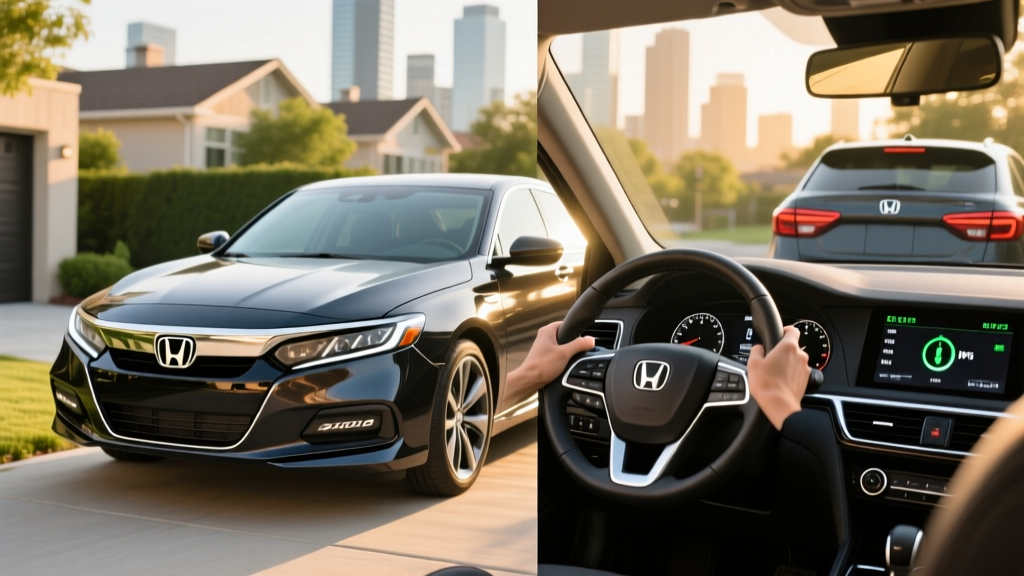
The 2017 Honda Accord Hybrid Touring at a Glance
The 2017 Honda Accord Hybrid Touring was the range-topping trim of Honda's midsize hybrid sedan, bundling every available feature — leather, navigation, Honda Sensing ADAS, premium audio — on top of a two-motor hybrid powertrain that still impresses nearly a decade later. If you're searching for a "honda hybrid touring 2017" on the used market in 2026, you're likely weighing its 49 MPG EPA combined rating against newer electrified options. This review covers the exact numbers you need: real-world fuel economy, battery longevity, powertrain specs, and whether this nine-year-old hybrid still holds up as a smart buy.
First, a critical clarification: the 2017 Accord Hybrid is a conventional hybrid (HEV), not a plug-in hybrid (PHEV). It charges its battery through regenerative braking and the gasoline engine — you never plug it in. Honda did produce a plug-in Accord for the 2014–2015 model years (with 13 miles of electric-only range), but that was discontinued well before this generation. If you want plug-in capability from Honda, you'd need to look at the Clarity PHEV or the newer CR-V Hybrid (which is still an HEV) or wait for Honda's upcoming PHEV offerings.
Powertrain Specs: Two-Motor i-MMD System
Honda's Intelligent Multi-Mode Drive (i-MMD) in the 2017 Accord Hybrid works differently from Toyota's planetary-gear hybrid system. Instead of blending engine and motor through a continuously variable transmission, Honda's system uses the gasoline engine primarily as a generator to feed electricity to the drive motor, with a direct-drive clutch that engages only at steady highway cruising speeds.
| Specification | Value |
|---|---|
| Engine | 2.0L Atkinson-cycle inline-4 |
| Engine horsepower | 143 hp @ 6,200 rpm |
| Engine torque | 129 lb-ft @ 4,000 rpm |
| Drive motor output | 184 hp / 232 lb-ft |
| Combined system output | 212 hp |
| Transmission | Direct-drive (no conventional CVT/gears) |
| Drivetrain | Front-wheel drive |
| 0–60 mph (tested) | ~7.2 seconds |
| Hybrid battery | 1.3 kWh lithium-ion (usable ~0.9 kWh) |
| Curb weight | ~3,559 lbs (Touring trim) |
The result is a driving experience that feels more like an EV around town — the drive motor handles most acceleration — with the engine kicking in seamlessly when you need sustained power or when the small battery buffer depletes. At highway speeds above ~45 mph under light load, the clutch locks the engine directly to the front wheels for efficiency.
Fuel Economy: EPA Ratings vs. Real-World MPG
| Driving Cycle | EPA MPG |
|---|---|
| City | 49 MPG |
| Highway | 47 MPG |
| Combined | 49 MPG |
Source: fueleconomy.gov — 2017 Honda Accord Hybrid
Those numbers were class-leading when the car launched, and they remain competitive in 2026. But what matters is what you'll actually see on the road.
Conventional hybrids like the Accord Hybrid typically exceed their EPA city rating in stop-and-go traffic because regenerative braking recovers more energy. Expect 50–55 MPG in urban driving. Highway MPG tends to run closer to the EPA sticker or slightly below — around 43–47 MPG at 70–75 mph. In mixed driving, owners commonly report 46–50 MPG. Cold weather (below 35°F) can reduce efficiency by 5–10%, and short trips where the engine runs to heat the cabin will drop city figures noticeably. The Accord Hybrid's lack of a dedicated heat pump means winter fuel economy takes a hit, as the engine must run more often for cabin warmth.
Over a 15,000-mile year at $3.40/gallon (a reasonable 2026 national average), the Accord Hybrid would consume roughly 306 gallons and cost about $1,040 in fuel. Compare that to the non-hybrid 2017 Accord 4-cylinder at ~30 MPG combined — roughly 500 gallons and $1,700 annually. That's roughly $660 in yearly fuel savings, which adds up fast on a used car you likely purchased for under $18,000.
HEV vs. PHEV vs. EV: Where the Accord Hybrid Fits
Understanding where the Accord Hybrid sits in the electrification spectrum helps you decide if it's the right choice versus a plug-in hybrid or full battery electric vehicle.
| Factor | HEV (Accord Hybrid) | PHEV (e.g., Toyota Prius Prime) | BEV (e.g., Tesla Model 3) |
|---|---|---|---|
| Plug in required? | No | Yes (for EV range) | Yes (always) |
| Electric-only range | ~1 mile (low-speed) | 25–44 miles | 250–360+ miles |
| Fuel/energy cost per mile | ~$0.07 | ~$0.04 (EV mode) / $0.08 (gas) | ~$0.04 |
| Home charging needed? | No | Recommended | Essential |
| Upfront cost (used market) | $14,000–$20,000 | $22,000–$32,000 | $18,000–$35,000+ |
| Maintenance complexity | Low (proven system) | Moderate | Low (fewer moving parts) |
| Best for | No home charging, long commutes | Short daily EV + road trips | Home charging access, daily driving |
- You don't have access to home or workplace charging (apartment, street parking)
- You want maximum fuel savings with zero behavior change — just fill up and go
- You regularly drive long highway distances where PHEV electric range is irrelevant
- You want a proven, low-risk hybrid system with strong reliability data
- Your budget is under $20,000
Touring Trim: What You Get at the Top
The Touring was the most expensive Accord Hybrid trim in 2017, and it came fully loaded. There were no factory options — everything was standard. Here's what distinguishes it:
- Honda Sensing suite: Adaptive cruise control, collision mitigation braking, lane keeping assist, road departure mitigation — this is SAE Level 1 driver assistance (the system can steer or brake, not both simultaneously in a hands-off manner). You must remain fully engaged.
- Leather-trimmed seats with heated front and rear outboard seats
- 8-inch Display Audio touchscreen with Apple CarPlay and Android Auto
- Navigation with Garmin-based mapping
- Premium audio: 7-speaker system
- LED headlights with auto high-beam
- Rain-sensing wipers, power moonroof, heated side mirrors
- Remote start via key fob
In 2026, the tech shows its age — the infotainment is sluggish by modern standards, and the Honda Sensing system is rudimentary compared to current Level 2 systems like Honda's updated Sensing or Toyota Safety Sense 3.0. But for a sub-$20K used car, the feature list is generous.
Battery Reliability, Warranty & Replacement Costs
Original warranty: Honda covered the hybrid battery for 8 years / 100,000 miles (10 years / 150,000 miles in CARB states like California, New York, Massachusetts, and others that follow California emissions standards). For a 2017 model, the federal 8-year warranty expired in 2025. The CARB-state 10-year coverage expires in 2027.
Real-world battery lifespan: Honda's lithium-ion hybrid battery is small (1.3 kWh total, ~0.9 kWh usable) and is managed conservatively — the system rarely lets it charge above ~60% or discharge below ~40% State of Charge. This shallow cycling dramatically extends cell life. Failures before 150,000 miles are uncommon based on owner forums and repair data. Many first-generation Insight and Civic Hybrid batteries lasted 150,000–200,000+ miles.
Replacement cost: A new OEM hybrid battery from Honda runs approximately $2,000–$3,000 (parts only), with installation adding $300–$500 at a dealer. Third-party refurbished batteries are available for $1,200–$1,800. Given the Accord Hybrid's fuel savings of ~$660/year over the gas model, a battery replacement pays for itself in roughly 3–4 years of typical driving.
One note for used buyers: ask the seller or check the vehicle history for any hybrid system warning lights. A degraded battery won't necessarily strand you — the car will still drive, but the engine runs more frequently, reducing MPG to near gas-model levels. An OBD-II scan tool can check hybrid battery health metrics if you're evaluating a specific vehicle.
Used Pricing & Tax Credit Reality
As of early 2026, the 2017 Honda Accord Hybrid Touring trades on the used market for roughly $14,000–$19,000 depending on mileage, condition, and region. Lower-mileage examples (under 60,000 miles) command the top of that range. Higher-mileage cars (100,000+) can be found for $12,000–$14,000.
Tax credit status: The federal §30D new clean vehicle tax credit does not apply — this vehicle is no longer new, and conventional hybrids (HEVs) have never qualified for §30D regardless, as the credit requires a minimum 7 kWh battery and plug-in capability. The federal used EV credit (up to $4,000 or 30% of sale price, whichever is lower) also does not apply because the Accord Hybrid is a conventional HEV, not a PHEV or BEV. Per IRS guidelines on the used clean vehicle credit, only plug-in electric vehicles with at least 7 kWh of battery capacity qualify.
Some states offer their own incentives for used hybrid purchases, but these vary widely and change frequently. Check your state's energy office or department of environmental quality for current programs.
Pros, Cons & the Verdict
Pros
- 49 MPG combined still ranks among the best for midsize sedans
- Touring trim loaded with features at a bargain used price
- i-MMD system is smooth, quiet, and proven reliable
- No charging infrastructure needed — zero lifestyle adjustment
- Honda Sensing provides baseline active safety
- Spacious cabin with 15.8 cu-ft trunk (hybrid battery doesn't eat cargo space)
Cons
- Infotainment is dated — slow response, no wireless CarPlay
- Honda Sensing is basic Level 1; no lane centering in curves
- Engine drone under hard acceleration (generator-mode RPM flare)
- 8-year federal hybrid warranty has expired for 2017 models
- No plug-in option means you're always burning some gasoline
- Ride quality is firm; road noise is noticeable on coarse pavement
Frequently Asked Questions
How many MPG does the 2017 Honda Accord Hybrid Touring get?
The EPA rates it at 49 MPG city, 47 MPG highway, and 49 MPG combined. In real-world driving, expect 46–55 MPG depending on conditions — city driving with frequent stops often yields higher numbers than the EPA sticker thanks to regenerative braking, while sustained 75-mph highway driving may return 43–47 MPG.
Can I plug in the 2017 Accord Hybrid to charge it?
No. The 2017 Accord Hybrid is a conventional hybrid (HEV). Its small 1.3 kWh battery charges exclusively through regenerative braking and the gasoline engine. There is no charging port. If you want plug-in capability from Honda in this era, you'd need the discontinued Clarity Plug-In Hybrid (2018–2022, 47 miles EV range).
Is the 2017 Accord Hybrid reliable, and what does a battery replacement cost?
Honda's i-MMD system has a strong reliability record. The hybrid battery is small and conservatively managed, which extends its life. Most batteries last well past 150,000 miles. If replacement is needed, expect $2,300–$3,500 for an OEM battery and dealer installation, or $1,200–$1,800 for a refurbished unit. The rest of the powertrain — the 2.0L engine and electric motors — is straightforward and durable.
Does the 2017 Honda Accord Hybrid qualify for any tax credit?
No. As a conventional hybrid, it does not qualify for the federal §30D new vehicle credit or the used clean vehicle credit (which requires plug-in capability and at least 7 kWh of battery). Check your state's incentive database — some states offer rebates for any high-efficiency vehicle, but these are uncommon and vary by jurisdiction.
How does the Accord Hybrid compare to a used Toyota Camry Hybrid?
The 2017 Camry Hybrid achieves 40–42 MPG combined (EPA), trailing the Accord Hybrid's 49 MPG by a significant margin. However, the Camry Hybrid's planetary-gear system is arguably even more proven, with decades of Toyota hybrid data behind it. The Accord Hybrid is quicker (212 hp vs. 200 hp for the 2017 Camry Hybrid), more spacious, and more fuel-efficient — but the Camry Hybrid may have a slight edge in long-term parts availability and mechanic familiarity.
What should I check before buying a used 2017 Accord Hybrid?
Prioritize these items: (1) hybrid battery health via OBD-II scan, (2) service records showing regular oil changes (the Atkinson-cycle engine still needs standard maintenance), (3) brake pad life — regenerative braking extends pad life significantly, so if pads were recently replaced at low mileage, that's a positive sign the hybrid system is working properly, (4) Honda Sensing calibration — if the windshield was replaced, the camera module may need recalibration, and (5) tire condition, as the Accord Hybrid came with low-rolling-resistance tires that affect MPG.