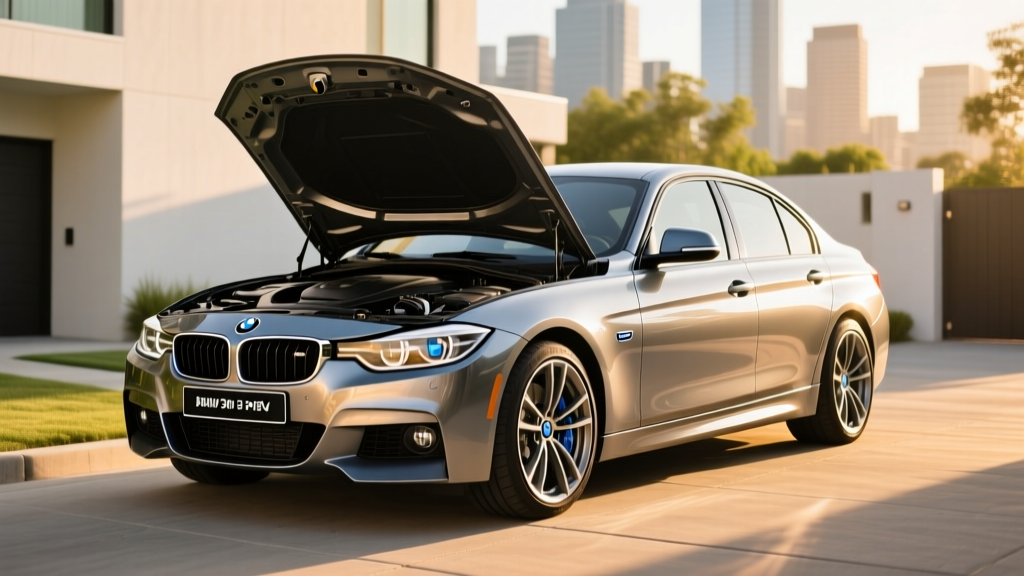
The 2016 BMW 330e iPerformance was the first plug-in hybrid in the modern 3 Series lineup, pairing a turbocharged four-cylinder with an electric motor and a small battery pack. For buyers searching for a 3 series hybrid 2016 model on the used market today, the 330e remains a compelling entry point into electrified BMW ownership — but its modest electric-only range and aging battery demand careful evaluation before you sign the paperwork.
This guide breaks down the EPA numbers, real-world efficiency, powertrain specs, battery longevity, and what it costs to own a decade-old PHEV in 2026. We'll also clarify how it stacks up against a conventional hybrid, a newer PHEV, or a full battery-electric vehicle so you can decide if this is the right move for your commute.
2016 BMW 330e Powertrain: Engine, Motor, and Combined Output
The 2016 330e combines BMW's B48 2.0-liter turbocharged inline-four with an electric motor integrated into the ZF 8-speed automatic transmission. Here is the full powertrain breakdown:
| Specification | Value |
|---|---|
| Gas Engine | 2.0L turbo I4 (B48), 180 hp / 258 lb-ft |
| Electric Motor | 87 hp / 184 lb-ft (integrated in transmission) |
| Combined System Output | 248 hp / 310 lb-ft |
| Transmission | 8-speed automatic (ZF 8HP50) |
| Drivetrain | Rear-wheel drive (sDrive only) |
| Battery (Gross / Usable) | 7.6 kWh gross / ~5.7 kWh usable |
| Battery Chemistry | NMC (nickel-manganese-cobalt) lithium-ion |
| Onboard Charger | 3.5 kW (Level 2 AC only, no DC fast charge) |
| 0–60 mph | 5.9 seconds |
| Top Speed | 140 mph (electronically limited) |
| Curb Weight | ~3,915 lbs |
The electric motor is sandwiched between the engine and the transmission, meaning it can drive the car independently at low speeds or assist the gas engine under hard acceleration. BMW's eDrive system offers three modes: Auto eDrive (the car decides when to use electric vs. gas), Max eDrive (electric-only until the battery depletes or you floor it), and Save Battery (reserves charge for later, running the gas engine).
One important limitation: the 2016 330e was offered only in rear-wheel drive (sDrive). If you need all-wheel drive, you'd have to look at the 2018+ xDrive variant or a different model entirely.
EPA Fuel Economy and Real-World MPG
The EPA rated the 2016 BMW 330e with separate figures for charge-depleting (electric-assisted) and charge-sustaining (gas-only hybrid) operation. Here is the full breakdown per fueleconomy.gov:
| Mode | City | Highway | Combined |
|---|---|---|---|
| Charge-Depleting (EV + Gas) | — | — | 75 MPGe |
| Charge-Sustaining (Gas Only) | 28 mpg | 34 mpg | 30 mpg |
Real-world MPG context: In mixed driving with a depleted battery (no plug-in charge), owners typically report 28–33 mpg combined — right in line with the EPA's 30 mpg estimate. On the highway at 70–75 mph, expect closer to 32–35 mpg thanks to the efficient ZF 8-speed and relatively low drag coefficient. In stop-and-go city traffic with a charged battery, you can push well beyond the EPA combined figure because regenerative braking recaptures energy that a gas car would waste as heat.
For comparison, the gas-only 2016 BMW 328i (same 2.0T engine, no hybrid system) was EPA-rated at 26 city / 36 highway / 30 combined. The 330e's advantage isn't raw MPG in gas-only mode — it's the ability to drive short commutes on electricity alone, dramatically reducing fuel consumption if you plug in regularly.
Electric-Only Range and Charging Times
The EPA rated the 2016 330e at 14 miles of electric-only range when new. Total combined range (electric + full gas tank) is approximately 350 miles.
Real-World Electric Range: The EPA's 14-mile figure assumed a mix of city and highway driving. In practice, expect 10–13 miles on a full charge at moderate speeds (under 50 mph) in mild weather. At highway speeds (70+ mph) or in cold weather (below 40°F), that figure drops to 8–10 miles. The 330e's electric top speed in Max eDrive is 75 mph, but sustained high-speed electric driving drains the small battery rapidly.
Charging the 7.6 kWh battery pack (5.7 kWh usable) is straightforward but slow by modern standards:
| Charging Level | Power | 0–100% Time | Connector |
|---|---|---|---|
| Level 1 (120V household outlet) | ~1.4 kW | ~5.5 hours | J1772 |
| Level 2 (240V, 16A) | 3.5 kW | ~2.25 hours | J1772 |
| DC Fast Charge | Not supported | N/A | N/A |
The 330e's 3.5 kW onboard charger is the bottleneck — even if you plug into a 7.2 kW or 11.5 kW Level 2 station, the car will only accept 3.5 kW. A full charge in about 2.25 hours on Level 2 is acceptable for overnight or workplace charging but means you can't quickly top up during a lunch stop. There is no DC fast-charging capability whatsoever.
HEV vs. PHEV: Where the 330e Fits
BMW did not offer a conventional hybrid (HEV) 3 Series in 2016. The ActiveHybrid 3 (2012–2015) used a different system — a larger inline-six with an electric assist motor and a tiny 0.6 kWh battery that could not be plugged in and offered no meaningful electric-only range. If you're searching for a "3 series hybrid 2016," the 330e PHEV is your only option.
Conventional Hybrid (HEV): Charges itself via regenerative braking and the gas engine. No plug. Typically achieves 40–55 mpg combined. Example: Toyota Prius, Honda Accord Hybrid.
Plug-in Hybrid (PHEV): Larger battery, plug-in charging, 14–45+ miles of electric-only range. Runs as a hybrid once the battery depletes. Example: 2016 BMW 330e, Toyota RAV4 Prime.
Battery Electric (BEV): No gas engine. 200–400+ miles of range. Requires charging infrastructure. Example: Tesla Model 3, BMW i4.
The 330e's 14-mile electric range is short by 2026 standards — the current-generation BMW 330e (G20) offers roughly 22–25 miles EV range, and competitors like the Toyota RAV4 Prime deliver 42 miles. But for a 2016 model-year vehicle at used-car prices, the 330e still eliminates gas for very short commutes.
Used Pricing and Tax Credit Eligibility in 2026
The 2016 BMW 330e launched with an MSRP of approximately $44,695 (including destination). In the 2026 used market, examples typically trade between $13,000 and $19,000 depending on mileage, condition, and battery health.
Federal Used EV/PHEV Tax Credit (§25E): The 2016 330e may qualify for the federal used clean vehicle credit, which provides 30% of the sale price, up to $4,000. Per IRS guidelines, requirements include:
- Sale price must be $25,000 or less (most 2016 330e examples qualify)
- Buyer income caps: $75,000 single / $112,500 head of household / $150,000 joint
- Vehicle must be at least two model years old (2016 qualifies)
- Must purchase from a licensed dealer (private-party sales excluded)
- Credit is non-refundable — you must have tax liability to claim it
- Available once per buyer every three years
At a $16,000 purchase price, the credit would be $4,000 (30% of $16,000 = $4,800, capped at $4,000), bringing effective cost to ~$12,000. Verify eligibility with a tax professional before relying on this figure.
The original $4,000–$6,000 federal new-vehicle tax credit (§30D) that applied when the 330e was sold new is no longer available — that benefit went to the original purchaser. State incentives vary by jurisdiction; check your local energy office or DMV for current rebate programs.
Battery Longevity, Warranty, and Replacement Cost
Original BMW High-Voltage Battery Warranty: 8 years / 80,000 miles, whichever comes first, against defects and capacity loss below 70% of original capacity. For a 2016 model, this warranty expired in 2024 at the latest.
The 330e's 7.6 kWh NMC battery pack is small and generally less stressed than a full EV's pack, which helps longevity. BMW engineered a generous buffer — only about 5.7 kWh of the 7.6 kWh gross capacity is usable, meaning the battery never sees extreme states of charge that accelerate degradation.
Real-world degradation data: Owner reports and forum data suggest most 2016 330e batteries retain 80–90% of original capacity at 80,000–100,000 miles. Some owners have reported electric-only range dropping from 14 miles to 10–12 miles after 7–8 years, which is consistent with moderate NMC degradation. Catastrophic battery failures are rare but not unheard of.
Battery replacement cost: A new OEM high-voltage battery from BMW currently costs between $8,000 and $12,000 (parts and labor). Independent EV repair shops may offer refurbished or salvaged packs for $4,000–$7,000. Given that a used 2016 330e might cost $15,000, a battery replacement can represent 30–80% of the vehicle's value — making a pre-purchase battery health check essential.
Pre-purchase tip: Use the car's iDrive system to check the "Battery Capacity" readout (under the energy flow or vehicle info menus) or have a BMW dealer run a high-voltage battery diagnostic to assess State of Health (SoH). If the pack is below 80% capacity, factor a replacement into your budget or negotiate the price accordingly.
Reliability and Common Issues
The 2016 330e's reliability is mixed. The B48 turbo four-cylinder engine is one of BMW's more dependable modern powerplants, and the ZF 8-speed transmission is widely regarded as bulletproof. The electric motor and power electronics have proven robust as well.
Common issues reported by owners include:
- Coolant system leaks: The B48 engine and the hybrid system both have coolant circuits. Water pump and expansion tank failures are known weak points.
- Charge port door mechanism: The motorized charge port door can fail, requiring a $200–$400 repair.
- 12V battery drain: Like many PHEVs and EVs, the 330e can drain its 12V auxiliary battery if left unplugged for extended periods, since the 12V system powers standby electronics.
- Standard F30 3 Series issues: Valve cover gasket leaks, oil filter housing gasket leaks, and VANOS solenoid wear carry over from the broader F30 generation.
According to NHTSA records, the 2016 330e has a relatively low number of recalls and complaints for its class, though sample sizes are smaller than high-volume models. BMW's IIHS testing for the F30 3 Series showed acceptable crashworthiness, though it did not earn Top Safety Pick designation due to marginal headlight ratings.
Who Should Buy the 2016 BMW 330e?
Choose the 2016 330e if:
- Your daily commute is under 15 miles round-trip and you can charge at home or work
- You want a sporty luxury sedan with lower running costs than a gas 328i
- You take occasional long road trips where a full EV's charging stops would be inconvenient
- You can find a well-maintained example with verified battery health under $16,000
Choose a full EV (e.g., Tesla Model 3, BMW i4) if:
- You want 250+ miles of range and zero gasoline use
- You have reliable home charging and access to DC fast-charging networks
- You want lower maintenance costs (no oil changes, no coolant system complexity)
Choose a conventional hybrid (e.g., Lexus IS 300h, Toyota Camry Hybrid) if:
- You cannot plug in at home or work
- You want simpler ownership with no battery degradation concerns beyond a small NiMH or Li-ion pack
- You prioritize 40+ mpg combined over electric-only driving
Pros
- Sporty driving dynamics — 248 hp, 5.9s 0–60, RWD balance
- Electric-only commuting for short trips (10–14 mi)
- Smooth, quiet operation in Max eDrive mode
- Eligible for up to $4,000 used EV federal tax credit (§25E)
- ZF 8-speed transmission is excellent and reliable
- Premium interior with iDrive infotainment
Cons
- Only 14 miles EPA electric range — short by modern standards
- No DC fast charging; Level 2 capped at 3.5 kW
- RWD only — no AWD option for 2016
- Battery replacement ($8K–$12K) can exceed vehicle value
- Original hybrid battery warranty has expired
- Trunk space reduced to 13 cu ft (vs. 17 cu ft in gas 3 Series) due to battery placement
- Rear seat pass-through blocked by battery housing
Frequently Asked Questions
How many MPG does the 2016 BMW 330e get?
The EPA rates the 2016 330e at 30 mpg combined (28 city / 34 highway) when operating as a hybrid with a depleted battery. In charge-depleting mode with a full battery, it achieves 75 MPGe combined. Real-world gas-only driving typically yields 28–33 mpg depending on conditions.
How far can the 2016 330e go on electric only?
The EPA rated it at 14 miles electric-only when new. In real-world conditions at age 10, expect 8–13 miles depending on battery health, driving speed, and temperature. Highway speeds and cold weather significantly reduce this figure.
Does the 2016 BMW 330e qualify for any tax credit in 2026?
It may qualify for the federal used clean vehicle credit (§25E): 30% of the sale price, up to $4,000, if purchased from a dealer for $25,000 or less and the buyer meets income limits ($75K single / $150K joint). The original new-vehicle credit is no longer available. Consult a tax professional for your specific situation.
Is the 2016 330e reliable, and what does a battery replacement cost?
The powertrain (B48 engine + ZF transmission + electric motor) is generally reliable. The main risk is the high-voltage battery, which is now out of warranty. OEM replacement costs $8,000–$12,000; refurbished options run $4,000–$7,000. Always verify battery State of Health before purchasing.
Can the 2016 330e charge at a DC fast charger?
No. The 2016 330e supports only Level 1 (120V, ~1.4 kW) and Level 2 (240V, up to 3.5 kW) AC charging. It uses a J1772 connector. There is no DC fast-charge port.
How does the 330e compare to a Tesla Model 3 or BMW i4?
A full EV like the Model 3 or i4 offers 250–300+ miles of range, DC fast charging, lower maintenance, and stronger performance. The 330e makes sense only if you need gas-engine flexibility for long trips, want a traditional luxury sedan interior, or find one at a compelling used price with a healthy battery.
Does the hybrid system affect trunk space?
Yes. The battery pack sits beneath the trunk floor, reducing cargo capacity from 17 cubic feet (gas 3 Series) to approximately 13 cubic feet. The rear seat pass-through is also partially blocked, limiting long-item storage.