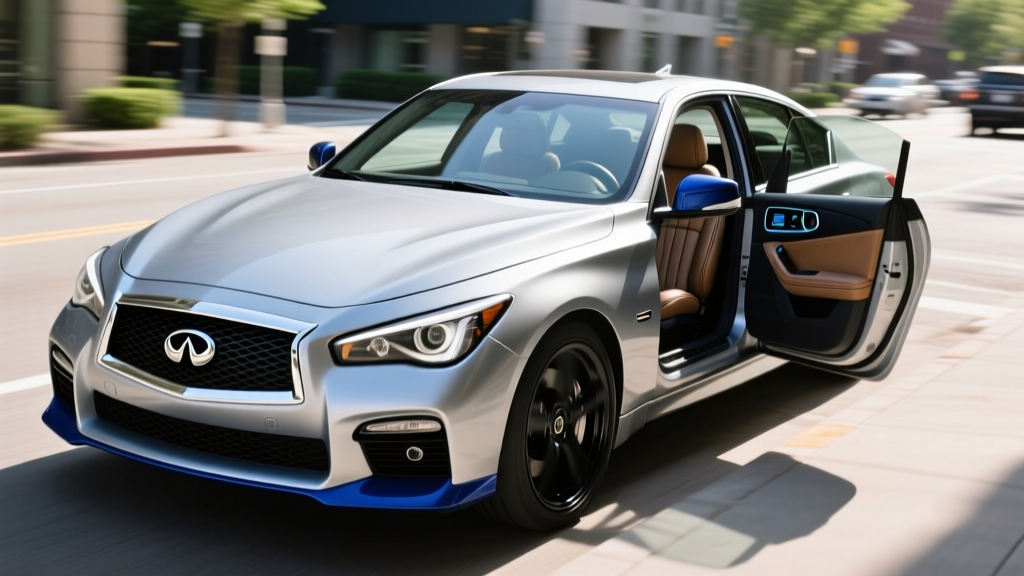
The 2014 Infiniti Q50 Hybrid Sport occupies a specific niche in the used-car market: a luxury sport sedan that pairs a supercharged V6 with an electric motor for meaningful fuel savings without ever needing to plug in. As a conventional hybrid (HEV), it generates its own electricity through regenerative braking and the gasoline engine — no charging cable required. For buyers in 2026 weighing a used luxury hybrid against newer plug-in hybrids or full EVs, the Q50 Hybrid Sport presents a compelling but nuanced value proposition.
This review covers the exact EPA figures, real-world MPG expectations, powertrain details, long-term battery reliability, and the ownership economics that matter when buying a 12-year-old hybrid sedan.
HEV vs PHEV: What the Q50 Hybrid Actually Is
Conventional Hybrid (HEV) — 2014 Infiniti Q50 Hybrid Sport:
- No plug-in charging required — the 1.4 kWh lithium-ion battery recharges via regenerative braking and the gas engine
- Electric motor assists the gasoline engine; cannot drive on electric power alone for meaningful distances
- Fuel economy benefit comes from engine load reduction, stop/start functionality, and regenerative energy capture
- No federal EV tax credit eligibility (new or used)
Plug-in Hybrid (PHEV) — for comparison:
- Larger battery (typically 10-25 kWh) that charges via wall outlet or public charger
- Can travel 20-50 miles on electric-only power before the gas engine engages
- Eligible for up to $7,500 federal tax credit when purchased new (subject to IRS §30D rules including MSRP caps, income limits, and battery sourcing requirements)
The Q50 Hybrid Sport is firmly in the HEV camp. You fuel it like any conventional car and never think about charging infrastructure. This matters enormously for buyers in apartments, condos, or areas with limited public charging access.
EPA Fuel Economy and Real-World MPG
| Metric | EPA Estimate | Real-World Expectation |
|---|---|---|
| City MPG | 29 MPG | 27–31 MPG |
| Highway MPG | 31 MPG | 28–33 MPG |
| Combined MPG | 29 MPG | 26–30 MPG |
| Fuel Tank Capacity | 20.0 gallons | — |
| Total Driving Range | ~580 miles | ~520–600 miles |
The 2014 Q50 Hybrid Sport's EPA ratings come from fueleconomy.gov for the rear-wheel-drive configuration. The AWD variant drops to 27 city / 28 highway / 27 combined MPG due to drivetrain losses.
Real-world factors that shift MPG:
- City driving favors hybrids: The electric motor handles low-speed acceleration where gasoline engines are least efficient. Expect city MPG to meet or slightly exceed the EPA estimate in stop-and-go traffic.
- Highway driving reduces the hybrid advantage: At sustained 70+ MPH speeds, the electric motor contributes minimally. Highway MPG may fall 1-3 MPG below the EPA sticker, especially with aggressive throttle inputs on the 354-hp powertrain.
- Cold weather impact: Expect a 5-10% fuel economy reduction in freezing temperatures. The engine runs richer during warm-up cycles, and battery efficiency drops in cold conditions.
- Sport mode penalty: The Sport trim's throttle mapping and transmission behavior prioritize responsiveness over efficiency. Drivers who lean into the 354 hp will see combined figures closer to 24-26 MPG.
For context, the non-hybrid 2014 Q50 with the 3.7L V6 achieves 20 city / 29 highway / 23 combined MPG. The hybrid powertrain delivers a 26% improvement in combined fuel economy — substantial for a vehicle this heavy and powerful.
Powertrain: 354 Horsepower from V6 + Electric Motor
| Specification | Detail |
|---|---|
| Gasoline Engine | 3.5L Supercharged V6 (VQ35HR) |
| Engine Horsepower | 296 hp @ 6,800 RPM |
| Engine Torque | 258 lb-ft @ 3,600 RPM |
| Electric Motor | 50 kW (67 hp) / 214 lb-ft |
| Combined System Output | 354 hp |
| Hybrid Battery | 1.4 kWh lithium-ion (not user-chargeable) |
| Transmission | 7-speed automatic with manual shift mode |
| Drivetrain | RWD standard; AWD available |
| 0–60 MPH | ~5.1 seconds (RWD) |
| Curb Weight | ~3,968 lbs |
Infiniti's Direct Response Hybrid system uses a single electric motor sandwiched between the engine and transmission, connected via two clutches. This architecture allows the motor to propel the car at very low speeds (under ~1 MPH in traffic creep), provide torque fill during acceleration, and capture kinetic energy during braking.
The supercharged V6 is notable — most hybrid systems pair with naturally aspirated or turbocharged engines. The supercharger provides immediate low-end response while the electric motor fills the torque curve, resulting in linear acceleration that feels more like a larger naturally aspirated V8 than a typical V6 hybrid.
Battery Longevity, Warranty, and Replacement Cost
Original Hybrid Battery Warranty: 8 years / 100,000 miles (whichever comes first) — covers defects and capacity loss below functional thresholds. For a 2014 model, this warranty expired in 2022 at the latest.
Powertrain Warranty (original): 6 years / 70,000 miles — also expired for all 2014 examples.
Real-world battery durability: Infiniti's lithium-ion hybrid battery in the Q50 has demonstrated strong longevity. Unlike early nickel-metal hydride (NiMH) packs in older hybrids, lithium-ion chemistry degrades more slowly under the shallow charge/discharge cycles that HEV systems use. The 1.4 kWh pack never fully charges or fully depletes — the hybrid control system maintains a state-of-charge window that minimizes stress.
Based on owner reports and technician data, most Q50 Hybrid batteries retain sufficient capacity well beyond 150,000 miles. Failures before 120,000 miles are uncommon but not unheard of, typically caused by cooling system issues rather than cell degradation.
Replacement cost in 2026:
- OEM new battery (dealer): $3,500–$5,000 including labor
- Refurbished/remanufactured pack: $2,000–$3,200 including labor
- Used/salvage pack: $1,200–$2,000 including labor (risky — unknown remaining life)
For a used 2014 Q50 Hybrid Sport, the battery replacement question is the single biggest ownership variable. A pre-purchase inspection should include a hybrid system diagnostic to check battery state of health (SoH), cell voltage balance, and cooling system integrity. Any dealer or qualified independent shop with Infiniti/Nissan hybrid scan tools can pull this data.
2026 Used Market Pricing and Tax Credit Reality
Used market price range (2026): $9,500–$16,000 depending on mileage, condition, and trim. The Sport trim commands a $1,000–$2,000 premium over the base Hybrid due to sport-tuned suspension, larger brakes, and 19-inch wheels.
Original MSRP (2014): The Q50 Hybrid Sport started at approximately $44,590 (RWD) and $46,190 (AWD), before options.
Tax credit eligibility:
- The 2014 Q50 Hybrid Sport does not qualify for the federal used clean vehicle credit (up to $4,000 or 30% of sale price). That credit applies only to used EVs and PHEVs — conventional hybrids like this HEV are excluded.
- No state-level EV/PHEV incentives apply to conventional hybrids in most jurisdictions.
- The only financial benefit is operational: lower fuel cost versus the non-hybrid Q50.
Who Should Buy This Hybrid — And Who Shouldn't
Choose the 2014 Q50 Hybrid Sport if:
- You want a luxury sport sedan with sub-30 MPG combined but cannot charge at home (apartment, condo, street parking)
- You drive 12,000–18,000 miles per year and want fuel savings without behavioral changes
- You value the 354-hp powertrain and prefer a supercharged V6 character over turbocharged four-cylinder alternatives
- Your budget is $10,000–$15,000 and you want Infiniti/BMW/3-Series competitor space and refinement
- You want zero charging infrastructure dependency — fill up at any gas station
Look at a PHEV or full EV instead if:
- You have home charging access (Level 2, 240V) and want to drive 20-50 miles daily on electricity alone
- You qualify for the federal used EV/PHEV tax credit (up to $4,000 for qualifying used plug-in vehicles under $25,000)
- You want the latest ADAS features — the 2014 Q50 predates modern systems like automatic emergency braking as standard, lane-keeping assist, or adaptive cruise with stop-and-go
- Fuel cost savings are your primary driver — a PHEV or EV will deliver dramatically lower per-mile energy costs with home charging
Reliability and Known Issues
The 2014 Q50 Hybrid Sport's reliability profile is mixed, reflecting both strong mechanical components and some first-generation hybrid system quirks:
Strengths:
- The VQ35HR engine family is proven across Nissan/Infiniti products with hundreds of thousands of service records
- The 7-speed automatic transmission is robust and well-matched to the hybrid system
- Lithium-ion hybrid battery longevity has exceeded expectations for most owners
Known issues to check:
- Hybrid battery cooling fan: Can accumulate debris and fail, leading to battery overheating and reduced performance. Check for service records showing cooling system maintenance.
- 12V auxiliary battery: Like all hybrids, the Q50 has a standard 12V battery for electronics. Parasitic drain can kill it if the car sits for extended periods.
- Steering rack (early 2014 models): Some early-production Q50s (hybrid and non-hybrid) had issues with the Direct Adaptive Steering system. The Sport trim typically has conventional hydraulic-assisted steering, which avoids this problem.
- Brake actuator: The regenerative braking system uses an electro-hydraulic brake actuator that can develop issues above 100,000 miles. Listen for unusual noises or inconsistent pedal feel during test drives.
The NHTSA database shows relatively few complaints for the Q50 Hybrid specifically, and no major safety recalls related to the hybrid system.
Pros
- 354 hp with 29 MPG combined — rare performance-efficiency pairing
- No plug-in charging required — works anywhere with a gas station
- Luxury interior with genuine sport sedan dynamics
- Strong highway passing power from combined V6 + electric torque
- Proven VQ engine family with widespread parts availability
Cons
- No federal or state tax credit eligibility (HEV, not PHEV/EV)
- Hybrid battery replacement risk ($2,000–$5,000) as cars age
- 2014-era tech: no Apple CarPlay/Android Auto, limited ADAS
- Fuel savings vs non-hybrid Q50 take years to offset used-price premium
- Infiniti dealer network is smaller than Toyota/Lexus for hybrid service
Frequently Asked Questions
How many MPG does the 2014 Infiniti Q50 Hybrid Sport get?
The EPA rates the RWD model at 29 city / 31 highway / 29 combined MPG. The AWD variant achieves 27 / 28 / 27 MPG. Real-world combined driving typically yields 26–30 MPG depending on driving style, climate, and route mix.
Can I plug in the 2014 Q50 Hybrid to charge it?
No. The Q50 Hybrid Sport is a conventional hybrid (HEV), not a plug-in hybrid (PHEV). Its 1.4 kWh battery charges exclusively through regenerative braking and the gasoline engine. There is no charge port and no electric-only driving range beyond momentary low-speed creep.
Is the hybrid battery still covered by warranty?
No. The original 8-year/100,000-mile hybrid battery warranty expired no later than 2022 for all 2014 models. Any battery replacement is an out-of-pocket expense. Budget $2,000–$5,000 depending on whether you use a refurbished or new OEM pack.
How does the Q50 Hybrid compare to a 2014 Lexus GS 450h or BMW ActiveHybrid 3?
The Lexus GS 450h offers more power (338 hp combined) and slightly better fuel economy (31 combined MPG) but at a higher used price. The BMW ActiveHybrid 3 was discontinued after 2015 and has fewer available examples. The Q50 Hybrid Sport sits in a value sweet spot — more affordable than the Lexus, more powerful than most competitors, and with a sportier character than the typical luxury hybrid.
Does the 2014 Q50 Hybrid qualify for any tax credit in 2026?
No. The federal used clean vehicle credit (up to $4,000 under IRS rules) applies only to battery electric vehicles and plug-in hybrids. Conventional hybrids like the Q50 Hybrid Sport are not eligible for any federal purchase incentive. Check your state's specific programs, but most states also exclude HEVs from incentive programs.
What's the fuel cost savings versus the non-hybrid Q50?
At $3.50/gallon and 15,000 miles per year: the non-hybrid Q50 (23 combined MPG) costs approximately $2,283/year in fuel. The hybrid (29 combined MPG) costs approximately $1,810/year. That's a savings of roughly $473/year, or about $2,365 over five years. Whether this justifies any price premium for the hybrid trim depends on the specific used-market pricing gap in your area.
Is this hybrid reliable for daily commuting?
Yes, with one caveat. The powertrain itself — engine, motor, transmission — is mechanically sound and well-proven. The variable is the hybrid battery. If the battery is healthy (confirmed via pre-purchase diagnostic), the Q50 Hybrid Sport is a dependable daily driver. If the battery is near end-of-life, factor replacement cost into your purchase negotiation or walk away.