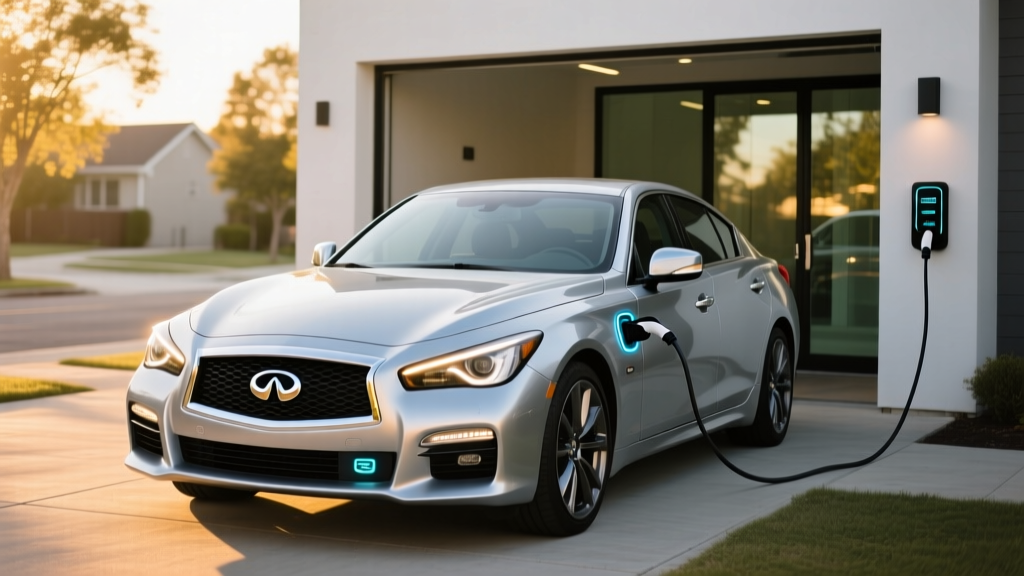
The 2014 Infiniti Q50 Hybrid arrived as a luxury sport sedan with a twist: a 354-horsepower V6 paired with an electric motor, delivering genuine fuel savings without sacrificing acceleration. More than a decade later, it remains a compelling used-car proposition for buyers who want premium badges, strong performance, and hybrid efficiency — without plugging in. If you're researching the 2014 Q50 Hybrid on the used market, this guide covers everything from real-world MPG to battery replacement costs.
HEV vs PHEV: What the Q50 Hybrid Actually Is
The 2014 Infiniti Q50 Hybrid is a conventional hybrid electric vehicle (HEV), not a plug-in hybrid (PHEV). This distinction matters enormously for ownership expectations:
Conventional Hybrid (HEV) — 2014 Q50 Hybrid
- No plug, no charging cable required
- Small battery recharges via regenerative braking and the engine
- No electric-only driving range to speak of (brief low-speed assist only)
- Fuels entirely with gasoline
- No federal tax credit eligibility
Plug-In Hybrid (PHEV)
- Requires plug-in charging (Level 1 or Level 2)
- Larger battery (typically 10-25 kWh) enables 20-50 miles electric-only
- Gas engine kicks in after battery depletes
- May qualify for federal §30D tax credit (new purchases only)
The Q50 Hybrid never needs to be plugged in. You simply fill it with gas and drive. The lithium-ion battery pack charges itself through regenerative braking and engine-driven generation. This makes it ideal for apartment dwellers or anyone without home charging access.
Fuel Economy: EPA Ratings vs Real-World MPG
The 2014 Q50 Hybrid was offered in both rear-wheel drive (RWD) and all-wheel drive (AWD) configurations, with slightly different EPA ratings for each. Here's the official breakdown from fueleconomy.gov:
| Drivetrain | City MPG | Highway MPG | Combined MPG |
|---|---|---|---|
| RWD | 29 | 33 | 29 |
| AWD | 27 | 32 | 28 |
For comparison, the non-hybrid 2014 Q50 with the 3.7L V6 rates at 20 city / 29 highway / 23 combined. The hybrid's advantage is most pronounced in city driving, where regenerative braking and electric motor assist do the heavy lifting.
Real-World MPG: What Owners Actually Report
Hybrids frequently exceed their EPA city ratings in stop-and-go traffic but may fall short on sustained highway runs. Based on owner-reported data from Fuelly and enthusiast forums, the 2014 Q50 Hybrid typically delivers:
- City driving: 27-31 MPG (close to or slightly above EPA)
- Highway cruising (70-80 mph): 28-32 MPG
- Mixed driving: 26-30 MPG
- Cold weather penalty: Expect 2-4 MPG reduction in winter months, as the engine runs more frequently to provide cabin heat and the battery is less efficient at low temperatures
These are respectable numbers for a 3,900-pound luxury sport sedan with 354 horsepower. For context, the BMW 335i of the same era managed around 22 MPG combined with similar power output.
Powertrain Specs: Engine, Motor, and Combined Output
| Specification | Detail |
|---|---|
| Engine | 3.5L V6 (VQ35HR) |
| Engine Output | 302 HP @ 6,800 rpm / 258 lb-ft torque |
| Electric Motor | 50 kW (67 HP) / 214 lb-ft torque |
| Combined System Output | 354 HP |
| Transmission | 7-speed automatic with manual shift mode |
| 0-60 mph | 4.9 seconds (RWD, manufacturer estimate) |
| Hybrid Battery | 1.4 kWh lithium-ion (gross), ~0.9 kWh usable |
| Drivetrain Options | RWD or AWD |
| Curb Weight | ~3,900 lbs (RWD) / ~4,050 lbs (AWD) |
The Q50 Hybrid uses Infiniti's Direct Response Hybrid system, which places the electric motor between the engine and transmission. Unlike some hybrids that use a CVT, the Q50 retains a conventional 7-speed automatic, which gives it a more natural, sporty driving feel. The electric motor provides instant torque fill at low RPMs, eliminating the lag typical of naturally aspirated V6 engines.
The 1.4 kWh battery pack is small by modern standards — a 2026 Toyota Prius Prime PHEV carries 13.6 kWh — but it's appropriately sized for a conventional hybrid. It stores enough energy for brief electric-only motoring at very low speeds (parking lots, traffic creep) but is primarily there to smooth power delivery and capture braking energy.
Battery Health, Warranty, and Replacement Cost
Original Hybrid Battery Warranty
Infiniti's original coverage: 8 years / 100,000 miles (whichever comes first) for the hybrid battery pack and related hybrid system components. In states that adopted California's stricter emissions rules (CA, CT, ME, MA, NJ, NY, OR, RI, VT, WA), coverage extended to 10 years / 150,000 miles.
2026 status: For a 2014 model year vehicle, original factory battery warranty has expired for virtually all examples on the road, even in CARB states (10 years from 2014 = 2024 expiration).
How Long Do Q50 Hybrid Batteries Actually Last?
The lithium-ion pack in the Q50 Hybrid has proven reasonably durable, though not without issues. Common patterns observed across owner communities and repair databases:
- Typical lifespan: 120,000-180,000 miles before significant degradation or cell failure
- Common failure mode: Individual cell imbalance rather than total pack death — the BMS (battery management system) flags a weak cell group and triggers a hybrid system warning
- Age factor: At 12 years old, calendar degradation is now a real concern regardless of mileage. Lithium-ion cells degrade with time even when not heavily cycled
- Heat sensitivity: Vehicles in hot climates (Arizona, Texas, Southern California) show accelerated battery degradation compared to cooler regions
Battery Replacement Cost in 2026
If the hybrid battery in a 2014 Q50 Hybrid fails out of warranty, here's what you're looking at:
- New OEM battery pack (Infiniti dealer): $3,500-$5,500 including parts and labor
- Refurbished/remanufactured pack: $1,800-$3,000 from third-party hybrid specialists
- Individual cell module replacement: $500-$1,200 if only one or two cell groups are bad — an option some independent hybrid shops offer
- Used battery from salvage yard: $800-$1,500, but carries unknown remaining life risk
Before purchasing any 2014 Q50 Hybrid, have the battery's State of Health (SoH) evaluated by a shop with Infiniti/Nissan hybrid diagnostic tools. A healthy pack should show less than 15-20% capacity loss from original.
Pricing and Tax Credit Eligibility
The 2014 Q50 Hybrid originally carried an MSRP starting around $44,700 (RWD) and $46,300 (AWD), representing roughly a $7,000 premium over the base 3.7L V6 model. In today's used market:
- 2014 Q50 Hybrid (80k-120k miles): $8,000-$14,000 depending on condition, mileage, and trim
- Low-mileage examples (under 60k miles): $14,000-$18,000
- High-mileage or salvage-title: $5,000-$8,000
Tax Credit Reality for Used Hybrids
Under current IRS §25E used clean vehicle credit rules, the federal used-EV credit of up to $4,000 applies only to plug-in electric vehicles (BEVs and PHEVs) with a battery capacity of at least 7 kWh. The 2014 Q50 Hybrid, as a conventional HEV with a 1.4 kWh battery, does not qualify for any federal tax credit — neither the new-vehicle §30D credit nor the used-vehicle §25E credit.
Some states may offer modest incentives for hybrid vehicles, but these vary widely by jurisdiction. Check your state's energy or environmental agency website for current programs.
Who Should Buy the 2014 Q50 Hybrid vs Alternatives
Pros
- 354 HP with 29 MPG combined — rare performance-efficiency combination
- No plug-in required; works for apartment/condo dwellers
- Premium interior with Infiniti build quality
- Strong 0-60 time (4.9s) for a luxury sedan
- Conventional 7-speed automatic (no CVT drone)
- Depreciation has been steep — strong value in 2026 used market
Cons
- Original battery warranty expired; replacement cost $2,000-$5,500
- No electric-only range (this is not a PHEV)
- Heavy curb weight affects handling vs non-hybrid Q50
- No federal tax credit eligibility
- Infiniti brand has lost resale value vs BMW/Mercedes
- Infotainment system is dated by 2026 standards
Hybrid vs PHEV vs EV: Which Fits You?
Choose the 2014 Q50 Hybrid (HEV) if:
- You lack access to home or workplace charging
- You want a luxury sedan under $15,000 with strong performance
- Your commute is mixed city/highway and you value fuel savings over electric driving
- You prefer the simplicity of gas-only fueling
Choose a used PHEV (e.g., BMW 330e, Audi A3 e-tron) if:
- You have Level 2 home charging and a short commute (under 20 miles)
- You want some electric-only driving for daily errands
- You still want a gas engine for road trips
Choose a used full EV (e.g., Tesla Model 3, Chevy Bolt) if:
- You have reliable home charging
- You want zero tailpipe emissions and the lowest per-mile fuel cost
- You're willing to plan around charging on longer trips
Reliability and Common Issues Beyond the Battery
The Q50 Hybrid shares much of its architecture with the conventional Q50, which helps parts availability and mechanic familiarity. Key reliability considerations for a 12-year-old example:
- Inverter coolant pump: Known failure point on Infiniti/Nissan hybrids. Replacement runs $400-$700. If it fails, the hybrid system shuts down to protect the inverter
- Electric power steering rack: Some units develop noise or stiffness — a $1,200-$2,000 repair
- Brake actuator: The regenerative braking system uses a complex electro-hydraulic actuator that can fail at higher mileages ($1,500-$2,500 replacement)
- Standard VQ35 items: Oil gallery gaskets, timing chain guides, and exhaust manifold bolts are known wear items shared with non-hybrid VQ engines
- Transmission: The 7-speed automatic is generally robust but requires fluid changes every 60,000 miles for longevity
Overall, the Q50 Hybrid is moderately reliable by luxury-car standards — better than some German contemporaries but not at Toyota/Lexus levels. Budget $1,500-$2,500 annually for maintenance and repairs once past 100,000 miles.
Frequently Asked Questions
How many MPG does the 2014 Q50 Hybrid get?
The EPA rates the RWD model at 29 city / 33 highway / 29 combined MPG, and the AWD at 27/32/28. Real-world owners typically report 26-30 MPG in mixed driving. City MPG can exceed the EPA rating in heavy stop-and-go traffic thanks to regenerative braking.
Can the 2014 Q50 Hybrid drive on electric power only?
Only at very low speeds (under 20 mph) for brief distances — think creeping through a parking lot. The 1.4 kWh battery is far too small for meaningful electric-only range. This is a conventional hybrid, not a plug-in. If electric-only commuting matters to you, look at a PHEV like the BMW 330e or a full EV.
Is the 2014 Q50 Hybrid reliable?
It's moderately reliable. The VQ35 V6 engine is proven, but the hybrid system adds complexity: inverter coolant pumps, brake actuators, and eventually the hybrid battery itself are potential failure points. At 12 years old, expect annual repair costs of $1,500-$2,500. A pre-purchase inspection by a hybrid-experienced shop is essential.
What does a replacement hybrid battery cost?
A new OEM battery from an Infiniti dealer runs $3,500-$5,500 installed. Refurbished packs from hybrid specialists cost $1,800-$3,000. Individual cell module repairs are possible for $500-$1,200 at some independent shops. Given the car's current used value of $8,000-$18,000, a full OEM battery replacement may not be economically justified — factor this into your purchase decision.
Does the 2014 Q50 Hybrid qualify for any tax credit?
No. As a conventional hybrid (HEV) with a 1.4 kWh battery, it does not meet the 7 kWh minimum threshold for the federal §25E used clean vehicle credit, nor does it qualify for the §30D new vehicle credit. It originally qualified for a modest federal tax credit when sold new in 2014, but that benefit was available only to the original purchaser. Check with your state's energy office for any local hybrid incentives, but don't count on them.
How does the Q50 Hybrid compare to the Lexus ES 300h?
The 2014 Lexus ES 300h delivers 40 MPG combined — significantly more than the Q50 Hybrid's 29 — but with only 200 HP and a CVT that lacks the Q50's sporty character. The ES 300h also benefits from Lexus/Toyota's reputation for hybrid battery longevity. Choose the Lexus for maximum efficiency and reliability; choose the Infiniti for performance and driving engagement.