Quick Verdict: The 2013 Kia Optima Hybrid as a Used Buy
The 2013 Kia Optima Hybrid was Kia's second year offering a gasoline-electric hybrid sedan, and it arrived with meaningful improvements over the 2011 debut model. With an EPA-estimated 35 MPG combined, a conventional hybrid powertrain (no plug required), and a 1.4 kWh lithium-polymer battery, it positioned itself against the Toyota Camry Hybrid and Ford Fusion Hybrid. Now, over a decade later, used 2013 Optima Hybrids are showing up on the market at prices between $5,000 and $9,000 depending on mileage and condition — making them an interesting budget hybrid option for cost-conscious buyers in 2026.
But before you sign the paperwork on a 12-year-old hybrid, you need hard data on real-world fuel economy, battery degradation risk, warranty status, and how it stacks up against newer hybrids and plug-in alternatives. That's what this guide delivers.
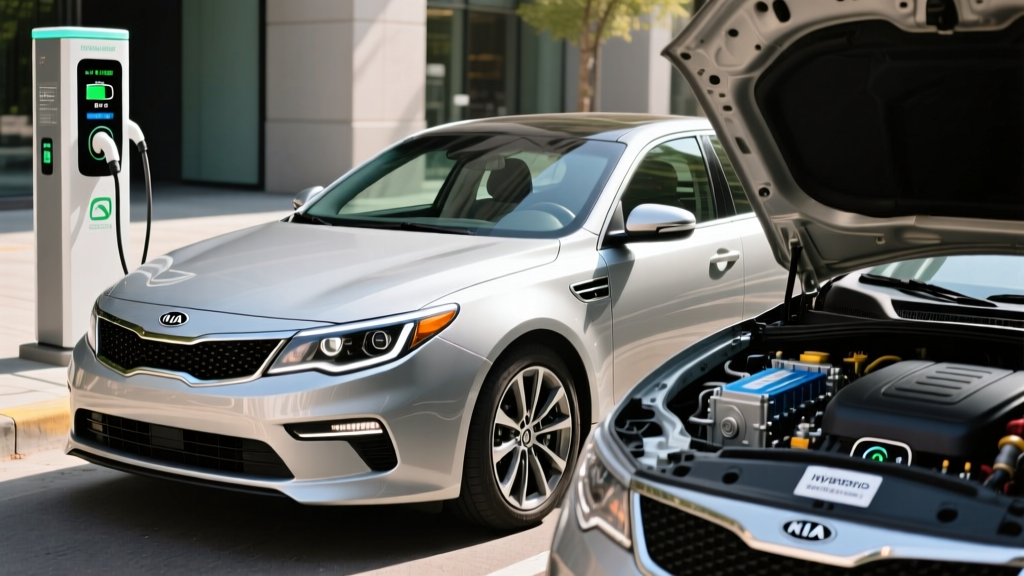
The 2013 Kia Optima Hybrid is a conventional hybrid (HEV). It does not plug in. Its small battery recharges through regenerative braking and the gasoline engine. Kia did offer an Optima Plug-In Hybrid (PHEV) starting with the 2017 model year — a completely different vehicle with a larger 9.8 kWh battery and ~27 miles of electric-only range. Do not confuse the two. This review covers only the 2013 HEV.
2013 Kia Optima Hybrid: Powertrain and Performance Specs
| Specification | Value |
|---|---|
| Powertrain Type | Conventional Hybrid (HEV) — no plug-in |
| Gasoline Engine | 2.4L 4-cylinder Atkinson-cycle, 159 hp |
| Electric Motor | 35 kW (47 hp) permanent-magnet synchronous |
| Combined System Output | 199 hp / 195 lb-ft torque |
| Transmission | 6-speed automatic |
| Hybrid Battery | 1.4 kWh lithium-polymer (47 cells) |
| 0–60 mph | ~8.7 seconds |
| Curb Weight | 3,496 lbs |
| Original MSRP (2013) | $26,700 (base) / $31,900 (EX with tech package) |
| Used Price Range (2026) | $5,000 – $9,000 |
Kia's 2013 hybrid system pairs a 2.4-liter Atkinson-cycle four-cylinder engine with a 35 kW electric motor sandwiched between the engine and a conventional 6-speed automatic transmission. Unlike Toyota's planetary-gear e-CVT approach, Kia used a traditional stepped transmission, which gives the Optima Hybrid a more familiar driving feel with distinct gear shifts. The trade-off is slightly less seamless electric-to-gas blending at low speeds.
Combined output of 199 horsepower was competitive for the class in 2013 and remains adequate for daily commuting and highway merging today. The 1.4 kWh lithium-polymer battery is small by modern standards — it provides roughly 1–2 miles of low-speed electric-only creeping, not meaningful EV driving range.
EPA Fuel Economy vs. Real-World MPG
| Driving Cycle | EPA Estimate | Real-World Expectation |
|---|---|---|
| City | 36 MPG | 34 – 38 MPG |
| Highway | 34 MPG | 30 – 34 MPG |
| Combined | 35 MPG | 32 – 36 MPG |
Source: fueleconomy.gov — 2013 Kia Optima Hybrid
The 2013 Optima Hybrid's EPA rating of 35 MPG combined was a notable improvement over the 2011–2012 model years, which were rated at just 33 MPG combined. Kia achieved this through revised software calibration, lower rolling-resistance tires, and aerodynamic tweaks including a revised front fascia and underbody panels.
In real-world driving, conventional hybrids like the Optima tend to perform close to or slightly above their EPA city rating because stop-and-go traffic maximizes regenerative braking opportunities. Highway driving, however, is where you'll see numbers dip below the sticker. At sustained 70–75 mph speeds, the electric motor contributes less, and the 2.4-liter engine carries most of the load. Expect 30–32 MPG on long highway trips.
Cold-weather impact: In freezing temperatures (below 32°F), expect a 5–10% reduction in fuel economy. The engine runs more frequently to provide cabin heat and maintain battery temperature, reducing the electric motor's contribution. Winter MPG of 29–31 combined is typical in northern climates.
How it compares: The 2013 Toyota Camry Hybrid LE was rated at 41 MPG combined — a significant 6 MPG advantage. The 2013 Ford Fusion Hybrid was rated at 44 MPG combined (later revised downward after Ford's MPG restatement). If maximum fuel economy is your priority, the Optima Hybrid trails its Japanese and American competitors from the same era.
Hybrid Battery Longevity, Warranty, and Replacement Cost
Kia covered the 2013 Optima Hybrid's lithium-polymer battery with a 10-year / 100,000-mile warranty (in states following California emissions rules) or 10 years / 100,000 miles under Kia's standard hybrid component warranty nationwide. This warranty applies to the original owner and subsequent owners, though transfer rules vary — check with a Kia dealer for your specific VIN.
Critical for 2026 buyers: A 2013 model is now 13 years old. The original 10-year battery warranty has expired based on age alone, regardless of mileage. Any battery failure is an out-of-pocket cost.
The 1.4 kWh lithium-polymer battery pack in the 2013 Optima Hybrid is modest in size and stress. Unlike larger PHEV or BEV batteries that undergo deep charge/discharge cycles, this pack operates within a narrow state-of-charge window — typically between 30% and 70% — which significantly reduces degradation. Kia also engineered the pack with an active air-cooling system to manage thermal stress.
Expected battery lifespan: Owner reports and industry data suggest the Optima Hybrid battery commonly lasts 150,000–200,000 miles before capacity loss becomes noticeable. "Noticeable" in a conventional hybrid means slightly reduced fuel economy (1–3 MPG drop) and more frequent engine engagement, not a total failure.
Replacement cost in 2026:
- New OEM battery from Kia: $2,500 – $3,500 (parts only; add $500–$800 for labor)
- Refurbished/remanufactured battery: $1,200 – $2,000 installed
- Used salvage battery: $600 – $1,000 installed (risky — unknown remaining life)
Before purchasing a used 2013 Optima Hybrid, request a hybrid battery health diagnostic from a Kia dealer or qualified hybrid specialist. They can read the battery's state-of-health (SoH) percentage and individual cell voltage balance, giving you a clear picture of remaining life.
Driving Experience and Practical Ownership
The 2013 Optima Hybrid drives more like a conventional sedan than many competitors from its era. The 6-speed automatic transmission avoids the "rubber band" feel of CVT-based hybrids, and the transition between electric and gasoline power is reasonably smooth — though not as seamless as Toyota's Hybrid Synergy Drive system.
The hybrid system adds approximately 200 lbs over a standard Optima, and you'll feel it through the steering during cornering. However, the low center of gravity from the battery placement (behind the rear seats) keeps the car stable. Cargo space is slightly reduced to 9.9 cubic feet (vs. 15.4 cu ft in the gas Optima) due to the battery pack intruding into the trunk.
Maintenance advantages: Conventional hybrids typically have lower maintenance costs than gas-only cars. Regenerative braking extends brake pad life (60,000–80,000+ miles is common), and the engine operates less frequently, reducing oil degradation. Kia recommends 5W-20 synthetic oil changes every 7,500 miles for the hybrid.
Known issues to watch for:
- Hybrid system cooling fan: Located in the trunk area; can accumulate dust and debris. Clean annually to prevent overheating.
- 12V auxiliary battery: Like all hybrids, the Optima has a standard 12V battery for electronics. It's located in the trunk and tends to last 3–5 years. A dead 12V battery will prevent the car from starting even if the hybrid battery is full.
- Transmission fluid: Kia recommends inspection at 60,000 miles and replacement at 120,000 miles. Many owners skip this — don't.
Tax Credits and Incentives (2026 Status)
The 2013 Kia Optima Hybrid was eligible for a modest federal tax credit when new (approximately $2,500 under the pre-2023 IRS §30D rules based on battery capacity). However, that credit has been exhausted and is no longer available for any used purchase.
Used EV credit (IRC §25E): Under current IRS rules, a used clean vehicle credit of up to $4,000 (or 30% of sale price, whichever is less) is available for qualifying used vehicles. However, this credit applies only to plug-in electric vehicles and fuel-cell vehicles. The 2013 Kia Optima Hybrid, as a conventional (non-plug-in) HEV, does not qualify for the federal used clean vehicle credit.
Source: IRS — Used Clean Vehicle Credit
State incentives: A small number of states offer modest incentives for used hybrid purchases (typically $250–$500 rebates or HOV lane access). Check your state's energy office or DMV for current programs. These vary widely and change frequently.
2013 Optima Hybrid vs. Alternatives: Which Should You Choose?
- Affordable used price ($5K–$9K)
- No plug-in required — works for apartment dwellers
- Conventional 6-speed automatic feels natural
- Lower brake wear from regen braking
- Decent trunk for a hybrid sedan
- Good highway stability
- Trails Camry/Fusion Hybrid in MPG by 6–9 MPG
- Battery warranty has expired (age-based)
- Trunk space reduced to 9.9 cu ft
- No federal tax credit for used purchase
- Hybrid system less refined than Toyota's
- Parts availability may decline long-term
| Your Situation | Best Fit |
|---|---|
| No home charging access; budget under $10K | Used HEV (like this Optima Hybrid, or a Camry Hybrid) |
| Home Level 2 charging available; commute under 30 miles | Used PHEV (2017+ Optima PHEV, Prius Prime, Clarity PHEV) |
| Home charging + mostly local driving + want lowest fuel cost | Used BEV (Chevy Bolt, Nissan Leaf, early Model 3) |
| Long highway commutes; no charging access | HEV with high MPG (Camry Hybrid, Accord Hybrid) |
Frequently Asked Questions
How many MPG does the 2013 Kia Optima Hybrid actually get?
The EPA rates it at 36 city / 34 highway / 35 combined. Real-world owners typically see 32–36 MPG combined depending on driving mix. City-heavy driving favors the hybrid system and can yield 36–38 MPG. Sustained highway driving at 70+ mph drops to 30–32 MPG.
Does the 2013 Optima Hybrid need to be plugged in?
No. This is a conventional hybrid (HEV). The 1.4 kWh battery charges exclusively through regenerative braking and the gasoline engine. You fuel it like any normal car — just less often.
How much does a replacement hybrid battery cost?
Expect $2,500–$3,500 for a new OEM battery from Kia (parts only), plus $500–$800 labor. Refurbished units run $1,200–$2,000 installed. The battery typically lasts 150,000–200,000 miles, so many used examples may never need replacement.
Is the 2013 Optima Hybrid reliable?
It has average-to-good reliability for its era. The hybrid system itself is robust, but the 2.4L engine can develop carbon buildup on intake valves (direct injection issue) and some owners report premature wear on the hybrid cooling fan. A pre-purchase inspection by a hybrid-qualified mechanic is strongly recommended.
Does it qualify for any tax credit in 2026?
No. The original federal hybrid tax credit expired long ago, and the current used clean vehicle credit (IRC §25E) only applies to plug-in electric and fuel-cell vehicles. A conventional hybrid like this Optima does not qualify for federal incentives. Check your state for any local programs.
Should I buy a 2013 Optima Hybrid or spend more on a newer hybrid?
If your budget is strictly under $10,000 and you have no home charging, the 2013 Optima Hybrid is a reasonable choice — but a same-year Camry Hybrid will save you roughly $300–$400 more per year in fuel. If you can stretch to $12,000–$15,000, a 2016–2018 Camry or Accord Hybrid offers 40+ MPG, updated safety tech, and some remaining battery warranty.