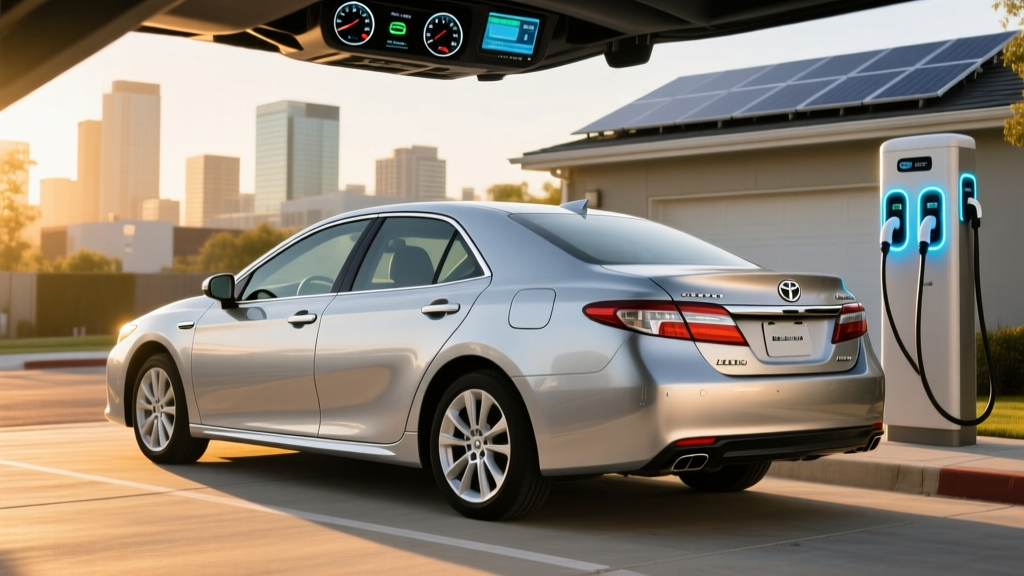
Quick Verdict: The 2013 Camry XLE Hybrid in 2026
The 2013 Toyota Camry XLE Hybrid remains one of the most practical used hybrid sedans on the market more than a decade after its debut. With an EPA-rated 40 MPG combined and Toyota's proven Hybrid Synergy Drive powertrain, it delivers real-world fuel savings that still compete with newer hybrids — at a fraction of the cost. For buyers seeking a comfortable midsize sedan with low running costs and no plug-in requirement, the XLE trim's premium features (leather, premium audio, dual-zone climate) make it the sweet spot of the 2013 Camry Hybrid lineup.
But at 13 years old, the big question is battery longevity. We'll break down exactly what to expect from the hybrid battery, replacement costs, real-world MPG data, and how this conventional hybrid (HEV) stacks up against modern PHEVs and full EVs in 2026.
| Specification | 2013 Camry Hybrid XLE |
|---|---|
| Powertrain | 2.5L 4-cyl + electric motor (HEV) |
| Combined Horsepower | 200 hp (net system) |
| Engine Output | 156 hp @ 5,700 rpm / 156 lb-ft torque |
| Electric Motor | 105 kW (141 hp) permanent-magnet AC |
| Hybrid Battery | 1.6 kWh NiMH (sealed, air-cooled) |
| EPA City / Highway / Combined | 40 / 38 / 40 MPG |
| Fuel Tank | 17.0 gallons |
| Total Range (est.) | ~680 miles |
| 0-60 mph | ~7.6 seconds |
| Drivetrain | FWD, eCVT |
| Cargo Volume | 14.0 cu ft (reduced by battery) |
| Original MSRP (XLE) | ~$30,510 (2013) |
| 2026 Used Price Range | $8,500 – $13,500 |
HEV vs PHEV vs EV: What the 2013 Camry Hybrid Actually Is
The 2013 Camry Hybrid is a conventional hybrid (HEV) — it cannot be plugged in. It charges its 1.6 kWh nickel-metal hydride (NiMH) battery exclusively through regenerative braking and the gasoline engine. This is fundamentally different from a plug-in hybrid (PHEV) like the Toyota RAV4 Prime or a full battery electric vehicle (BEV) like the Tesla Model 3.
| Feature | HEV (2013 Camry Hybrid) | PHEV (e.g., RAV4 Prime) | BEV (e.g., Model 3) |
|---|---|---|---|
| Plug-in charging | No | Yes | Yes |
| Battery size | 1.6 kWh | 18.1 kWh | 60–82 kWh |
| Electric-only range | ~1 mile at low speed | 42 miles EPA | 272–363 miles EPA |
| Gas engine | Yes (primary) | Yes (backup) | No |
| Fuel cost per mile | ~$0.09 | ~$0.04 (electric) / $0.09 (gas) | ~$0.04 |
| Home charger needed | No | Recommended (Level 2) | Required (Level 2) |
| Federal tax credit (new) | None | Up to $7,500 (§30D) | Up to $7,500 (§30D) |
If you can't charge at home or at work, an HEV like the 2013 Camry Hybrid is the electrified vehicle that requires zero infrastructure change. You simply fill up with gas and let the hybrid system optimize efficiency automatically.
Fuel Economy: EPA Ratings vs Real-World MPG
| Driving Condition | EPA Rating | Real-World Expectation |
|---|---|---|
| City | 40 MPG | 38–44 MPG |
| Highway | 38 MPG | 35–40 MPG |
| Combined | 40 MPG | 37–42 MPG |
The 2013 Camry Hybrid's EPA ratings of 40 city / 38 highway / 40 combined were class-leading when new, per fueleconomy.gov. Unlike most gas cars, hybrids often exceed their EPA city rating because stop-and-go driving maximizes regenerative braking and electric-motor assist.
Real-world factors that affect your MPG:
- Cold weather (below 40°F): Expect a 5–10% MPG drop. The engine runs more frequently to maintain cabin heat and bring the catalytic converter to operating temperature. The NiMH battery also operates less efficiently when cold.
- Highway cruising above 75 mph: Aerodynamic drag increases exponentially. Expect 34–36 MPG at sustained 80+ mph speeds.
- Hilly terrain: Net MPG may drop on long climbs, but regenerative braking on descents partially recovers the energy.
- Battery age: A degraded hybrid battery forces the gas engine to work harder. A 13-year-old battery with reduced capacity may drop combined MPG by 2–4 MPG versus new.
For context, a comparable 2013 Camry with the 2.5L gas-only engine rates 25/35/28 MPG (city/highway/combined). The hybrid delivers roughly 43% better combined fuel economy, translating to approximately $500–$700 in annual fuel savings at 15,000 miles/year and $3.40/gallon regular unleaded.
Powertrain Deep Dive: How the Hybrid System Works
The 2013 Camry Hybrid uses Toyota's third-generation Hybrid Synergy Drive, pairing a 2.5-liter Atkinson-cycle four-cylinder engine with a 105 kW permanent-magnet electric motor through an electronically controlled continuously variable transmission (eCVT). Net system output is 200 horsepower.
The Atkinson-cycle engine sacrifices some low-RPM torque for higher thermal efficiency — the electric motor fills in the torque gap instantly. The result is seamless acceleration from a stop and adequate passing power at highway speeds. The 0-60 mph time of approximately 7.6 seconds is competitive with the V6 Camry of the same era.
The eCVT is not a belt-and-pulley CVT like those in Nissan or Subaru vehicles. It uses a planetary gearset to blend engine and motor power with no fixed gear ratios and no belt to wear out. This design is one reason Toyota hybrid transmissions are among the most durable in the industry — there are no clutch packs, torque converters, or friction bands to fail.
Hybrid Battery: Lifespan, Warranty, and Replacement Cost
Original Battery Warranty: Toyota warranted the hybrid battery for 10 years / 150,000 miles in CARB states (California, New York, Massachusetts, and others adopting California emissions standards) and 8 years / 100,000 miles in all other states. As of 2026, the original factory warranty has expired on all 2013 models regardless of mileage.
The 2013 Camry Hybrid uses a 1.6 kWh nickel-metal hydride (NiMH) battery pack consisting of 34 modules. NiMH chemistry is less energy-dense than modern lithium-ion but has proven exceptionally durable in Toyota's hybrid applications. Many Camry Hybrids have reached 200,000+ miles on the original battery pack.
Signs of hybrid battery degradation:
- Noticeable drop in fuel economy (3–5+ MPG below normal)
- Engine running more frequently, even at low speeds
- State-of-charge meter fluctuating rapidly
- Check hybrid system warning light (indicates a fault, not just degradation)
- Reduced regenerative braking strength
Battery replacement costs in 2026:
- New OEM Toyota battery: $2,500–$3,500 (parts) + $500–$800 labor = $3,000–$4,300 total
- Refurbished/reconditioned battery: $1,200–$2,000 installed from specialty hybrid shops
- Individual module replacement: $150–$400 if only 1–2 modules have failed (diagnostic-dependent)
Independent hybrid specialists like those in the NHTSA-registered repair network can often diagnose and replace individual failed modules rather than the entire pack, significantly reducing cost. The battery is located behind the rear seat, and replacement typically takes 2–3 hours.
XLE Trim Features: What You Get
The XLE was the top trim for the 2013 Camry Hybrid, and it came well-equipped. Standard features included:
- Leather-trimmed seats with heated front seats
- Dual-zone automatic climate control
- Toyota Display Audio with 6.1-inch touchscreen
- Backup camera
- Bluetooth hands-free and audio streaming
- Smart Key with push-button start
- 17-inch alloy wheels
- Auto-dimming rearview mirror with compass and HomeLink
The available Navigation package added a JBL premium audio system, HDD navigation, and Entune app integration. While the infotainment is dated by 2026 standards (no Apple CarPlay or Android Auto), aftermarket solutions like the CarPlay adapter boxes ($80–$150) can add smartphone mirroring through the existing USB port.
Tax Credits and Incentives: What Applies in 2026
The 2013 Camry Hybrid does not qualify for any federal tax credit — neither when new nor as a used purchase in 2026. Here's why:
- When new (2013): Conventional hybrids (HEVs) have never qualified for the federal §30D plug-in vehicle tax credit, which requires a minimum 4 kWh battery and plug-in capability. The Camry Hybrid's 1.6 kWh NiMH battery and lack of a charge port made it ineligible.
- Used EV credit (§25E): The used clean vehicle credit of up to $4,000 (enacted under the Inflation Reduction Act) applies only to used BEVs and PHEVs — not conventional HEVs. Per IRS guidelines, the vehicle must have a battery capacity of at least 7 kWh and be a plug-in vehicle.
- State incentives: A handful of states offer modest rebates or HOV lane access for hybrids, but most state-level incentive programs in 2026 focus on PHEVs and BEVs. Check your state's energy office or DMV for current programs.
The financial case for the 2013 Camry Hybrid rests entirely on its low purchase price and fuel savings — not on government incentives.
Who Should Buy the 2013 Camry XLE Hybrid?
Pros
- 40 MPG combined — still competitive with 2026 hybrids
- No plug-in charging required — works with existing gas infrastructure
- Toyota reliability and massive parts/service network
- XLE premium features (leather, heated seats, dual-zone) at a budget price
- eCVT planetary gearset — virtually no transmission failure risk
- Low annual fuel cost (~$1,275 at 15k mi/yr, $3.40/gal)
- Spacious cabin with comfortable ride quality
Cons
- Hybrid battery is 13+ years old — replacement likely within ownership
- Dated infotainment (no CarPlay/Android Auto without adapter)
- Cargo space reduced to 14.0 cu ft by battery placement
- No federal or state tax credits available
- Safety tech is basic (no automatic emergency braking, no lane-keeping)
- NiMH battery less efficient in extreme cold vs modern Li-ion hybrids
- Rear seats don't fold flat (battery partition blocks pass-through)
Choose the 2013 Camry XLE Hybrid if:
- You want hybrid fuel savings without changing your fueling habits
- Your budget is $8,000–$14,000 and you want a comfortable, feature-rich sedan
- You drive mostly city/suburban miles where hybrid efficiency shines
- You can't install a home charger (apartment, street parking)
- You plan to drive the car 3–5 years and accept potential battery replacement
Consider a newer PHEV or BEV instead if:
- You have home charging access and want to eliminate most gas usage
- You want current safety tech (AEB, blind-spot monitoring, lane centering)
- You qualify for the §30D tax credit (income and MSRP dependent) on a new PHEV/BEV
- You want a warranty-backed battery (new Toyota hybrids carry 10yr/150k coverage)
- You drive more than 20,000 miles/year and want maximum fuel cost savings
Ownership Cost Breakdown (5-Year Estimate)
| Cost Category | 2013 Camry Hybrid XLE | 2013 Camry 2.5L Gas (LE) |
|---|---|---|
| Purchase price (avg. used 2026) | $11,000 | $9,500 |
| Fuel (15k mi/yr × 5 yr, $3.40/gal) | $6,375 | $9,070 |
| Insurance (avg.) | $5,500 | $5,200 |
| Maintenance (5 yr) | $2,500 | $2,800 |
| Hybrid battery replacement (if needed) | $2,000–$3,500 | N/A |
| Total 5-year cost | $27,375–$28,875 | $26,570 |
The hybrid's fuel savings of ~$2,700 over five years largely offset its higher purchase price. If the battery needs replacement, the cost gap narrows or reverses — making a pre-purchase hybrid battery health check essential.
Frequently Asked Questions
How many MPG does the 2013 Camry XLE Hybrid actually get?
The EPA rates it at 40 city / 38 highway / 40 combined. In real-world driving, most owners report 37–42 MPG combined. City driving often exceeds the EPA rating thanks to regenerative braking, while sustained highway driving above 75 mph may dip to 34–36 MPG. A degraded hybrid battery can reduce these figures by 2–4 MPG.
Does the 2013 Camry Hybrid need to be plugged in?
No. The 2013 Camry Hybrid is a conventional hybrid (HEV) with no plug and no electric-only driving mode beyond brief low-speed EV mode (~1 mile at under 25 mph). The battery charges itself through regenerative braking and the gasoline engine. You fuel it exactly like any other gas car.
How long does the hybrid battery last, and what does replacement cost?
Toyota's NiMH hybrid batteries commonly last 150,000–200,000+ miles, but age is also a factor. At 13 years old, a 2013 battery may show reduced capacity even at lower mileage. New OEM replacement runs $3,000–$4,300 installed; refurbished packs cost $1,200–$2,000 installed. Individual module repair can cost as little as $150–$400.
Is the 2013 Camry Hybrid reliable?
Yes. The 2013 Camry Hybrid has above-average reliability for its age. The planetary eCVT has no wearable friction components and rarely fails. The main long-term concern is hybrid battery degradation. According to NHTSA records, the 2013 Camry Hybrid has no major systemic defect patterns beyond normal wear items. Routine maintenance (oil changes every 10,000 miles, coolant service, brake fluid) keeps these cars running well past 200,000 miles.
Does the 2013 Camry Hybrid qualify for any tax credit?
No. The 2013 Camry Hybrid is a conventional HEV and does not qualify for the federal §30D new vehicle credit or the §25E used clean vehicle credit. These credits require plug-in capability and minimum battery capacity thresholds (4 kWh for §30D, 7 kWh for §25E) that the Camry Hybrid's 1.6 kWh NiMH pack does not meet. Check your state energy office for any local hybrid incentives, though most have shifted to PHEVs and BEVs.
How does the 2013 Camry Hybrid compare to a 2026 hybrid?
Modern hybrids like the 2026 Toyota Camry Hybrid (51 MPG combined) or Honda Accord Hybrid (48 MPG combined) deliver roughly 20–25% better fuel economy through more efficient engines, lighter lithium-ion batteries, and improved aerodynamics. They also include advanced safety systems (AEB, lane centering) and current infotainment (wireless CarPlay). However, a 2026 Camry Hybrid LE starts around $29,000 — roughly $18,000 more than a used 2013 XLE. The value proposition depends on your budget and how long you plan to keep the vehicle.
Should I get a pre-purchase inspection for the hybrid battery?
Absolutely. Before buying any used hybrid, have a Toyota dealer or qualified hybrid technician perform a battery health check. This typically costs $100–$150 and includes a diagnostic scan showing individual module voltages, internal resistance, and state-of-health percentage. A battery with more than 15–20% capacity loss will likely need service within 1–2 years and should be factored into your purchase negotiation.