Quick Verdict: A Proven Hybrid That's Now a Used-Car Bargain
The 2009 Toyota Camry Hybrid occupies a specific niche in 2026: it's a 17-year-old conventional hybrid (HEV) that buyers are snapping up on the used market for $4,000–$7,500 as a reliable, ultra-low-cost commuter. With an EPA-rated 33 MPG combined, a nickel-metal hydride (NiMH) battery that routinely lasts 150,000+ miles, and Toyota's legendary Hybrid Synergy Drive powertrain, this sedan remains one of the most pragmatic used-car purchases available — provided you understand the battery-age risks.
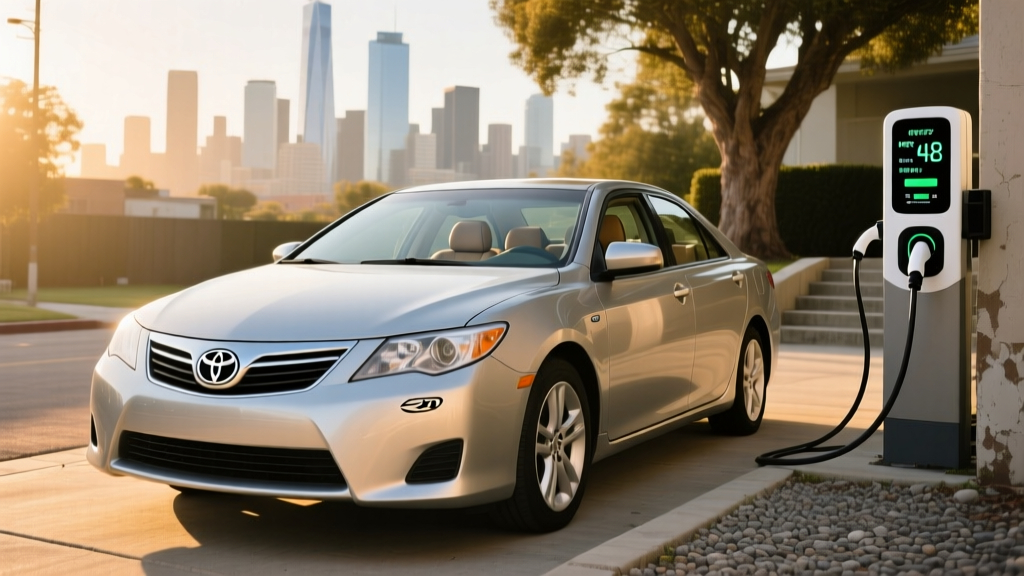
This is not a plug-in hybrid (PHEV). The 2009 Camry Hybrid cannot be plugged in, has no electric-only driving range to speak of, and does not qualify for any federal EV or PHEV tax credit. It's a self-charging HEV that recovers energy through regenerative braking and engine cycling. If you're searching for "toyota camry 2009 hybrid" to evaluate one as a daily driver, this guide gives you the exact numbers you need.
| Specification | Value |
|---|---|
| Powertrain Type | Conventional Hybrid (HEV) — no plug |
| Engine | 2.4L 4-cylinder Atkinson-cycle (147 hp) |
| Electric Motor | Permanent-magnet synchronous (40 hp / 199 lb-ft) |
| Combined System Output | 192 hp (net) |
| Transmission | eCVT (planetary gearset) |
| Battery Chemistry | Nickel-Metal Hydride (NiMH) |
| Battery Capacity | ~1.6 kWh (gross), ~0.9 kWh usable |
| EPA MPG (City / Hwy / Combined) | 33 / 34 / 33 |
| Fuel Tank | 17.2 gallons |
| Total Range | ~567 miles (EPA combined) |
| 0–60 mph | ~8.4 seconds |
| Cargo Volume | 10.6 cu ft (trunk reduced by battery) |
| Original MSRP (2009) | ~$27,950 |
| 2026 Used Market Price | $4,000–$7,500 (depending on mileage/condition) |
HEV vs PHEV vs EV: Where the 2009 Camry Hybrid Fits
Before we dive into MPG and reliability, let's clarify a common source of confusion. The 2009 Camry Hybrid is a conventional hybrid (HEV). Toyota did not offer a Camry plug-in hybrid (PHEV) until much later, and a fully electric Camry has never existed. Here's how these three powertrain types differ:
| Feature | HEV (2009 Camry Hybrid) | PHEV (e.g., 2026 Prius Prime) | BEV (e.g., 2026 Tesla Model 3) |
|---|---|---|---|
| Plug-in Charging? | No — self-charging via regen/engine | Yes — Level 1 or Level 2 | Yes — Level 1, 2, or DC fast |
| Electric-Only Range | ~1 mile at low speed | ~40–44 miles | 250–360+ miles |
| Gasoline Engine? | Yes (primary power + charging) | Yes (backup after EV range) | No |
| Federal Tax Credit (§30D) | Not eligible | Up to $7,500 (if eligible) | Up to $7,500 (if eligible) |
| Home Charger Needed? | No | Recommended (Level 2) | Essential (Level 2) |
| Best For | No-plug commuters, budget buyers | Short commutes + road-trip flexibility | Home-charging access, low fuel cost |
The 2009 Camry Hybrid is right for you if you lack home charging access, want a sub-$8,000 commuter, and don't want to think about plugging in. It is not right for you if you want electric-only driving, the latest safety tech, or a federal tax credit.
Fuel Economy: EPA MPG vs Real-World Results
| Driving Condition | EPA MPG | Real-World Expectation (2026) |
|---|---|---|
| City | 33 MPG | 33–37 MPG (hybrids excel in stop-and-go) |
| Highway | 34 MPG | 30–33 MPG (aero drag + aging battery) |
| Combined | 33 MPG | 31–35 MPG |
One of the defining characteristics of Toyota's Hybrid Synergy Drive is that city and highway MPG are nearly identical — and in real-world driving, city MPG often exceeds the EPA estimate. That's because regenerative braking recovers kinetic energy at every stoplight, and the electric motor handles low-speed launches where gasoline engines are least efficient.
On the highway, the 2.4L Atkinson-cycle engine does most of the work, and the hybrid system provides less benefit. Expect highway fuel economy to dip to 30–33 MPG, particularly at sustained speeds above 70 mph or in hilly terrain.
Battery age matters. A 2009 Camry Hybrid with an original, 17-year-old NiMH battery that has degraded significantly will see MPG drop — sometimes to 27–29 MPG combined — because the electric motor contributes less and the engine runs more frequently. A refurbished or replacement battery restores the system to near-original efficiency.
For comparison, the EPA-rated 2009 Camry Hybrid fuel economy data is published on fueleconomy.gov, where owners report lifetime averages clustering around 32–35 MPG — closely tracking the EPA combined figure.
Powertrain Deep Dive: How the Hybrid System Works
The 2009 Camry Hybrid uses Toyota's second-generation Hybrid Synergy Drive, pairing a 2.4-liter 2AZ-FXE Atkinson-cycle four-cylinder engine (147 hp, 138 lb-ft) with a permanent-magnet synchronous electric motor (40 hp, 199 lb-ft) through a planetary-gearset eCVT. The combined net output is 192 horsepower.
The Atkinson cycle is key: it keeps the intake valve open slightly longer during the compression stroke, reducing pumping losses and improving thermal efficiency at the cost of peak power. The electric motor compensates for that lost low-end torque, delivering instant response from a stoplight.
The eCVT is not a belt-driven CVT like those in many conventional cars. It's a planetary gearset with no belts, cones, or clutches to wear out — which is why Toyota hybrid transmissions are among the most durable in the industry. There are no traditional gear shifts; acceleration is seamless and linear.
The NiMH battery pack sits behind the rear seat, which reduces trunk space to 10.6 cubic feet (vs. 15.0 cu ft in the gas Camry). This is a real compromise for cargo-heavy buyers.
Battery Life, Degradation, and Replacement Cost
Original Battery Warranty
Toyota warranted the 2009 Camry Hybrid's battery for 8 years / 100,000 miles (10 years / 150,000 miles in California-emissions states: CA, CT, ME, MA, NJ, NY, OR, RI, VT, WA). As of 2026, all original factory battery warranties have expired — even in CARB states — due to the vehicle's age.
The NiMH battery in the 2009 Camry Hybrid has a well-documented track record. Many original batteries have lasted 150,000–200,000 miles before significant degradation, though capacity loss is gradual rather than sudden. A degraded hybrid battery doesn't leave you stranded — it simply reduces the electric motor's contribution, increasing fuel consumption and reducing acceleration smoothness.
Signs of battery degradation:
- MPG dropping below 28 combined (from a baseline of 33)
- Engine running more frequently, even at low speeds
- Reduced regenerative braking feel
- State-of-charge gauge cycling rapidly between full and low
- Check Engine or Hybrid System Warning light (diagnostic codes P0A80, P0A7F)
Replacement cost in 2026:
- OEM new battery (Toyota dealer): $2,500–$3,500 installed
- Aftermarket refurbished battery: $1,200–$2,000 installed
- Individual cell/module replacement: $500–$1,000 (specialist shops can replace only the weak modules)
- Junkyard/salvage battery: $300–$600 (risky — unknown remaining life)
For a car worth $5,000–$7,500, a $3,500 OEM replacement may not be economically justified. Most owners opt for refurbished packs or module-level repair from hybrid-specialist shops. Companies like Green Bean Battery and Dorman offer reconditioned NiMH packs with 1–3 year warranties.
Reliability, Safety, and Long-Term Ownership Costs
The 2009 Camry Hybrid benefits from Toyota's reputation for mechanical durability. The 2AZ-FXE engine is under-stressed in hybrid duty, the eCVT has no wear-prone belts, and the brake pads last 80,000–100,000+ miles thanks to regenerative braking doing most of the deceleration work.
Known issues to inspect before buying:
- Hybrid battery age: The single biggest cost risk. Budget $1,500–$2,500 for a replacement unless the seller provides proof of a recent battery swap.
- Hybrid inverter coolant pump: Toyota issued a recall (NHTSA recall 13V054) for the inverter coolant pump, which could fail and overheat the inverter. Verify this recall was performed — it's free at any Toyota dealer.
- Brake actuator assembly: Some 2007–2011 Camry Hybrids experienced premature brake actuator wear, a $1,500–$2,000 repair. Listen for unusual brake pedal feel or a buzzing noise from the brake system at startup.
- Oil consumption (2AZ-FE/FXE): Some 2.4L engines from this era consume oil. Check the dipstick and ask about oil consumption history.
- Dash/crack issues: 2007–2009 Camrys are known for dashboard cracking — cosmetic but annoying.
Safety ratings: The NHTSA rated the 2009 Camry with 5 stars for frontal crash (driver and passenger) and 4 stars for side impact. The IIHS rated it "Good" for moderate overlap front and side impact. However, it lacks modern ADAS features — no automatic emergency braking, no lane-keeping assist, no blind-spot monitoring. This is a 2009 vehicle; drive it accordingly.
Tax Credits, Incentives, and Total Cost of Ownership
Federal tax credit: The 2009 Toyota Camry Hybrid does not qualify for the IRS §30D Clean Vehicle Credit. That credit applies only to new plug-in electric vehicles (BEVs and PHEVs) meeting battery-sourcing and MSRP requirements. The original 2009 hybrid tax credit of up to $2,200 (under the pre-2009 Energy Policy Act) expired long ago and was fully phased out after Toyota hit its 60,000-vehicle cap in 2007.
Used EV credit (§25E): Also not applicable. The §25E credit of up to $4,000 applies only to used BEVs and PHEVs with at least 4 kWh of battery capacity. The 2009 Camry Hybrid's ~1.6 kWh NiMH pack and non-plug-in design make it ineligible. See the IRS used clean vehicle credit page for current eligibility rules.
State incentives: A few states offer minimal incentives for used hybrid purchases or emissions-reduction rebates, but these vary widely and change frequently. Check your state's energy or environmental agency for current programs.
Pros
- 33 MPG combined — still excellent for a midsize sedan
- No plug-in charging required — works like any gas car
- eCVT is one of the most durable transmissions ever built
- Brake pads last 80,000–100,000+ miles via regen
- Low purchase price ($4,000–$7,500 used in 2026)
- Smooth, quiet hybrid powertrain with 192 hp
- Widely available parts and mechanic familiarity
Cons
- Hybrid battery warranty expired — replacement is $1,200–$3,500
- Trunk space reduced to 10.6 cu ft by battery pack
- No modern ADAS features (no AEB, lane-keep, blind-spot)
- No federal tax credit eligibility
- NiMH battery less efficient than modern lithium-ion systems
- Highway MPG dips to 30–33 — less advantage over gas Camry at speed
- 17-year-old vehicle: inspect for rust, suspension wear, electronics
5-Year Ownership Cost Estimate (2026–2031)
| Cost Category | Estimated 5-Year Total |
|---|---|
| Purchase Price | $5,500 (mid-range used) |
| Fuel (33 MPG avg, $3.40/gal) | $7,727 |
| Hybrid Battery Replacement (likely needed) | $1,800 (refurbished) |
| Insurance (basic liability + comp/collision) | $4,500 ($900/yr avg) |
| Maintenance (oil, tires, brakes, fluids) | $2,500 |
| Registration & Taxes | $750 |
| Total 5-Year Cost | ~$22,777 |
| Cost Per Mile | ~$0.30/mile |
For comparison, a 2009 gas Camry (4-cylinder, 24 MPG combined) would cost approximately $10,625 in fuel over the same period — nearly $3,000 more. The hybrid's fuel savings offset the likely battery replacement cost within about 3 years.
Who Should Buy the 2009 Camry Hybrid — And Who Shouldn't
Choose the 2009 Camry Hybrid if:
- You need a sub-$8,000 daily commuter with no plug-in requirement
- You drive primarily in city or suburban stop-and-go traffic (where hybrid efficiency shines)
- You lack access to home or workplace EV charging
- You want Toyota reliability and can budget $1,500–$2,500 for a battery replacement if needed
- You prioritize low fuel costs over modern tech and safety features
Look elsewhere if:
- You want electric-only driving — consider a used PHEV like the 2017+ Prius Prime
- You need the latest safety tech (AEB, adaptive cruise, lane-keep) — look at 2018+ vehicles
- You want a federal tax credit — only new or qualifying used BEVs/PHEVs are eligible
- You need significant cargo space — the battery eats 4.4 cu ft of trunk
- You primarily drive highway miles — a modern turbo-diesel or efficient gas car closes the MPG gap at sustained speed
Frequently Asked Questions
How many MPG does the 2009 Toyota Camry Hybrid get?
The EPA rates the 2009 Camry Hybrid at 33 MPG city, 34 MPG highway, and 33 MPG combined. In real-world driving, owners commonly report 31–37 MPG combined, with city driving often exceeding the EPA estimate due to regenerative braking. A degraded hybrid battery can reduce real-world MPG to 27–29 combined.
Does the 2009 Camry Hybrid need to be plugged in?
No. The 2009 Camry Hybrid is a conventional hybrid (HEV), not a plug-in hybrid (PHEV). It charges its battery entirely through regenerative braking and the gasoline engine. There is no charging port and no electric-only driving range beyond approximately 1 mile at very low speeds.
How long does the hybrid battery last, and what does replacement cost?
Toyota's NiMH hybrid batteries in the 2009 Camry Hybrid commonly last 150,000–200,000 miles before significant degradation. Replacement costs range from $1,200–$2,000 for a refurbished pack to $2,500–$3,500 for a new OEM battery from a Toyota dealer. Module-level repair by a hybrid specialist can cost $500–$1,000.
Does the 2009 Camry Hybrid qualify for any tax credit?
No. The original hybrid purchase tax credit (up to $2,200) expired after Toyota hit its 60,000-vehicle cap in 2007. The current federal §30D credit and §25E used-EV credit apply only to plug-in vehicles (BEVs and PHEVs). The 2009 Camry Hybrid is not eligible for any federal tax incentive.
Is the 2009 Camry Hybrid reliable?
Yes, with one major caveat. The powertrain (engine, eCVT, hybrid system) is extremely durable — the eCVT has no belts or clutches to fail, and the engine is under-stressed. The primary reliability risk is the aging NiMH hybrid battery, which at 17 years old is near or past its expected service life. Budget for a battery replacement or verify it has been recently replaced before purchase.
How does the 2009 Camry Hybrid compare to a modern hybrid like the 2026 Prius?
The 2026 Toyota Prius achieves 57 MPG combined with a lithium-ion battery, modern ADAS (Toyota Safety Sense 3.0), and a starting price around $29,000. The 2009 Camry Hybrid delivers 33 MPG with no modern safety tech but costs $4,000–$7,500 used. If your budget allows, a newer hybrid is far more efficient and safer. The 2009 model is strictly a budget play.
What should I inspect before buying a used 2009 Camry Hybrid?
Prioritize: (1) hybrid battery health — have a hybrid specialist run a battery diagnostic, (2) verify the inverter coolant pump recall (13V054) was completed, (3) check for brake actuator issues (buzzing, soft pedal), (4) inspect for oil consumption on the 2.4L engine, (5) check for rust on the undercarriage, especially in salt-belt states. A pre-purchase inspection by a Toyota-qualified mechanic is strongly recommended.