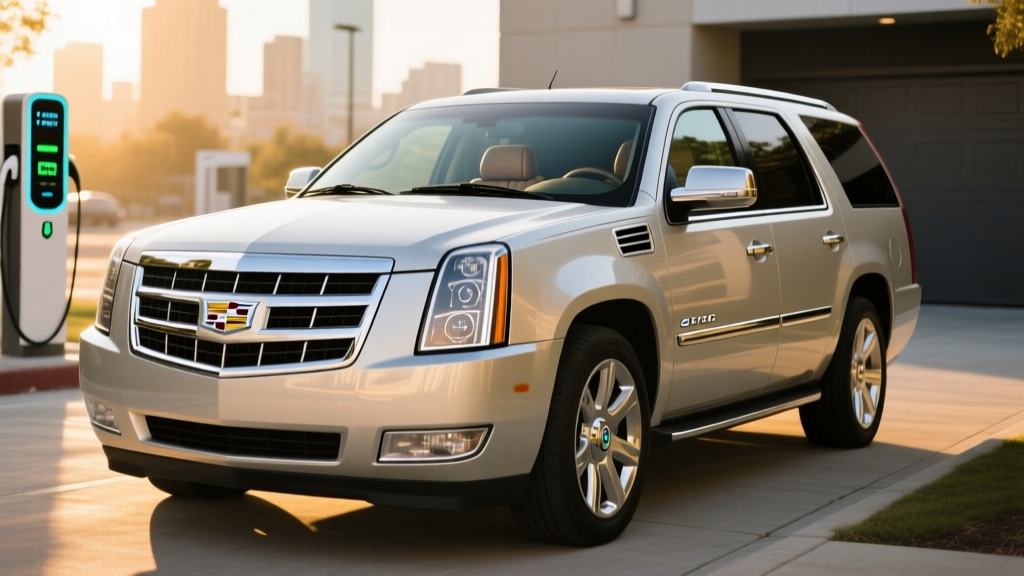
The 2009 Cadillac Escalade Hybrid was a bold experiment: a 5,800-pound luxury SUV that promised V8 power with V6 fuel economy using GM's two-mode hybrid system. More than 15 years later, it remains a popular search for budget-conscious buyers who want full-size luxury without full-size fuel bills. But does a nearly two-decade-old hybrid powertrain hold up in 2026? This guide examines the real-world MPG, hybrid battery longevity, replacement costs, and whether this pioneering HEV still makes financial sense compared to modern plug-in hybrids and full EVs.
2009 Escalade Hybrid Powertrain: How GM's Two-Mode System Works
The 2009 Escalade Hybrid pairs a 6.0-liter V8 engine (332 hp) with two electric motors integrated into a specialized 2-mode continuously variable transmission (CVT). Combined system output is 379 horsepower. Unlike modern plug-in hybrids, this is a conventional hybrid electric vehicle (HEV) — it has no plug, no electric-only driving range, and recharges its small battery entirely through regenerative braking and the gasoline engine.
HEV vs. PHEV: What Escalade Hybrid Buyers Need to Know
2009 Escalade Hybrid (HEV): No plug. Small ~1.8 kWh nickel-metal hydride (NiMH) battery. Electric motors assist the gas engine at low speeds and during acceleration. You never plug it in — it fuels like a normal gas vehicle.
Modern PHEV (e.g., 2026 Jeep Wrangler 4xe): Has a plug. Larger 17+ kWh lithium-ion battery. Offers 20–50 miles of electric-only driving before the gas engine engages. Requires access to charging to realize full efficiency benefits.
The two-mode system was sophisticated for its era. At low speeds (under ~30 mph), the Escalade Hybrid can operate on electric motors alone for very short distances — think creeping through a parking lot, not highway merging. At higher loads, the V8 and electric motors work together, and the system can shut down the engine at stops to save fuel. The result is meaningful city MPG improvement over the standard V8 Escalade, with more modest highway gains.
Fuel Economy: EPA MPG and Real-World Expectations
The EPA rated the 2009 Escalade Hybrid at 20 mpg city / 21 mpg highway / 21 mpg combined for the 2WD model. The 4WD version drops slightly to 20 city / 20 highway / 20 combined. For context, the standard 2009 Escalade with the 6.2L V8 was rated at 12 city / 18 highway / 14 combined — making the hybrid roughly 50% more efficient in city driving.
| Model | City MPG | Highway MPG | Combined MPG |
|---|---|---|---|
| 2009 Escalade Hybrid (2WD) | 20 | 21 | 21 |
| 2009 Escalade Hybrid (4WD) | 20 | 20 | 20 |
| 2009 Escalade (6.2L V8, 2WD) | 12 | 18 | 14 |
| 2026 Cadillac Escalade (6.2L V8, 2WD) | 14 | 19 | 16 |
Source: fueleconomy.gov
Real-World MPG vs. EPA Sticker
Hybrid vehicles often exceed their EPA city ratings in stop-and-go traffic because regenerative braking captures energy that conventional vehicles waste. Owners on fuel-tracking platforms report real-world combined figures between 18 and 22 mpg, depending on driving style and climate. Highway-heavy commutes tend to land closer to 19–20 mpg, while city-dominant driving can push toward 22 mpg. However, if the hybrid battery has degraded significantly (more on this below), expect real-world numbers to fall toward the low end of that range or below, as the system relies more heavily on the gasoline engine.
In cold weather (below 30°F), the engine runs more frequently to maintain cabin heat and battery temperature, reducing the hybrid system's efficiency advantage. Expect a 1–3 mpg drop in winter conditions.
Hybrid Battery: Lifespan, Warranty, and Replacement Cost
The 2009 Escalade Hybrid uses a ~1.8 kWh nickel-metal hydride (NiMH) battery pack located under the second-row seat. NiMH chemistry is less energy-dense than modern lithium-ion but has proven reasonably durable in GM's two-mode hybrid applications.
Original Battery Warranty
GM originally covered the hybrid battery for 8 years / 100,000 miles (10 years / 150,000 miles in CARB states like California, New York, and Massachusetts). As of 2026, every 2009 Escalade Hybrid is well past its factory battery warranty. Any battery failure is an out-of-pocket expense.
Battery Degradation and Failure Signs
NiMH batteries in the two-mode system tend to degrade gradually rather than fail catastrophically. Symptoms of a weakening hybrid battery include:
- Noticeably lower fuel economy (dropping below 17–18 mpg combined)
- The gasoline engine running more frequently at stops and low speeds
- Reduced regenerative braking feel
- A "Check Hybrid System" or "Service Hybrid System" warning on the dash
Many 2009 Escalade Hybrids on the road in 2026 are running on either a replacement battery or a significantly degraded original unit. At 17 years old, original NiMH cells are near or past their practical lifespan regardless of mileage.
Battery Replacement Cost
Replacement options for the 2009 Escalade Hybrid battery include:
- GM dealership (new OEM battery): $3,000–$4,500 including labor, though new OEM stock is increasingly scarce for this model year
- Aftermarket/remanufactured battery: $1,800–$2,800 including labor from hybrid-specialty shops
- Individual cell reconditioning: $800–$1,500 — replacing only the weak cells within the pack, offered by some hybrid specialists
Given that a clean 2009 Escalade Hybrid trades for roughly $7,000–$12,000 in 2026 depending on mileage and condition, a full OEM battery replacement can consume 30–50% of the vehicle's value. This is the single most important cost to factor into a purchase decision.
Spec Sheet: 2009 Cadillac Escalade Hybrid at a Glance
| Specification | Value |
|---|---|
| Powertrain | 6.0L V8 + 2 electric motors, 2-mode CVT |
| Combined Horsepower | 379 hp |
| Battery Type | NiMH, ~1.8 kWh |
| Plug-In Capable? | No (conventional HEV) |
| Electric-Only Range | N/A (motor assist only at low speed) |
| EPA Fuel Economy (2WD) | 20 city / 21 highway / 21 combined |
| EPA Fuel Economy (4WD) | 20 city / 20 highway / 20 combined |
| Towing Capacity | 5,600 lbs (2WD) / 5,700 lbs (4WD) |
| Curb Weight | ~5,841 lbs |
| Seating | 7–8 passengers |
| Original MSRP (2009) | ~$71,615 (base) |
| Used Price Range (2026) | $7,000–$12,000 |
| Original Hybrid Battery Warranty | 8 yr / 100,000 mi (expired) |
Tax Credits and Incentives: Does It Qualify?
No. The 2009 Escalade Hybrid does not qualify for the federal §30D Clean Vehicle Credit or any current plug-in vehicle incentive. The IRS tax credit under current §30D rules applies only to new plug-in electric vehicles (BEVs and PHEVs) that meet battery sourcing, critical mineral, MSRP cap, and buyer income requirements. Conventional hybrids like this Escalade are not eligible.
When new, the 2009 Escalade Hybrid did qualify for a federal tax credit of up to $2,200 under the older Energy Policy Act hybrid credit — but that provision expired long ago and has no retroactive application.
Some states offer modest incentives for used hybrid purchases or emissions-related rebates, but these vary widely by jurisdiction. Check your state's environmental or DMV agency for current programs.
Reliability and Ownership Costs in 2026
The 2009 Escalade Hybrid's reliability is a mixed story. The 6.0L V8 (Vortec 6000) is a proven, durable engine shared with GM trucks and SUVs. The transmission and hybrid system, however, add complexity that the standard Escalade doesn't have.
Common Issues
- Hybrid battery degradation/failure: The most expensive and most likely major issue at this age
- Hybrid system cooling: The battery cooling fan and ducts can clog or fail, accelerating battery degradation
- Standard Escalade issues: Power-folding mirror failures, dashboard cracking, transmission shift solenoid wear, and air suspension compressor failure (if equipped)
- Brake wear: Regenerative braking reduces brake pad wear compared to the standard model — a genuine ownership benefit
Annual Operating Cost Estimate
Assuming 15,000 miles/year at $3.50/gallon and 20 mpg combined, annual fuel cost is approximately $2,625. For comparison, the standard 2009 Escalade (14 mpg combined) would cost about $3,750/year — a $1,125 annual fuel savings for the hybrid. Over five years, that's roughly $5,625 in fuel savings, which can partially offset a battery replacement if needed.
2009 Escalade Hybrid vs. Modern Alternatives
How does a 17-year-old luxury hybrid compare to what you can buy today? Here's a framework for the three paths buyers typically consider:
Pros: 2009 Escalade Hybrid
- Low purchase price ($7K–$12K) for full-size luxury SUV
- 50% better city MPG than non-hybrid Escalade of same era
- Strong V8 towing (5,600+ lbs)
- No charging infrastructure needed
- Reduced brake wear from regenerative braking
Cons: 2009 Escalade Hybrid
- Expired battery warranty — replacement costs $1,800–$4,500
- Outdated safety tech (no automatic emergency braking, lane-keep, or blind-spot monitoring)
- Dated infotainment (no Apple CarPlay, Android Auto, or modern navigation)
- Still only 20–21 mpg — modern PHEVs and BEVs dramatically more efficient
- No tax credit eligibility
- Scarce parts availability for hybrid-specific components
Choose the 2009 Escalade Hybrid If:
You need a full-size, three-row SUV on a tight budget (under $15K total including potential battery replacement), you drive primarily in the city where the hybrid system delivers its biggest MPG advantage, and you accept that safety technology and infotainment reflect 2009 standards.
Choose a Modern PHEV Instead If:
You have home charging access and want 30–50 miles of electric-only commuting, modern safety features (AEB, adaptive cruise, lane-centering), and a new-vehicle warranty. Vehicles like the 2026 Chrysler Pacifica Hybrid (32 mi electric, 30 mpg combined) or 2026 Jeep Grand Cherokee 4xe (25 mi electric, 23 mpg combined) offer plug-in flexibility with full warranty coverage, though at $45,000+ MSRP.
Choose a Full EV Instead If:
You want zero tailpipe emissions, minimal maintenance, and access to the §30D federal tax credit (up to $7,500 for qualifying new BEVs). The 2026 Cadillac Lyriq ($52,990 MSRP, 314 mi EPA range) delivers modern Cadillac luxury in a fully electric package, though it cannot match the Escalade's towing capacity or third-row space.
Frequently Asked Questions
How many MPG does the 2009 Escalade Hybrid get?
The EPA rates it at 20 city / 21 highway / 21 combined (2WD). Real-world owners report 18–22 mpg combined depending on driving mix and battery condition. City driving yields the best results thanks to regenerative braking and electric motor assist at low speeds.
Can the 2009 Escalade Hybrid drive on electric power only?
Not in any meaningful way. This is a conventional hybrid (HEV), not a plug-in. The electric motors can move the vehicle at very low speeds (parking lot speeds) for brief distances, but the V8 engine is always the primary power source. There is no electric-only range figure and no plug to charge it.
Is the 2009 Escalade Hybrid reliable?
The 6.0L V8 engine is durable and well-proven. The hybrid system adds complexity, and at 17 years old, the NiMH battery is the primary reliability concern. If the battery has been recently replaced or reconditioned by a reputable shop, the powertrain can be dependable. If it's running on the original battery, plan for a $1,800–$4,500 replacement in the near term.
How much does it cost to replace the hybrid battery?
A remanufactured battery installed by a hybrid specialist typically costs $1,800–$2,800. A new OEM battery from a GM dealer (if available) runs $3,000–$4,500. Individual cell reconditioning can be done for $800–$1,500 at some specialists. Always get a pre-purchase hybrid system diagnostic before buying.
Does the 2009 Escalade Hybrid qualify for any tax credit?
No. The federal §30D Clean Vehicle Credit applies only to new plug-in electric vehicles (BEVs and PHEVs). Conventional hybrids are not eligible. The hybrid tax credit available when this vehicle was new (up to $2,200) expired long ago.
How does it compare to the standard 2009 Escalade?
The hybrid gets roughly 50% better city fuel economy (20 mpg vs. 12 mpg) and slightly better highway mileage (21 vs. 18). It sacrifices about 300 lbs of towing capacity and adds hybrid system complexity. If you drive mostly in the city, the fuel savings can reach $1,100+ per year. If you drive mostly highway, the advantage narrows considerably.
Should I buy a 2009 Escalade Hybrid in 2026?
Only if three conditions are met: (1) the purchase price plus a potential battery replacement still fits your budget under ~$15,000 total, (2) you're comfortable with 2009-era safety and technology, and (3) you've had the hybrid system inspected by a qualified technician before purchase. For buyers with a larger budget, a modern PHEV or BEV delivers dramatically better efficiency, current safety technology, and warranty protection.