Quick Verdict: A Pioneering Full-Size Hybrid SUV — Now a Used-Market Curiosity
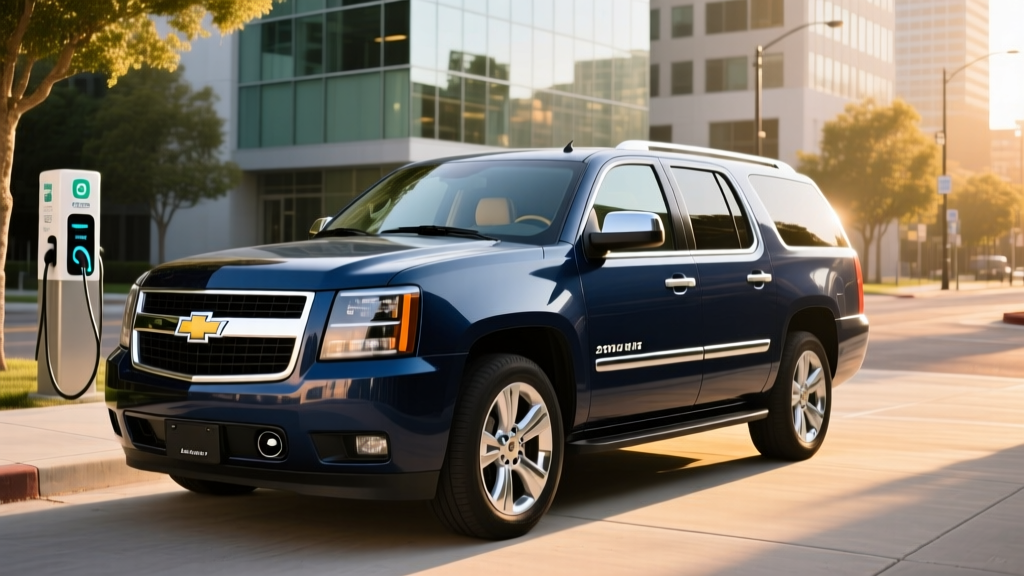
The 2009 Chevrolet Tahoe Hybrid was General Motors' bold attempt to bring hybrid efficiency to the full-size SUV segment. Built on GM's two-mode hybrid system, it paired a 6.0L V8 with two electric motors to deliver a meaningful fuel-economy bump over its gas-only sibling — without sacrificing towing or passenger space. In 2026, this SUV is exclusively available on the used market, and its value proposition has shifted from "cutting-edge efficiency" to "budget-friendly family hauler with a hybrid twist."
Before you consider one, understand exactly what you're getting: a conventional hybrid (HEV) — not a plug-in — with a battery pack that's now 17 years old. This guide covers every number that matters.
HEV vs. PHEV vs. EV: Where the 2009 Tahoe Hybrid Fits
Conventional Hybrid (HEV): The 2009 Tahoe Hybrid is an HEV. It generates all its electricity internally through regenerative braking and the gasoline engine. There is no plug, no electric-only driving range to speak of, and no charging infrastructure needed. You simply fill it with gas.
Plug-in Hybrid (PHEV): A PHEV (like the current Jeep Wrangler 4xe or Toyota RAV4 Prime) has a larger battery you plug in to charge, offering 25–50 miles of electric-only driving before the gas engine kicks in. The Tahoe Hybrid is not a PHEV.
Full Battery EV (BEV): A BEV (like the Rivian R1S or Chevy Silverado EV) runs entirely on electricity with zero gasoline. No engine, no tailpipe emissions.
This distinction matters because some buyers mistakenly assume the Tahoe Hybrid can plug in. It cannot. Its 1.8 kWh nickel-metal hydride (NiMH) battery is recharged solely by the engine and regenerative braking.
Fuel Economy: EPA MPG and Real-World Numbers
The headline reason anyone bought the 2009 Tahoe Hybrid was fuel economy. Here's how the numbers break down according to fueleconomy.gov:
| Metric | 2009 Tahoe Hybrid | 2009 Tahoe Gas (5.3L V8) | Improvement |
|---|---|---|---|
| City MPG | 21 | 14 | +50% |
| Highway MPG | 22 | 20 | +10% |
| Combined MPG | 21 | 16 | +31% |
| Annual Fuel Cost* | ~$2,950 | ~$3,850 | ~$900/yr savings |
*Based on 15,000 miles/year at $3.50/gallon regular unleaded. Your actual costs depend on local fuel prices and driving habits.
Real-World MPG: What Owners Actually Report
The two-mode hybrid system excels in stop-and-go city driving, where the electric motors handle low-speed propulsion and regenerative braking recaptures energy. Many owners on forums and fuel-tracking sites report 19–23 MPG combined in mixed driving — closely tracking the EPA estimate. In heavy city traffic, some drivers see 22–24 MPG, exceeding the EPA city figure. Highway-only driving at 75+ mph tends to drop to 19–20 MPG, as the aerodynamic penalty of a full-size SUV overwhelms the hybrid system's benefits.
At 17 years old, expect a 1–2 MPG reduction from original spec if the hybrid battery has degraded. A healthy battery is essential to maintaining the EPA-rated numbers.
Powertrain and Performance Specs
| Specification | 2009 Chevrolet Tahoe Hybrid |
|---|---|
| Engine | 6.0L V8 (Vortec) with Active Fuel Management (cylinder deactivation) |
| Electric Motors | Two 60 kW AC motors integrated into the 2-mode CVT transmission |
| Combined System Output | 379 hp |
| Engine-Only Output | 332 hp @ 5,100 rpm / 367 lb-ft @ 4,100 rpm |
| Transmission | Electrically Variable Transmission (EVT) — 2-mode hybrid CVT |
| Drivetrain | RWD or 4WD (4WD adds ~1 MPG penalty) |
| 0-60 mph | ~8.2 seconds |
| Towing Capacity | 5,800 lbs (RWD) / 5,600 lbs (4WD) |
| Curb Weight | ~5,840 lbs |
| Battery Type | 1.8 kWh Nickel-Metal Hydride (NiMH), 300V pack |
| Fuel Tank | 26 gallons |
| Total Range | ~546 miles (at 21 MPG combined) |
| Seating | Up to 8 passengers (3 rows) |
The two-mode hybrid system was co-developed by GM, BMW, and Chrysler (then DaimlerChrysler). At low speeds, the Tahoe can run on electric power alone for very short distances (under 1 mile at low speed), but this is not a meaningful "electric-only range" — it's a launch assist. The real benefit comes from the system's ability to shut off the V8 at stops, run on 4 cylinders via Active Fuel Management during light-load cruising, and recapture energy during braking.
Hybrid Battery Lifespan, Warranty, and Replacement Cost
⚡ Hybrid Battery: Critical for Used Buyers
Original Warranty: GM warranted the hybrid battery for 8 years / 100,000 miles (10 years / 150,000 miles in CARB states). This warranty expired on all 2009 models by 2019 at the latest.
Battery Chemistry: Nickel-Metal Hydride (NiMH) — a mature, proven chemistry also used in the Toyota Prius of that era. NiMH degrades more predictably than early lithium-ion but loses capacity steadily with age and heat exposure.
Expected Lifespan: Most NiMH packs in GM two-mode hybrids last 120,000–180,000 miles before significant degradation. At 17 years old, any original battery is living on borrowed time regardless of mileage.
Replacement Cost (2026):
- Remanufactured pack: $2,500–$3,500 (parts + labor at independent hybrid shops)
- New OEM pack (if available): $4,000–$5,500 (limited availability from GM)
- Cell-level rebuild: $1,500–$2,500 (specialty hybrid repair shops replace individual failed modules)
Warning signs of a failing pack: Reduced MPG (2–4 MPG drop), "Service Hybrid System" dashboard message, reduced regenerative braking feel, and the engine running more frequently at stops.
If you're shopping for a 2009 Tahoe Hybrid in 2026, assume the battery will need replacement unless the seller has documentation of a recent swap. Factor $2,500–$4,000 into your purchase budget. Some owners choose to disable the hybrid system and drive it as a conventional V8 Tahoe, but this eliminates the fuel-economy advantage entirely and may trigger check-engine codes.
Pricing, Tax Credits, and Used-Market Value
The 2009 Tahoe Hybrid originally carried an MSRP of approximately $50,490 (RWD) to $53,295 (4WD), making it one of the most expensive Tahoes in the lineup. The premium over a gas-only Tahoe LT was roughly $10,000–$12,000.
Federal Tax Credit Status
When new, the 2009 Tahoe Hybrid qualified for a federal income tax credit of $2,200 under the pre-2010 hybrid credit rules (IRS §30B, now expired). This credit was not the current §30D credit that applies to modern EVs and PHEVs.
2026 Tax Credit Reality: The 2009 Tahoe Hybrid does not qualify for any current federal tax credit. The IRS §30D Clean Vehicle Credit applies only to new or qualifying used EVs and PHEVs with plug-in capability. Since the Tahoe Hybrid is a conventional HEV with no plug, it is ineligible. The used-EV credit (§25E, up to $4,000) also requires plug-in capability. No state hybrid credits currently apply to a 2009 model year vehicle. Consult a tax professional for your specific situation, and verify rules at IRS.gov.
2026 Used-Market Pricing
As of 2026, expect to pay $4,500–$8,500 for a 2009 Chevrolet Tahoe Hybrid depending on mileage, condition, and battery health. Low-mileage examples (< 100,000 miles) with a documented battery replacement command the top of that range. High-mileage units (> 160,000 miles) with the original battery sell for $4,000–$5,500 — but carry the near-certain $2,500+ battery replacement cost.
Reliability and Common Issues
The 2009 Tahoe Hybrid's powertrain is more complex than the gas-only version, which introduces additional failure points:
Known Problem Areas
- Hybrid battery degradation: The most common and expensive issue. NiMH cells lose capacity over time, especially in hot climates (Arizona, Texas, Florida). See battery section above.
- Hybrid inverter cooling system: The power electronics have a separate cooling loop. Coolant leaks or pump failures can trigger "Service Hybrid System" warnings. Repair: $800–$1,500.
- Active Fuel Management (AFM) lifter failure: The 6.0L V8's cylinder-deactivation system is known for collapsing lifters at high mileage, leading to misfires and costly engine repairs ($2,000–$4,000). Many owners preemptively disable AFM with an aftermarket module.
- EVT transmission: The two-mode CVT is generally robust but has limited service infrastructure. Few transmission shops outside of GM dealers can repair it. Replacement: $3,000–$5,000 remanufactured.
- Standard Tahoe issues: Power window regulators, door lock actuators, dashboard pixel bleed, and rear suspension air springs (if equipped) all carry the same failure rates as gas models.
On the positive side, the NiMH battery chemistry is well-understood, and a growing network of independent hybrid repair shops can service the two-mode system at lower cost than dealers. The V8 engine itself (LFA variant of GM's LS family) is mechanically stout when maintained.
Who Should Buy the 2009 Tahoe Hybrid in 2026?
✅ Pros
- 31% better combined MPG than gas Tahoe (21 vs. 16)
- Full 8-passenger seating and 3-row capability
- 5,600–5,800 lb towing — legitimate utility
- No plug required — works with any gas station
- Low used-market entry price ($4,500–$8,500)
- Proven NiMH battery chemistry with aftermarket support
❌ Cons
- Hybrid battery likely needs replacement ($2,500–$4,000)
- Complex powertrain with limited repair-shop options
- No electric-only range — still burns gas at every stop over ~25 mph
- Outdated infotainment and safety tech (no auto emergency braking, no backup camera standard)
- AFM lifter risk on the 6.0L V8 at high mileage
- No tax credit eligibility of any kind
Decision Framework: Is This the Right Hybrid for You?
Choose the 2009 Tahoe Hybrid if:
- You need a 3-row SUV with towing capability on a tight budget
- Your driving is predominantly city/suburban (where hybrid MPG shines)
- You're comfortable budgeting $2,500–$4,000 for a battery replacement
- You have access to a hybrid-knowledgeable mechanic
Look at a modern PHEV or BEV instead if:
- You want electric-only commuting (consider a used Chrysler Pacifica Hybrid or Toyota RAV4 Prime)
- You want current safety tech (AEB, lane-keep, backup camera)
- You qualify for the §30D tax credit on a new PHEV or EV
- You want warranty coverage on the hybrid/EV battery
Stick with a gas Tahoe if:
- You drive mostly highway miles (the hybrid advantage shrinks to ~2 MPG)
- You want simpler, cheaper maintenance with any mechanic
- You can't absorb a potential $3,000+ battery repair
How the 2009 Tahoe Hybrid Compares to Modern Alternatives
For context, here's how this 2009 pioneer stacks up against current and recent electrified SUVs in the used and new market:
| Vehicle | Type | Combined MPG / MPGe | EV Range | Seats | Approx. Price |
|---|---|---|---|---|---|
| 2009 Tahoe Hybrid | HEV | 21 MPG | N/A | 8 | $4.5K–$8.5K |
| Toyota Highlander Hybrid (2024) | HEV | 35 MPG | N/A | 7–8 | $42K–$53K |
| Jeep Grand Cherokee 4xe (2024) | PHEV | 56 MPGe / 23 MPG gas | 25 mi | 5 | $60K–$75K |
| Rivian R1S (2025) | BEV | 70–77 MPGe | 321–410 mi | 7 | $79K–$100K |
The 2009 Tahoe Hybrid's advantage in 2026 is purely financial: it's the cheapest way to get a hybrid 3-row SUV with real towing capability. The efficiency gap versus modern hybrids is significant — the Toyota Highlander Hybrid delivers 67% better combined MPG — but at 5–10× the price.
Frequently Asked Questions
How many MPG does the 2009 Chevrolet Tahoe Hybrid get?
The EPA rates the 2009 Tahoe Hybrid at 21 city / 22 highway / 21 combined MPG (RWD). The 4WD version drops to 20/20/20. Real-world combined driving typically yields 19–23 MPG depending on conditions. A degraded hybrid battery can reduce this by 2–4 MPG.
Can the 2009 Tahoe Hybrid drive on electric power only?
Only in very limited circumstances. The two-mode system can propel the Tahoe on electric motors alone at speeds under ~25 mph for less than one mile. This is not a usable electric-only range — it's a launch and low-speed maneuvering assist. You cannot plug this vehicle in to charge.
Is the 2009 Tahoe Hybrid reliable?
The V8 engine and chassis are solid GM truck components with wide aftermarket support. The hybrid-specific components (NiMH battery, inverter, EVT transmission) add complexity and potential expense. The biggest risk is hybrid battery failure, which is likely at this vehicle's age. Budget for a $2,500–$4,000 battery replacement and find a hybrid-capable mechanic before purchasing.
What does it cost to replace the hybrid battery?
A remanufactured NiMH battery pack runs $2,500–$3,500 installed at an independent hybrid shop. An OEM pack (if available from GM) costs $4,000–$5,500. Cell-level module rebuilds are the cheapest option at $1,500–$2,500 but offer shorter warranties.
Does the 2009 Tahoe Hybrid qualify for any tax credit?
No. The original $2,200 federal hybrid credit (IRS §30B) expired for this model year long ago. The current §30D Clean Vehicle Credit and §25E used-EV credit both require plug-in capability, which this conventional HEV lacks. There are no federal or state tax incentives for purchasing this vehicle in 2026.
How does the two-mode hybrid system work?
GM's two-mode system uses two electric motors inside a specialized transmission. "Mode 1" handles low-speed driving, where one motor assists the engine or drives the wheels independently. "Mode 2" engages at higher speeds and under heavy load (towing, highway merging), where both motors work with the V8 for optimal power delivery. The system seamlessly shuts off the engine at stops and during light-load coasting, and uses Active Fuel Management to run the V8 on just 4 cylinders during steady-speed cruising.
Should I buy a 2009 Tahoe Hybrid or a regular gas Tahoe?
If your driving is mostly city and suburban, the hybrid saves roughly $900/year in fuel over the gas V8. At a $1,000–$2,000 used-price premium over a gas Tahoe, the payback is quick — but only if the hybrid battery is healthy. If you drive mostly highway or can't afford a potential battery replacement, the simpler gas Tahoe (especially the 5.3L V8) is the safer financial choice.
Sources: EPA fuel economy data from fueleconomy.gov; IRS Clean Vehicle Credit rules at IRS.gov; NHTSA safety data at NHTSA.gov.