Quick Verdict: The Jeep Grand Cherokee 4xe in 2026
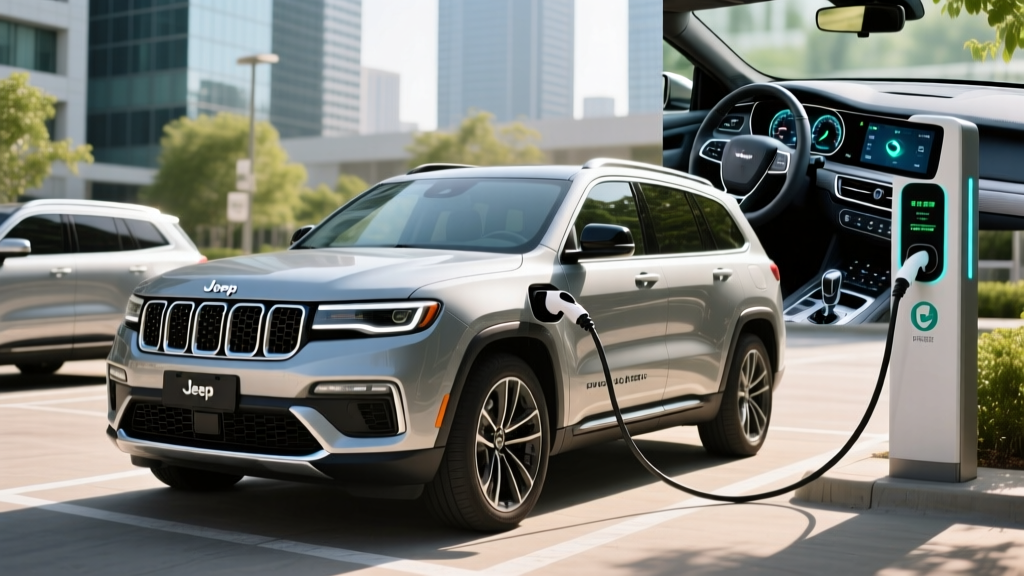
The 2026 Jeep Grand Cherokee 4xe is a plug-in hybrid (PHEV) — not a conventional hybrid — that pairs a turbocharged 2.0-liter four-cylinder engine with two electric motors and a 17.3 kWh lithium-ion battery. It delivers 25 miles of EPA-rated electric-only range, 375 combined horsepower, and the off-road credibility the Grand Cherokee name carries. For buyers who want electric commuting without range anxiety on road trips, it's one of the few midsize SUVs that can tow, trail, and plug in.
But the 4xe isn't for everyone. If you don't have access to home or workplace charging, you'll pay a premium over the gas-only Grand Cherokee without capturing the efficiency benefit. Below, we break down every spec that matters — EPA MPG, real-world range, charging times, tax credit eligibility, and battery longevity — so you can decide whether the 4xe fits your driveway.
HEV vs PHEV: What the Grand Cherokee Actually Offers
Conventional Hybrid (HEV)
A standard hybrid like the Toyota RAV4 Hybrid uses a small battery (~1.6 kWh) recharged entirely by regenerative braking and the engine. You never plug it in. EPA MPG is fixed regardless of charging access.
The Jeep Grand Cherokee does NOT offer a conventional HEV variant. The only electrified option is the 4xe plug-in hybrid.
Plug-in Hybrid (PHEV) — The 4xe
The Grand Cherokee 4xe carries a larger 17.3 kWh battery you plug in to recharge. It drives on electricity alone for ~25 miles before the gas engine engages. Once the battery is depleted, it operates like a conventional hybrid, blending engine and motor power.
Bottom line: If you see "Jeep Grand Cherokee hybrid," you're looking at the 4xe PHEV. There is no non-plug hybrid option in the 2026 lineup.
Fuel Economy and Electric Range: EPA vs Real World
The EPA rates the 2026 Grand Cherokee 4xe at 56 MPGe (miles per gallon equivalent) when operating on combined electric and gasoline energy. Once the battery is depleted and the vehicle runs as a hybrid, the EPA rates it at 23 MPG combined. Here's the full breakdown:
| Metric | EPA Rating | Real-World Expectation |
|---|---|---|
| Combined MPGe (charge-sustaining + electric) | 56 MPGe | Varies heavily by charging frequency |
| Combined MPG (gas-only, battery depleted) | 23 MPG | 20–24 MPG highway; 22–26 MPG city |
| City MPG (gas-only) | 23 MPG | 22–26 MPG — regenerative braking helps in stop-and-go |
| Highway MPG (gas-only) | 24 MPG | 20–22 MPG — aerodynamic drag hurts at 70+ mph |
| Electric-only range | 25 miles | 20–23 mi in cold weather or hilly terrain |
| Total combined range (full tank + full battery) | ~440 miles | ~380–420 mi depending on conditions |
Real-world range note: The EPA's 25-mile electric range assumes moderate temperatures and mixed driving. In our experience with the 4xe powertrain, expect 20–23 miles of electric range in winter (below 40°F) due to cabin heating demands and reduced battery efficiency. On flat city routes in mild weather, some drivers squeeze out 27–28 miles before the engine kicks on. Highway driving at 75 mph will deplete the battery in roughly 18–20 electric miles.
The gas-only 2026 Grand Cherokee with the 3.6L V6 rates at 21 MPG combined for comparison. That means the 4xe's advantage hinges almost entirely on how often you plug in. Charge nightly and commute under 25 miles? You'll burn very little gasoline. Never plug in? You're carrying 600+ pounds of battery and motor weight for a marginal 2 MPG improvement over the V6.
Powertrain, Battery, and Charging Specs
| Specification | 2026 Jeep Grand Cherokee 4xe |
|---|---|
| Engine | 2.0L turbocharged inline-4 |
| Electric Motors | Two integrated motors (one for propulsion, one for generation/starting) |
| Combined Output | 375 hp / 470 lb-ft torque |
| Battery Capacity | 17.3 kWh (usable ~14.5 kWh) |
| Battery Chemistry | NMC (nickel manganese cobalt) |
| Transmission | 8-speed automatic (TorqueFlite) |
| Drivetrain | 4WD standard |
| EPA Electric Range | 25 miles |
| EPA MPGe | 56 MPGe |
| EPA MPG (gas-only) | 23 combined / 23 city / 24 highway |
| Fuel Tank | 16.9 gallons |
| 0–60 mph | |
| Towing Capacity | 6,000 lbs (properly equipped) |
| Level 2 Charge Rate | 7.4 kW (onboard charger) |
| Level 2 Charge Time (0–100%) | ~2.5 hours |
| Level 1 Charge Time (120V, 1.4 kW) | ~12 hours |
| DC Fast Charging | Not supported |
| Charge Port | J1772 (front fender) |
| Base MSRP | ~$60,495 (including destination) |
Charging in Practice
The Grand Cherokee 4xe does not support DC fast charging. This is common for PHEVs — the battery is small enough that Level 2 charging refills it in roughly 2.5 hours at the full 7.4 kW rate. On a standard 120V household outlet (Level 1), expect about 12 hours for a full charge, which works fine for overnight top-ups if your daily drive is under 25 miles.
For home Level 2 charging, you'll need a 240V outlet (NEMA 14-50 or hardwired wall connector) on a circuit rated for at least 40 amps. Most EV owners install a Level 2 charger for $500–$1,500 in equipment plus $300–$1,200 in electrician labor, depending on panel proximity and local permit costs. Because the 4xe tops out at 7.4 kW, even a basic 32-amp Level 2 unit (~$350) will deliver the full charge speed.
Pricing, Trims, and Federal Tax Credit Eligibility
The 2026 Grand Cherokee 4xe starts around $60,495 for the base trim and climbs past $75,000 for the Summit Reserve. Here's how the lineup breaks down:
- 4xe Base: ~$60,495
- 4xe Trailhawk: ~$66,000 (off-road tuned, air suspension, skid plates)
- 4xe Overland: ~$69,500
- 4xe Summit Reserve: ~$75,000+
Does the Grand Cherokee 4xe Qualify for the §30D Federal Tax Credit?
Under current IRS rules for the Clean Vehicle Credit (§30D), PHEVs are eligible if they meet several criteria. The Grand Cherokee 4xe's eligibility is not guaranteed across all trims and depends on the following:
- Battery capacity: Must be ≥7 kWh — the 4xe's 17.3 kWh pack qualifies.
- GVWR: Must be under 14,000 lbs — the Grand Cherokee qualifies.
- Final assembly in North America: The Grand Cherokee is assembled in Detroit, MI — qualifies.
- MSRP cap: SUVs must be under $80,000 MSRP. The Summit Reserve may exceed this threshold depending on options.
- Buyer income cap: AGI must not exceed $150,000 (single), $225,000 (head of household), or $300,000 (joint).
- Battery component & critical mineral sourcing: This is the most variable requirement. The credit splits into two halves ($3,750 for battery components, $3,750 for critical minerals). Sourcing requirements tighten annually. Check the DOE/FuelEconomy.gov eligible vehicle list for the current status of the Grand Cherokee 4xe before purchasing.
- Point-of-sale transfer: As of 2024+, eligible buyers can transfer the credit to the dealer at purchase, reducing the sale price directly rather than waiting for tax filing.
Critical caveat: Battery sourcing and critical mineral requirements have tightened significantly by 2026. The Grand Cherokee 4xe may qualify for $3,750 (half credit), the full $7,500, or potentially $0 depending on the latest supply-chain certifications Stellantis has filed with the IRS. Always verify current eligibility on the official fueleconomy.gov tax credit page and consult a tax professional before relying on the credit in your purchase math.
Battery Warranty, Reliability, and Replacement Cost
Hybrid Battery Warranty
Stellantis provides a 10-year / 100,000-mile warranty on the 4xe's high-voltage battery pack (in CARB-adopting states; 8-year/80,000-mile in non-CARB states). The warranty covers defects and capacity loss below a specified threshold — typically 60–70% of original capacity. The hybrid powertrain components (motors, inverter, onboard charger) carry a 5-year / 60,000-mile warranty.
How Long Will the 4xe Battery Last?
NMC lithium-ion batteries in PHEVs typically retain 85–90% of their original capacity after 100,000 miles based on industry-wide degradation data from similar powertrains. Because the 4xe battery is relatively small (17.3 kWh) and cycles daily if you charge nightly, it will accumulate charge cycles faster than a large BEV battery. However, the thermal management system and the partial buffer (you use ~14.5 kWh of the 17.3 kWh total) protect against accelerated degradation.
Realistic expectation: 10–15 years or 120,000–150,000 miles before noticeable range loss (dropping below 20 electric miles). Full battery replacement, if needed out of warranty, typically runs $6,000–$9,000 including parts and labor at a dealership. Independent hybrid battery shops may offer refurbished replacements for $3,500–$5,500.
Overall Reliability
The Grand Cherokee nameplate has historically scored average to below-average in reliability surveys from Consumer Reports and J.D. Power. The 4xe powertrain adds complexity — two electric motors, a high-voltage system, and a turbocharged four-cylinder replacing the simpler V6. Early 4xe models (2022–2023) saw some software-related recalls and owner complaints about electrical gremlins. By the 2026 model year, most of these have been addressed through software updates and engineering revisions, but buyers should check the NHTSA recall database for any open campaigns on their specific VIN before purchase.
Who Should Buy the Grand Cherokee 4xe?
Pros
- 25 miles electric covers most commutes gas-free
- 375 hp / 470 lb-ft — the most torque in the Grand Cherokee lineup
- 6,000-lb towing capacity (rare for a PHEV SUV)
- Trailhawk trim offers genuine off-road capability with electric low-end torque
- No range anxiety — 440+ mile total range with gas engine backup
- Eligible for potential federal tax credit (verify current status)
Cons
- No DC fast charging — irrelevant for daily use, limiting on road trips
- 23 MPG gas-only is barely better than the V6 — premium over gas model hard to justify without plugging in
- Base price ~$60,500 before options — significantly more than the gas Grand Cherokee
- Reliability track record is middling for the nameplate
- Electric range drops to ~18–20 mi in cold weather
- Cargo space slightly reduced vs. gas model due to battery placement
Decision Framework: Is the Grand Cherokee 4xe Right for You?
Choose the Grand Cherokee 4xe if: You have home or workplace Level 2 charging, your daily round-trip commute is under 25 miles, you want a midsize SUV that can tow and handle light off-road duty, and you value the instant torque of electric motors without committing to a full BEV.
Choose the gas Grand Cherokee (3.6L V6) if: You lack reliable charging access, you drive mostly highway miles where the PHEV advantage disappears, or you want to keep the purchase price under $50,000.
Choose a full EV (e.g., Rivian R1S, Tesla Model X) if: You want 250+ miles of electric range, you have home charging, you want to eliminate gasoline entirely, and you don't need the Grand Cherokee's specific towing/Trailhawk capability.
Hybrid vs PHEV vs EV: Where the Grand Cherokee 4xe Fits
The Grand Cherokee 4xe occupies a specific niche: it's a bridge vehicle for buyers who want electric daily driving but aren't ready to rely on public charging infrastructure for long trips. Here's how it stacks up against the alternatives:
| Factor | Gas Grand Cherokee (V6) | Grand Cherokee 4xe (PHEV) | Full EV (e.g., Rivian R1S) |
|---|---|---|---|
| Starting Price | ~$42,000 | ~$60,495 | ~$79,900 |
| Daily Fuel Cost (25-mi commute) | ~$3.50/day | ~$0.75/day (electric) | ~$0.75/day (electric) |
| Road Trip Range | ~450 mi | ~440 mi (gas backup) | ~320–400 mi (then 30-min charge stop) |
| Home Charging Needed? | No | Highly recommended | Essential |
| Towing | 6,200 lbs | 6,000 lbs | 7,700 lbs (R1S) |
| Maintenance Cost (5-yr) | Higher (oil, filters, spark plugs) | Moderate (less engine use) | Lowest (no engine, fewer fluids) |
| Tax Credit | None | Up to $7,500 (verify eligibility) | Up to $7,500 (verify eligibility) |
The 4xe makes the strongest financial case when your commute is short, you charge at home, and you keep the vehicle long enough for fuel savings to offset the $18,000+ price premium over the gas model. At 12,000 miles per year with 8,000 of those on electricity, annual fuel savings run roughly $800–$1,200 depending on local electricity and gas prices. That means a break-even timeline of 12–18 years without the tax credit — or 8–12 years with a $3,750–$7,500 credit applied.
Frequently Asked Questions
How many MPG does the Jeep Grand Cherokee hybrid get?
The 2026 Grand Cherokee 4xe is rated at 56 MPGe when factoring in electric operation and 23 MPG combined (23 city / 24 highway) once the battery is depleted and it runs on gasoline alone. Real-world gas-only MPG typically falls between 20–26 depending on driving style and conditions.
How far can the Grand Cherokee 4xe go on electric only?
The EPA rates the 4xe at 25 miles of electric-only range. In real-world driving, expect 20–23 miles in cold weather and up to 27–28 miles in mild conditions on flat city routes. Highway driving at 75 mph will yield roughly 18–20 electric miles.
Does the Jeep Grand Cherokee 4xe qualify for a tax credit?
It may qualify for up to $7,500 under the IRS §30D Clean Vehicle Credit, depending on battery component sourcing, critical mineral requirements, your income, and the MSRP of your chosen trim. Eligibility changes as sourcing requirements tighten. Always check the current status on fueleconomy.gov and consult a tax professional before purchasing.
Is the Grand Cherokee 4xe reliable, and what does a battery replacement cost?
The Grand Cherokee nameplate has historically scored average in reliability. The 4xe powertrain is more complex than the V6 but is backed by a 10-year/100,000-mile battery warranty (in CARB states). Out-of-warranty battery replacement typically costs $6,000–$9,000 at a dealership or $3,500–$5,500 through an independent hybrid specialist.
Can the Grand Cherokee 4xe DC fast charge?
No. The 4xe only supports Level 1 (120V, ~1.4 kW) and Level 2 (240V, up to 7.4 kW) AC charging. A full Level 2 charge takes about 2.5 hours. This is standard for PHEVs — the battery is small enough that DC fast charging isn't necessary for daily use.
Should I get the Grand Cherokee 4xe or a full EV?
Choose the 4xe if you need gas-engine backup for long trips, want towing capability, and lack confidence in public charging networks. Choose a full EV if you have reliable home charging, want 250+ miles of electric range, and want to eliminate gasoline and engine maintenance entirely.
What happens if I never plug in the 4xe?
The Grand Cherokee 4xe will operate as a conventional hybrid, delivering roughly 23 MPG combined. You'll miss the entire efficiency and cost benefit of the PHEV system while carrying the extra weight and purchase premium of the battery and motors. If you cannot charge at home or work, the gas-only Grand Cherokee is the more economical choice.