Quick Verdict: A Pioneering Full-Size Hybrid, Now a Used-Market Curiosity
The 2008 GMC Yukon Hybrid was one of the first full-size SUVs to pair a two-mode hybrid powertrain with serious towing capability. Nearly two decades later, it remains a niche used-market find for buyers who need three-row seating and trailer capacity but want marginally better fuel economy than a gas-only Yukon. With an EPA-rated 21 MPG combined, it delivers roughly a 30% improvement over its V8 siblings — but by 2026 standards, its hybrid system is a generation behind modern PHEVs and full EVs.
This guide covers everything a prospective used buyer needs to know: real-world MPG data, the two-mode hybrid powertrain, battery replacement costs, reliability patterns, and whether this aging hybrid still makes sense versus a modern electrified SUV.
HEV vs PHEV vs EV: Where the 2008 Yukon Hybrid Fits
Before diving into specs, it's essential to clarify what the 2008 Yukon Hybrid is — and isn't.
| Type | Plug In? | Electric-Only Range | Example |
|---|---|---|---|
| HEV (Conventional Hybrid) | No — charges via regenerative braking and engine | None (motor assists engine) | 2008 Yukon Hybrid, Toyota Prius |
| PHEV (Plug-In Hybrid) | Yes — plug into Level 1/2 charger | 20–50 miles typical | 2026 Chrysler Pacifica PHEV, Toyota RAV4 Prime |
| BEV (Battery Electric) | Yes — requires charging | 200–400+ miles | Rivian R1S, Tesla Model X |
The 2008 Yukon Hybrid is a conventional hybrid (HEV). It has no plug, no electric-only driving mode, and no external charging capability. Its nickel-metal hydride (NiMH) battery pack charges exclusively through regenerative braking and the gasoline engine. If you're looking for electric-only commuting, this isn't it — you'd need a modern PHEV or BEV.
Fuel Economy: EPA Ratings and Real-World MPG
The headline number for the 2008 Yukon Hybrid is its EPA-rated fuel economy, which was remarkable for a 5,800-pound SUV when it launched.
| Metric | 2008 Yukon Hybrid (2WD) | 2008 Yukon Hybrid (4WD) | 2008 Yukon 5.3L V8 (Gas, 2WD) |
|---|---|---|---|
| City MPG | 21 | 20 | 14 |
| Highway MPG | 22 | 20 | 19 |
| Combined MPG | 21 | 20 | 16 |
Source: EPA Fuel Economy
Real-World MPG: What Owners Actually Report
Conventional hybrids tend to perform close to or slightly above their EPA city ratings because stop-and-go traffic maximizes regenerative braking and electric-motor assist. However, the 2008 Yukon Hybrid's real-world results depend heavily on driving conditions and vehicle age:
- City driving (mixed stop-and-go): 19–22 MPG — the two-mode system shines here, allowing electric-only creeping at low speeds under 30 mph.
- Highway cruising (70+ mph): 18–20 MPG — aerodynamic drag on this boxy SUV dominates, and the hybrid system offers less benefit at sustained high speeds.
- Towing (5,000–6,000 lbs trailer): 12–15 MPG — towing negates most hybrid advantage. The Yukon Hybrid's max tow rating is 6,000 lbs (2WD) or 5,800 lbs (4WD), down slightly from the gas model.
- Cold weather (below 30°F): Expect a 10–15% drop, to roughly 17–19 MPG combined, as the engine runs more frequently to provide cabin heat and the NiMH battery becomes less efficient.
Powertrain: The Two-Mode Hybrid System Explained
The 2008 Yukon Hybrid uses GM's Two-Mode Hybrid system, co-developed with BMW and Chrysler (then DaimlerChrysler). It's a fundamentally different design from the simpler series-parallel systems in a Prius or Camry Hybrid.
| Specification | Detail |
|---|---|
| Engine | 6.0L Vortec V8 (VVT, cylinder deactivation — Active Fuel Management) |
| Engine Output | 332 hp @ 5,100 rpm / 367 lb-ft @ 4,100 rpm |
| Electric Motors | Twin 60-kW motors integrated into the transmission |
| Combined System Output | 379 hp |
| Transmission | Electrically Variable Transmission (EVT) — 2 modes + 4 fixed gears |
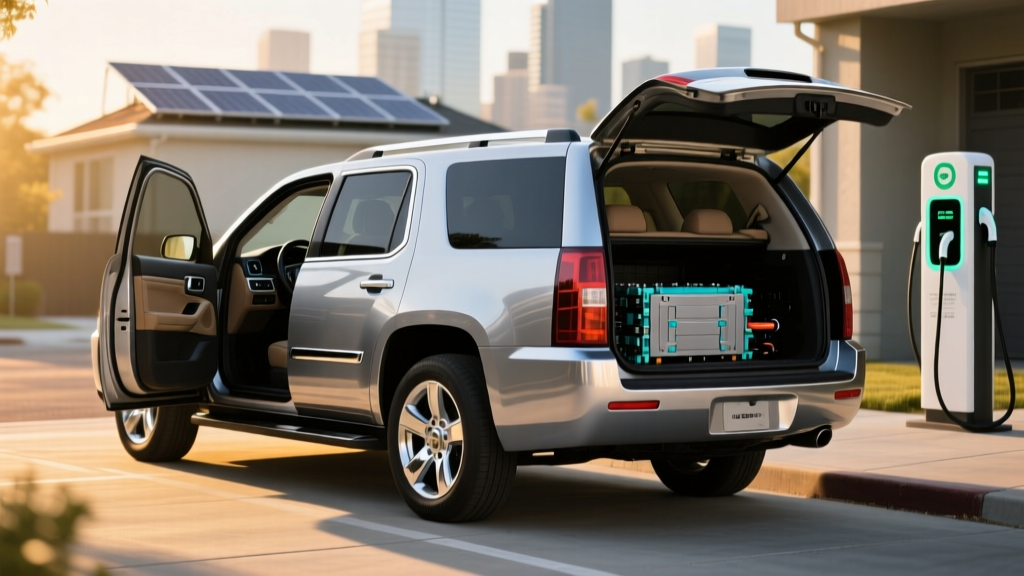
| Battery Pack | NiMH, ~1.8 kWh (gross), located under the second-row seat |
| Drivetrain | RWD (2WD) or AWD (4WD) |
| 0–60 mph | ~8.0 seconds |
| Max Towing | 6,000 lbs (2WD) / 5,800 lbs (4WD) |
| Curb Weight | ~5,840 lbs (2WD) |
How the Two-Mode System Works
The "two modes" refer to the transmission's operating ranges:
- Mode 1 (low-speed / city): At speeds below ~30 mph, the vehicle can operate on electric power alone for short bursts, or the engine can run on four cylinders (Active Fuel Management) while one motor provides assist. This is where the city MPG advantage comes from.
- Mode 2 (high-speed / highway): Above roughly 30 mph, the system locks into one of four fixed mechanical gear ratios for efficient power transfer. The electric motors still provide assist during acceleration but can't drive the wheels independently at highway speeds.
The result is a hybrid system that's effective in both city and highway driving — unusual for 2008. However, the ~1.8 kWh NiMH battery is tiny by modern standards (a 2026 RAV4 PHEV has 18.1 kWh), so electric-only assist is brief and limited to low speeds.
Hybrid Battery Lifespan, Warranty & Replacement Cost
For any used hybrid buyer, battery health is the single biggest financial risk. Here's what you need to know about the 2008 Yukon Hybrid's NiMH pack.
Original Warranty (Now Expired)
GM originally warranted the hybrid battery and related components for 8 years / 100,000 miles (10 years / 150,000 miles in California Air Resources Board states). In 2026, every 2008 Yukon Hybrid is well beyond factory hybrid-battery warranty coverage unless an extended aftermarket warranty was purchased and maintained.
Real-World Battery Lifespan
NiMH batteries are known for gradual, linear degradation rather than sudden failure. Based on owner reports and fleet data:
- Typical lifespan: 120,000–180,000 miles before noticeable capacity loss reduces hybrid functionality
- Symptoms of a failing pack: Reduced MPG (dropping to 15–17 combined), frequent engine running at stops, "Check Hybrid System" warning, reduced regenerative braking feel
- Complete failure: The vehicle will still drive on the gasoline engine alone, but fuel economy reverts to gas-model levels (~14–16 MPG combined)
Battery Replacement Cost in 2026
| Option | Estimated Cost | Notes |
|---|---|---|
| OEM New (GM) | $3,500–$5,500 + labor | Increasingly difficult to source for a 2008 model year; some dealers no longer stock this pack |
| Remanufactured Pack | $2,000–$3,500 + labor | Most common option; companies like Green Bean Battery offer refurbished NiMH packs with 1–3 year warranties |
| Individual Cell Replacement | $500–$1,500 | Independent hybrid shops can replace failed cells within the pack; requires diagnostic expertise |
| Used/Salvage Pack | $500–$1,200 + labor | Risky — unknown remaining lifespan; pulled from wrecked vehicles |
Labor typically adds $500–$1,000 depending on the shop. Total replacement cost for the most common path (remanufactured pack + professional install) runs $2,500–$4,500.
Reliability & Common Issues
The 2008 Yukon Hybrid shares its GMT900 platform with the Chevrolet Tahoe Hybrid and Cadillac Escalade Hybrid. Reliability data from nearly two decades of real-world use reveals a mixed picture.
Known Problem Areas
- Hybrid battery degradation: The most predictable expense. Budget $2,500–$4,500 for eventual replacement if the original pack hasn't been swapped.
- Active Fuel Management (AFM) lifter failure: The 6.0L V8's cylinder-deactivation system is prone to collapsed lifters, particularly past 100,000 miles. Repair cost: $2,000–$4,000. Some owners install an AFM disabler module (~$300) as preventive maintenance.
- Electric power steering (EPS): The Yukon Hybrid uses an electric power steering pump (to allow engine-off steering). These can fail and cost $800–$1,500 to replace.
- Transmission EVT issues: While generally robust, the complex EVT has been known to develop bearing or solenoid issues past 150,000 miles. Rebuild cost: $3,000–$5,000.
- Standard GMT900 issues: Dashboard cracking, power door lock actuator failures, and HVAC blend door problems — shared with all 2007–2014 Yukon/Tahoe models.
What Holds Up Well
- The 6.0L Vortec V8 (LFA engine code) is a proven, durable engine when maintained. With regular oil changes, 200,000+ miles is common.
- The twin electric motors in the EVT have proven extremely reliable — motor failures are rare.
- Brakes tend to last significantly longer than on gas-only Yukons due to regenerative braking reducing pad wear. Original brake pads at 80,000+ miles are not unusual.
2026 Used Pricing & Tax Credit Eligibility
The 2008 GMC Yukon Hybrid originally carried an MSRP of approximately $55,000–$62,000 depending on trim and options. In the 2026 used market:
| Condition | Mileage Range | Typical Asking Price (2026) |
|---|---|---|
| Excellent (battery replaced, well-maintained) | 100,000–140,000 | $7,000–$10,000 |
| Good (original battery, functional hybrid system) | 140,000–180,000 | $4,500–$7,000 |
| Fair (hybrid system degraded or non-functional) | 180,000+ | $2,500–$4,500 |
Federal Tax Credit Status
The 2008 Yukon Hybrid does not qualify for the current federal §30D Clean Vehicle Credit. That credit applies only to new qualifying plug-in vehicles (BEVs and PHEVs meeting battery sourcing, MSRP caps, and buyer income limits). Conventional hybrids without plug-in capability have not qualified for the federal purchase credit since the early Qualified Hybrid Vehicle tax credit expired — and even that original credit ($1,300–$2,200 for the Yukon Hybrid) phased out for GM vehicles in 2010.
Some states offer used-vehicle incentives or emissions-reduction rebates that may apply to older hybrids, but these vary widely by jurisdiction. Check your state's energy or environmental agency for current programs.
Who Should Buy the 2008 Yukon Hybrid — And Who Shouldn't
Pros
- ~30% better city MPG than gas-only Yukon/Tahoe (21 vs 14)
- Full three-row seating and 6,000-lb towing capability
- Longer brake life from regenerative braking
- Proven, torquey 6.0L V8 for highway passing and hauling
- Low used entry price ($4,500–$10,000)
Cons
- No electric-only range — this is an HEV, not a PHEV
- Hybrid battery replacement cost ($2,500–$4,500) may exceed vehicle value
- AFM lifter failure risk on the 6.0L V8
- No federal tax credit eligibility
- Outdated infotainment and safety tech by 2026 standards
- Highway MPG advantage over gas model is modest (22 vs 19)
Choose the 2008 Yukon Hybrid If:
- You need a cheap, large tow-capable SUV for occasional trailer use and want slightly lower fuel costs around town.
- You drive primarily in the city where the two-mode hybrid system delivers its biggest MPG advantage.
- You're mechanically inclined or have access to a hybrid-qualified independent shop for battery maintenance.
- Your budget is under $10,000 and you need three rows and a V8.
Look at a Modern PHEV or BEV Instead If:
- You want electric-only commuting. A 2026 Toyota Grand Highlander Hybrid Max or Chrysler Pacifica PHEV offers 28–32 miles of electric range plus 30+ MPG combined when the engine kicks in.
- You want current safety tech. Automatic emergency braking, blind-spot monitoring, and lane-keeping assist were not available on the 2008 Yukon. Modern SUVs include these as standard.
- You want federal tax credits. The used EV credit (§25E, up to $4,000) applies to qualifying used BEVs and PHEVs priced under $25,000 — but not to conventional hybrids.
- You don't want battery replacement risk. A gas-only 2015+ Yukon avoids the hybrid-battery wildcard entirely, though you'll spend more on fuel.
Frequently Asked Questions
How many MPG does the 2008 Yukon Hybrid get?
The EPA rates the 2WD model at 21 city / 22 highway / 21 combined. The 4WD version is rated at 20/20/20. In real-world mixed driving, expect 18–22 MPG depending on conditions, with towing dropping that to 12–15 MPG.
Can I plug in the 2008 Yukon Hybrid to charge?
No. The 2008 Yukon Hybrid is a conventional hybrid (HEV) with no plug and no external charging capability. Its NiMH battery charges only through regenerative braking and the gasoline engine. If you want plug-in capability, look at a PHEV like the 2026 Toyota Grand Highlander PHEV or the Chrysler Pacifica Hybrid.
How far can it go on electric only?
The 2008 Yukon Hybrid has no meaningful electric-only range. The two-mode system can creep at very low speeds (under ~30 mph) on electric power for brief distances — perhaps a quarter mile in stop-and-go traffic — but the 1.8 kWh NiMH battery depletes almost immediately. This is not a vehicle designed for electric-only driving.
Is the 2008 Yukon Hybrid reliable?
It's moderately reliable with caveats. The 6.0L V8 and electric motors are durable, but the Active Fuel Management lifters, hybrid battery, and electric power steering pump are known failure points past 100,000 miles. Budget $2,500–$4,500 for an eventual hybrid battery replacement. A pre-purchase inspection by a hybrid-qualified mechanic is essential.
What does a replacement hybrid battery cost?
A remanufactured NiMH battery pack costs $2,000–$3,500, with labor adding $500–$1,000, for a total of roughly $2,500–$4,500. New OEM packs are increasingly scarce and cost $3,500–$5,500 plus labor. Individual cell replacement at a specialist shop runs $500–$1,500 if only one or two cells have failed.
Does the 2008 Yukon Hybrid qualify for any tax credit in 2026?
No. The federal §30D Clean Vehicle Credit applies only to new plug-in vehicles (BEVs and PHEVs). The original Qualified Hybrid Vehicle credit for the Yukon Hybrid phased out for GM in 2010. The used-EV credit (§25E) also requires plug-in capability. No federal incentive is available. Check your state's energy office for any local programs.
How does it compare to a 2026 hybrid SUV?
Modern full-size hybrids like the 2026 Toyota Grand Highlander Hybrid (36 MPG combined) or the Ford Expedition PowerBoost (23 MPG combined, with limited electric-only assist) significantly outperform the 2008 Yukon Hybrid's 21 MPG. Modern systems use lighter, more energy-dense lithium-ion batteries, more powerful electric motors, and sophisticated thermal management. The 2008 model's advantage is its low used price — roughly one-sixth the cost of a new full-size hybrid.
Is the 2008 Yukon Hybrid a good tow vehicle?
It's adequate but not exceptional. Maximum tow rating is 6,000 lbs (2WD) or 5,800 lbs (4WD) — less than the gas-only Yukon's 7,600-lb rating. The hybrid system adds low-speed torque, but fuel economy while towing drops to 12–15 MPG, negating the hybrid advantage. For heavy towing, a modern turbocharged gas or diesel SUV is more capable.