Quick Verdict: A Pioneer That Still Commutes
The 2008 Honda Civic Hybrid was one of the first mainstream hybrid electric vehicles (HEVs) sold in the United States, competing directly with the Toyota Prius during a period of surging fuel prices. Nearly two decades later, it remains a recognizable name on the used-car market. If you're researching a 2008 Honda Civic Hybrid as a budget commuter, this guide covers the real-world MPG you can expect, the Integrated Motor Assist (IMA) battery's longevity and replacement cost, and how this early hybrid stacks up against modern HEVs, PHEVs, and full EVs in 2026.
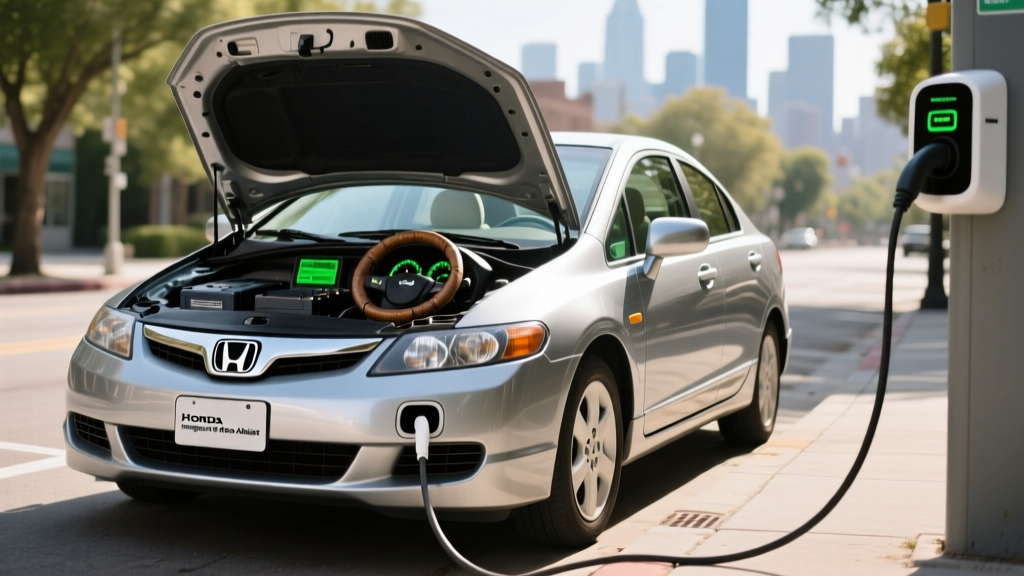
The 2008 Civic Hybrid is a conventional hybrid (HEV). It does not plug in. The small battery charges through regenerative braking and the gasoline engine. This is fundamentally different from a plug-in hybrid (PHEV), which has a larger battery, an external charging port, and a measurable electric-only driving range. If you're looking for plug-in capability, you'll need to consider a newer PHEV like the Toyota Prius Prime or Hyundai Tucson PHEV.
EPA Fuel Economy and Real-World MPG
The headline number for any hybrid buyer is fuel economy. Here's what the EPA rated the 2008 Honda Civic Hybrid at, alongside what owners actually report after years of real-world driving.
| Metric | EPA Rating | Real-World Owner Average |
|---|---|---|
| City MPG | 40 MPG | 36–42 MPG |
| Highway MPG | 45 MPG | 38–44 MPG |
| Combined MPG | 42 MPG | 37–43 MPG |
Source: fueleconomy.gov — 2008 Honda Civic Hybrid
Honda's IMA system in this generation was optimized for highway cruising, which is why the highway EPA number (45 MPG) actually exceeds the city figure. This is the opposite of the Toyota Prius, whose series-parallel hybrid system favors stop-and-go city driving. In practice, many owners report that the 2008 Civic Hybrid delivers its best economy on steady-speed suburban and highway commutes. Heavy city traffic with long idle periods yields less benefit because the IMA system has a relatively small electric motor (20 hp assist) compared to Toyota's full hybrid synergy drive.
Real-world caveat: A degraded IMA battery will reduce fuel economy by 3–8 MPG depending on severity. If the battery is original and has 150,000+ miles, expect MPG closer to the lower end of the ranges above until the battery is replaced or reconditioned.
Powertrain and Performance Specs
| Specification | Value |
|---|---|
| Gasoline Engine | 1.3L i-VTEC 4-cylinder (95 hp @ 6,000 rpm) |
| Electric Motor (IMA) | 20 hp / 76 lb-ft assist |
| Combined System Output | 110 hp @ 6,000 rpm / 123 lb-ft @ 1,000–2,500 rpm |
| Transmission | CVT (Continuously Variable Transmission) |
| 0–60 mph (est.) | ~11.5 seconds |
| Drivetrain | Front-wheel drive |
| Fuel Tank | 12.4 gallons |
| Total Driving Range | ~520 miles (combined) |
| Curb Weight | ~2,850 lbs |
The IMA (Integrated Motor Assist) system is a mild hybrid architecture. The electric motor sits between the engine and transmission and provides torque fill during acceleration, but it cannot propel the car on electric power alone for any meaningful distance. Unlike Toyota's Hybrid Synergy Drive, the Civic Hybrid cannot drive in EV mode at low speeds. The engine does shut off at stops (auto idle-stop) and during light-load deceleration (cylinder deactivation via VTEC), which is where much of the fuel savings come from.
IMA Battery: Chemistry, Lifespan, and Replacement Cost
The 2008 Civic Hybrid uses a nickel-metal hydride (NiMH) battery pack — not the lithium-ion chemistry found in modern hybrids and EVs. The pack is relatively small, rated at approximately 0.65 kWh (nominal), mounted behind the rear seat. This is a fraction of the capacity in even a modest modern PHEV (typically 10–18 kWh) and reflects the IMA system's role as a torque-assist rather than a primary propulsion source.
How Long Does the IMA Battery Last?
This is the single most important ownership question for a 2008 Civic Hybrid buyer. Based on owner reports, Honda dealer service data, and aftermarket reconditioning shops:
- Original battery typical lifespan: 100,000–150,000 miles (roughly 8–12 years depending on climate and driving patterns)
- Failure mode: Gradual capacity loss leading to reduced MPG, more frequent engine cycling, and eventually an IMA warning light on the dashboard
- Hot-climate degradation: Batteries in Arizona, Texas, and similar states tend to fail earlier (closer to 80,000–100,000 miles) due to heat accelerating NiMH cell degradation
Battery Replacement Options and Costs (2026)
| Option | Estimated Cost | Expected Lifespan |
|---|---|---|
| New OEM Honda IMA battery (dealer) | $2,500–$3,500 (parts + labor) | 100,000–150,000 mi |
| Aftermarket new NiMH pack (e.g., BumbleBee Batteries, Green Bean Battery) | $1,200–$2,000 (parts + install) | 80,000–120,000 mi |
| Reconditioned / refurbished pack | $600–$1,200 | 40,000–80,000 mi |
| DIY cell-level reconditioning (advanced) | $150–$400 (parts only) | Variable, 30,000–60,000 mi |
Cost reality check: A dealer-installed OEM battery at $3,000+ can approach or exceed the vehicle's market value (typically $3,000–$5,500 for a 2008 Civic Hybrid in 2026 depending on mileage and condition). Most owners opt for aftermarket packs or reconditioned units to keep the repair economically justified. Several aftermarket providers offer their own warranties of 3–5 years.
Reliability and Common Issues
The 2008 Civic Hybrid's reputation is mixed — the underlying Civic platform is durable, but the IMA system introduces specific failure points that non-hybrid Civics don't share.
Known Problem Areas
- IMA battery failure: The most common and costly issue. See battery section above.
- CVT transmission shudder: Some owners report a juddering sensation during low-speed acceleration. Honda issued software updates and, in some cases, extended CVT warranty coverage. At 150,000+ miles, CVT wear is a consideration.
- Motor mount deterioration: The front motor mount wears prematurely under the combined torque pulses of the IMA system. Replacement is ~$300–$500.
- 12V battery drain: The auxiliary 12V battery can drain if the car sits for extended periods, as the IMA system draws a small standby current. Standard 12V battery replacement: $120–$180.
- Brake actuator / regen blending: The transition between regenerative braking and friction braking can feel abrupt, especially as the IMA battery ages and accepts less regen current.
For reliability reference, the non-hybrid 2008 Civic (1.8L and 2.0L gasoline models) is widely considered one of the most reliable compact cars of its era. The hybrid variant's reliability is largely contingent on IMA battery health — with a fresh battery, the car is dependable; with a failing one, it becomes a money pit relative to its value.
Pricing in 2026 and Tax Credit Eligibility
| Metric | Value |
|---|---|
| Original MSRP (2008) | $22,600 (single trim) |
| Used Market Price (2026, typical) | $3,000–$5,500 |
| Federal Tax Credit | None (see below) |
Does the 2008 Honda Civic Hybrid Qualify for Any Tax Credit?
No. The 2008 Civic Hybrid does not qualify for any current federal tax credit. Here's why:
- §30D New Clean Vehicle Credit: Only applies to new vehicles purchased new. A 2008 model is not eligible. (IRS §30D rules)
- §25E Previously-Owned Clean Vehicle Credit: This credit (up to $4,000 or 30% of sale price, whichever is less) applies to used EVs and PHEVs sold for $25,000 or less through a licensed dealer. However, the vehicle must be a plug-in electric vehicle or fuel cell vehicle. Conventional hybrids like the Civic Hybrid (HEV) do not qualify because they lack a plug and do not meet the minimum 4 kWh battery capacity requirement for PHEVs under the statute.
- Historical credit (expired): When new, the 2008 Civic Hybrid qualified for a federal income tax credit of up to $2,100 under the Energy Policy Act of 2005. This credit phased out for Honda vehicles after mid-2008 and is no longer claimable.
2008 Civic Hybrid vs. Modern Alternatives: HEV, PHEV, and EV
If you're weighing a used 2008 Civic Hybrid against other options, here's how the decision framework breaks down across the three electrified categories:
Examples: 2008 Civic Hybrid, Toyota Prius, modern Hyundai Elantra Hybrid
- No plug needed
- 40–57 MPG combined
- Lower purchase cost (used)
- No electric-only range
- Best for: budget commuters without home charging
Examples: Toyota Prius Prime, Hyundai Tucson PHEV
- 25–44 miles electric-only
- Plugs in (Level 1 or Level 2)
- 46–52 MPG combined after battery depletes
- May qualify for §30D credit ($3,750–$7,500)
- Best for: short commutes + occasional road trips
Examples: Chevrolet Equinox EV, Tesla Model 3, Hyundai Ioniq 5
- 250–360+ miles range
- No gasoline at all
- DC fast charging (100–350 kW)
- $7,500 federal credit eligible (new)
- Best for: home-charging access, lowest fuel cost
How Does the 2008 Civic Hybrid Compare to a Modern HEV?
Against a 2026 Toyota Prius (57 MPG combined EPA, starting ~$29,000), the 2008 Civic Hybrid is 15 MPG behind on fuel economy but costs $24,000 less to acquire. The math works if your annual mileage is moderate. At 12,000 miles/year and $3.40/gallon gas:
- 2008 Civic Hybrid (42 MPG): ~$971/year in fuel
- 2026 Prius (57 MPG): ~$716/year in fuel
- Annual fuel savings of the new Prius: ~$255/year
- Time to recoup a $24,000 price premium at $255/year: ~94 years
The used Civic Hybrid wins on pure acquisition cost if you can secure one with a healthy battery or budget for a replacement.
Who Should Buy the 2008 Honda Civic Hybrid?
- Very low purchase price ($3,000–$5,500)
- 42 MPG combined — still competitive for an older vehicle
- No plug-in infrastructure required
- Comfortable ride, decent cargo space for a compact
- Strong non-hybrid Civic parts availability
- Proven Honda durability (engine, chassis)
- IMA battery likely needs replacement (or has been replaced)
- No tax credits available
- 110 hp combined — underpowered by modern standards
- CVT transmission can be a costly failure point
- NiMH battery tech is outdated vs modern Li-ion hybrids
- No EV-only driving mode
- Safety tech is minimal (no AEB, no lane-keep, no blind-spot)
Buy it if: You need an ultra-budget commuter with strong MPG, you can verify the IMA battery has been recently replaced with a quality unit, and you don't have access to home or workplace charging (ruling out PHEVs and EVs). It's also a reasonable choice for a secondary car or a teen driver's first vehicle.
Skip it if: The IMA battery is original with 130,000+ miles and the seller won't discount accordingly. The $1,500–$3,000 replacement cost can negate the value proposition. Also skip it if you want modern safety features (automatic emergency braking, lane departure warning) — those weren't available on any 2008 compact.
Frequently Asked Questions
How many MPG does the 2008 Honda Civic Hybrid get?
The EPA rates it at 40 city / 45 highway / 42 combined MPG. Real-world owners typically report 37–43 MPG combined depending on battery health, driving style, and climate. Highway driving at steady speeds tends to yield the best results, which is unusual for a hybrid — most modern hybrids favor city driving due to more aggressive regenerative braking systems.
Is the 2008 Honda Civic Hybrid a plug-in?
No. The 2008 Civic Hybrid is a conventional hybrid (HEV). It has no plug and no electric-only driving range. The small NiMH battery charges exclusively through regenerative braking and the gasoline engine. You fuel it like a normal car — just less frequently.
How much does it cost to replace the hybrid battery?
A new OEM Honda IMA battery costs $2,500–$3,500 installed at a dealer. Aftermarket new packs run $1,200–$2,000 installed, and reconditioned packs cost $600–$1,200. Given the car's market value of $3,000–$5,500, most owners choose aftermarket or reconditioned options. Several aftermarket suppliers offer 3–5 year warranties on their packs.
Is the 2008 Civic Hybrid reliable?
The underlying Civic platform (engine, chassis, suspension) is very reliable. The IMA battery is the primary reliability concern — it will need replacement at 100,000–150,000 miles. The CVT transmission is generally durable but can develop shudder issues at high mileage. With a fresh IMA battery, the car is a dependable daily driver. Without one, expect degraded performance and fuel economy.
Does the 2008 Honda Civic Hybrid qualify for a federal tax credit?
No. The original $2,100 federal tax credit expired in 2008. The current §25E used-vehicle credit only applies to plug-in vehicles (PHEVs and BEVs), not conventional hybrids. There are no federal incentives for purchasing a used 2008 Civic Hybrid. Some states may offer minimal registration or inspection fee differences, but no meaningful purchase incentives exist.
How does it compare to a 2008 Toyota Prius?
The 2008 Prius is rated at 48 MPG combined (EPA) — 6 MPG better than the Civic Hybrid — and has a more sophisticated full-hybrid system that can drive on electric power alone at low speeds. However, the Prius also has a larger, more expensive NiMH battery pack (replacement: $2,000–$3,500 aftermarket). The Civic Hybrid offers a more conventional driving feel (it drives like a normal Civic), while the Prius has a more distinctive hybrid character with its planetary gearset CVT. On the used market, the 2008 Prius typically commands $500–$1,500 more than the Civic Hybrid.
Should I buy a used 2008 Civic Hybrid or a newer used hybrid?
If your budget is strictly under $6,000, the 2008 Civic Hybrid is one of the most fuel-efficient options available. If you can stretch to $10,000–$14,000, a 2016–2019 Toyota Prius or Hyundai Ioniq Hybrid will deliver 52–58 MPG with a more modern lithium-ion battery, better safety tech, and remaining factory hybrid warranty coverage. The newer car also avoids the NiMH aging issues inherent to the 2008 Civic's older battery chemistry.