The 2008 Ford Escape Hybrid: An Early HEV Pioneer Evaluated for 2026
Long before plug-in hybrids and 300-mile EVs dominated headlines, the Ford Escape Hybrid helped mainstream electrified driving in the U.S. The 2008 model year represents the first generation of Ford's compact hybrid SUV, built on a powertrain co-developed with Toyota's Hybrid Synergy Drive architecture. In 2026, these vehicles are approaching 18 years old — making reliability, battery health, and real-world fuel economy the critical questions for anyone considering one as a budget commuter or second vehicle.
This guide covers exactly what the 2008 Ford Escape Hybrid delivers in MPG, how its conventional hybrid (HEV) system works, what battery replacement actually costs, and whether it still makes financial sense compared to a modern PHEV or full EV.
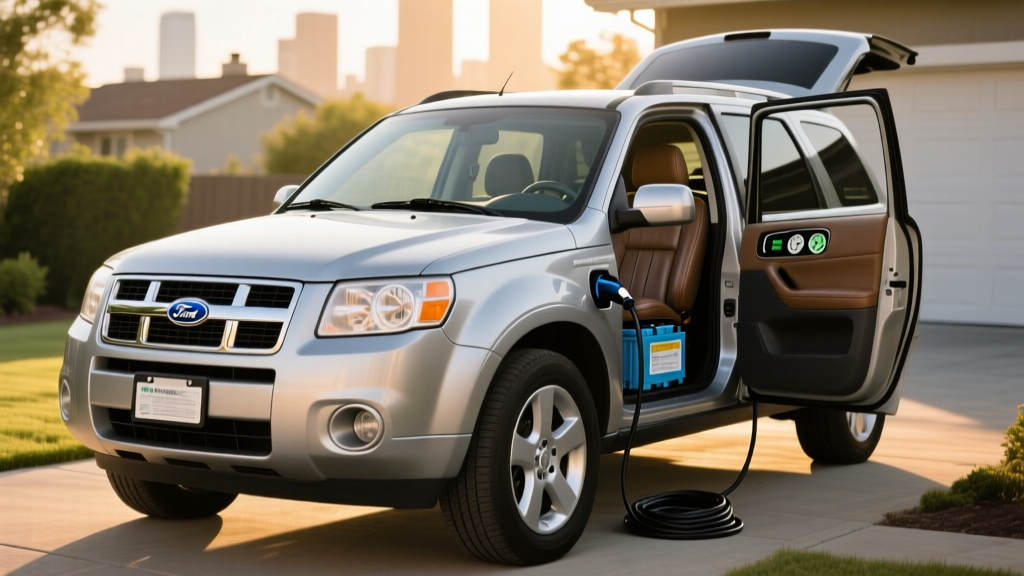
The 2008 Ford Escape Hybrid is a conventional hybrid (HEV). It does not plug in. It has no electric-only driving range. The battery recharges exclusively through regenerative braking and the gasoline engine. This is fundamentally different from a plug-in hybrid (PHEV) like the modern Toyota RAV4 Prime or Ford Escape PHEV, which offers 30–40 miles of electric-only range and requires wall or station charging to realize its efficiency gains. If you're looking for plug-in capability, the 2008 Escape Hybrid does not offer it.
2008 Ford Escape Hybrid: Full Spec Table
| Specification | 2008 Ford Escape Hybrid (FWD) | 2008 Ford Escape Hybrid (AWD) |
|---|---|---|
| Powertrain Type | Conventional Hybrid (HEV) | Conventional Hybrid (HEV) |
| Gas Engine | 2.3L Atkinson-cycle I4, 133 hp | 2.3L Atkinson-cycle I4, 133 hp |
| Electric Motor | Permanent-magnet AC synchronous, 94 hp | Permanent-magnet AC synchronous, 94 hp |
| Combined Net Horsepower | 155 hp | 155 hp |
| Transmission | eCVT (planetary gearset) | eCVT (planetary gearset) |
| Hybrid Battery | NiMH, ~1.3 kWh (nominal) | NiMH, ~1.3 kWh (nominal) |
| EPA City MPG | 34 mpg | 29 mpg |
| EPA Highway MPG | 30 mpg | 27 mpg |
| EPA Combined MPG | 32 mpg | 28 mpg |
| Plug-In Charging | No — self-charging only | No — self-charging only |
| Electric-Only Range | N/A (brief low-speed EV mode only) | N/A |
| 0–60 mph (est.) | ~10.5 seconds | ~11.0 seconds |
| Original MSRP | ~$26,995 (base) | ~$28,995 (base) |
| 2026 Used Price Range | $3,500 – $7,000 (depending on mileage & condition) | |
Fuel Economy: EPA Ratings vs Real-World MPG
According to EPA data on fueleconomy.gov, the front-wheel-drive 2008 Ford Escape Hybrid achieves 34 mpg city / 30 mpg highway / 32 mpg combined. The all-wheel-drive variant drops to 29/27/28 mpg respectively.
| Metric | EPA Rating (FWD) | Real-World Expectation |
|---|---|---|
| City Driving | 34 mpg | 32–36 mpg (hybrids often exceed EPA in stop-and-go) |
| Highway Driving | 30 mpg | 26–30 mpg (less regen benefit at steady speed) |
| Combined | 32 mpg | 28–33 mpg (varies with battery health & driving style) |
| Cold Weather Impact | — | 10–15% reduction (engine runs more for cabin heat) |
The key advantage of a conventional hybrid like this Escape is city efficiency. The electric motor handles low-speed propulsion and assists during acceleration, while regenerative braking recaptures energy in stop-and-go traffic. On the highway, where the gasoline engine does most of the work, the advantage over a conventional gas Escape narrows considerably. Owner-reported data on fueleconomy.gov shows real-world averages clustering around 28–31 mpg combined, with some drivers achieving 34+ mpg in predominantly urban driving.
Age-related caveat: A 2008 model in 2026 is 18 years old. NiMH battery degradation, aging oxygen sensors, and general engine wear can reduce efficiency by 5–10% from original ratings. A well-maintained example with a healthy battery pack will track closer to EPA numbers; one with a degraded battery will lean more on the gasoline engine and return lower figures.
Powertrain Deep Dive: How the 2008 Escape Hybrid Works
The 2008 Escape Hybrid pairs a 2.3-liter Atkinson-cycle four-cylinder engine (133 hp, 129 lb-ft torque) with a 94-hp permanent-magnet electric motor through an electronically controlled continuously variable transmission (eCVT). This is not a belt-driven CVT — it uses a planetary gearset that seamlessly blends power from both sources, a design shared with the Toyota Prius of the same era.
The combined system output is 155 net horsepower. The electric motor provides strong low-end torque fill, making the Escape Hybrid feel reasonably responsive from a stop despite its modest 0–60 mph time of approximately 10.5 seconds. The eCVT eliminates shift shock entirely, though it produces the characteristic "rubber-band" engine drone under hard acceleration that was common to early hybrids.
The nickel-metal hydride (NiMH) battery pack stores approximately 1.3 kWh of energy — tiny by modern standards (a current PHEV packs 15–20 kWh; a full EV, 60–100 kWh). This small buffer is enough to power brief low-speed electric-only movement (under ~25 mph, for short distances), assist during acceleration, and store energy recaptured from regenerative braking. The system manages all of this automatically — there is no plug, no charging cable, and no driver intervention required.
Hybrid Battery Lifespan, Warranty, and Replacement Cost
Ford originally warranted the 2008 Escape Hybrid's NiMH battery pack for 8 years / 100,000 miles (extended to 10 years / 150,000 miles in California Air Resources Board states). As of 2026, all factory battery warranties on 2008 models have expired by time, though some low-mileage examples in CARB states may have been covered until 2018.
NiMH batteries in this generation of Escape Hybrid have proven remarkably durable. Many owner reports document 150,000–200,000+ miles on the original pack with minimal capacity loss. Unlike lithium-ion chemistries, NiMH degrades more gradually and is less susceptible to sudden capacity cliff-falloff. However, at 18 years old, any 2008 Escape Hybrid still on its original battery is operating on borrowed time.
Battery replacement cost in 2026:
- OEM new battery pack (Ford dealer): $3,000 – $4,500 installed
- Remanufactured/reconditioned pack: $1,500 – $2,500 installed (most common choice for a vehicle in this price range)
- Individual cell/module replacement: $400 – $800 at a hybrid specialist shop (if only a few modules have failed)
- Junkyard/salvage pack: $300 – $600 (high risk — unknown remaining lifespan)
For a vehicle worth $3,500–$7,000 on the used market, a full OEM battery replacement rarely makes financial sense. Most owners opt for a remanufactured pack from suppliers like Green Bean Battery or Dorman, which typically include a 3–5 year warranty. The replacement process takes 2–4 hours at a qualified hybrid shop and does not require specialized Ford dealer equipment.
Warning signs of battery degradation: Noticeably reduced MPG (dropping below 25 mpg combined), the gasoline engine running constantly even at low speeds, reduced regenerative braking feel, and a dashboard warning light indicating a hybrid system fault. A hybrid battery diagnostic scan (available at most hybrid specialists for $50–$100) can identify individual weak modules before complete failure.
Tax Credits and Incentives: What Applies in 2026?
The 2008 Ford Escape Hybrid originally qualified for a federal income tax credit of up to $650 under the pre-2009 Energy Policy Act hybrid credit (not the modern §30D clean vehicle credit). This credit phased out for Ford hybrids after 2010 and is no longer available for any purchase.
For a used 2008 Escape Hybrid purchased in 2026:
- Federal §30D new vehicle credit: Does not apply (used vehicle, and the model is long discontinued)
- Federal used EV credit (§25E): Does not apply — this credit covers used BEVs and PHEVs only, not conventional hybrids (HEVs)
- State incentives: A small number of states offer modest rebates or HOV lane access for hybrids, but most have shifted incentives exclusively to PHEVs and BEVs. Check your state's energy office or the DOE's Alternative Fuels Data Center for current state-level programs.
Bottom line: there are no meaningful tax credits available for purchasing a 2008 Ford Escape Hybrid in 2026. The purchase decision rests entirely on the vehicle's low acquisition cost and fuel savings relative to a gas-only alternative.
2008 Escape Hybrid vs Modern Alternatives: HEV, PHEV, or EV?
If you're cross-shopping a used 2008 Escape Hybrid, you're likely also considering modern hybrids, plug-in hybrids, or entry-level EVs. Here's how the decision breaks down:
| Factor | 2008 Escape Hybrid (HEV) | Modern HEV (e.g., 2026 RAV4 Hybrid) | Modern PHEV (e.g., 2026 Escape PHEV) | Entry-Level EV (e.g., Chevy Equinox EV) |
|---|---|---|---|---|
| Acquisition Cost | $3,500–$7,000 | $32,000–$40,000 | $38,000–$45,000 | $33,000–$42,000 |
| Combined MPG / MPGe | 28–32 mpg | 38–41 mpg | 40+ mpg / 100+ MPGe | 100+ MPGe (no gas) |
| Plugs In? | No | No | Yes (Level 1/2) | Yes (Level 1/2/DC) |
| Tax Credit Eligible? | No | No | Up to $7,500 (§30D)* | Up to $7,500 (§30D)* |
| Reliability Risk | Moderate–High (age) | Low (warranty) | Low (warranty) | Low (warranty) |
| Annual Fuel Cost (est.) | ~$1,450 | ~$1,100 | ~$600–$900 | ~$500–$700 |
* §30D federal tax credit eligibility depends on MSRP caps, buyer income limits, battery critical-mineral sourcing, and point-of-sale transfer rules. Verify current-year requirements at irs.gov or consult a tax professional.
Choose the 2008 Escape Hybrid if: Your budget is under $7,000, you need an AWD-capable compact SUV for commuting, you have no access to plug-in charging, and you're comfortable accepting higher maintenance risk for a dramatically lower purchase price.
Choose a modern HEV if: You want hybrid fuel economy with full warranty coverage, modern safety features (AEB, lane-keeping, adaptive cruise), and don't want to plug in. Budget: $30K+.
Choose a PHEV if: You have home charging access, your daily commute is under 40 miles, and you want to drive mostly on electricity while keeping a gas engine for road trips. Budget: $35K+ after potential tax credits.
Choose a full EV if: You have reliable home or workplace charging, want the lowest per-mile fuel cost, and are ready to commit to electric-only driving. Budget: $30K+ after potential tax credits.
Reliability Track Record and Common Issues
The 2008 Escape Hybrid's powertrain is one of the most proven hybrid systems ever sold in the U.S. Ford licensed key hybrid technology from Toyota/Aisin, and the eCVT planetary gearset is essentially bulletproof — there are no belts, clutches, or traditional transmission components to wear out. The electric motor has no brushes and requires zero maintenance.
Common issues reported by high-mileage owners include:
- Hybrid battery degradation: The most significant expense. NiMH cells lose capacity gradually; expect reduced electric-assist and slightly lower MPG after 150K+ miles.
- Brake actuator/ABS module: Some 2008–2012 Escape Hybrids experienced premature wear in the regenerative brake actuator assembly. Replacement runs $800–$1,500.
- Electric power steering (EPS): Intermittent failures reported; Ford issued extended coverage on some model years.
- Standard age-related wear: Suspension bushings, engine mounts, coolant system hoses, and the 12V auxiliary battery all require typical maintenance for a vehicle of this age.
The hybrid-specific components (eCVT, electric motor, inverter) have proven extremely reliable. Most mechanical issues on a 2008 model are the same age-related wear items you'd find on any 18-year-old vehicle — not hybrid-specific failures.
Pros and Cons: The Honest 2026 Verdict
- Very low acquisition cost ($3,500–$7,000)
- Proven, Toyota-derived hybrid powertrain
- 32 mpg combined (FWD) — still competitive with some new non-hybrid SUVs
- No plug-in charging required — works anywhere gas does
- eCVT is virtually maintenance-free
- AWD available for snow/rain climates
- Remanufactured battery replacements widely available at reasonable cost
- 18 years old — all major components are on borrowed time
- No modern safety tech (no AEB, no blind-spot monitoring, no backup camera standard)
- Sluggish acceleration (10.5 sec 0–60)
- Hybrid battery replacement likely needed if still original
- No tax credits or incentives available
- Dated interior, infotainment, and NVH refinement
- Spare parts supply declining for model-specific components
Frequently Asked Questions
How many MPG does the 2008 Ford Escape Hybrid get?
The EPA rates the FWD model at 34 city / 30 highway / 32 combined mpg. The AWD model rates 29/27/28. Real-world owners report 28–33 mpg combined depending on driving mix, battery health, and climate. City-heavy driving tends to yield higher numbers thanks to regenerative braking.
Does the 2008 Escape Hybrid need to be plugged in?
No. It is a conventional hybrid (HEV), not a plug-in hybrid (PHEV). The battery charges exclusively through regenerative braking and the gasoline engine. You simply fill it with gasoline and drive — no charging cable, no outlet, no behavioral change required.
How far can the 2008 Escape Hybrid drive on electric power alone?
It cannot meaningfully drive on electric power alone. The system can propel the vehicle at very low speeds (under ~25 mph) for brief distances (a few hundred yards) in EV mode, such as creeping through a parking lot. This is not a usable electric-only range — it's an efficiency assist feature. If you want electric-only commuting, you need a PHEV or a full BEV.
Is the 2008 Ford Escape Hybrid reliable?
The hybrid powertrain itself (eCVT, electric motor, inverter) is among the most reliable ever produced, benefiting from Toyota-licensed engineering. The main reliability concern in 2026 is age: at 18 years old, the hybrid battery, brake actuator, suspension, and all rubber/plastic components are subject to wear and degradation. A well-maintained example with a replaced or healthy battery can be a dependable commuter, but buyers should budget $1,000–$2,500 for potential hybrid battery work.
What does it cost to replace the hybrid battery?
A remanufactured NiMH battery pack costs $1,500–$2,500 installed at a hybrid specialist shop. A new OEM pack from a Ford dealer runs $3,000–$4,500. Individual module replacement (if only a few cells have failed) can cost $400–$800. Given the vehicle's $3,500–$7,000 market value, most owners choose the remanufactured route.
Does the 2008 Escape Hybrid qualify for any tax credit in 2026?
No. The original federal hybrid tax credit (up to $650) expired for Ford hybrids after 2010. The current §30D clean vehicle credit and the §25E used EV credit both apply only to plug-in vehicles (PHEVs and BEVs), not conventional hybrids. No state or federal incentive is currently available for this vehicle. Always verify current rules at irs.gov.
Should I buy a 2008 Escape Hybrid or a newer hybrid?
If your budget is strictly under $7,000 and you need an economical AWD SUV, the 2008 Escape Hybrid offers strong fuel economy for the money — but accept the age-related maintenance risk. If you can afford $25,000+, a 2018–2022 Toyota RAV4 Hybrid or Honda CR-V Hybrid offers 40+ mpg, modern safety features, remaining warranty coverage, and far lower risk of costly repairs. The 2008 model makes sense as a budget stopgap, not a long-term ownership commitment.