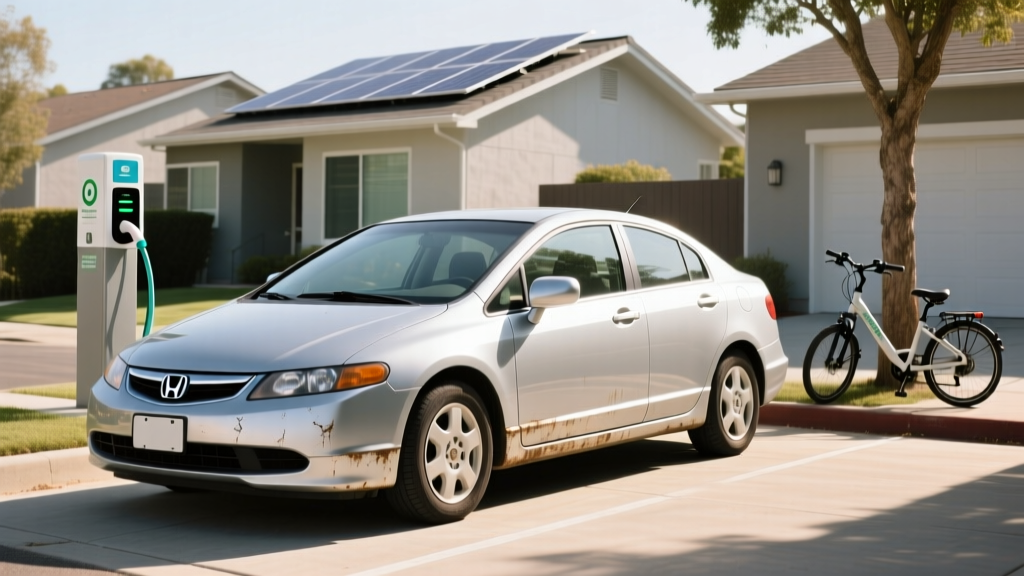
The 2007 Honda Civic Hybrid was one of the most fuel-efficient cars sold in America when it debuted, and nearly two decades later, it still draws interest from budget-conscious drivers and hybrid-curious shoppers. If you're researching the 2007 Honda Civic Hybrid fuel economy, you're likely evaluating a used purchase, comparing it against modern hybrids, or trying to understand what kind of efficiency a first-generation IMA (Integrated Motor Assist) system actually delivers on today's roads.
This guide covers every number that matters: EPA ratings, real-world MPG data, the nickel-metal hydride (NiMH) battery's longevity, replacement costs, and how this early hybrid stacks up against 2026 alternatives — from the Toyota Prius to plug-in hybrids and full EVs.
2007 Honda Civic Hybrid Fuel Economy: EPA Ratings vs. Real-World MPG
The 2007 Civic Hybrid carries EPA ratings that were class-leading at the time. Under the EPA's revised testing methodology (which applies retroactively to older models on fueleconomy.gov), the numbers break down as follows:
| Metric | Value |
|---|---|
| City MPG | 49 MPG |
| Highway MPG | 51 MPG |
| Combined MPG | 50 MPG |
| Fuel Tank Capacity | 13.2 gallons |
| Total Range (est.) | ~660 miles |
| Annual Fuel Cost (EPA est.) | ~$950 (at $3.20/gal) |
It's critical to understand why real-world numbers fall short of the EPA sticker. The 2007 Civic Hybrid uses Honda's IMA system, which pairs a 1.3-liter four-cylinder engine with a thin 15-kW electric motor sandwiched between the engine and CVT transmission. Unlike the Toyota Prius's full hybrid system, the IMA cannot propel the car on electric power alone at any meaningful speed. The electric motor assists during acceleration and enables idle stop (engine shutoff at red lights), but the gas engine is always doing the heavy lifting.
How the IMA Hybrid System Works (HEV, Not PHEV)
The 2007 Civic Hybrid is a conventional hybrid electric vehicle (HEV) — it does not plug in, has no electric-only driving range, and charges its small battery entirely through regenerative braking and the gasoline engine. This is a fundamentally different architecture from a plug-in hybrid (PHEV) like the 2026 Toyota Prius Prime or a full battery electric vehicle (BEV).
| Feature | HEV (2007 Civic Hybrid) | PHEV (e.g., Prius Prime) | BEV (e.g., Tesla Model 3) |
|---|---|---|---|
| Plugs In? | No | Yes (Level 1/2) | Yes (Level 1/2/DC) |
| Electric-Only Range | 0 miles | 35–45 miles | 250–360+ miles |
| Battery Size | ~0.5 kWh (NiMH) | 13.6 kWh (Li-ion) | 60–82 kWh (Li-ion) |
| Federal Tax Credit (§30D) | Not eligible | Up to $7,500* | Up to $7,500* |
| Home Charging Needed? | No | Recommended | Required |
| Tailpipe Emissions | Low | Low (zero in EV mode) | Zero |
*§30D tax credit eligibility depends on MSRP caps, buyer income limits, and battery mineral sourcing requirements. See IRS.gov for current-year rules.
Powertrain Specs: Engine, Motor, and Combined Output
| Specification | Value |
|---|---|
| Gasoline Engine | 1.3L i-DSI 4-cylinder |
| Engine Horsepower | 93 hp @ 6,000 rpm |
| Electric Motor (IMA) | 15 kW (20 hp) @ 1,000 rpm |
| Combined System Output | 110 hp @ 6,000 rpm |
| Combined Torque | 123 lb-ft @ 1,000–2,500 rpm |
| Transmission | CVT (Continuously Variable) |
| Drivetrain | Front-wheel drive |
| 0–60 mph (est.) | ~11.0 seconds |
| Battery Chemistry | NiMH (Nickel-Metal Hydride) |
| Battery Capacity | ~0.5 kWh (nominal) |
The combined 110 hp is adequate for city merging and suburban driving, but highway passing requires planning. The CVT keeps the engine in its most efficient RPM band, which helps fuel economy but produces the characteristic "drone" under hard acceleration that Civic Hybrid owners know well. The IMA motor's 15 kW of assist is small by modern standards — for comparison, the 2026 Toyota Prius hybrid uses a combined 196 hp system — but it was effective for its era.
IMA Battery Lifespan, Warranty, and Replacement Cost
The IMA battery in the 2007 Civic Hybrid is a nickel-metal hydride (NiMH) pack — not the lithium-ion chemistry used in modern EVs and PHEVs. NiMH batteries are durable but not immune to degradation. The most common failure mode is cell imbalance: individual cells within the pack weaken unevenly, causing the battery management system to reduce usable capacity and triggering the IMA warning light on the dashboard.
Expected lifespan: Most owner reports and mechanic surveys place the IMA battery's functional life at 120,000–170,000 miles, though some units fail earlier (especially in hot climates where under-hood temperatures stress the NiMH cells) and others exceed 200,000 miles with gentle use.
Replacement cost in 2026:
- New OEM IMA battery (Honda dealer): $2,000–$3,500 including labor
- Refurbished/remanufactured pack: $900–$1,600 including labor
- Aftermarket grid-charger-balanced pack: $600–$1,000 (DIY-friendly options exist from specialist shops)
- Junkyard pull (used, untested): $200–$500 — high risk of inheriting someone else's degraded battery
Many owners of 2007 Civic Hybrids opt for the refurbished route, which typically includes cell balancing and a 1–3 year warranty from the rebuilder. A grid charger (an aftermarket device that slowly balances the NiMH cells) costs $200–$400 and can extend a weakening battery's life by 1–2 years if used proactively.
2007 Civic Hybrid vs. Modern Hybrids: Is the Efficiency Gap Worth the Savings?
If you're cross-shopping a used 2007 Civic Hybrid against a new or newer hybrid, the efficiency and technology gap is significant. Here's how the numbers compare:
| Vehicle | EPA Combined MPG | Combined HP | Battery | Approx. Price |
|---|---|---|---|---|
| 2007 Honda Civic Hybrid (used) | 50 MPG (EPA) / ~42 real-world | 110 hp | 0.5 kWh NiMH | $3,000–$6,000 |
| 2026 Toyota Prius LE (new) | 57 MPG combined | 196 hp | 1.0 kWh Li-ion | $29,450 MSRP |
| 2026 Hyundai Elantra Hybrid (new) | 54 MPG combined | 139 hp | 1.6 kWh Li-ion | $26,500 MSRP |
| 2026 Toyota Prius Prime (PHEV) | 52 MPG + 44 mi EV range | 220 hp | 13.6 kWh Li-ion | $34,000 MSRP |
The 2007 Civic Hybrid's headline advantage is purchase price. At $3,000–$6,000 on the used market (depending on mileage and condition), it's accessible to buyers who can't stretch to a $26,000+ new hybrid. The tradeoffs are clear: less power, older safety equipment (no automatic emergency braking, no lane-keeping assist), a NiMH battery nearing or past its expected lifespan, and real-world fuel economy that falls 8–12 MPG below the EPA sticker.
Modern hybrids also benefit from lithium-ion batteries that degrade more slowly, more sophisticated regenerative braking systems, and powertrains that can operate in electric-only mode at low speeds — all of which improve real-world efficiency and driving refinement.
Does the 2007 Civic Hybrid Qualify for Any Tax Credit?
No. The 2007 Honda Civic Hybrid does not qualify for the federal §30D Clean Vehicle Credit. That credit applies only to new plug-in electric vehicles (BEVs and PHEVs) meeting specific battery sourcing, MSRP, and buyer income requirements. Conventional hybrids (HEVs) that don't plug in have never been eligible for §30D.
When the 2007 Civic Hybrid was new, buyers could claim a much smaller Alternative Motor Vehicle Credit (a one-time credit of up to $2,100 that phased out after Honda reached its sales cap). That credit expired long ago and has no relevance for used purchases in 2026.
Some states offer rebates or HOV lane access for hybrids, but these programs typically apply to new purchases only. Check your state's energy or DMV website for current programs.
Who Should Buy the 2007 Civic Hybrid — and Who Shouldn't?
- Your budget is under $6,000 and you need maximum MPG per dollar
- You drive primarily in the city with frequent stops (where regen braking helps most)
- You're comfortable with the risk of a potential $1,000–$2,500 IMA battery replacement
- You don't need modern ADAS features (AEB, blind-spot monitoring, etc.)
- You want a proven Honda drivetrain with widely available parts
- You primarily drive highway miles (the IMA system provides minimal benefit at sustained high speed)
- You live in a hot climate (Arizona, Texas) where NiMH batteries degrade faster
- You want plug-in capability or electric-only driving
- Safety tech (AEB, lane departure, backup camera) is a priority
- You want to claim a federal tax credit — look at new PHEVs/BEVs instead
Frequently Asked Questions
How many MPG does the 2007 Honda Civic Hybrid actually get?
The EPA rates the 2007 Civic Hybrid at 49 city / 51 highway / 50 combined MPG under revised testing methodology. In real-world mixed driving, owners report 38–44 MPG combined. City driving with frequent stops yields the best results (42–46 MPG), while sustained highway driving at 75+ mph drops efficiency to 36–40 MPG.
Can the 2007 Civic Hybrid drive on electric power alone?
No. The IMA system cannot propel the car on electric-only power at any meaningful speed. The electric motor assists the gasoline engine during acceleration and enables idle-stop (engine shutoff at stops), but the 1.3L gas engine is always the primary power source. This is a conventional HEV, not a PHEV or EV.
Is the 2007 Honda Civic Hybrid reliable?
The underlying Civic platform is reliable, but the IMA battery is the weak link. Most units require battery replacement or refurbishment between 120,000–170,000 miles. The CVT transmission has a mixed reputation — some units last 200,000+ miles, others require fluid flushes or replacement. The 1.3L i-DSI engine itself is durable with regular maintenance. Check for IMA warning lights and have the battery's state of health tested before purchasing.
How much does it cost to replace the IMA battery?
A refurbished IMA battery costs $900–$1,600 installed. A new OEM Honda battery runs $2,000–$3,500 at a dealer. Given the car's current market value of $3,000–$6,000, a battery replacement represents a significant percentage of the vehicle's worth — factor this into your purchase decision.
How does the 2007 Civic Hybrid compare to a 2026 Prius?
The 2026 Toyota Prius delivers 57 MPG combined (EPA) with 196 hp, modern safety tech, and a lithium-ion hybrid battery with a 10-year/150,000-mile warranty — but costs $29,450 new. The 2007 Civic Hybrid offers similar (or slightly lower real-world) MPG for $3,000–$6,000 used, but with 110 hp, outdated safety equipment, and a NiMH battery likely nearing end-of-life. The Prius is the objectively better vehicle; the Civic Hybrid is the budget option.
Sources: EPA Fuel Economy Guide, IRS Clean Vehicle Credits, Honda owner documentation and NHTSA records.