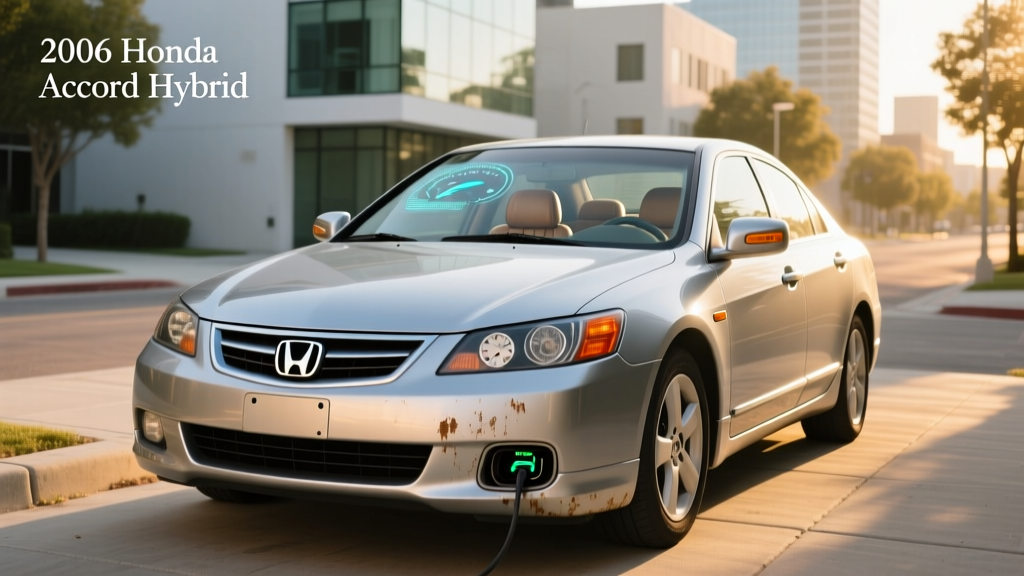
The 2006 Honda Accord Hybrid was Honda's second production hybrid and one of the earliest mainstream hybrid sedans sold in the United States. Built on the seventh-generation Accord platform, it paired a 3.0-liter V6 with Honda's Integrated Motor Assist (IMA) system — a mild-hybrid architecture fundamentally different from the full-parallel and series-parallel hybrid systems in today's Toyota Camry Hybrid or Honda Accord Hybrid. Nearly two decades later, a surprising number of these cars remain on the road, and used-car shoppers occasionally encounter them at bargain prices. This guide covers exactly what you're getting: real fuel economy, battery longevity, replacement costs, and whether a 2006 Accord Hybrid makes sense in 2026 compared to a modern hybrid, plug-in hybrid (PHEV), or full battery-electric vehicle (BEV).
What the 2006 Accord Hybrid Actually Is: HEV, Not PHEV
Before diving into specs, a critical distinction: the 2006 Accord Hybrid is a conventional hybrid electric vehicle (HEV). It cannot be plugged in. There is no electric-only driving mode, no charging port, and no kWh battery you can replenish from the grid. The small nickel-metal hydride (NiMH) IMA battery recharges exclusively through regenerative braking and the gasoline engine. If you're looking for plug-in hybrid capability — electric-only commuting, say 20–40 miles before the gas engine kicks in — you need a PHEV like the current Toyota RAV4 Prime or Chrysler Pacifica Hybrid, not this car.
HEV vs PHEV vs BEV — Quick Reference
| Feature | HEV (e.g., 2006 Accord Hybrid) | PHEV (e.g., 2026 RAV4 Prime) | BEV (e.g., 2026 Tesla Model 3) |
|---|---|---|---|
| Plug-in charging | No | Yes | Yes |
| Electric-only range | 0 miles | ~42 miles | ~340 miles |
| Battery size | ~0.6 kWh (NiMH) | ~18.1 kWh (Li-ion) | ~60–82 kWh (Li-ion) |
| DC fast charging | N/A | Rare / slow | Yes, 150–250 kW |
| Federal tax credit (§30D) | No (discontinued + no plug) | Up to $7,500 (if eligible) | Up to $7,500 (if eligible) |
| EPA combined MPG / MPGe | ~28 MPG (original) | ~38 MPG + 94 MPGe | ~130 MPGe |
EPA Fuel Economy: What the Sticker Said vs Reality
When new, the 2006 Accord Hybrid carried an EPA rating of 25 city / 34 highway / 28 combined MPG. However, the EPA revised its testing methodology in 2008, and under the updated (more realistic) cycle, the re-calculated figures dropped to roughly 21 city / 31 highway / 25 combined MPG — which is what fueleconomy.gov now displays for this model year.
2006 Honda Accord Hybrid — EPA Fuel Economy
| Drive Cycle | Original 2006 EPA | Revised EPA (current fueleconomy.gov) | Real-World Owner Reports |
|---|---|---|---|
| City | 25 MPG | 21 MPG | 19–23 MPG |
| Highway | 34 MPG | 31 MPG | 28–33 MPG |
| Combined | 28 MPG | 25 MPG | 23–27 MPG |
For context, the conventional 2006 Accord V6 (non-hybrid, 5-speed automatic) was rated at 20 city / 29 highway / 23 combined under the revised EPA cycle. The hybrid's advantage was modest — roughly 2 MPG combined — because Honda's IMA system on this generation was a mild hybrid. The electric motor (15 kW / 20 hp) assisted the V6 during acceleration and enabled idle stop-start, but could not propel the car on electric power alone. Highway cruising saw minimal hybrid benefit since the V6 already ran efficiently at steady state, and the IMA system's cylinder-deactivation (Variable Cylinder Management, or VCM) contributed some highway fuel savings by shutting down three cylinders under light load.
Real-world note: Owners on Fuelly and hybrid-specific forums consistently report 23–27 MPG combined in mixed driving. City-heavy routes with frequent stops maximize regen braking and idle-stop benefits, nudging figures toward the upper end. Highway-dominant commutes at 75+ MPH tend to yield 26–28 MPG. If the IMA battery has degraded (common on 20-year-old NiMH packs), expect the lower end of the range or worse, as the system relies less on electric assist.
Powertrain Specs: V6 + IMA Mild Hybrid
| Specification | Value |
|---|---|
| Engine | 3.0L SOHC V6 (J30A4) with VCM |
| Engine output | 240 hp @ 6,000 rpm / 212 lb-ft @ 5,000 rpm |
| IMA electric motor | 15 kW (20 hp) / 60 lb-ft assist |
| Combined peak output | 255 hp @ 6,000 rpm |
| Transmission | 5-speed automatic |
| IMA battery | NiMH, ~0.6 kWh (nominal), 132V pack |
| 0–60 mph | ~7.0 seconds |
| Drivetrain | Front-wheel drive |
The 2006 Accord Hybrid was actually one of the quickest hybrids of its era — quicker than the four-cylinder Camry Hybrid and competitive with non-hybrid V6 Accords. Honda positioned it as a performance-oriented hybrid rather than a maximum-efficiency one. The trade-off was clear: you got V6 acceleration with a small fuel-economy bump, not Prius-level efficiency. If a buyer in 2006 wanted maximum MPG, the four-cylinder Civic Hybrid (49/51 city/highway) was the better Honda option.
IMA Battery Longevity, Degradation, and Replacement Cost
The single biggest ownership question for a 20-year-old hybrid is the battery. The 2006 Accord Hybrid uses a compact NiMH IMA pack mounted behind the rear seat. Honda originally warranted the IMA battery for 8 years / 80,000 miles (10 years / 150,000 miles in California and states that adopted CARB emissions standards).
Battery Warranty & Lifespan
- Original warranty: 8 yr / 80,000 mi (10 yr / 150,000 mi in CARB states)
- Expected NiMH lifespan: 10–15 years / 120,000–180,000 miles before significant degradation
- Current status (2026): All original batteries are well beyond warranty. Most surviving examples have had at least one replacement or reconditioning.
NiMH batteries degrade through charge-discharge cycling and calendar aging. By 2026, any original IMA pack is 20 years old and almost certainly shows reduced capacity. Symptoms of a degraded IMA battery include:
- Frequent "recalibration" cycles (the car forces a charge/discharge routine)
- IMA warning light on the dash
- Reduced assist during acceleration
- Idle stop-start no longer engaging
- Lower observed MPG (dropping to 20–22 combined)
Replacement cost breakdown:
| Option | Cost Range | Notes |
|---|---|---|
| New OEM Honda IMA battery | $2,000–$3,000 (if still available) | Honda has limited availability for discontinued models; some dealers can no longer source new packs |
| Remanufactured IMA battery | $1,000–$1,800 | Third-party suppliers like Bumblebee Batteries or Dorman offer reconditioned packs; typically 1–3 year warranty |
| Used IMA battery (junkyard) | $300–$700 | Highest risk — unknown remaining life; may only buy 1–3 years |
| DIY cell-level rebuild | $200–$500 (parts) | Advanced DIY only; requires NiMH cell sourcing and spot-welding; no warranty |
For a car with a current market value of $2,500–$5,500 (private party, depending on mileage and condition), a $2,000+ OEM battery replacement is economically difficult to justify. Most owners opt for remanufactured packs or accept reduced hybrid functionality. Notably, the 2006 Accord Hybrid will still drive with a dead IMA battery — the V6 operates independently — but you lose all hybrid benefits, idle stop-start, and the car may throw persistent warning codes.
How Does It Compare to a Modern Hybrid?
The gap between the 2006 Accord Hybrid and a 2026 hybrid sedan is enormous. Here's how it stacks up against the current-generation Honda Accord Hybrid and Toyota Camry Hybrid:
| Spec | 2006 Accord Hybrid | 2026 Accord Hybrid (Sport) | 2026 Camry Hybrid (LE) |
|---|---|---|---|
| Hybrid type | Mild (IMA) | Full (two-motor e-CVT) | Full (Toyota Hybrid System) |
| Engine | 3.0L V6 | 2.0L I4 + 2 motors | 2.5L I4 + motor |
| Combined HP | 255 hp | 204 hp | 225 hp |
| EPA combined MPG | 25 MPG | 44 MPG | 51 MPG |
| Battery | ~0.6 kWh NiMH | ~1.3 kWh Li-ion | ~1.6 kWh Li-ion |
| Electric-only driving | No | Limited (low-speed, short distance) | Limited (low-speed, short distance) |
| Base MSRP (when new / current) | ~$30,140 (2006) | ~$33,655 (2026) | ~$29,495 (2026) |
| Federal tax credit | None | None (HEV) | None (HEV) |
Modern full-hybrid systems deliver nearly double the fuel economy of the 2006 IMA system while offering genuine electric-only creeping and more sophisticated regenerative braking. The 2006 Accord Hybrid was a technology showcase for its time, but Honda itself moved to a two-motor full-hybrid system (the current e:HEV / i-MMD architecture) starting with the 2014 Accord Hybrid — a fundamentally superior design.
Tax Credits and Incentives: What Applies in 2026?
The 2006 Accord Hybrid does not qualify for any federal tax credit under current IRS rules. The §30D Clean Vehicle Credit applies exclusively to new plug-in vehicles (BEVs and PHEVs) meeting battery-sourcing, critical-mineral, MSRP, and buyer-income requirements — details available at irs.gov. Conventional hybrids (HEVs) have never qualified for §30D, and the older Hybrid Vehicle Tax Credit that existed in 2006 (up to $3,150 for this model) expired for Honda vehicles after Honda hit its 60,000-unit manufacturer cap in 2007.
On the used side, the Used Clean Vehicle Credit (up to $4,000 or 30% of sale price, whichever is less) also requires a plug-in vehicle — BEV or PHEV — with a sale price at or below $25,000. A conventional HEV like the 2006 Accord Hybrid is ineligible regardless of price.
Some states offer modest rebates for used hybrids, but these are uncommon and vary by jurisdiction. Check your state energy office or department of environmental quality for current programs.
Who Should Consider This Car in 2026 — And Who Shouldn't
Pros
- Very low purchase price ($2,500–$5,500 used)
- V6 performance with mild efficiency bump over non-hybrid V6 Accord
- Comfortable, spacious midsize sedan with good ride quality
- Honda's general mechanical reliability (engine, transmission)
- Simple hybrid system — fewer high-voltage components than modern full hybrids
Cons
- MPG (25 combined) is unimpressive by 2026 standards — a Civic Hybrid from the same era gets nearly double
- IMA battery likely degraded or already replaced; replacement costs are significant relative to car value
- No electric-only mode, no plug-in capability
- No federal or state hybrid tax credits
- Variable Cylinder Management (VCM) on the J30 V6 is known for oil consumption and engine-mount wear
- Outdated safety tech (no AEB, no lane-keep, no backup camera standard)
Choose the 2006 Accord Hybrid if:
- You need a cheap, comfortable V6 sedan and the hybrid badge is a bonus, not the primary draw
- You're mechanically inclined and can handle IMA battery reconditioning or replacement yourself
- You drive a mix where 25 MPG is acceptable and you can't afford a newer hybrid
Choose a modern hybrid (2020+ Accord Hybrid, Camry Hybrid) if:
- Fuel economy is your priority — you'll get 44–51 MPG combined
- You want current warranty coverage on the hybrid battery (8–10 yr / 100,000–150,000 mi)
- You want modern safety features (AEB, blind-spot monitoring, adaptive cruise)
Choose a PHEV (RAV4 Prime, Prius Prime) if:
- You have home charging and a short commute — 25–42 miles electric-only eliminates most gas use
- You want federal tax credit eligibility (up to $7,500 on qualifying new models)
Choose a BEV (Model 3, Ioniq 6) if:
- You have reliable home or workplace charging
- You want zero tailpipe emissions and the lowest per-mile fuel cost (~$0.04–$0.06/mi on home electricity vs ~$0.12/mi for the Accord Hybrid)
Frequently Asked Questions
How many MPG does the 2006 Accord Hybrid actually get?
Under the current (revised) EPA methodology, it's rated at 21 city / 31 highway / 25 combined MPG. Real-world owners typically report 23–27 MPG combined depending on driving mix and IMA battery health. This is modest by modern hybrid standards — the 2026 Camry Hybrid achieves 51 MPG combined.
Is the 2006 Accord Hybrid reliable, and what does a battery replacement cost?
The conventional mechanical components (V6 engine, 5-speed automatic) are generally reliable, though the VCM system is known for oil consumption issues and worn engine mounts. The IMA hybrid system is simple but the NiMH battery is now 20 years old; replacement runs $1,000–$1,800 for a remanufactured pack or $2,000–$3,000 for OEM (if available). The car remains drivable with a failed IMA battery but loses all hybrid functionality.
Can I plug in the 2006 Accord Hybrid to charge?
No. This is a conventional hybrid (HEV), not a plug-in hybrid (PHEV). The IMA battery charges only through regenerative braking and the gasoline engine. There is no charge port.
Does the 2006 Accord Hybrid qualify for any tax credit in 2026?
No. The federal §30D Clean Vehicle Credit and the Used Clean Vehicle Credit both require plug-in vehicles (BEVs or PHEVs). Conventional hybrids are ineligible. The original hybrid tax credit available when this car was new expired for Honda in 2007.
How does the 2006 Accord Hybrid compare to a Prius of the same era?
The second-generation Prius (2004–2009) was rated at 46 combined MPG under the revised EPA cycle — nearly double the Accord Hybrid's 25 MPG. The Prius used a full-hybrid system (Toyota's THS-II) with genuine electric-only low-speed driving and a more powerful motor-generator setup. However, the Accord Hybrid offered far more power (255 hp vs 110 hp), a larger cabin, and a more conventional driving feel. They served different buyer priorities.
Is it worth buying a 2006 Accord Hybrid in 2026?
Only at the right price and with realistic expectations. At $3,000–$4,000 with a recently replaced IMA battery and solid maintenance records, it's a comfortable, peppy used sedan with slightly better fuel economy than a non-hybrid V6 Accord. But if fuel savings are your goal, a used 2010+ Prius, a 2014+ Accord Hybrid (full two-motor system, 47+ MPG), or any modern HEV will save significantly more at the pump — and most still have battery warranty remaining.