The Pioneer That Started It All: 2006 Ford Escape Hybrid at a Glance
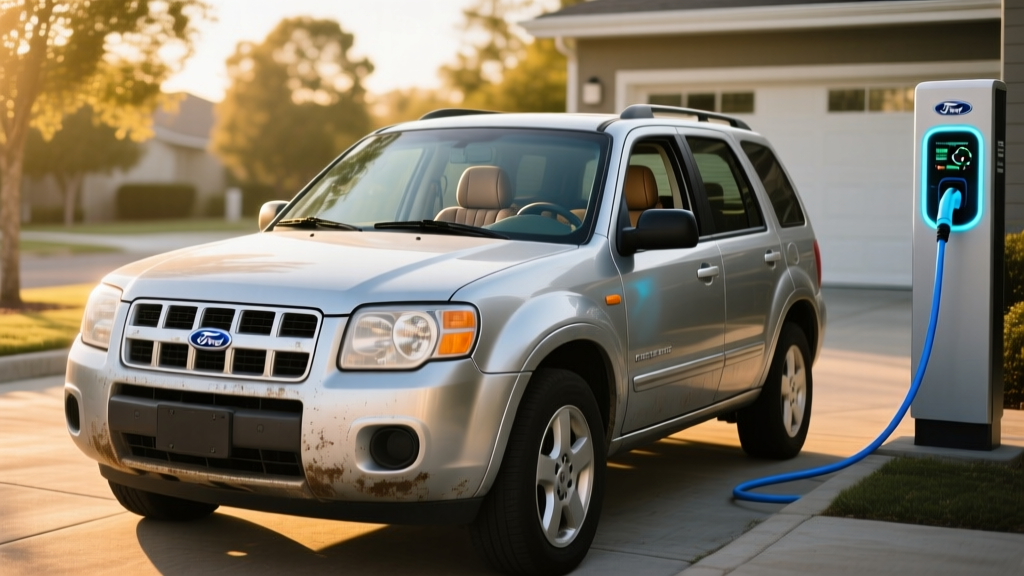
Long before plug-in hybrids and 300-mile EVs dominated headlines, the 2006 Ford Escape Hybrid broke ground as the world's first hybrid SUV. Built on Ford's partnership with Toyota-licensed hybrid synergy drive technology, it paired a 2.3-liter Atkinson-cycle four-cylinder with an electric motor and a nickel-metal hydride (NiMH) battery pack. Nearly two decades later, this compact crossover remains a fixture on the used-car market — and for buyers eyeing a budget-friendly hybrid commuter, it demands a careful, data-driven look.
This is a conventional hybrid (HEV), not a plug-in. You never plug it in. The battery recharges through regenerative braking and the gasoline engine. If you're searching for electric-only driving range, this isn't the vehicle — but if your goal is squeezing maximum MPG out of every gallon without changing your refueling habits, the 2006 Escape Hybrid still delivers competitive numbers.
| Specification | 2006 Ford Escape Hybrid (FWD) | 2006 Ford Escape Hybrid (AWD) |
|---|---|---|
| Powertrain Type | Conventional Hybrid (HEV) | Conventional Hybrid (HEV) |
| Engine | 2.3L Atkinson-cycle I4 | 2.3L Atkinson-cycle I4 |
| Combined System HP | 155 hp | 155 hp |
| Battery Chemistry | NiMH (Nickel-Metal Hydride) | NiMH (Nickel-Metal Hydride) |
| Battery Capacity | ~1.3 kWh (gross) | ~1.3 kWh (gross) |
| EPA City MPG | 36 | 33 |
| EPA Highway MPG | 31 | 29 |
| EPA Combined MPG | 33 | 31 |
| Transmission | eCVT (planetary gearset) | eCVT (planetary gearset) |
| 0–60 mph | ~10.5 sec | ~11.0 sec |
| Towing Capacity | 1,000 lbs | 1,000 lbs |
How Many MPG Does the 2006 Ford Escape Hybrid Actually Get?
The EPA rates the front-wheel-drive 2006 Escape Hybrid at 36 city / 31 highway / 33 combined MPG. The all-wheel-drive variant drops to 33/29/31. These figures come from the revised EPA testing methodology, and you can verify them at fueleconomy.gov.
| Drivetrain | City MPG | Highway MPG | Combined MPG |
|---|---|---|---|
| FWD Hybrid | 36 | 31 | 33 |
| AWD Hybrid | 33 | 29 | 31 |
| FWD Gas (2.3L I4) | 20 | 25 | 22 |
Real-World MPG vs. EPA Sticker
Like most conventional hybrids, the 2006 Escape Hybrid tends to exceed its EPA city rating in stop-and-go traffic — that's where regenerative braking and electric-motor assist do the most work. Owner-reported data on Fuelly and similar platforms shows real-world combined averages between 28 and 34 MPG, with city-heavy drivers occasionally hitting 35–37 MPG. Highway-only driving at 75+ mph drops efficiency to roughly 27–29 MPG because the electric motor contributes less at sustained high speeds and the NiMH battery's small capacity limits electric-only assist.
Cold weather reduces MPG by roughly 10–15% due to longer engine warm-up cycles and increased accessory load. Expect 27–30 combined in winter conditions if you live in northern climates.
Hybrid vs. Plug-In Hybrid vs. Full EV: Which Fits You?
The 2006 Escape Hybrid is strictly a conventional hybrid (HEV). Ford did not offer a plug-in variant of the Escape until the 2020 model year, and the current-generation Escape PHEV is an entirely different vehicle. Here's how the three electrified powertrain types compare for a buyer considering this generation:
| Factor | HEV (2006 Escape Hybrid) | PHEV (Modern Example) | Full BEV |
|---|---|---|---|
| Plug In Required? | No | Yes (for EV range) | Yes |
| Electric-Only Range | ~1 mile at low speed | 25–45 miles typical | 200–370+ miles |
| Combined Efficiency | 33 MPG | 35–40 MPG + 80–105 MPGe | 100–130 MPGe |
| Fuel Cost per Mile (2026) | ~$0.10–$0.12 | ~$0.04–$0.10 | ~$0.03–$0.06 |
| Maintenance Burden | Moderate (ICE + hybrid) | Moderate (ICE + hybrid) | Low (no ICE) |
| Used Price Range (2026) | $2,500–$5,500 | $15,000–$35,000 | $12,000–$40,000 |
| Federal Tax Credit | None | Up to $7,500 (new only) | Up to $7,500 (new); up to $4,000 (used) |
Choose the 2006 Escape Hybrid if your budget is under $6,000, you lack home charging access, and you want better fuel economy without altering your driving routine. Choose a modern PHEV or BEV if you can charge at home, want electric-only commuting, and qualify for incentives.
Powertrain Deep Dive: How the 2006 Escape Hybrid Works
The 2006 Escape Hybrid uses a power-split eCVT — the same planetary gearset architecture Toyota pioneered with the Prius, licensed to Ford. Here's the hardware breakdown:
- Gasoline engine: 2.3L Atkinson-cycle inline-4 producing 133 hp and 124 lb-ft of torque. The Atkinson cycle delays intake-valve closing, improving thermal efficiency at the cost of peak power density.
- Electric motor: Permanent-magnet synchronous motor integrated into the transaxle, contributing up to 94 hp (combined system output is 155 hp due to power-band overlap).
- Battery pack: NiMH, approximately 1.3 kWh gross (~0.9 kWh usable), located beneath the cargo floor. It contains 25 modules.
- Regenerative braking: Captures kinetic energy during deceleration, recharging the pack without plugging in.
The eCVT has no fixed gears and no traditional belt or chain — it's a continuously variable power-split device. This makes it one of the most durable transmissions in any vehicle, with virtually no wear components. Acceleration to 60 mph takes roughly 10.5 seconds, which is leisurely by 2026 standards but adequate for commuting and merging.
Battery Life, Warranty, and Replacement Cost
This is the single biggest concern for any buyer considering a 20-year-old hybrid. The 2006 Escape Hybrid's NiMH battery was originally covered by Ford's hybrid-component warranty: 8 years / 100,000 miles in most states, and 10 years / 150,000 miles in California Air Resources Board (CARB) states. That factory coverage has expired for every surviving example.
Battery Replacement Reality (2026):
- Remanufactured NiMH pack: $1,500–$2,500 installed (third-party suppliers like Green Bean Batteries or Dorman)
- Used/salvage pack: $500–$1,200, but carries unknown remaining life
- OEM Ford dealer replacement: Rarely stocked; expect $3,000–$4,500 if available
- Individual module replacement: Some hybrid-specialty shops can replace failed modules for $300–$800, extending pack life at lower cost
NiMH batteries degrade differently than modern lithium-ion. They lose capacity gradually and develop voltage imbalances between modules. A 2006 Escape Hybrid with its original battery at 180,000+ miles will likely show reduced electric-assist frequency and slightly lower MPG — but total failure (vehicle inoperable) is uncommon. Many examples exceed 200,000 miles on the original pack.
Reliability Track Record
The 2006 Escape Hybrid's powertrain is widely regarded as one of the most reliable Ford products of its era. The eCVT avoids the failure-prone conventional automatics of the period, and the 2.3L Duratec engine is simple and well-understood by mechanics. Common non-hybrid issues include:
- Power steering pump leaks (hydraulic, not electric)
- Lower control arm bushing wear
- Rear wheel bearing noise above 120,000 miles
- HVAC blend-door actuator failure
None of these are hybrid-specific, and repair costs are comparable to any 2006 compact SUV.
Does the 2006 Ford Escape Hybrid Qualify for Any Tax Credit?
No. The 2006 Escape Hybrid does not qualify for the current federal §30D Clean Vehicle Credit, which applies only to new plug-in electric vehicles and fuel-cell vehicles meeting battery-sourcing and critical-mineral requirements. Conventional hybrids (HEVs) have never qualified for §30D.
When new, the 2006 Escape Hybrid was eligible for a much smaller federal tax deduction (up to $2,600 for the 2006 tax year under the Energy Policy Act of 2005), but that provision expired long ago. There is no current federal, and very rarely any state, incentive for purchasing a used conventional hybrid. The IRS outlines current credit eligibility at irs.gov — and it applies exclusively to new BEVs, PHEVs, and FCEVs.
§30D Credit — Why the 2006 Escape Hybrid Doesn't Qualify:
- ❌ Not a plug-in vehicle (HEV, not PHEV or BEV)
- ❌ Not a new vehicle purchase
- ❌ Does not meet battery critical-mineral or component sourcing rules
- ❌ Conventional hybrids are excluded from §30D by statute
Who Should Buy the 2006 Escape Hybrid — and Who Shouldn't
Pros
- 33 MPG combined — 50% better than the gas-only Escape
- Proven, durable eCVT with minimal failure risk
- Low purchase price ($2,500–$5,500 in 2026 used market)
- No plug-in required — works with existing gas-station infrastructure
- Strong city MPG from regen braking
- Simple, well-understood mechanicals for independent mechanics
Cons
- No electric-only driving range beyond ~1 mile at low speed
- NiMH battery aging risk; replacement adds $1,500–$2,500
- Slow acceleration (~10.5 sec 0–60) for modern traffic
- Dated safety tech (no ESC standard, no ADAS features)
- No federal or state tax incentives
- Small cargo area due to battery placement under cargo floor
- High-mileage examples may need suspension and steering work
The Right Buyer
The 2006 Escape Hybrid makes sense for budget-conscious commuters who drive 15,000+ miles per year in mixed city/highway conditions, lack access to home or workplace charging, and want to minimize fuel costs without the upfront investment of a newer PHEV or BEV. At 33 MPG combined and $3.30/gallon gas (2026 national average), annual fuel cost is approximately $1,500 — roughly $700 less per year than the gas-only Escape.
The Wrong Buyer
If you have Level 2 home charging and can spend $18,000+, a modern used PHEV (like a 2019–2021 Toyota RAV4 Prime or 2020+ Escape PHEV) will deliver 30–42 miles of electric-only commuting, dramatically lower fuel costs, and modern safety features. If your budget extends to $25,000+, a used BEV eliminates gasoline entirely and qualifies for the used-EV tax credit (up to $4,000 under §25E).
Frequently Asked Questions
How many MPG does the 2006 Ford Escape Hybrid get in real-world driving?
Owners report 28–34 MPG combined on average. City-heavy drivers often see 35–37 MPG thanks to regenerative braking, while highway-only driving at 75+ mph drops to 27–29 MPG. Cold weather reduces efficiency by 10–15%.
Can the 2006 Escape Hybrid drive on electric power alone?
Only at very low speeds (under 25 mph) and for roughly one mile. This is a conventional hybrid — the electric motor assists the gas engine but cannot sustain highway-speed driving on battery alone. There is no EV mode button and no plug-in capability.
How much does it cost to replace the hybrid battery?
A remanufactured NiMH pack costs $1,500–$2,500 installed through a third-party hybrid specialist. Individual module replacement can cost $300–$800. OEM dealer replacement, if available, runs $3,000–$4,500. Many original packs last 200,000+ miles with gradual capacity loss rather than sudden failure.
Is the 2006 Ford Escape Hybrid reliable?
Yes. The power-split eCVT is among the most durable transmissions ever produced, and the 2.3L Duratec engine is well-understood. Hybrid-specific components (inverter, electric motor) have strong longevity records. Non-hybrid wear items (suspension bushings, power steering pump, wheel bearings) follow typical 2006 compact-SUV patterns.
Does the 2006 Escape Hybrid qualify for any tax credit in 2026?
No. The federal §30D Clean Vehicle Credit applies only to new plug-in vehicles (PHEVs, BEVs, FCEVs). Conventional hybrids are excluded. The original $2,600 federal deduction available when the vehicle was new expired after the 2010 tax year. No state incentives currently target used conventional hybrids.
How does the 2006 Escape Hybrid compare to a 2026 hybrid SUV?
Modern hybrid SUVs like the 2026 Toyota RAV4 Hybrid achieve 39–41 MPG combined with 219 hp, standard AWD, and current safety technology — but cost $32,000+ new. The 2006 Escape Hybrid delivers roughly 80% of the fuel efficiency at 10–15% of the price, making it a strong value proposition for budget buyers willing to accept older safety and tech.
What should I check before buying a used 2006 Escape Hybrid?
Prioritize a hybrid-battery health scan (a hybrid-specialty shop can read individual module voltages), verify the inverter coolant level and pump operation, check for power steering leaks, and inspect lower control arm bushings. A pre-purchase inspection by a technician familiar with Ford's hybrid system is strongly recommended.