Quick Verdict: A Pioneer That Still Commutes
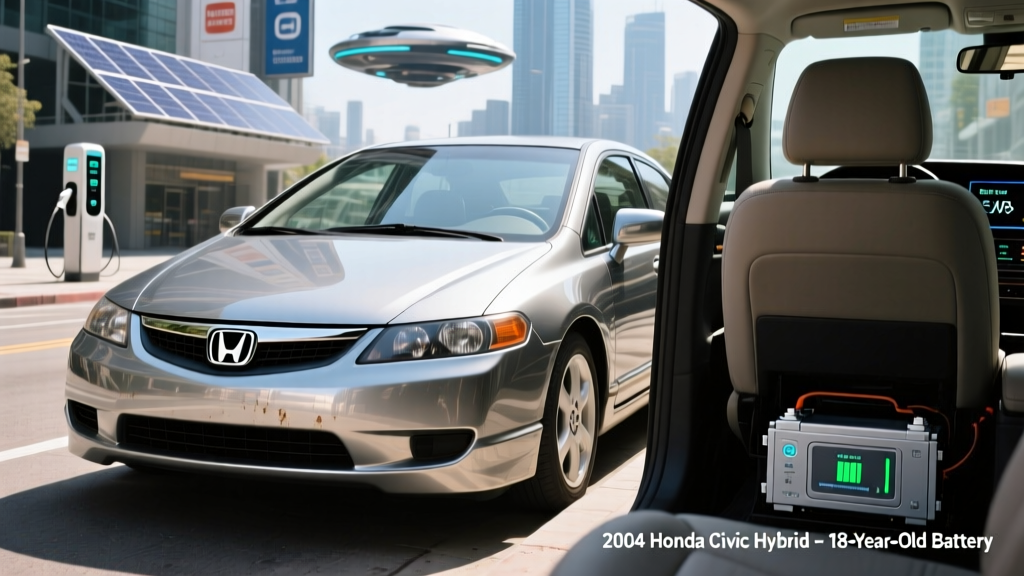
The 2004 Honda Civic Hybrid was one of the first mass-market hybrids sold in the United States, arriving on the heels of the original Toyota Prius and Honda Insight. Powered by Honda's Integrated Motor Assist (IMA) system, it paired a lean-burn 1.3-liter gasoline engine with a thin electric motor sandwiched between the engine and transmission. The result was a compact sedan that achieved an EPA-estimated 48 MPG combined — a figure that still holds up against many modern non-hybrid compacts.
But in 2026, evaluating a 22-year-old hybrid means asking different questions than you would about a new model. Battery degradation, parts availability, and the total cost of keeping an aging IMA system alive are the real purchase considerations. This guide breaks down what you need to know before buying or keeping a 2004 Civic Hybrid on the road.
HEV vs PHEV vs EV: Where the 2004 Civic Hybrid Fits
Before diving into specs, it's critical to understand what the 2004 Civic Hybrid is — and what it is not.
Conventional Hybrid (HEV) — This Car
The 2004 Civic Hybrid is a conventional hybrid (HEV). It has a small nickel-metal hydride (NiMH) battery pack that recharges through regenerative braking and the gasoline engine. You never plug it in. There is no electric-only driving range to speak of — the electric motor assists the gas engine during acceleration and enables idle stop-start, but the car cannot move on electric power alone at any meaningful speed or distance.
Plug-In Hybrid (PHEV)
A PHEV has a larger battery (typically 8–20 kWh) that you charge from a wall outlet or public charger, enabling 20–50 miles of electric-only driving before the gas engine kicks in. Honda did not offer a Civic PHEV in 2004. The modern equivalent would be something like a Toyota Prius Prime or the discontinued Honda Clarity Plug-In Hybrid.
Battery Electric Vehicle (BEV)
A full EV like the Chevrolet Bolt or Hyundai Ioniq 5 runs entirely on electricity, with 200–350+ miles of EPA range and no gasoline engine. If your goal is zero tailpipe emissions and no gas station visits, a BEV is the answer — but it requires reliable charging access.
Fuel Economy: EPA Ratings and Real-World MPG
The 2004 Honda Civic Hybrid came with a continuously variable transmission (CVT) or a 5-speed manual. EPA ratings differed slightly between the two.
| Transmission | City MPG | Highway MPG | Combined MPG |
|---|---|---|---|
| CVT (Automatic) | 48 | 47 | 48 |
| 5-Speed Manual | 46 | 51 | 48 |
Source: EPA Fuel Economy Guide
Real-World MPG Expectations
Owners on forums like CleanMPG and Fuelly historically reported real-world averages between 42 and 50 MPG depending on driving style. The IMA system's lean-burn engine excels in steady-state cruising and light-throttle city driving. However, aggressive acceleration, sustained high-speed highway driving (75+ mph), and cold weather can drop observed fuel economy into the high 30s. Unlike Toyota's Hybrid Synergy Drive, Honda's IMA system does not allow significant electric-only coasting, so the engine is running more often than in a modern hybrid.
Powertrain and Battery Specifications
| Specification | Detail |
|---|---|
| Engine | 1.3L i-DSI 4-cylinder (lean-burn) |
| Engine Horsepower | 85 hp @ 5,700 rpm |
| Electric Motor (IMA) | 15 kW (20 hp) assist |
| Combined System Output | ~93 hp |
| Combined Torque | ~123 lb-ft |
| Battery Chemistry | Nickel-Metal Hydride (NiMH) |
| Battery Capacity | ~0.35 kWh (nominal) |
| Transmission | CVT or 5-speed manual |
| 0-60 mph | ~10.5 seconds (estimated) |
| Curb Weight | ~2,635 lbs |
The IMA motor's 15 kW output is modest by modern standards — a 2026 Toyota Prius hybrid motor produces over 80 kW. The Civic Hybrid's electric assist was designed for incremental efficiency gains, not performance. Expect leisurely acceleration, particularly when merging onto highways. The lean-burn i-DSI engine prioritizes fuel sip over power, and the CVT drones under hard throttle.
Battery Lifespan, Degradation, and Replacement Cost
This is the single most important ownership question for any 2004 Civic Hybrid buyer or current owner.
Original Warranty
Honda originally warranted the IMA battery for 8 years / 80,000 miles (10 years / 150,000 miles in California and states that adopted CARB emissions standards). That warranty has long since expired on every 2004 model.
How Long Does the IMA Battery Last?
Real-world data from owners indicates the NiMH IMA pack typically lasted 80,000 to 120,000 miles before significant degradation triggered an IMA warning light or noticeable loss of assist and fuel economy. Some units failed earlier (60,000–70,000 miles); others soldiered past 150,000 miles with grid-charger maintenance.
NiMH chemistry degrades differently than modern lithium-ion. The cells lose capacity gradually and can develop voltage imbalances between individual sticks. A common symptom is the IMA system disabling itself, which causes the car to lose its electric assist and idle stop-start — effectively becoming a slightly heavier, less efficient conventional Civic. The car still drives, but MPG drops to the low-to-mid 30s.
Battery Replacement Options and Costs
| Option | Approximate Cost (2026) | Notes |
|---|---|---|
| New OEM IMA battery (Honda) | $2,500–$3,500 | Increasingly difficult to source; Honda has discontinued some part numbers for this generation |
| Refurbished/remanufactured pack | $1,200–$2,000 | Available from hybrid specialists like BumbleBee Batteries or Dorman; quality varies |
| Used pack from salvage yard | $400–$800 | Highest risk — unknown remaining life; may need grid charging and rebalancing |
| Aftermarket lithium conversion | $1,500–$2,500 | NiMH-to-LiFePO4 conversion kits exist in enthusiast communities; requires technical skill |
| Grid charger maintenance (existing pack) | $150–$300 (charger) | Can extend life of a weakening pack by rebalancing cells; not a permanent fix |
Given that a clean 2004 Civic Hybrid might be worth $2,500–$4,500 in 2026 depending on mileage and condition, a $2,500+ OEM battery replacement is often uneconomical. Most owners opt for refurbished packs or grid chargers, or simply drive the car with a degraded IMA system and accept the reduced fuel economy.
Reliability and Common Issues Beyond the Battery
The 7th-generation Civic platform (2001–2005) is generally reliable, but a few known issues compound with age:
- IMA system warnings: Beyond battery failure, the IMA control module and DC-DC converter can fail. Replacement modules are scarce.
- CVT shudder: Early Honda CVTs in this era are prone to judder and shudder, particularly if fluid was not changed at recommended intervals. A CVT fluid drain-and-fill with genuine Honda HMMF fluid is critical maintenance.
- Idle stop-start system: The auto-stop feature (engine shuts off at red lights) depends on a healthy IMA battery. With a degraded pack, this feature disables — removing one of the car's key city-driving efficiency advantages.
- 12V battery drain: If the IMA battery is weak, the 12V system can be overtaxed. Keep the 12V battery in good condition and on a maintainer if the car sits for extended periods.
- Lean-burn engine specifics: The i-DSI engine uses two spark plugs per cylinder (8 total). Replacement intervals and costs are higher than a standard 4-cylinder.
Does the 2004 Civic Hybrid Qualify for Tax Credits?
No. The 2004 Honda Civic Hybrid does not qualify for any current federal tax credit.
- The federal hybrid tax credit that originally applied to this vehicle (up to $2,100 under the Energy Policy Act of 2005) expired when Honda reached its manufacturer cap, and that credit program itself has long since ended.
- The current IRS §30D Clean Vehicle Credit applies only to new qualifying EVs and PHEVs — not to conventional hybrids, and certainly not to 22-year-old used vehicles.
- The Used Clean Vehicle Credit (up to $4,000) applies only to used EVs and PHEVs purchased from a dealer, not to conventional HEVs, and the vehicle must be at least two model years old with a sale price under $25,000 — but the powertrain must be plug-in capable.
- Some states offer their own incentives for hybrids or efficient vehicles, but most have sunset or shifted focus to EVs and PHEVs. Check your state's current programs.
Who Should Buy a 2004 Civic Hybrid in 2026?
Pros
- Excellent fuel economy (42–50 MPG real-world) for a vehicle this inexpensive
- Low purchase price ($2,000–$4,500 depending on condition)
- No plug-in charging required — just fill up with gas
- Honda build quality and comfortable ride for a compact
- Simple enough for DIY maintenance (aside from IMA-specific components)
Cons
- IMA battery likely needs replacement or has already been replaced — verify before buying
- Spare parts for IMA-specific components are increasingly scarce
- Slow acceleration (~10.5 seconds to 60 mph) — underpowered for highway merging
- No modern safety features (no electronic stability control, no backup camera, basic airbags)
- CVT reliability concerns in this generation
- No tax credits or incentives available
Decision Framework
Choose the 2004 Civic Hybrid if: You need an ultra-cheap, high-MPG commuter car, you're comfortable with the risk of IMA battery replacement, and you can verify the hybrid system is functioning before purchase. It makes sense as a budget daily driver where $3,000 buys you 45+ MPG transportation.
Choose a newer used hybrid instead if: You want modern safety features, better reliability, and a battery with remaining warranty life. A 2016–2020 Toyota Prius or Honda Insight (2019–2022) offers 50+ MPG with a much lower risk of costly battery failure and includes features like automatic emergency braking and lane-keeping assist.
Choose a PHEV or EV if: You have home charging access and want to reduce or eliminate gasoline use entirely. A used Chevrolet Bolt EV (2017–2023) can be found for $12,000–$18,000 with 238–259 miles of range and qualifies for the $4,000 used-EV tax credit if purchased from a dealer.
Frequently Asked Questions
How many MPG does the 2004 Honda Civic Hybrid get?
The EPA rates the CVT model at 48 city / 47 highway / 48 combined MPG. The 5-speed manual is rated 46 city / 51 highway / 48 combined. Real-world owners typically report 42–50 MPG depending on driving conditions and IMA battery health.
Can I drive the 2004 Civic Hybrid on electric power only?
No. The IMA system does not support electric-only propulsion at any meaningful speed. The electric motor only assists the gasoline engine during acceleration and enables idle stop-start. This is a conventional hybrid (HEV), not a plug-in hybrid or EV.
How much does it cost to replace the IMA battery?
A refurbished NiMH pack costs $1,200–$2,000 installed. A new OEM battery (if available) runs $2,500–$3,500. Used salvage packs are $400–$800 but carry significant risk. Aftermarket lithium conversions are available in the $1,500–$2,500 range from enthusiast suppliers.
Is the 2004 Honda Civic Hybrid reliable?
The underlying Civic platform is solid, but the IMA hybrid system is the weak link. Expect the NiMH battery to need replacement every 80,000–120,000 miles. The CVT requires strict fluid maintenance. If the IMA system has been recently refurbished or replaced with a quality pack, the car can be a reliable budget commuter.
Does the 2004 Civic Hybrid qualify for any tax credits in 2026?
No. The original federal hybrid credit for this vehicle expired over a decade ago. Current IRS §30D credits apply only to new plug-in vehicles. The used EV credit does not cover conventional hybrids.
What should I check before buying a used 2004 Civic Hybrid?
Verify the IMA system is active (no warning lights on the dash, idle stop-start functions, and the "assist" bar on the instrument cluster shows electric motor engagement under acceleration). Check CVT fluid condition and service history. Look for rust, timing chain condition (this engine uses a timing chain, not a belt), and confirm the 8 spark plugs have been replaced on schedule.