If you're shopping for a more efficient vehicle but aren't ready to commit to a fully electric car, you've likely encountered the term "hybrid" — and probably "plug-in hybrid" right next to it. These two powertrain types share a name but operate very differently, serve different use cases, and come with different price tags, fuel savings, and tax incentive eligibility.
This guide answers the core question — what is a hybrid car and how does it work — with precise specifications, real-world efficiency data, and a practical framework for deciding between a conventional hybrid (HEV), a plug-in hybrid (PHEV), and a full battery-electric vehicle (BEV).
What Is a Hybrid Car? The Basic Powertrain Explained
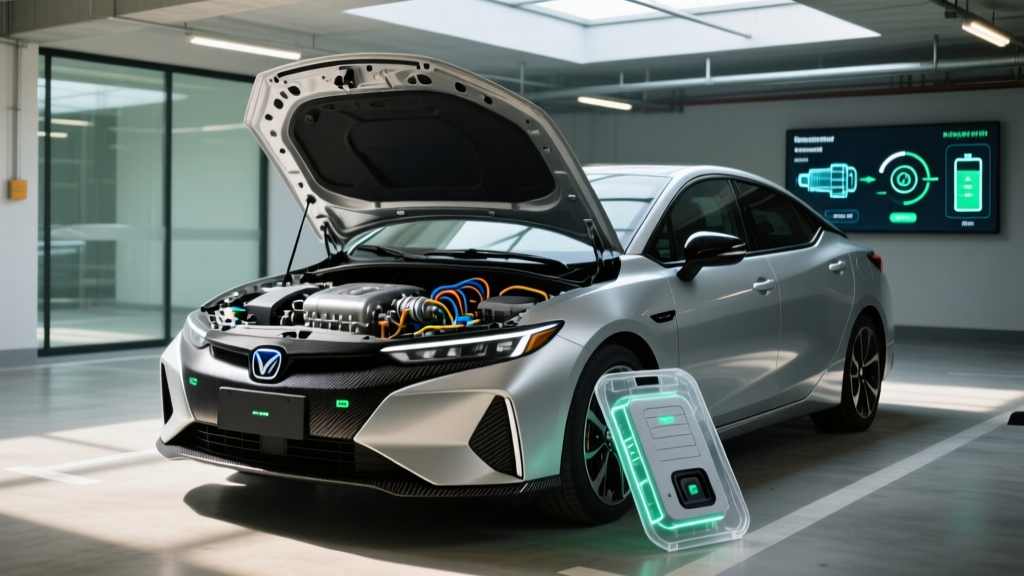
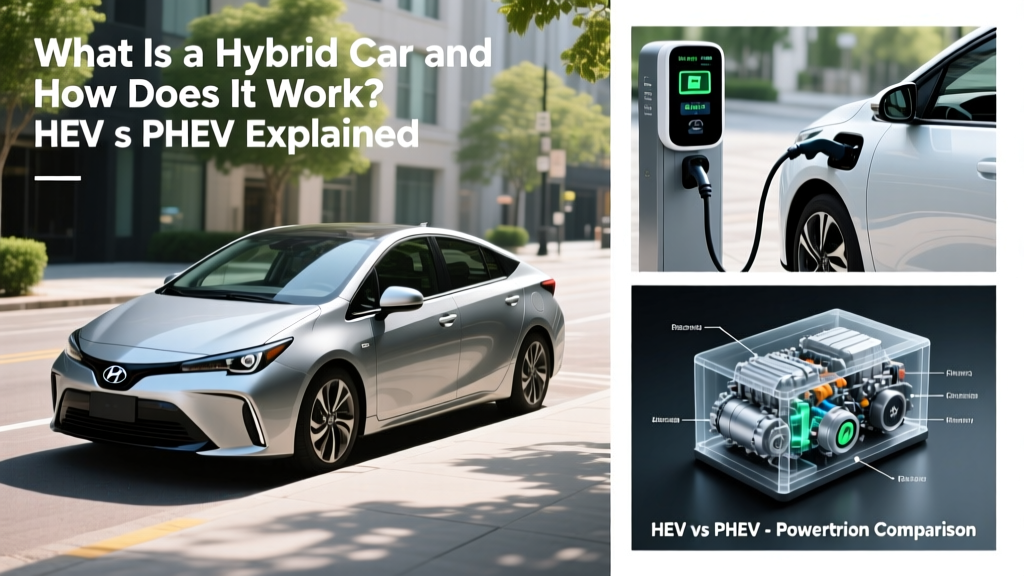
A hybrid electric vehicle (HEV) pairs a gasoline internal combustion engine with one or more electric motors and a small battery pack — typically between 1.0 and 2.0 kWh. The electric motor assists the engine during acceleration, captures energy during braking (regenerative braking), and in some models can drive the car at low speeds for short distances.
The key mechanical insight: you never plug in a conventional hybrid. The battery charges exclusively through the engine and regenerative braking. This means zero change to your fueling routine — you still visit gas stations — but you extract significantly more miles per gallon, especially in stop-and-go city driving where the electric motor does the most work.
Modern hybrid systems use a power-split device (like Toyota's e-CVT) or a parallel hybrid setup (like Hyundai's 6-speed automatic hybrid) to seamlessly blend engine and motor power. The driver experiences a single, unified powertrain — there's no manual switching between gas and electric modes in most HEVs.
HEV vs PHEV: The Critical Difference
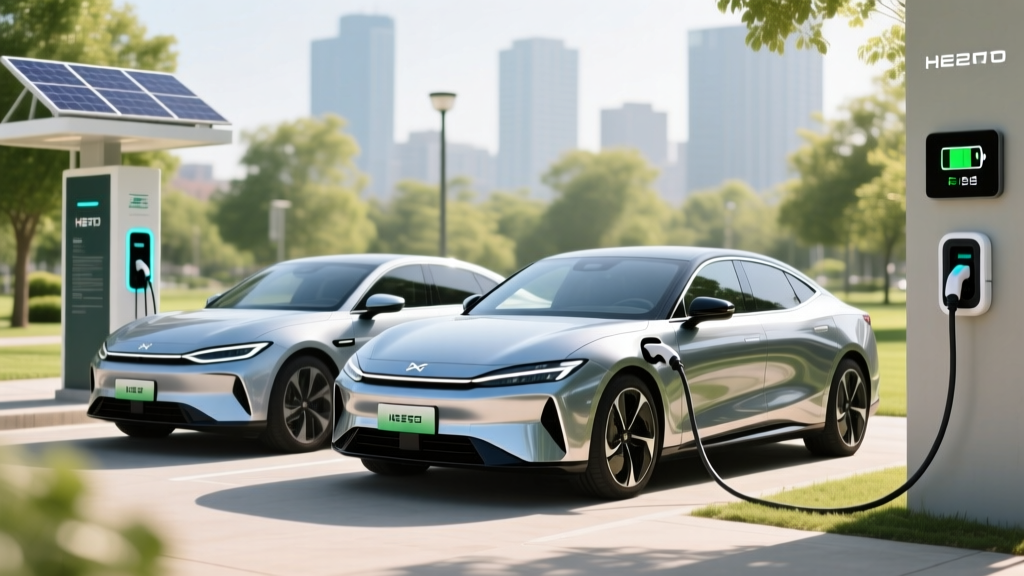
A plug-in hybrid electric vehicle (PHEV) takes the hybrid concept further with a much larger battery — typically 13 to 30+ kWh — and the ability to charge from an external power source (a wall outlet or Level 2 charger). This larger battery enables genuine electric-only driving for 25 to 50+ miles before the gasoline engine engages.
| Feature | Conventional Hybrid (HEV) | Plug-in Hybrid (PHEV) |
|---|---|---|
| Battery size | 1.0 – 2.0 kWh | 13 – 30+ kWh |
| Plug-in charging | No — self-charging only | Yes — Level 1 (120V) or Level 2 (240V) |
| Electric-only range | ~1 mile at low speed | 25 – 50+ miles (EPA) |
| Total range (gas + electric) | 500 – 650+ miles | 400 – 600+ miles |
| Federal tax credit (§30D) | Not eligible | Up to $7,500 (with caveats) |
| Price premium over gas model | $1,000 – $3,000 | $4,000 – $10,000+ |
| Best for | No home charging access; want simplicity | Home charging + short daily commute |
The decision between HEV and PHEV often comes down to one question: can you charge at home? If yes, and your daily round-trip commute falls within a PHEV's electric-only range, you'll drive most days without burning a drop of gasoline. If you can't charge at home, a PHEV's larger battery becomes dead weight you're hauling around, and an HEV delivers better value.
Fuel Economy: Real-World MPG vs EPA Stickers
Hybrid fuel economy varies widely by model, but the general pattern holds: hybrids typically exceed their EPA city estimates in real-world driving because regenerative braking recovers more energy in traffic. Highway MPG, however, often falls slightly below the EPA sticker because the electric motor provides less benefit at sustained high speeds.
Here's how several popular 2025–2026 model-year hybrids and PHEVs stack up on EPA estimates:
| Vehicle | Type | City MPG | Highway MPG | Combined MPG | PHEV Electric Range | PHEV MPGe |
|---|---|---|---|---|---|---|
| Toyota Prius (FWD) | HEV | 57 | 56 | 57 | — | — |
| Toyota Prius Prime | PHEV | 52 (gas) | 48 (gas) | 50 (gas) | 44 mi | 127 MPGe |
| Honda Accord Hybrid | HEV | 51 | 44 | 48 | — | — |
| Hyundai Tucson Hybrid | HEV | 38 | 38 | 38 | — | — |
| Hyundai Tucson PHEV | PHEV | 35 (gas) | 35 (gas) | 35 (gas) | 33 mi | 80 MPGe |
| Toyota RAV4 Prime | PHEV | 40 (gas) | 36 (gas) | 38 (gas) | 42 mi | 94 MPGe |
| Ford Escape PHEV | PHEV | 42 (gas) | 37 (gas) | 40 (gas) | 37 mi | 105 MPGe |
| Chrysler Pacifica PHEV | PHEV | 30 (gas) | 30 (gas) | 30 (gas) | 32 mi | 82 MPGe |
Real-world note: The Toyota Prius HEV's 57 MPG combined EPA estimate is among the highest of any non-plug-in vehicle sold in the US. In mixed suburban driving, owners frequently report 55–62 MPG. On long highway trips at 75+ mph, expect 48–52 MPG. Cold weather (below 30°F) can reduce efficiency by 10–15% due to increased engine warm-up time and cabin heating demands.
For PHEVs, the MPGe figure (miles per gallon equivalent) applies only when driving on battery power. Once the battery depletes and the gas engine takes over, the vehicle reverts to its standard hybrid MPG — which is why the gas-mode MPG matters even for a PHEV.
Powertrain Specs: How the Engine and Motor Work Together
Modern hybrid powertrains are sophisticated systems that blend internal combustion and electric propulsion. Here are representative specs for popular models:
| Vehicle | Engine | Motor Power | Combined HP | 0–60 mph | Battery (kWh) | Drivetrain |
|---|---|---|---|---|---|---|
| Toyota Prius | 2.0L 4-cyl | 83 kW front | 194 hp | 7.0 sec | 1.0 kWh (NiMH) | FWD |
| Prius Prime | 2.0L 4-cyl | 120 kW front | 220 hp | 6.6 sec | 13.6 kWh (Li-ion) | FWD |
| Toyota RAV4 Prime | 2.5L 4-cyl | 134 kW front + 40 kW rear | 302 hp | 5.7 sec | 18.1 kWh (Li-ion) | AWD |
| Honda Accord Hybrid | 2.0L 4-cyl | 135 kW (two-motor) | 204 hp | 7.3 sec | 1.3 kWh (Li-ion) | FWD |
| Hyundai Tucson PHEV | 1.6L turbo 4-cyl | 66.9 kW | 261 hp | 7.1 sec | 13.8 kWh (Li-ion) | AWD |
A few things to notice: PHEVs generally produce more combined horsepower than their HEV counterparts because the larger battery can deliver more sustained electric power. The RAV4 Prime's 302 hp makes it the quickest RAV4 Toyota sells — a reminder that efficiency and performance aren't mutually exclusive in modern hybrids.
Honda's two-motor hybrid system (used in the Accord Hybrid and CR-V Hybrid) operates differently from Toyota's power-split design. At low speeds, the engine acts solely as a generator while the electric motor drives the wheels. At highway speeds, a lock-up clutch connects the engine directly to the wheels for maximum efficiency. This series-parallel architecture eliminates the traditional transmission entirely.
PHEV Charging: Times, Connectors, and DC Fast Charging
If you're considering a PHEV, charging logistics matter. Here's what to expect:
| Charging Level | Power | Time (0–100%) | Availability |
|---|---|---|---|
| Level 1 (120V household outlet) | 1.2 – 1.4 kW | 9 – 14 hours | Any standard outlet |
| Level 2 (240V home/public) | 3.3 – 7.2 kW | 2 – 5 hours | Home install or public stations |
| DC fast charge | 25 – 50 kW (rare on PHEVs) | 30 – 45 min (to 80%) | Very few PHEVs support DCFC |
Critical detail: Most PHEVs do not support DC fast charging. The Mitsubishi Outlander PHEV is one of the few exceptions, offering CHAdeMO DC charging at up to 22 kW (though this is slow by BEV standards). For most PHEV owners, Level 2 home charging is the primary method — a full charge overnight is all you need to start each morning with a full battery.
Level 1 charging from a standard 120V outlet works fine for PHEVs because the batteries are small. A Prius Prime's 13.6 kWh battery charges fully in about 10 hours on a standard outlet — adequate if you park for 8+ hours overnight. If you want faster turnaround, a Level 2 home charger (240V, typically 32A or 48A) cuts that to roughly 2–3 hours.
Battery Longevity, Warranty, and Replacement Cost
Hybrid battery reliability is one of the most common buyer concerns — and the data is reassuring. Toyota has sold millions of hybrids since the original 1997 Prius, and real-world data shows hybrid battery packs regularly last 150,000–200,000+ miles before significant degradation. Many first-generation Prius taxis surpassed 300,000 miles on the original battery.
Federal Hybrid Battery Warranty Mandate
By federal law, all hybrid and PHEV battery packs carry a minimum warranty of 8 years / 100,000 miles. In California Air Resources Board (CARB) states — which include California, New York, Massachusetts, and over a dozen others — that extends to 10 years / 150,000 miles.
These warranties typically cover the battery if it drops below 60–70% of original capacity, though exact thresholds vary by manufacturer. Check your specific warranty documentation.
Replacement costs have declined significantly. A refurbished Toyota Prius hybrid battery runs $1,500–$2,500 installed at an independent hybrid specialist. A new OEM battery from a Toyota dealer typically costs $2,500–$4,000 installed. PHEV batteries, being larger, cost more — expect $4,000–$8,000 for a replacement, though failures within the warranty period are rare.
Modern lithium-ion hybrid batteries (used in most 2020+ models) have better thermal management and more conservative state-of-charge buffers than earlier nickel-metal-hydride (NiMH) packs, further extending lifespan. Toyota still uses NiMH in some base Prius trims, while the Prius Prime and most other manufacturers have moved to lithium-ion.
Tax Credits: What Hybrids and PHEVs Qualify For
This is where HEVs and PHEVs diverge sharply:
- Conventional hybrids (HEVs): Not eligible for the federal §30D clean vehicle credit. No plug, no credit. Some states offer small rebates (typically $250–$500) for high-efficiency vehicles, but these are uncommon and vary by jurisdiction.
- Plug-in hybrids (PHEVs): May qualify for up to $7,500 under the federal §30D credit, but eligibility depends on several conditions that change frequently.
As of 2025–2026, the IRS §30D credit requires:
- Vehicle MSRP under $55,000 (sedans/wagons) or $80,000 (SUVs/trucks/vans)
- Buyer adjusted gross income under $150,000 (single) / $225,000 (head of household) / $300,000 (joint)
- Battery capacity of at least 7 kWh
- Critical minerals and battery component sourcing requirements (phased in progressively through 2026, disqualifying some models)
- The credit can now be transferred to the dealer at point of sale, reducing your purchase price directly
Practical example: The 2025 Toyota RAV4 Prime (MSRP ~$44,500) has historically qualified for a partial federal credit, but battery sourcing rules have tightened. Always verify current eligibility on fueleconomy.gov before purchasing, as credit amounts change when manufacturers update supply chains.
Always consult a tax professional regarding your specific eligibility — income limits, filing status, and tax liability all affect whether you can claim the full credit.
Hybrid vs PHEV vs Full EV: Which Is Right for You?
Choosing between these three powertrain types comes down to your daily driving pattern, charging access, and budget. Here's a practical decision framework:
Choose a conventional hybrid (HEV) if:
- You have no access to home or workplace charging
- You want maximum simplicity — no plugs, no new habits
- Your budget is tight and you want the smallest price premium over a gas car
- You drive a mix of city and highway and want consistent fuel savings everywhere
Choose a plug-in hybrid (PHEV) if:
- You can install a Level 2 charger at home or have reliable workplace charging
- Your daily round-trip commute is under 40 miles (covering most PHEV electric ranges)
- You want electric daily driving but need gas flexibility for road trips
- You want to reduce — but not eliminate — your gasoline consumption
Choose a full battery-electric vehicle (BEV) if:
- You can charge at home and your daily driving is under 250 miles
- You want the lowest per-mile fuel cost and zero tailpipe emissions
- You're ready to plan around public charging for longer trips
- You want access to the full $7,500 federal credit (more BEVs qualify than PHEVs)
For many households, a PHEV is the pragmatic middle ground: you get electric commuting most days and a 400+ mile total range for weekend road trips with zero charging anxiety. The trade-off is higher upfront cost and the complexity of maintaining both an electric drivetrain and a gasoline engine.
Pros and Cons: Hybrid Ownership at a Glance
Pros
- Significantly better fuel economy — 38–57 MPG combined for HEVs
- No range anxiety — gas stations everywhere
- Proven long-term reliability with 8–10 year battery warranties
- Lower purchase price than comparable BEVs
- HEVs require no charging infrastructure
- PHEVs enable zero-emission daily commuting
- Strong resale value, especially Toyota and Honda hybrids
Cons
- HEVs still burn gasoline and require oil changes and engine maintenance
- PHEVs carry a $4,000–$10,000 price premium over equivalent HEVs
- PHEV electric range (25–50 mi) is insufficient for some commutes
- Two powertrains mean two systems to maintain (PHEV)
- Federal tax credit eligibility for PHEVs is uncertain and changes frequently
- Highway MPG advantage over gas cars is smaller than city MPG advantage
- Most PHEVs lack DC fast charging capability
Frequently Asked Questions
How many MPG does a hybrid car get?
It depends on the model. The most efficient conventional hybrid, the Toyota Prius, achieves an EPA-estimated 57 MPG combined (57 city / 56 highway). Hybrid SUVs like the Honda CR-V Hybrid and Toyota RAV4 Hybrid deliver 40–43 MPG combined. In real-world city driving, many hybrids slightly exceed their EPA estimates thanks to regenerative braking; highway driving typically yields 5–10% below the EPA sticker.
How far can a plug-in hybrid go on electric only?
Current PHEVs offer between 25 and 50 miles of EPA-rated electric-only range. The Toyota Prius Prime leads at 44 miles, the RAV4 Prime at 42 miles, and the Ford Escape PHEV at 37 miles. Real-world electric range depends on speed, temperature, and terrain — expect 15–25% less range in cold weather (below 30°F) or at sustained highway speeds above 65 mph.
Do hybrid cars need to be plugged in?
Conventional hybrids (HEVs) do not need to be plugged in — they charge their own battery through the engine and regenerative braking. Plug-in hybrids (PHEVs) can be plugged in to charge their larger battery for electric-only driving, and you'll want to plug in regularly to realize their efficiency benefits. A PHEV driven without ever plugging in functions as a slightly heavier conventional hybrid.
Is a hybrid car reliable, and what does battery replacement cost?
Hybrid vehicles are among the most reliable vehicles on the road. Toyota and Honda hybrids consistently earn top reliability scores from Consumer Reports and J.D. Power. The hybrid battery is warranted for 8 years/100,000 miles (10 years/150,000 miles in CARB states). When replacement is eventually needed, a refurbished HEV battery costs $1,500–$2,500 installed; a new OEM battery costs $2,500–$4,000. PHEV batteries cost more ($4,000–$8,000) due to larger capacity.
Does a hybrid qualify for any tax credit?
Conventional hybrids do not qualify for the federal §30D clean vehicle credit. Only plug-in hybrids (and full EVs) with a battery capacity of 7 kWh or more are potentially eligible. Even among PHEVs, eligibility depends on MSRP caps, buyer income limits, and battery sourcing requirements. Check fueleconomy.gov for the current list of qualifying vehicles and consult a tax professional for your specific situation.
What happens when a hybrid battery dies while driving?
In a conventional hybrid, if the battery fails, the vehicle will typically enter a reduced-power "limp mode" that allows you to drive to a service station — the gasoline engine can still propel the car, just with reduced efficiency and acceleration. In a PHEV, once the battery depletes to its minimum state of charge, the gasoline engine seamlessly takes over and the car operates as a conventional hybrid. You will not be stranded.
Are hybrids more expensive to maintain than gas cars?
Maintenance costs are generally comparable or slightly lower. Hybrids use regenerative braking, which reduces wear on brake pads — many hybrid owners report 80,000–100,000+ miles on original brake pads. Oil changes, tire rotations, and other routine maintenance are the same as any gasoline car. The electric motor has no consumable parts. The main long-term risk is hybrid battery replacement, but this typically occurs well past 150,000 miles and is covered by warranty for the first 8–10 years.
Understanding what a hybrid car is and how it works is the first step toward choosing the right electrified vehicle for your lifestyle. Whether you opt for a no-plug HEV like the Prius, a plug-in PHEV like the RAV4 Prime, or a full BEV, the key is matching the powertrain to your daily driving reality — not chasing the highest spec sheet number.