What Does Hybrid Mean in a Car?
A hybrid car pairs a gasoline engine with one or more electric motors and a battery pack. The electric system assists the engine during acceleration, captures energy during braking (regenerative braking), and in some cases can drive the car on electricity alone for short distances. The result is measurably better fuel economy than a conventional gas car — without requiring you to plug in, unless you choose a plug-in hybrid variant.
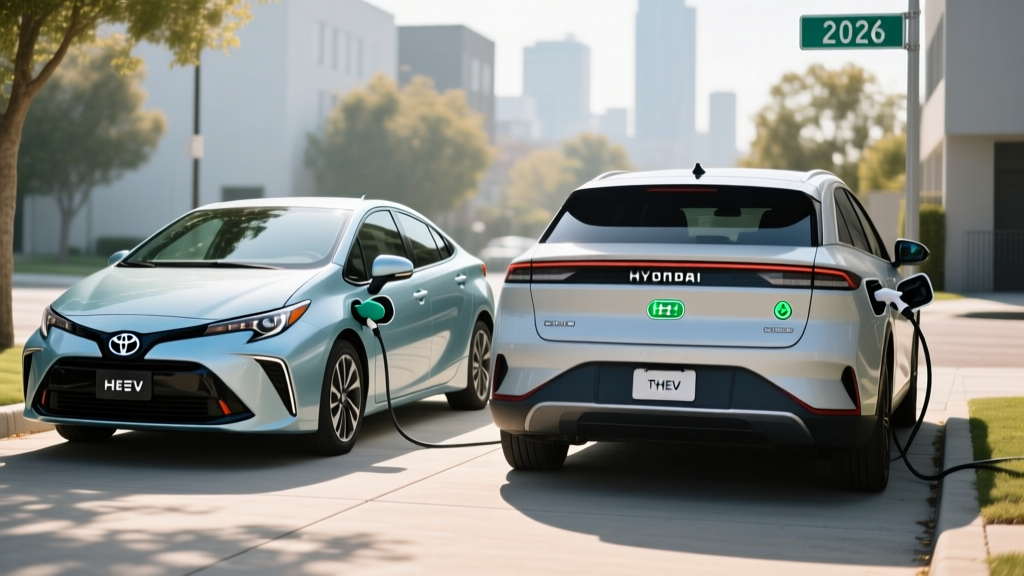
For 2026, the hybrid market splits into two distinct categories, and confusing them is the single most common mistake shoppers make. A conventional hybrid (HEV) charges its small battery entirely through the engine and regenerative braking. You never plug it in. A plug-in hybrid (PHEV) carries a larger battery you can charge from a wall outlet or public charger, giving you a meaningful electric-only driving range before the gas engine kicks in.
Both types exist across sedans, SUVs, minivans, and even trucks in 2026. Here's how to figure out which one — if either — fits your driving life.
HEV vs PHEV: The Two Types of Hybrid Explained
| Attribute | Conventional Hybrid (HEV) | Plug-In Hybrid (PHEV) |
|---|---|---|
| Plug in to charge? | No — self-charging via engine + regen | Yes — plug in for electric-only range |
| Battery size | 0.5–2.0 kWh | 13–25 kWh (usable) |
| Electric-only range | None (motor assists engine only) | 25–50 miles typical (EPA) |
| Refueling | Gas station only | Gas station + Level 1/Level 2 charging |
| Federal tax credit (§30D) | Not eligible | Up to $7,500 (if eligible — see rules below) |
| Ideal for | No home charging access; want simplicity | Home charging + short daily commutes |
| Example (2026) | Toyota RAV4 Hybrid | Toyota RAV4 Prime |
The key decision point is whether you can charge at home. If you have a garage or driveway where you can install a Level 2 charger (or even just use a standard 120V outlet overnight), a PHEV lets you drive most daily errands on electricity while keeping a gas engine for road trips. If you park on the street or in a garage without charging access, a conventional HEV gives you the efficiency boost without any infrastructure changes.
Fuel Economy: Real-World MPG for Popular 2026 Hybrids
Hybrid fuel economy varies widely by vehicle class and powertrain tuning. One important nuance: conventional hybrids often exceed their EPA city rating in real-world stop-and-go driving, because city traffic maximizes regenerative braking and electric-motor assist. Highway driving, by contrast, relies more heavily on the gas engine at sustained speeds.
| 2026 Model | Type | EPA City | EPA Highway | EPA Combined | Real-World Expectation |
|---|---|---|---|---|---|
| Toyota Prius | HEV | 57 mpg | 56 mpg | 57 mpg | 52–60 mpg (exceeds in city) |
| Toyota RAV4 Hybrid | HEV | 41 mpg | 38 mpg | 40 mpg | 36–43 mpg |
| Honda CR-V Hybrid | HEV | 43 mpg | 36 mpg | 40 mpg | 37–44 mpg (city-biased) |
| Toyota RAV4 Prime | PHEV | 42 mi (EV) / 38 mpg (hybrid) | 42 mi (EV) / 36 mpg | 94 MPGe / 38 mpg | 38–44 mi EV; 34–38 mpg hybrid |
| Hyundai Tucson PHEV | PHEV | 33 mi (EV) / 35 mpg | 33 mi (EV) / 33 mpg | 80 MPGe / 35 mpg | 29–35 mi EV; 31–35 mpg hybrid |
| Ford Maverick Hybrid | HEV | 42 mpg | 33 mpg | 38 mpg | 35–44 mpg (strong city regen) |
Sources: EPA Fuel Economy, manufacturer specifications. Real-world ranges reflect aggregated owner reports and independent testing; your results will vary with climate, terrain, and driving style.
For PHEVs, the MPGe figure (miles per gallon equivalent) measures efficiency during electric-only operation. Once the battery depletes and the gas engine takes over, the vehicle operates as a conventional hybrid at the lower MPG number. This is why a PHEV's total fuel cost depends heavily on how often you recharge.
How Far Can a PHEV Go on Electric Only?
Electric-only range on a 2026 PHEV typically falls between 25 and 50 miles, depending on battery capacity and vehicle weight. The RAV4 Prime leads the compact SUV segment at an EPA-rated 42 miles of electric range, which covers most American commutes — the U.S. Census Bureau reports a median one-way commute of roughly 26 miles.
Real-world electric range depends on several factors:
- Cold weather: Expect a 20–30% reduction in electric range below freezing, because battery chemistry is less efficient and cabin heating draws significant power.
- Highway speeds: PHEV electric range drops sharply above 65 mph. Most PHEVs are optimized for city and suburban speeds on battery power.
- Hills and cargo: Heavy loads and mountain routes drain the battery faster than flat, unloaded driving.
When the electric range is exhausted, the PHEV seamlessly transitions to hybrid mode — no driver action needed. You simply keep driving on gasoline like any other hybrid.
PHEV Charging: Battery Size, Charge Times, and DC Fast Charging
PHEV batteries in 2026 range from about 13 kWh to 25 kWh of usable capacity. That's roughly one-fifth to one-third the size of a full EV battery, which keeps weight and cost down but limits electric range.
| Charging Method | Power Level | Typical PHEV Charge Time (0–100%) | Notes |
|---|---|---|---|
| Level 1 (120V household outlet) | ~1.4 kW | 9–18 hours | Adequate for overnight if battery <18 kWh |
| Level 2 (240V home/public) | 3.3–7.2 kW | 2–5 hours | Recommended for daily PHEV use |
| DC Fast Charge | 25–50 kW | 30–45 min (10–80%) | Available on select PHEVs only |
DC fast charging on PHEVs is rare. The RAV4 Prime, for example, does not support DC fast charging — it tops out at Level 2 (6.6 kW onboard charger, ~2.5 hours for a full charge). The Chrysler Pacifica PHEV is one of the few that has offered DC capability in prior model years. If fast charging matters to you, verify the specific model's onboard charger rating and connector type before purchasing.
For most PHEV owners, a standard 120V outlet is enough to fully recharge overnight if the battery is under 18 kWh. Larger PHEV batteries benefit from a Level 2 home charger, which requires a 240V circuit — similar to a dryer outlet. Installation typically costs $500–$2,000 depending on your electrical panel's capacity and the distance from panel to charger location.
Hybrid Powertrains: Horsepower and How the Engine-Motor Team Works
Hybrid powertrains combine engine and electric motor output, and the combined horsepower figure is what matters for real-world acceleration. In 2026, hybrid systems range from efficiency-focused (Prius at 196 hp combined) to performance-oriented (RAV4 Prime at 302 hp combined, 0–60 mph in 5.7 seconds).
| 2026 Model | Engine | Electric Motor(s) | Combined HP | 0–60 mph |
|---|---|---|---|---|
| Toyota Prius | 2.0L 4-cyl | 2 motors (front) | 196 hp | 7.0 sec |
| Toyota RAV4 Hybrid | 2.5L 4-cyl | 3 motors (AWD-e) | 219 hp | 7.4 sec |
| Toyota RAV4 Prime | 2.5L 4-cyl | 2 motors (AWD) | 302 hp | 5.7 sec |
| Honda CR-V Hybrid | 2.0L 4-cyl | 2 motors (front) | 204 hp | 7.6 sec |
| Ford Maverick Hybrid | 2.5L 4-cyl | 1 motor (front) | 191 hp | 7.7 sec |
The electric motor provides instant torque from zero RPM, which makes hybrids feel peppier in city driving than their horsepower numbers suggest. PHEVs with larger batteries and more powerful motors — like the RAV4 Prime — can accelerate briskly on electric power alone, making them genuinely quick vehicles that happen to be efficient.
Pricing and Federal Tax Credits for Hybrids and PHEVs
Conventional hybrids carry a modest price premium over their gas-only siblings, typically $1,000–$2,500 at the trim level equivalent. PHEVs are priced higher due to the larger battery and more complex powertrain, often $5,000–$8,000 above the comparable gas model.
| 2026 Model | Type | Base MSRP | Federal §30D Credit | Effective Price (if eligible) |
|---|---|---|---|---|
| Toyota Prius LE | HEV | $29,445 | $0 (not eligible) | $29,445 |
| Toyota RAV4 Hybrid XLE | HEV | $34,095 | $0 (not eligible) | $34,095 |
| Toyota RAV4 Prime SE | PHEV | $44,945 | Up to $7,500* | ~$37,445* |
| Hyundai Tucson PHEV SEL | PHEV | $39,440 | Up to $7,500* | ~$31,940* |
*Federal §30D credit eligibility is not automatic. Per IRS guidelines, you must meet all of the following:
- Income caps: Modified AGI ≤ $150,000 (single), $225,000 (head of household), $300,000 (joint)
- MSRP caps: ≤ $55,000 for sedans; ≤ $80,000 for SUVs, vans, and trucks
- Battery sourcing: Required percentages of critical minerals and battery components must be sourced from the U.S. or free-trade-agreement countries — this eliminates some models
- Point-of-sale transfer: As of 2024, you can transfer the credit to the dealer for an immediate price reduction, rather than waiting to claim it on your tax return
Conventional HEVs do not qualify for the §30D federal tax credit. Some states offer separate rebates for PHEVs or even for HEVs — check your state energy office or the AFDC state incentive database for specifics, as these vary by jurisdiction and change frequently.
Battery Reliability, Warranty, and Replacement Cost
Hybrid battery warranty standard: Federal law mandates that hybrid and EV battery packs carry a minimum warranty of 8 years / 100,000 miles. In California Air Resources Board (CARB) states, that extends to 10 years / 150,000 miles. Most manufacturers meet or exceed these minimums.
Hybrid battery reliability has proven strong over two decades of real-world use. Toyota's Hybrid Synergy Drive, the most widely deployed system globally, shows typical battery degradation of roughly 10–15% capacity loss over 150,000 miles — and because HEV batteries are small (1–2 kWh), even degraded batteries continue to function adequately. The electric motor simply assists slightly less.
For PHEVs, the larger battery (13–25 kWh) is subject to more charge cycles if you drive on electric daily. However, manufacturers build in buffer zones — you never actually use 100% of the battery's gross capacity, which protects longevity. Real-world data from fleets and high-mileage owners suggests PHEV batteries retain 80–90% of original capacity at the 8-year/100,000-mile warranty threshold.
If a hybrid battery does require replacement out of warranty, costs in 2026 range from approximately:
- HEV battery replacement: $2,000–$4,000 (small battery, simpler pack)
- PHEV battery replacement: $5,000–$9,000 (larger battery, more cells)
These are significantly less than full EV battery replacements ($10,000–$20,000+), and independent hybrid battery refurbishers now offer reconditioned packs for 40–60% less than OEM pricing. The likelihood of needing a replacement within the first 10 years remains low based on long-term fleet data.
Hybrid vs PHEV vs Full EV: Which Should You Choose?
Choose a Conventional Hybrid (HEV) If:
- You have no access to home or workplace charging
- You want better MPG with zero behavior change
- You drive long highway stretches where EV range would be stressful
- You want the lowest purchase price among electrified options
- You live in an area with sparse public charging infrastructure
Choose a Plug-In Hybrid (PHEV) If:
- You can charge at home (garage, driveway, or workplace)
- Your daily driving is under 40 miles round-trip
- You want EV-like daily driving but gas flexibility for road trips
- You qualify for the §30D tax credit (makes the math compelling)
- You're not ready to commit to a full EV but want to reduce gas use
The 3-question framework:
- Can you charge at home? No → HEV. Yes → continue to Q2.
- Is your daily round-trip under 40 miles? Yes → PHEV covers most of your driving on electricity. No → HEV or full EV may be better value.
- Do you regularly drive 300+ miles in a single trip? Yes → PHEV (no range anxiety, no charging stops). Rarely → Full EV is worth considering for lower running costs.
A full battery electric vehicle (BEV) offers the lowest per-mile fuel cost and zero tailpipe emissions, but requires reliable charging access and involves a higher upfront price. Hybrids and PHEVs are bridge solutions — and for many households in 2026, they're the most practical electrified choice.
Frequently Asked Questions
Do hybrid cars need to be plugged in?
Conventional hybrids (HEVs) do not need to be plugged in. They charge their small battery through the gas engine and regenerative braking. Only plug-in hybrids (PHEVs) require plugging in to access their electric-only range — and even PHEVs can operate indefinitely on gasoline alone if you never plug them in.
How long do hybrid batteries last?
Most hybrid batteries are warranted for 8 years / 100,000 miles (10 years / 150,000 miles in CARB states). Real-world data from Toyota, Honda, and Ford hybrids shows many original batteries lasting 150,000–200,000+ miles with only modest capacity degradation. Replacement cost, if needed, is $2,000–$4,000 for HEVs and $5,000–$9,000 for PHEVs.
Does a hybrid qualify for a tax credit?
Conventional hybrids (HEVs) do not qualify for the federal §30D clean vehicle credit. Plug-in hybrids (PHEVs) may qualify for up to $7,500, subject to buyer income limits ($150K–$300K MAGI depending on filing status), vehicle MSRP caps ($55K sedans / $80K SUVs), and battery critical-mineral sourcing requirements. Check the IRS clean vehicle credit page for current eligibility before purchasing.
Are hybrids more expensive to maintain than gas cars?
No. Hybrids typically have lower maintenance costs than conventional gas cars because regenerative braking reduces wear on brake pads (often lasting 80,000+ miles), the electric motor has no maintenance requirements, and the gas engine runs fewer hours per mile driven. Oil changes, tires, and other routine items are identical to gas vehicles.
What happens if the hybrid battery dies while driving?
Hybrid battery failure is rare and typically gradual (reduced efficiency, warning lights) rather than sudden. If the traction battery fails completely, most hybrids can still limp to a service location on the gas engine alone, though with reduced power and fuel economy. The vehicle's 12V auxiliary battery — which powers lights, infotainment, and computers — is separate and operates identically to a standard car battery.