What Does a Hybrid Car Mean? The Short Answer
A hybrid car pairs a gasoline engine with at least one electric motor and a small battery pack. The electric motor assists during acceleration, recovers energy during braking (regenerative braking), and in some cases can drive the vehicle on electricity alone for short distances. The result: significantly better fuel economy than a conventional gas car, without the range limitations or charging infrastructure dependence of a full battery-electric vehicle (BEV).
But the term "hybrid" now covers two very different architectures. Understanding which one you're looking at is the single most important thing to get right before shopping — because the ownership experience, fuel savings, and upfront cost diverge sharply between them.
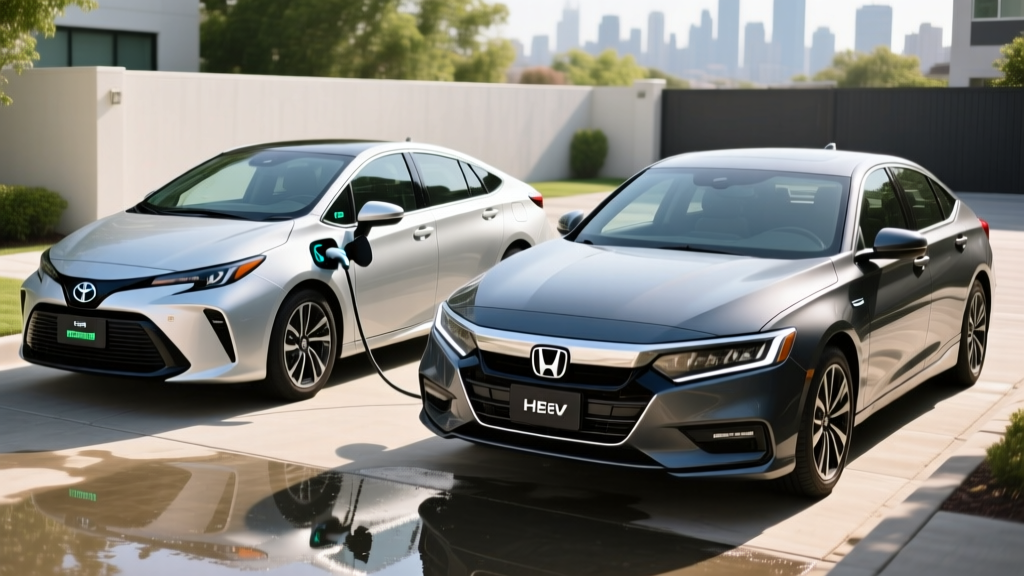
HEV vs PHEV: The Core Distinction
| Feature | Conventional Hybrid (HEV) | Plug-in Hybrid (PHEV) |
|---|---|---|
| Plug in to charge? | No — charges via engine & regen | Yes — plug in for electric-only miles |
| Battery size | 0.5–2.0 kWh | 10–25 kWh (usable) |
| Electric-only driving | Very brief, low speed only | 20–50 miles at highway speed |
| EPA fuel economy | 40–57 MPG combined | 25–42 MPG combined (gas mode) + MPGe |
| Federal tax credit | Not eligible (§30D) | Up to $7,500 if eligible |
| Typical price premium over gas | $1,000–$3,000 | $5,000–$12,000 |
How Conventional Hybrids (HEVs) Work — and What MPG You Actually Get
A conventional hybrid like the 2026 Toyota RAV4 Hybrid or Honda CR-V Hybrid never plugs in. Its small nickel-metal-hydride or lithium-ion battery (typically 1.0–1.6 kWh) is recharged by the gasoline engine and by capturing kinetic energy every time you brake or coast downhill. The electric motor fills in torque gaps the engine alone can't cover efficiently — especially from a stop and during low-speed city driving.
This is why hybrids routinely exceed their EPA city ratings in real-world stop-and-go traffic. The electric motor does the heavy lifting where gas engines are least efficient. On the highway, however, the engine carries most of the load, so real-world highway MPG often tracks closely with — or slightly below — the EPA sticker.
| Model | City MPG | Highway MPG | Combined MPG | Real-World Combined (observed) |
|---|---|---|---|---|
| 2026 Toyota RAV4 Hybrid | 41 | 38 | 40 | 38–43 |
| 2026 Honda CR-V Hybrid | 43 | 36 | 40 | 37–42 |
| 2026 Toyota Prius (LE) | 57 | 56 | 57 | 54–60 |
| 2026 Hyundai Tucson Hybrid | 38 | 38 | 38 | 35–40 |
| 2026 Ford Maverick Hybrid | 42 | 33 | 38 | 36–41 |
Source: fueleconomy.gov EPA estimates. Real-world figures reflect aggregated owner reports and independent testing; individual results vary by climate, terrain, and driving style.
Plug-in Hybrids (PHEVs): Electric-First Commuting With a Gas Safety Net
A plug-in hybrid operates on two distinct modes. In EV mode, the vehicle runs entirely on its larger battery (typically 12–20 kWh usable) and electric motor, delivering 25–50 miles of zero-tailpipe-emission range. Once the battery depletes, the gasoline engine engages and the car behaves like a conventional hybrid — no range anxiety, no charging dependency.
This makes PHEVs ideal for drivers who can charge at home overnight and have a round-trip commute under 40 miles, but who also take regular road trips where a full BEV's charging logistics would be inconvenient.
| Model | EV Range (mi) | Battery (kWh usable) | Combined HP | Gas-Mode MPG | Total Range (mi) | MSRP |
|---|---|---|---|---|---|---|
| 2026 Toyota RAV4 Prime | 42 | 18.1 | 302 | 38 | ~600 | $44,900 |
| 2026 Jeep Wrangler 4xe | 22 | 17.3 | 375 | 20 | ~370 | $52,095 |
| 2026 Hyundai Tucson PHEV | 33 | 13.8 | 261 | 35 | ~430 | $38,750 |
| 2026 Chrysler Pacifica PHEV | 32 | 16.0 | 260 | 30 | ~460 | $51,095 |
| 2026 Toyota Prius Prime | 44 | 13.6 | 220 | 48 | ~510 | $33,975 |
Sources: fueleconomy.gov, manufacturer specifications. Total range = EV range + gas tank range combined. MSRP is base trim before destination.
PHEV Charging: What You Need to Know
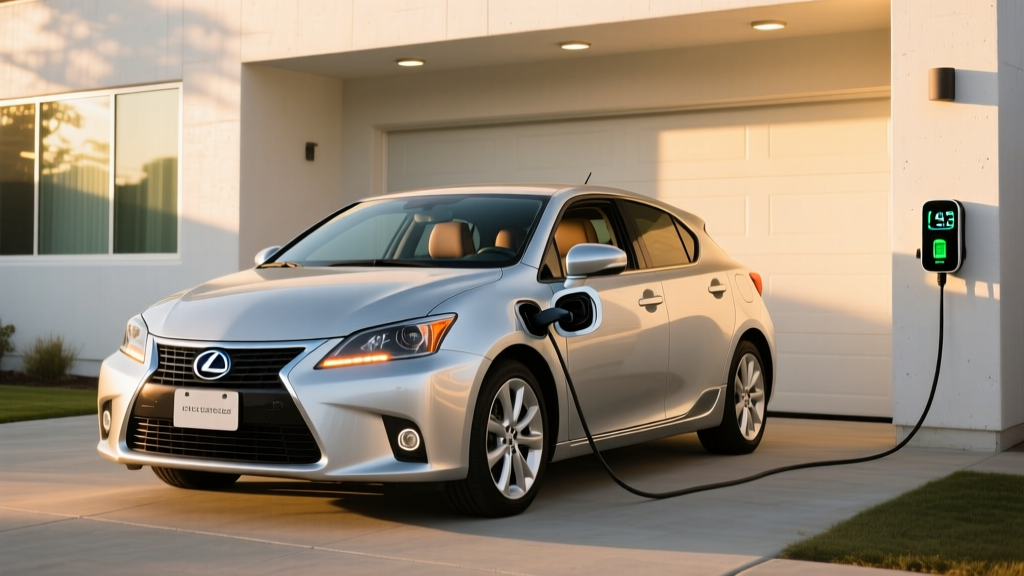
Most PHEVs charge via Level 1 (120V household outlet) in 8–12 hours or Level 2 (240V) in 2–4 hours. Because PHEV batteries are small, even a standard 120V outlet can replenish enough overnight for a 30-mile commute. Very few PHEVs support DC fast charging — the Toyota RAV4 Prime is a notable exception, offering DC fast charge capability on higher trims that can reach 80% in approximately 45 minutes at a 50 kW station. For most PHEV owners, a Level 2 home charger (or even a dedicated 120V circuit) is the only charging equipment needed.
Hybrid vs PHEV vs Full EV: Which One Fits Your Life?
This is where the rubber meets the road. The right choice depends on your charging access, commute pattern, budget, and tolerance for behavioral change.
Choose a Conventional Hybrid (HEV) If:
- You cannot charge at home (apartment, street parking, no garage outlet)
- You want maximum simplicity — no plugs, no apps, no new habits
- Your budget is tight and you want a $1,000–$3,000 premium over a gas model
- You drive 15,000+ miles/year mostly on the highway
Choose a Plug-in Hybrid (PHEV) If:
- You have home charging access (garage or driveway with a 120V/240V outlet)
- Your daily round-trip commute is under 40 miles
- You want electric commuting but take road trips where charging infrastructure is sparse
- You qualify for the federal §30D tax credit (up to $7,500)
Choose a Full EV (BEV) If:
- You have reliable home Level 2 charging
- Your daily driving is under 250 miles and you're comfortable planning road-trip charging
- You want the lowest per-mile "fuel" cost and minimal maintenance
- You're ready to commit fully to electric and want the maximum environmental benefit
Pricing, Tax Credits, and Total Cost of Ownership
Hybrid pricing has become competitive with gas-only models in many segments. A 2026 RAV4 Hybrid starts around $33,000 — roughly $1,500 more than its gas counterpart — and the fuel savings typically pay back that premium in 2–3 years for a driver covering 15,000 miles annually.
PHEVs carry a larger premium but may qualify for the federal §30D clean vehicle tax credit, which can offset $3,750–$7,500 of the purchase price. However, eligibility is not automatic. Under current IRS rules, a qualifying PHEV must meet several conditions:
- MSRP cap: Vans, SUVs, and pickups must be under $80,000; sedans under $55,000
- Buyer income cap: Modified AGI must not exceed $150,000 (single), $225,000 (head of household), or $300,000 (joint)
- Battery sourcing: Critical minerals and battery components must meet phased-in domestic/free-trade-partner sourcing requirements (thresholds increase annually through 2029)
- Final assembly: Vehicle must be assembled in North America
- Point-of-sale transfer: As of 2024, eligible buyers can transfer the credit to the dealer at purchase for an immediate price reduction
Source: IRS.gov Clean Vehicle Credit. Rules are subject to change — consult a tax professional and check the IRS eligible vehicle list before purchasing.
5-Year Cost Snapshot: Hybrid vs Gas vs PHEV
For a driver covering 15,000 miles/year with gas at $3.50/gallon and electricity at $0.14/kWh:
| Vehicle Type | Example | Purchase Price | 5-Yr Fuel Cost | 5-Yr Total |
|---|---|---|---|---|
| Gas-only SUV | RAV4 LE (30 MPG) | $31,500 | $8,750 | $40,250 |
| Hybrid SUV | RAV4 Hybrid (40 MPG) | $33,000 | $6,563 | $39,563 |
| PHEV SUV | RAV4 Prime (42 mi EV + 38 MPG) | $44,900 | $2,800* | $47,700** |
*Assumes 70% of miles driven on electricity. **Before any tax credit. After the $7,500 §30D credit (if eligible), the PHEV 5-year total drops to ~$40,200 — competitive with the gas model and with far lower tailpipe emissions.
Battery Reliability, Warranties, and Replacement Costs
Hybrid battery longevity is one of the most persistent buyer concerns — and one of the most overblown. Two decades of real-world data from Toyota, Honda, Hyundai, and Ford show that modern hybrid batteries routinely last 150,000–200,000+ miles before needing replacement, and many outlast the vehicles they're installed in.
Hybrid Battery Warranty Standards (2026)
- Federal minimum: All hybrid and PHEV batteries must carry at least an 8-year/100,000-mile warranty (10 years/150,000 miles in CARB states including CA, NY, MA, and others)
- Toyota: 10 years / 150,000 miles on hybrid battery (all 50 states)
- Honda: 8 years / 100,000 miles (10/150k in CARB states)
- Hyundai/Kia: 10 years / 100,000 miles
- Ford: 8 years / 100,000 miles
Warranty covers battery capacity loss below a defined threshold (typically 60–70% of original capacity) and any cell or module failure.
What Does a Hybrid Battery Replacement Actually Cost?
If your battery fails outside warranty, replacement costs have dropped significantly:
- Toyota Prius / RAV4 Hybrid: $2,000–$4,000 for a new OEM battery; $1,000–$2,000 for a refurbished unit
- PHEV battery (larger pack): $4,000–$8,000 depending on model and capacity
- Module-level repair: Many shops now replace individual failed modules rather than the entire pack, reducing cost to $500–$1,500
For context, a hybrid battery replacement at 180,000 miles is comparable in cost to a transmission replacement on a conventional gas car at similar mileage — and far less common than transmission failures historically were.
Powertrain Deep Dive: How Hybrid Systems Deliver Power
Modern hybrids use one of three architectures, and the distinction matters for driving feel and efficiency:
Series-Parallel (Power-Split) — Toyota, Ford
A planetary gearset blends engine and motor power seamlessly. The engine can drive the wheels directly, the motor can drive alone at low speed, or both work together. This is the most efficient design for mixed driving. The 2026 RAV4 Hybrid produces a combined 219 HP from a 2.5L four-cylinder plus front and rear electric motors.
Parallel Hybrid — Honda, Hyundai
The engine and motor share a common driveline. Honda's two-motor system in the CR-V Hybrid (204 HP combined) uses the motor for most low-speed driving and engages the engine primarily at highway speeds or under hard acceleration. This design offers strong low-end electric torque feel.
PHEV Powertrains — Added Complexity, Added Capability
PHEVs add a larger battery, a more powerful electric motor, and onboard charging hardware. The 2026 RAV4 Prime's 302 HP combined output makes it the quickest RAV4 Toyota sells (0–60 in 5.7 seconds) — a fact that surprises people who assume hybrids are slow. The tradeoff is weight: the Prime is roughly 500 lbs heavier than the standard Hybrid, which slightly reduces handling agility.
Pros and Cons: Hybrid Ownership in 2026
Advantages
- 30–60% better fuel economy than equivalent gas models
- No charging required (HEV) or optional home charging (PHEV)
- Lower maintenance than gas-only (less brake wear from regen, no engine idling)
- Proven long-term reliability with 20+ years of market data
- PHEV tax credit can offset $3,750–$7,500
- No range anxiety — gas station backup always available
- Strong resale value, especially Toyota and Honda hybrids
Limitations
- Higher purchase price than gas equivalents ($1,000–$12,000 premium)
- HEVs don't qualify for federal tax credits
- Highway MPG advantage over gas cars is smaller than city advantage
- PHEVs add weight, slightly reducing cargo and handling
- PHEV electric range insufficient for drivers with 50+ mile commutes
- Two powertrains mean two systems that could theoretically need service
- Some hybrid models have long waitlists (RAV4 Prime: 6–12 month wait in many markets)
Frequently Asked Questions
How many MPG does a hybrid car get?
It depends on the model, but current 2026 hybrids range from 35 MPG combined (larger SUVs like the Hyundai Santa Fe Hybrid) to 57 MPG combined (Toyota Prius LE). Most compact and midsize hybrid SUVs cluster around 38–42 MPG combined. In real-world city driving, many hybrids exceed their EPA rating by 2–5 MPG thanks to aggressive regenerative braking. Highway driving at 75+ mph typically returns figures at or slightly below the EPA highway number.
How far can a plug-in hybrid go on electric only?
Current 2026 PHEVs offer between 22 and 50 miles of electric-only range. The Toyota Prius Prime leads the pack at 44 miles, while the RAV4 Prime delivers 42 miles. The Jeep Wrangler 4xe, constrained by its heavy body-on-frame design and off-road tires, manages 22 miles. For most commuters with a sub-40-mile round trip, a PHEV can handle daily driving entirely on electricity, with the gas engine reserved for weekend trips.
Do hybrid cars need to be plugged in?
Conventional hybrids (HEVs) never need to be plugged in. They generate all their electricity internally through the engine and regenerative braking. Plug-in hybrids (PHEVs) can be plugged in to access their electric-only range, but they will still function as regular hybrids if you never plug them in — you simply lose the EV-mode benefit and burn more gasoline.
Is a hybrid car reliable? What about battery replacement cost?
Hybrid drivetrains are among the most reliable powertrains on the market. Toyota's hybrid system, in particular, has accumulated billions of real-world miles since 1997 with very low failure rates. Hybrid battery warranties cover 8–10 years and 100,000–150,000 miles. Out-of-warranty battery replacement costs $2,000–$4,000 for most HEVs and $4,000–$8,000 for PHEVs, but most batteries last well beyond 150,000 miles.
Does a hybrid qualify for any tax credit?
Conventional hybrids (HEVs) do not qualify for the federal §30D clean vehicle tax credit. Plug-in hybrids (PHEVs) may qualify for up to $7,500, but eligibility depends on the vehicle's MSRP, battery component sourcing, your income level, and where the vehicle was assembled. Check the fueleconomy.gov tax credit lookup tool and the IRS guidelines before purchasing. Some states also offer additional rebates for PHEVs — check your state energy office.
Hybrid vs PHEV vs EV — which should I buy?
Buy an HEV if you can't charge at home and want a no-compromise improvement in fuel economy. Buy a PHEV if you have home charging, a short commute, and want electric daily driving without giving up road-trip flexibility. Buy a BEV if you have reliable home charging, want the lowest operating cost, and are ready to plan around charging on long trips. There's no universally "best" choice — only the best choice for your specific driving pattern and charging situation.
How long do hybrid batteries last?
Based on two decades of fleet and owner data, most hybrid batteries last 150,000–200,000+ miles. Failures before 100,000 miles are rare and covered by warranty. Heat is the primary degradation accelerant — hybrids in hot climates (Arizona, Texas) may see slightly faster capacity loss, but modern thermal management systems have largely mitigated this concern. Many first-generation Prius taxis surpassed 300,000 miles on their original battery packs.