Quick Verdict: The XC90 Recharge in 2026
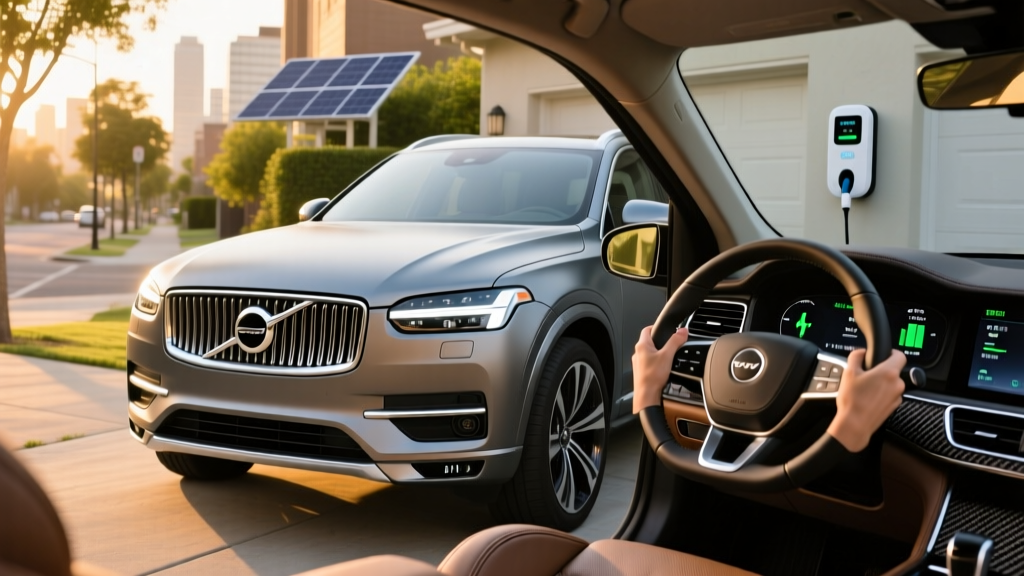
The Volvo XC90 plug-in hybrid — officially badged as the XC90 Recharge — occupies a narrow but valuable space in the luxury SUV market. It delivers 35 miles of EPA-rated electric-only range for daily commutes, 455 combined horsepower when you need it, and a third row that most plug-in competitors simply don't offer. For families who want to drive electric on weekdays without sacrificing road-trip flexibility on weekends, the XC90 Recharge makes a compelling case.
But at a starting MSRP around $80,000 and with a relatively modest 18.8 kWh battery, the value proposition depends heavily on your driving patterns, home charging access, and whether you actually need three rows. Let's break down every number that matters.
| Spec | Value |
|---|---|
| Powertrain | 2.0L turbocharged + supercharged I-4 + rear electric motor (PHEV) |
| Combined Horsepower | 455 hp / 523 lb-ft torque |
| Battery (usable) | 18.8 kWh (NMC lithium-ion) |
| EPA Electric-Only Range | 35 miles |
| Total Combined Range | ~430 miles (electric + gas) |
| MPGe (electric + gas) | 55 MPGe combined |
| MPG (gas-only, after battery depletes) | 27 combined (26 city / 28 highway) |
| Level 2 Charge Time (0–100%) | ~5 hours at 3.6 kW |
| DC Fast Charging | Not supported |
| 0–60 mph | 5.5 seconds |
| Towing Capacity | 5,000 lbs |
| Seating | 7 passengers (3 rows) |
| Base MSRP (Core) | ~$80,350 |
| Battery/Powertrain Warranty | 8 years / 100,000 miles |
HEV vs PHEV: What the XC90 Recharge Actually Is
Volvo sells the XC90 in two electrified forms, and confusing them is easy if you're scanning a dealer lot. Here's the distinction:
| Feature | XC90 B5/B6 (Mild Hybrid) | XC90 Recharge T8 (PHEV) |
|---|---|---|
| Plug-in charging | No — charges via regenerative braking only | Yes — plug in at home or public Level 2 |
| Electric-only driving | Not possible (48V system assists engine only) | Up to 35 miles on battery alone |
| Battery size | ~0.4 kWh (48V mild-hybrid) | 18.8 kWh (high-voltage traction battery) |
| Combined horsepower | 247 hp (B5) / 295 hp (B6) | 455 hp |
| EPA combined fuel economy | 24–26 MPG combined | 55 MPGe / 27 MPG gas-only |
| Federal tax credit eligible | No | Potentially (see tax credit section below) |
| Starting MSRP | ~$60,000 | ~$80,350 |
The B5 and B6 variants are mild hybrids (sometimes called HEVs in Volvo's marketing). They use a small 48-volt battery and integrated starter-generator to smooth stop/start events and recapture a tiny amount of braking energy. You never plug them in, and they cannot drive on electric power alone. They are not the subject of this review.
The XC90 Recharge T8 is the plug-in hybrid (PHEV). It pairs a larger high-voltage battery with a rear-axle electric motor and a charge port. You plug it in overnight, drive up to 35 miles without the engine firing, and when the battery depletes, it operates as a conventional hybrid. This is the powertrain we're analyzing in depth.
Fuel Economy: EPA Numbers and Real-World Expectations
Plug-in hybrid fuel economy is notoriously tricky to interpret because it depends entirely on how often you charge. The EPA publishes two figures for PHEVs:
| Mode | City | Highway | Combined |
|---|---|---|---|
| Electric + Gas (MPGe) | 58 MPGe | 52 MPGe | 55 MPGe |
| Gas Only (MPG, battery depleted) | 26 MPG | 28 MPG | 27 MPG |
What these numbers mean in practice: If you charge every night and your daily round-trip commute is under 35 miles, you may use almost zero gasoline for months. Owners who charge religiously report real-world "MPG" equivalents well above the 55 MPGe sticker — sometimes exceeding 100 MPGe in warm-weather city driving where the electric motor handles everything.
Conversely, if you never plug in, the XC90 Recharge operates as a heavy luxury SUV with a 2.0L engine doing extra work. Expect real-world fuel economy around 24–26 MPG combined in mixed driving when the battery is depleted — slightly below the EPA's 27 MPG gas-only figure, particularly in cold weather or stop-and-go traffic where the engine runs richer. Highway cruising at 70+ mph with a depleted battery can yield 26–28 MPG thanks to the relatively efficient turbocharged engine.
The key insight: PHEV fuel economy is a function of your charging discipline. The EPA's 55 MPGe assumes a specific charge-depleting/charge-sustaining blend. Your actual results will vary dramatically based on plug-in frequency.
Real-World Electric Range Caveat: The EPA rates the XC90 Recharge at 35 miles electric-only. In real-world testing, expect 28–33 miles in mild weather (60–75°F) with mixed city/highway driving. In winter conditions (below 32°F), plan for 20–25 miles of electric range due to battery chemistry limitations and cabin heating demands. Highway-only driving at 75+ mph will also reduce electric range to roughly 25–28 miles.
Battery, Charging, and the No-DC-Fast-Charge Limitation
The XC90 Recharge uses an 18.8 kWh usable NMC (nickel-manganese-cobalt) lithium-ion battery pack mounted in the vehicle's center tunnel between the front and rear axles. This placement preserves cargo space and keeps the center of gravity low, but it limits the battery's physical size — which is why the electric range caps at 35 miles rather than the 40–50 miles some competitors offer.
Charging options:
- Level 1 (120V household outlet): ~1.4 kW — full charge in roughly 13 hours. Fine for overnight top-ups if you have a 10-hour window.
- Level 2 (240V home or public): ~3.6 kW — full charge in approximately 5 hours. This is the practical daily charging method.
- DC Fast Charging: Not supported. The XC90 Recharge uses a J1772 connector for AC charging only. There is no CCS or NACS inlet, and no DC fast-charge capability.
The lack of DC fast charging is a deliberate Volvo engineering decision tied to the PHEV's smaller battery and intended use case: you charge at home overnight and drive electric locally. On a road trip, the gasoline engine handles long distances. But if you're accustomed to the 20-minute DC fast-charge stops of a full BEV, this is a meaningful trade-off to understand.
Charge rate nuance: The onboard charger is rated at 3.6 kW maximum. Even if you connect to a 7.2 kW or 11.5 kW Level 2 public station, the XC90 Recharge will only draw 3.6 kW. Plan accordingly — a "quick top-up" at a public charger still takes over two hours from near-empty.
Powertrain Deep Dive: 455 HP from a 2.0L + Electric Motor
The XC90 Recharge's powertrain is one of the most densely engineered in the luxury SUV segment:
- Internal combustion engine: 2.0-liter inline-4, both turbocharged and supercharged, producing 312 hp and 295 lb-ft of torque to the front wheels through an 8-speed automatic transmission.
- Rear electric motor: 143 hp and 228 lb-ft of torque, driving the rear axle independently. This provides all-wheel drive without a mechanical driveshaft connecting the axles.
- Combined output: 455 hp and 523 lb-ft of torque (Volvo's combined rating accounts for the fact that peak ICE and peak electric outputs don't occur at the same RPM).
The result is a 0–60 mph time of 5.5 seconds — genuinely quick for a 5,100-pound three-row SUV. In "Pure" drive mode, the vehicle operates on the rear electric motor alone (rear-wheel drive). In "Hybrid" mode, the car blends both power sources automatically. "Power" mode engages both systems aggressively for maximum acceleration.
One practical note: the engine is a 2.0L four-cylinder. Despite the supercharger and turbocharger, some buyers at this price point expect a six-cylinder. The engine is refined and the electric motor fills in low-end torque seamlessly, but under hard acceleration at highway speeds, the four-cylinder's vocal character is noticeable. This is a trade-off for the efficiency gains the smaller displacement enables.
Pricing, Trims, and Federal Tax Credit Eligibility
The 2026 Volvo XC90 Recharge is offered in several trims, with pricing that positions it firmly in the luxury PHEV tier:
| Trim | MSRP (approx.) |
|---|---|
| Core | $80,350 |
| Plus | $84,350 |
| Ultra | $89,850 |
Federal tax credit (§30D) eligibility: This is where the XC90 Recharge faces headwinds. Under current IRS rules for the Clean Vehicle Credit, PHEVs must meet several criteria:
- MSRP cap: SUVs must have an MSRP at or below $80,000. The XC90 Recharge Core trim squeaks in just above this threshold at ~$80,350, potentially disqualifying most trims from the credit. Verify exact MSRP with your dealer, as destination charges and options can push pricing further above the cap.
- Battery capacity: Must be at least 7 kWh — the XC90 Recharge's 18.8 kWh battery easily qualifies.
- Buyer income limits: Modified AGI must not exceed $150,000 (single), $225,000 (head of household), or $300,000 (joint filers).
- Critical minerals and battery component sourcing: The vehicle must meet phased-in percentages of North American-sourced critical minerals and battery components. Volvo's supply chain compliance varies by model year — confirm current-year status on the IRS qualified vehicles list.
- Final assembly: Must occur in North America. The XC90 is manufactured in Gothenburg, Sweden and Chengdu, China — this is a likely disqualifier for the federal credit under current rules.
Bottom line on tax credits: The XC90 Recharge is unlikely to qualify for the federal §30D credit due to its non-North-American assembly and MSRP above the SUV cap. Some states offer separate PHEV rebates (California's CVRP, Colorado's state credit, and others) that may still apply — check your state's energy office for current programs. Always consult a tax professional before making purchase decisions based on credit eligibility.
Reliability, Battery Longevity, and Warranty Coverage
Volvo's PHEV powertrain has been in production since 2016 (initially as the T8 Twin Engine), giving it nearly a decade of real-world validation. The high-voltage battery and hybrid components carry Volvo's standard electrified powertrain warranty:
Volvo XC90 Recharge Warranty Summary:
- Hybrid battery & components: 8 years / 100,000 miles (whichever comes first), covering defects and capacity loss below a defined threshold (typically 70% of original capacity).
- Basic vehicle warranty: 4 years / 50,000 miles.
- Powertrain warranty: 4 years / 50,000 miles (extended to 8 years for hybrid-specific components).
Battery degradation: Based on owner reports and fleet data from earlier T8/Recharge models, NMC batteries in Volvo's PHEV platform typically retain 85–92% of original capacity after 5 years of normal use. The 18.8 kWh pack has a relatively conservative state-of-charge window (Volvo buffers the top and bottom to reduce stress), which aids longevity. If you charge nightly to 100% and regularly deplete to near-zero, expect slightly faster degradation — though still within the warranty threshold for most owners.
Battery replacement cost: If the high-voltage battery fails outside warranty, replacement costs range from $8,000 to $14,000 including parts and labor at a Volvo dealer. This is a meaningful long-term ownership risk, though the 8-year/100,000-mile warranty covers the vast majority of owners through their typical ownership period.
General reliability: According to IIHS data, the XC90 has maintained strong safety ratings. Reliability ratings from Consumer Reports and J.D. Power have been mixed for Volvo's SPA-platform vehicles, with some owners reporting issues with the infotainment system (Sensus and the newer Google-based system), air suspension components, and electrical gremlins. The PHEV powertrain itself has proven more robust than early-generation Volvo hybrid systems, but Volvo as a brand still trails Toyota/Lexus and Honda in long-term reliability perception. For a NHTSA safety overview, check the latest crash test results directly.
XC90 Recharge vs Full EV vs Gas SUV: Which Fits You?
Choose the Volvo XC90 Recharge (PHEV) if:
- You have home Level 2 charging (or reliable workplace charging) and a daily commute under 35 miles round-trip.
- You need three rows of seating but don't want a full-electric SUV (the only 3-row BEV alternatives are the Tesla Model X, Rivian R1S, and Kia EV9).
- You take regular road trips exceeding 200 miles where public charging infrastructure is sparse or unreliable.
- You want the option of electric daily driving without committing fully to BEV ownership.
Choose a full EV (e.g., Tesla Model X, Rivian R1S, Kia EV9) if:
- You have reliable home charging and your daily driving rarely exceeds 200 miles.
- You want to eliminate gasoline entirely — no oil changes, no gas station visits, lower per-mile fuel cost.
- You want access to DC fast charging for road trips (20–30 minute stops at 150–350 kW stations).
- You want to potentially qualify for the full $7,500 federal tax credit (many BEVs still qualify where PHEVs may not).
Choose the gas/mild-hybrid XC90 (B5/B6) if:
- You cannot install a home charger and have no reliable access to plug-in charging.
- Your budget is closer to $60,000–$70,000 and the $15,000+ PHEV premium isn't justified by your driving patterns.
- Your daily commute exceeds 40+ miles and you'd rarely use the 35-mile electric range anyway.
The XC90 Recharge's strongest competitive position is its three-row layout combined with plug-in capability. Most PHEV SUVs — the BMW X5 xDrive50e, Mercedes GLE 350e, Lincoln Aviator Grand Touring — offer only two rows. If third-row seating is non-negotiable and you want a plug-in, the XC90 Recharge is essentially alone in its segment.
Pros
- 35 miles electric-only covers most daily commutes
- 455 hp delivers genuinely quick acceleration (5.5s to 60)
- Three-row seating in a PHEV — rare in the segment
- Smooth electric-only "Pure" mode for silent neighborhood driving
- Strong safety ratings (IIHS Top Safety Pick history)
- Google-based infotainment with native navigation and charging integration
Cons
- No DC fast charging — a significant limitation for a $80K+ vehicle
- Likely ineligible for the federal $7,500 tax credit (foreign assembly, MSRP cap)
- 3.6 kW onboard charger means slow Level 2 charging (~5 hours)
- Electric range drops to ~20–25 miles in cold weather
- Four-cylinder engine lacks the refinement of a six-cylinder at this price point
- Volvo reliability ratings trail Japanese and German luxury competitors
- Premium of ~$15,000+ over mild-hybrid B5/B6 trims
Ownership Economics: 5-Year Cost Snapshot
| Cost Factor | XC90 Recharge (PHEV) | XC90 B6 (Mild Hybrid) |
|---|---|---|
| Purchase price (MSRP) | $84,350 (Plus) | $68,000 (Plus) |
| Federal tax credit | $0 (likely ineligible) | $0 |
| Fuel cost (5 yrs, 12K mi/yr) | ~$4,500 (gas + electricity, assuming nightly charging) | ~$10,800 (gas only, 25 MPG avg, $3.60/gal) |
| Home charger installation | ~$1,200 (Level 2, 240V/30A) | $0 |
| Insurance (5 yrs avg) | ~$14,000 | ~$12,500 |
| Maintenance (5 yrs) | ~$3,800 (less engine wear, but complex hybrid system) | ~$4,500 |
| Estimated depreciation | ~$38,000 | ~$32,000 |
| Approx. 5-year total | ~$145,850 | ~$127,800 |
The PHEV saves roughly $6,300 in fuel over five years but costs ~$16,350 more upfront (before any state incentives). The break-even point on fuel savings alone takes well over a decade. The Recharge's value proposition is therefore not primarily financial — it's about the driving experience (silent electric commutes, 455 hp on demand) and emissions reduction, not payback math.
Frequently Asked Questions
How many MPG does the Volvo XC90 plug-in hybrid get?
The EPA rates the XC90 Recharge at 55 MPGe combined when operating in blended electric-gas mode, and 27 MPG combined (26 city / 28 highway) when the battery is depleted and it runs on gasoline alone. Real-world gas-only MPG typically falls between 24–26 MPG combined, depending on driving conditions and temperature. If you charge nightly and drive under 35 miles daily, your gasoline consumption may approach zero for months at a time.
How far can the XC90 Recharge go on electric power only?
The EPA rates the 2026 XC90 Recharge at 35 miles of electric-only range. In real-world conditions, expect 28–33 miles in mild weather and 20–25 miles in freezing temperatures. Highway driving at 75+ mph will also reduce electric range to roughly 25–28 miles. The total combined range (electric + full gas tank) is approximately 430 miles.
Does the Volvo XC90 plug-in hybrid qualify for a federal tax credit?
Under current IRS §30D rules, the XC90 Recharge is unlikely to qualify for the federal Clean Vehicle Credit. Two primary barriers exist: the vehicle is assembled outside North America (Sweden and China), and most trims exceed the $80,000 MSRP cap for SUVs. Some state-level incentives may still apply. Always verify eligibility on the IRS qualified vehicles list and consult a tax professional.
Can the XC90 Recharge DC fast charge?
No. The XC90 Recharge only supports AC charging via a J1772 connector at up to 3.6 kW (Level 2). There is no DC fast-charge capability. A full charge from empty on Level 2 takes approximately 5 hours. This is typical for PHEVs, which prioritize overnight home charging over rapid public charging.
Is the Volvo XC90 plug-in hybrid reliable, and what does battery replacement cost?
The T8/Recharge powertrain has been in production since 2016 and has proven reasonably robust, though Volvo as a brand receives middling reliability ratings from Consumer Reports and J.D. Power compared to Lexus or BMW. The high-voltage battery is warrantied for 8 years / 100,000 miles. Out-of-warranty replacement costs range from $8,000 to $14,000. Most owners will not need a battery replacement within the warranty period given the conservative charge-discharge window Volvo engineers into the system.
Should I buy the XC90 Recharge or a full electric SUV?
If you have home charging, a commute under 35 miles, and regularly take road trips to areas with limited charging infrastructure, the XC90 Recharge offers a practical bridge. If you rarely exceed 200 miles daily and want the lowest operating cost and strongest tax credit eligibility, a full EV like the Kia EV9 or Rivian R1S may serve you better. The deciding factor is often whether you need three rows — the XC90 Recharge is one of the only PHEVs offering them.