Quick Verdict: The XC60 Recharge Bridges Two Worlds
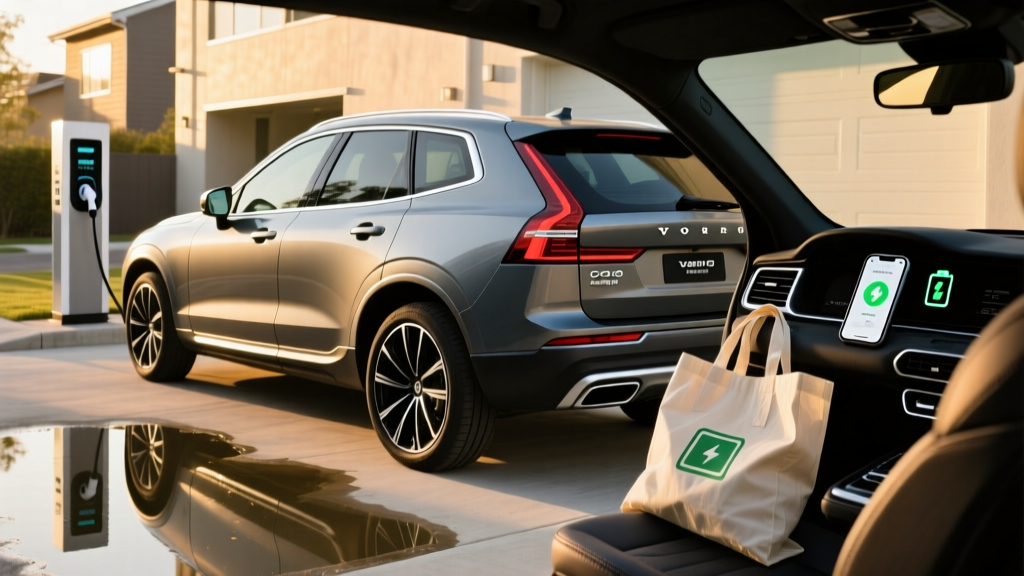
The 2026 Volvo XC60 Recharge — the brand's plug-in hybrid (PHEV) compact luxury SUV — targets buyers who want daily electric commuting without surrendering the flexibility of a gasoline engine for longer trips. With 35 miles of EPA-rated electric-only range, a combined 455 horsepower, and a starting MSRP around $59,000, the XC60 plug-in hybrid occupies a specific niche: the one-car household that can charge at home but isn't ready to commit to a battery-electric vehicle (BEV).
This guide covers what the numbers actually mean for your commute, your wallet, and your charging routine — plus where the XC60 Recharge falls short compared to a full EV or a conventional hybrid.
| Specification | Value |
|---|---|
| Powertrain | 2.0L turbocharged/supercharged I4 + rear electric motor (P8 AWD) |
| Combined Horsepower | 455 hp / 523 lb-ft torque |
| Battery (Usable) | 14.9 kWh (18.8 kWh gross), lithium-ion NMC |
| EPA Electric-Only Range | 35 miles |
| EPA MPGe (Electric + Gas) | 63 MPGe combined |
| EPA MPG (Gas Only, Charge-Depleted) | 28 city / 28 highway / 28 combined |
| Total Combined Range | ~440 miles (electric + gasoline) |
| DC Fast Charging | Not supported |
| Level 2 Charging (240V) | ~3.7 kW onboard charger; ~5 hours (0–100%) |
| Level 1 Charging (120V) | ~12–14 hours (0–100%) |
| 0–60 mph | 4.5 seconds |
| Drivetrain | eAWD (electric rear axle, no mechanical link) |
| Towing Capacity | 3,500 lbs (braked) |
| Base MSRP (Core trim) | ~$59,050 (before destination) |
| Federal Tax Credit (§30D) | Eligible up to $7,500 (subject to sourcing/income rules) |
| Battery Warranty | 8 years / 100,000 miles |
HEV vs. PHEV: Understanding What You're Buying
The Volvo XC60 is available in two electrified forms, and confusing them is a common buyer mistake:
| Feature | XC60 B5 (Mild Hybrid) | XC60 Recharge T8 (PHEV) |
|---|---|---|
| Plugs in? | No — regenerative braking only | Yes — Level 1 or Level 2 AC charging |
| Electric-Only Range | 0 miles (electric assist only) | 35 miles EPA |
| Battery Size | 0.4 kWh (48V system) | 18.8 kWh gross / 14.9 kWh usable |
| Combined HP | 247 hp | 455 hp |
| EPA MPG Combined | 26 MPG | 28 MPG (gas) / 63 MPGe (with charge) |
| Starting MSRP | ~$47,000 | ~$59,050 |
| Federal Tax Credit | Not eligible | Up to $7,500 (if eligible) |
The mild hybrid (B5) uses a small 48-volt battery and integrated starter-generator to smooth stop-start events and recover tiny amounts of energy. It never drives on electricity alone. You will never plug it in. It's a conventional gasoline vehicle with efficiency assist.
The XC60 Recharge (T8 PHEV) has a substantially larger battery pack, a dedicated rear-axle electric motor, and a charge port. It can drive up to 35 miles on electricity alone before the gasoline engine engages. This is the "XC60 plug-in hybrid" that buyers research — and the focus of this guide.
Electric-Only Range and Efficiency: What 35 Miles Actually Means
The EPA rates the 2026 XC60 Recharge at 35 miles of electric-only range. That figure is derived from a mix of city and highway driving cycles at moderate temperatures.
Real-World Range Expectations:
- Mild weather, city/suburban driving (under 45 mph): 32–37 miles — regenerative braking extends range in stop-and-go traffic
- Highway driving (70+ mph): 25–28 miles — aerodynamic drag and higher speeds deplete the battery faster
- Cold weather (below 32°F): 22–27 miles — battery chemistry slows, cabin heating draws energy, and the engine may start to provide heat
- Hot weather with A/C: 28–32 miles — less penalty than cold, but climate control still reduces range
For context, the average American one-way commute is roughly 16 miles, according to FHWA data. That means a large share of XC60 Recharge owners can complete their daily commute entirely on electricity — provided they plug in at home or work each day.
When the battery is depleted, the 2.0-liter turbocharged and supercharged four-cylinder engine takes over. In this charge-depleted (hybrid) mode, the EPA rates the XC60 Recharge at 28 MPG combined (28 city / 28 highway). That's modestly better than the mild-hybrid B5's 26 MPG combined, but it's not a dramatic improvement. The real efficiency gain comes from those electric-only miles, which is why the combined MPGe rating reaches 63 MPGe — a metric that blends electric and gasoline energy consumption into a gasoline-equivalent figure (source: fueleconomy.gov).
Charging the XC60 Recharge: Level 1, Level 2, and What's Missing
The XC60 Recharge uses a standard J1772 connector (the same plug used by virtually all non-Tesla PHEVs and EVs in North America). Here's what charging looks like in practice:
| Charging Level | Voltage | Power (kW) | Time (0–100%) | Miles Added per Hour |
|---|---|---|---|---|
| Level 1 (Standard outlet) | 120V | ~1.4 kW | ~12–14 hours | ~3 miles/hr |
| Level 2 (Home/public AC) | 240V | ~3.7 kW (onboard limit) | ~5 hours | ~7 miles/hr |
| DC Fast Charging | N/A | Not supported | N/A | N/A |
The critical limitation: The XC60 Recharge does not support DC fast charging. The onboard AC charger is capped at approximately 3.7 kW, which is typical for PHEVs but means you cannot rapidly top up at a highway fast-charging station. This is a deliberate engineering choice — the battery is small enough that overnight Level 2 charging is sufficient for most owners, and adding DC fast-charge hardware would increase cost, weight, and complexity.
Home charging setup: Most XC60 Recharge owners will want a Level 2 home charger (240V, 16-amp or higher circuit). A quality Level 2 unit costs $300–$700, and professional installation by a licensed electrician typically runs $500–$1,500 depending on whether your electrical panel needs an upgrade. Since the onboard charger maxes out at ~3.7 kW, you don't need a 48-amp charger — a 16-amp or 24-amp unit is sufficient. That said, installing a higher-capacity circuit (e.g., 40-amp) future-proofs your garage for a future full-EV purchase.
Level 1 charging (a standard 120V household outlet) is viable if your daily driving is under 25 miles and you can leave the car plugged in overnight. It will fully recharge the battery in 12–14 hours, which works for low-mileage commuters but won't keep up with a high-mileage day.
Powertrain and Performance: 455 HP in a Luxury SUV
The XC60 Recharge powertrain pairs a turbocharged and supercharged 2.0-liter inline-four engine (316 hp on its own) with a 143-hp electric motor driving the rear axle. Combined output is 455 horsepower and 523 lb-ft of torque. The electric rear axle provides all-wheel drive without a mechanical driveshaft connecting the front and rear — Volvo calls this eAWD.
The result is a 0–60 mph time of 4.5 seconds, which is genuinely quick for a compact luxury SUV and matches or beats many sport-tuned gasoline competitors. The electric motor delivers instant torque from a standstill, making the XC60 Recharge feel responsive in city driving and confident during highway merges.
Four drive modes manage the powertrain:
- Pure: Electric-only driving, up to 35 miles (engine stays off unless you floor the accelerator or need heat)
- Hybrid: Default mode — the car blends electric and gasoline power for optimal efficiency
- Power: Maximum combined output for performance driving
- Off-Road: Low-speed eAWD traction mode (limited to ~25 mph)
You can also use a "Hold" function to save battery charge for later (useful if you're driving on the highway and want to save electric range for city driving at your destination) or a "Charge" mode that uses the engine to recharge the battery while driving — though this reduces fuel economy significantly.
Pricing, Trims, and Federal Tax Credit Eligibility
The 2026 Volvo XC60 Recharge is available in several trim levels:
- Core: ~$59,050 MSRP (before $1,195 destination)
- Plus: ~$63,050 MSRP
- Ultimate: ~$67,550 MSRP
- Polestar Engineered: ~$72,350 MSRP (performance-tuned suspension, brakes, software)
All trims include the same powertrain and battery — trim differences are primarily interior materials, technology packages, and exterior styling.
Federal Tax Credit (§30D) — Current Rules
The XC60 Recharge has historically qualified for the full $7,500 federal tax credit under IRS §30D, but eligibility depends on several conditions that change frequently:
- MSRP cap: SUVs must have an MSRP at or below $80,000 — all XC60 Recharge trims qualify
- Buyer income cap: Modified AGI ≤ $150,000 (single), ≤ $300,000 (married filing jointly), ≤ $225,000 (head of household)
- Battery sourcing: Critical minerals and battery components must meet phased-in domestic-content thresholds (these thresholds tighten annually through 2030)
- Point-of-sale transfer: As of 2024, buyers can transfer the credit to the dealer at purchase, reducing the purchase price directly rather than waiting for a tax refund
- FEOC restriction: Vehicles with battery components from a "foreign entity of concern" (e.g., certain Chinese suppliers) may be disqualified — verify current status at purchase
Important: Battery sourcing rules have shifted multiple times since 2023. Always verify current eligibility on the IRS qualified vehicles list before signing a purchase agreement. Your tax situation is unique — consult a tax professional for personalized advice.
With the full $7,500 credit applied, the effective starting price of the XC60 Recharge Core drops to approximately $51,550 — narrowing the gap with the mild-hybrid B5 and making the PHEV a more compelling value proposition for eligible buyers.
Battery Warranty, Reliability, and Replacement Costs
Volvo PHEV Battery Warranty: 8 years or 100,000 miles (whichever comes first), covering defects and capacity loss below 70% of original capacity. This is consistent with industry-standard PHEV battery warranties from BMW, Audi, and Mercedes-Benz.
The 18.8 kWh (gross) lithium-ion NMC battery pack in the XC60 Recharge is liquid-cooled, which helps manage thermal degradation — a key factor in long-term battery health. PHEV batteries undergo shallower charge/discharge cycles than full-EV batteries (you're using 14.9 kWh of usable capacity, not 80+ kWh), which generally translates to slower degradation over time.
Real-world reliability data: Volvo's PHEV powertrain (internally called T8, now marketed as "Recharge") has been in production since 2016 across the 60- and 90-series lines. Early-model (2016–2018) T8 systems had some reported issues with the electric rear axle and charging system, but the 2022+ refresh — which introduced the larger 18.8 kWh battery and more powerful rear motor — has shown improved reliability in owner surveys. IIHS has rated the XC60 as a Top Safety Pick+ in recent model years.
Battery replacement cost: If the battery pack needs replacement outside of warranty, expect a cost in the range of $8,000–$14,000 (parts and labor), based on current Volvo PHEV battery pricing. However, PHEV battery failures within the first decade are uncommon, and the 8-year/100,000-mile warranty provides substantial coverage. Most PHEV batteries retain 85–92% of original capacity after 8 years based on fleet data from similar systems.
Who Should Buy the XC60 Plug-In Hybrid — And Who Shouldn't
Choose the XC60 Recharge PHEV if:
- Your daily round-trip commute is under 35 miles and you can charge at home every night
- You want one vehicle that handles both electric commuting and long road trips without range planning
- You live in a cold climate where EV range loss is a genuine concern
- You value the 455-hp performance and eAWD traction
- You qualify for the $7,500 federal tax credit and want to apply it at point of sale
Choose a full EV (like the Volvo EX40 or Tesla Model Y) instead if:
- Your daily driving regularly exceeds 35 miles — you'll burn gas often in the XC60 Recharge, negating the efficiency benefit
- You want DC fast charging for road trips (the XC60 Recharge can't use it)
- You want zero tailpipe emissions and minimal maintenance (no oil changes, no spark plugs, no engine)
- You can install Level 2 charging at home and have access to public fast-charging networks
Choose the XC60 B5 mild hybrid instead if:
- You cannot charge at home or at work — a PHEV you never plug in is just a heavier, more expensive gas car
- Your budget is tighter and the ~$12,000 price gap (before tax credits) isn't justifiable
- Your daily driving is mostly highway miles where the PHEV's electric range provides minimal benefit
Pros
- 35-mile electric range covers most daily commutes
- 455 hp / 4.5-second 0–60 — genuinely quick
- $7,500 federal tax credit eligible (if sourcing/income rules met)
- Luxury interior with Google-based infotainment
- No range anxiety on road trips — gas engine takes over seamlessly
- eAWD without a mechanical driveshaft reduces drivetrain complexity
Cons
- No DC fast charging — highway top-ups not possible
- Only 28 MPG combined in gas-only mode — modest for a hybrid
- 3.7 kW onboard charger is slow for public Level 2 stations
- Premium price vs. non-luxury PHEVs (Toyota RAV4 Prime: ~$44,000, 42-mile range)
- Cold-weather electric range drops to ~22–27 miles
- Cargo space slightly reduced vs. B5 mild hybrid (battery placement)
Frequently Asked Questions
How many MPG does the Volvo XC60 plug-in hybrid get?
When operating in charge-depleted (gas-only) mode, the EPA rates the 2026 XC60 Recharge at 28 MPG city / 28 highway / 28 MPG combined. When you factor in electric-only driving, the combined rating is 63 MPGe. In real-world use, owners who charge daily and drive under 35 miles report using very little gasoline — some averaging over 80 MPGe equivalent over a month. Those who rarely charge and drive long distances will see closer to 26–28 MPG, similar to the mild-hybrid model.
How far can the XC60 Recharge go on electric only?
The EPA rates it at 35 miles on electricity alone. In real-world conditions, expect 32–37 miles in mild-weather city driving, 25–28 miles on the highway, and 22–27 miles in freezing temperatures. The gasoline engine will automatically start if you demand full acceleration, if cabin heat is needed in very cold weather, or if the battery reaches its minimum state of charge.
Does the XC60 plug-in hybrid qualify for a tax credit?
The XC60 Recharge has been eligible for up to $7,500 under the federal §30D clean vehicle credit, and it can be transferred to the dealer at point of sale as a purchase-price reduction. However, eligibility depends on your income (AGI caps apply), the vehicle's battery sourcing compliance (which changes annually), and the MSRP cap ($80,000 for SUVs — all trims qualify). Always check the IRS qualified vehicle list before purchasing, and consult a tax professional.
Is the XC60 Recharge reliable, and what does a battery replacement cost?
Volvo's PHEV system has been in production since 2016, with the current-generation (2022+) powertrain showing improved reliability over early models. The battery is covered by an 8-year/100,000-mile warranty. Out-of-warranty replacement costs are estimated at $8,000–$14,000, though PHEV battery failures within the first decade are rare. The smaller battery (vs. a full EV) and shallower charge cycles contribute to slower degradation.
Hybrid vs. PHEV vs. EV — which is right for me?
A conventional hybrid (HEV) like the Toyota RAV4 Hybrid requires no plug-in charging and delivers consistent MPG (38–41 combined) regardless of driving habits. A plug-in hybrid (PHEV) like the XC60 Recharge gives you 35 electric-only miles when charged, but reverts to average gas-car efficiency when the battery depletes — it only makes sense if you can charge daily. A full EV (BEV) eliminates gasoline entirely, has lower maintenance costs, and offers 250–350+ miles of range, but requires reliable home or workplace charging and planning for road trips. If you can charge at home and your commute is under 35 miles, the PHEV offers the best of both worlds. If your commute is longer or you can't charge, choose an HEV. If you're ready to go all-electric and have charging access, a BEV will have the lowest operating cost over time.
Can I charge the XC60 Recharge at a Tesla Supercharger?
No. The XC60 Recharge uses a J1772 connector for AC Level 1 and Level 2 charging. It does not support DC fast charging at all, including Tesla Superchargers, Electrify America, or any other DC network. You can charge at any public Level 2 station with a J1772 connector (ChargePoint, EVgo Level 2, Blink, etc.), but the 3.7 kW onboard charger means charging will be slower than most full EVs at those stations.