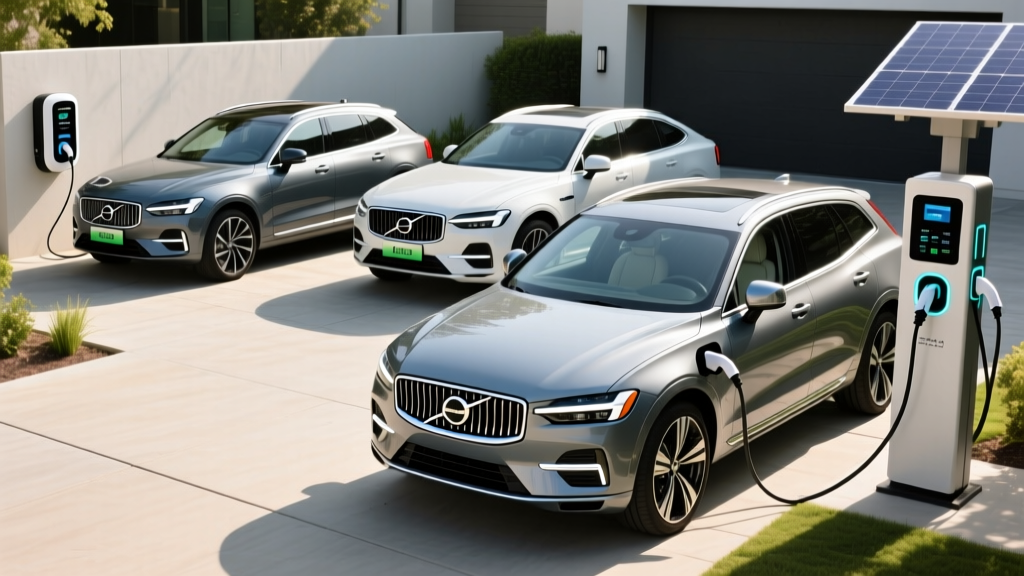
Volvo has committed heavily to plug-in hybrid technology as a bridge to full electrification, and its 2026 Recharge lineup reflects that strategy with meaningful updates to battery capacity, electric-only range, and powertrain refinement. If you're researching a Volvo PHEV, you're likely weighing whether the plug-in hybrid format fits your daily driving pattern better than a full battery-electric vehicle (BEV) or a conventional hybrid. This guide covers the exact specifications, real-world expectations, and ownership economics for every current Volvo PHEV model.
Volvo's PHEV Lineup at a Glance: 2026 Recharge Models
For 2026, Volvo offers three PHEV models in the U.S. under the "Recharge" badge (formerly designated "T8 eAWD"). All three share the same fundamental plug-in hybrid architecture: a turbocharged and supercharged 2.0-liter four-cylinder gasoline engine paired with a rear-axle electric motor and an 18.8 kWh (usable) lithium-ion battery pack. Here's the lineup:
| Model | Combined HP | Battery (usable kWh) | EPA Electric Range | EPA Combined MPGe | 0-60 mph | Base MSRP |
|---|---|---|---|---|---|---|
| XC60 Recharge | 455 hp | 18.8 kWh | 35 mi | 63 MPGe | 4.5 sec | $59,250 |
| XC90 Recharge | 455 hp | 18.8 kWh | 33 mi | 58 MPGe | 4.9 sec | $73,350 |
| S60 Recharge | 455 hp | 18.8 kWh | 40 mi | 69 MPGe | 4.3 sec | $51,950 |
All three models use the same powertrain but deliver slightly different electric-only ranges and efficiency figures due to weight and aerodynamic differences. The S60 sedan, being the lightest and sleekest, extracts the most electric miles from the same 18.8 kWh pack.
HEV vs. PHEV vs. BEV: Where Does a Volvo PHEV Fit?
Before evaluating specific models, it's critical to understand the distinction between the three electrified powertrain types Volvo buyers consider:
Conventional Hybrid (HEV)
A standard hybrid like the Toyota RAV4 Hybrid uses a small battery (1-2 kWh) charged exclusively by regenerative braking and the gasoline engine. You never plug it in. It improves fuel economy by 20-40% over a gas-only car but offers no meaningful electric-only driving. Volvo does not currently sell a conventional HEV in the U.S. — their "Mild Hybrid" (B5/B6) models use a 48-volt system that assists the engine but cannot propel the car on electricity alone.
Plug-In Hybrid (PHEV) — Volvo Recharge
A PHEV carries a substantially larger battery (18.8 kWh usable in Volvo's case) that you charge by plugging into a wall outlet or Level 2 charger. This enables 33-40 miles of pure electric driving before the gasoline engine engages. Once the battery depletes, it operates like a conventional hybrid. Total combined range exceeds 450 miles.
Battery Electric Vehicle (BEV)
A full EV like the Volvo EX90 or EX30 has no gasoline engine — propulsion comes entirely from a large battery (77-111 kWh). Range is 250-350+ miles per charge, but you depend entirely on charging infrastructure.
Choose a Volvo PHEV if: You can charge at home overnight, your daily commute is under 40 miles round-trip, but you regularly take road trips exceeding 250 miles and want gasoline flexibility.
Choose a full EV instead if: You have reliable home charging, rarely drive more than 250 miles in a single day, and want to eliminate gasoline costs and maintenance entirely.
Choose a conventional hybrid instead if: You cannot charge at home (apartment, street parking) but still want improved fuel economy without plugging in.
Electric-Only Range and Real-World MPG
The EPA-rated electric-only range for Volvo's 2026 PHEVs is 33-40 miles depending on the model. That number comes from fueleconomy.gov testing on a mixed driving cycle. Here's what to expect in practice:
EPA Electric Range: 35 miles (XC60 Recharge)
Real-World Expectation: 28-32 miles in mixed driving; 22-26 miles at sustained highway speeds (70+ mph); 25-30 miles in cold weather (below 40°F) due to cabin heating demand and reduced battery efficiency.
Total Combined Range (electric + gasoline): Approximately 460-520 miles depending on model and driving conditions.
Once the battery depletes, the Volvo PHEVs operate as conventional hybrids. EPA-rated gasoline-only fuel economy is:
| Model | City MPG | Highway MPG | Combined MPG |
|---|---|---|---|
| XC60 Recharge | 27 | 28 | 27 |
| XC90 Recharge | 25 | 27 | 26 |
| S60 Recharge | 30 | 33 | 31 |
In real-world ownership, drivers who charge nightly and commute short distances report effectively using little to no gasoline during the work week. However, on long highway trips where the battery depletes within the first 35 miles, expect fuel economy to align closely with the EPA gasoline-only figures above — or slightly lower if driving aggressively or in mountainous terrain. The XC90 Recharge, being the heaviest at approximately 5,100 lbs, is the most sensitive to load and terrain effects on fuel economy.
Powertrain Deep Dive: 455 Horsepower from Engine + Motor
Every 2026 Volvo PHEV pairs the same powertrain components:
- Gasoline Engine: 2.0L turbocharged and supercharged inline-4 producing 312 hp and 295 lb-ft of torque, driving the front wheels
- Electric Motor: 143 hp / 228 lb-ft rear-axle motor, providing electric-only propulsion and all-wheel-drive capability when the engine is running
- Combined Output: 455 hp and 523 lb-ft of torque
- Transmission: 8-speed automatic (no traditional torque converter — the electric motor fills torque gaps)
- Drivetrain: eAWD (front wheels engine-driven, rear wheels electric motor-driven)
This configuration means the car is effectively rear-wheel drive in Pure (electric-only) mode and all-wheel drive when the gasoline engine engages. The transition between electric and gasoline power is seamless in normal driving, though under hard acceleration you'll feel the engine engage with a brief delay as the turbocharger spools. The supercharger provides immediate low-end response while the turbo takes over at higher RPMs.
Performance is genuinely quick for the class. The S60 Recharge hits 60 mph in 4.3 seconds — competitive with a BMW 340i xDrive — while the heavier XC90 Recharge manages 4.9 seconds, which is rapid for a three-row SUV.
Charging: What You Need to Know
Volvo PHEVs use a relatively compact 18.8 kWh usable battery, which means charging is straightforward and doesn't require the heavy infrastructure of a full EV.
| Charging Level | Power (kW) | 0-100% Time | Typical Use Case |
|---|---|---|---|
| Level 1 (120V household outlet) | ~1.4 kW | ~13-14 hours | Overnight top-off if no Level 2 available |
| Level 2 (240V, 32A) | ~7.7 kW (vehicle-limited to ~3.7 kW onboard) | ~5 hours | Home garage, workplace charging |
| DC Fast Charging | Not supported | N/A | N/A |
Critical detail: Volvo PHEVs do not support DC fast charging. The onboard charger maxes out at approximately 3.7 kW, meaning even if you connect to a 48-amp Level 2 station, the car will only draw about 3.7 kW. A full 0-100% charge takes roughly 5 hours on Level 2. This is perfectly adequate for overnight home charging — plug in when you arrive home, and the car is fully charged by morning. However, you cannot quickly top up at a public DC fast charger during a road trip.
The charging port is located on the driver's side front fender and uses a standard J1772 connector (the same connector used by all non-Tesla EVs in North America for Level 1 and Level 2 charging). If you're installing a home Level 2 charger, a standard 240V/20A circuit (NEMA 14-50 or hardwired) is sufficient — no electrical panel upgrade is typically required for PHEV charging, unlike full EVs that may draw 48 amps.
Pricing, Tax Credits, and Total Cost of Ownership
Here's where Volvo PHEV buyers need to pay close attention to current incentive rules.
| Model | Base Trim (Core) | Mid Trim (Plus) | Top Trim (Ultimate) |
|---|---|---|---|
| XC60 Recharge | $59,250 | $63,050 | $68,250 |
| XC90 Recharge | $73,350 | $77,150 | $82,950 |
| S60 Recharge | $51,950 | $55,750 | $60,450 |
Federal Tax Credit Eligibility (§30D)
Under the current IRS §30D rules, qualifying plug-in hybrids may be eligible for up to $7,500 in federal tax credits. However, eligibility depends on several factors that change periodically:
- MSRP Cap: Vans/SUVs/pickups must be under $80,000 MSRP; sedans under $55,000. This means the S60 Recharge in Core trim ($51,950) qualifies, but Plus and Ultimate trims exceed the $55,000 sedan cap. The XC60 Recharge Core and Plus fall under the $80,000 SUV cap. The XC90 Recharge Core ($73,350) qualifies, but Ultimate ($82,950) does not.
- Battery Sourcing: A percentage of critical minerals and battery components must be sourced from the U.S. or free-trade-agreement countries. Volvo's supply chain compliance varies by model year — verify current eligibility on IRS.gov before purchasing.
- Buyer Income Limits: Modified adjusted gross income must not exceed $300,000 (joint filers), $225,000 (head of household), or $150,000 (single filers).
- Point-of-Sale Transfer: As of 2024, buyers can transfer the credit to the dealer at point of sale, receiving it as an immediate price reduction rather than waiting to claim it on their tax return.
Important: Tax credit eligibility for Volvo PHEVs is model- and trim-specific and subject to change as sourcing requirements tighten. Always confirm with your dealer and consult a tax professional before relying on the credit in your purchase decision. The credit may be reduced to $3,750 if only one of the two sourcing requirements (critical minerals or battery components) is met.
Battery Warranty, Reliability, and Replacement Cost
Volvo PHEV Hybrid Battery Warranty: 8 years or 100,000 miles (whichever comes first), covering defects and capacity loss below 70% of original capacity. In states that follow California Air Resources Board (CARB) regulations (including CA, NY, MA, WA, and others), the warranty extends to 10 years or 150,000 miles.
Volvo's PHEV battery pack is a lithium-ion unit with active liquid thermal management, which significantly extends lifespan compared to passively cooled packs. Based on data from earlier-generation Volvo T8 PHEVs (2016-2022 models using a smaller 11.6 kWh pack), battery degradation has been modest — most owners report 5-10% range loss over 5-7 years of use. The current 18.8 kWh pack, introduced for the 2023 model year, is too new for long-term degradation data, but the chemistry and thermal management suggest similar or better longevity.
Regarding reliability: Volvo's PHEV powertrains add complexity compared to a conventional gasoline car (electric motor, power electronics, high-voltage battery, charging system), but they have fewer moving parts than a traditional automatic transmission. Consumer Reports and J.D. Power reliability ratings for Volvo PHEVs have been mixed — some model years score average, while others dip below average due to infotainment software issues rather than powertrain failures. The gasoline engine and electric motor themselves have proven durable.
Battery Replacement Cost: If the hybrid battery fails outside of warranty, replacement costs range from approximately $8,000 to $12,000 including parts and labor, based on current dealer pricing for the T8/Recharge battery pack. This is a significant expense, but battery failures within the first 8-10 years are uncommon given Volvo's thermal management system and warranty coverage.
Who Should Buy a Volvo PHEV — and Who Shouldn't?
Reasons to Choose a Volvo PHEV
- Daily commutes under 35 miles can be completed entirely on electricity, eliminating weekday gasoline use
- 455 hp provides effortless acceleration and confident highway merging
- No range anxiety on road trips — the gasoline engine provides 400+ additional miles
- Home charging is simple — a standard 120V outlet provides enough overnight range for most commutes; a 240V outlet is ideal
- Lower upfront cost than a comparable full-electric luxury SUV
- Standard AWD via the rear electric motor — no mechanical driveshaft complexity
- Volvo's safety reputation and standard Pilot Assist (Level 2 driver assistance)
Reasons to Look Elsewhere
- No DC fast charging — cannot quickly replenish battery on road trips
- Gasoline-only MPG (25-31 combined) is unremarkable once the battery depletes, especially for the XC90
- Higher purchase price than non-electrified luxury competitors
- Maintenance complexity: you're maintaining both a gasoline engine and an electric powertrain
- Electric-only range (33-40 mi) may not cover longer commutes without gasoline
- If you cannot charge at home, the PHEV advantage disappears — you'll operate mostly on gasoline at modest MPG
Frequently Asked Questions
How many MPG does a Volvo PHEV get?
When the battery is charged, Volvo PHEVs achieve 58-69 MPGe (miles per gallon equivalent) combining electric and gasoline operation. Once the 18.8 kWh battery depletes after 33-40 miles, fuel economy drops to 25-31 MPG combined (gasoline only), depending on the model. The S60 Recharge is the most efficient at 31 MPG combined on gasoline alone; the XC90 Recharge is the least at 26 MPG combined.
How far can a Volvo PHEV go on electric only?
The EPA-rated electric-only range is 35 miles (XC60), 33 miles (XC90), or 40 miles (S60). In real-world conditions, expect 28-32 miles in mixed driving, less at sustained highway speeds or in cold weather. This covers most daily commutes but falls short for drivers with one-way commutes exceeding 20 miles.
Does the Volvo PHEV qualify for a tax credit?
Potentially yes — under IRS §30D rules, qualifying Volvo PHEVs may be eligible for up to $7,500 in federal tax credits, subject to MSRP caps, buyer income limits, and battery sourcing requirements. Eligibility varies by model, trim level, and current sourcing compliance. Always verify on IRS.gov and consult a tax professional before purchasing.
Is the Volvo PHEV reliable and what does battery replacement cost?
Volvo's PHEV powertrain has proven reasonably reliable, with most issues relating to software and infotainment rather than the hybrid system itself. The battery carries an 8-year/100,000-mile warranty (10 years/150,000 miles in CARB states). Out-of-warranty battery replacement costs approximately $8,000-$12,000, though premature battery failures are uncommon with Volvo's liquid-cooled thermal management system.
Do I need to install a special charger at home for a Volvo PHEV?
No special equipment is required. You can charge on a standard 120V household outlet (Level 1), which adds roughly 4-5 miles of range per hour — sufficient for overnight replenishment of the 33-40 mile electric range. For faster charging (~5 hours from empty), a 240V Level 2 outlet (NEMA 14-50) or hardwired station is recommended. Most homes can support PHEV charging without an electrical panel upgrade, unlike full EVs that draw higher amperage.
Should I buy a Volvo PHEV or go full electric?
Choose the PHEV if you can charge at home but regularly drive more than 250 miles in a single day and don't want to plan around charging infrastructure. Choose a full EV (like the Volvo EX90 or EX30) if your daily driving stays under 250 miles, you have reliable home charging, and you want to eliminate gasoline costs and engine maintenance entirely. The PHEV is the pragmatic choice for one-car households that need maximum flexibility; the EV is the lower-operating-cost choice for households with predictable driving patterns.