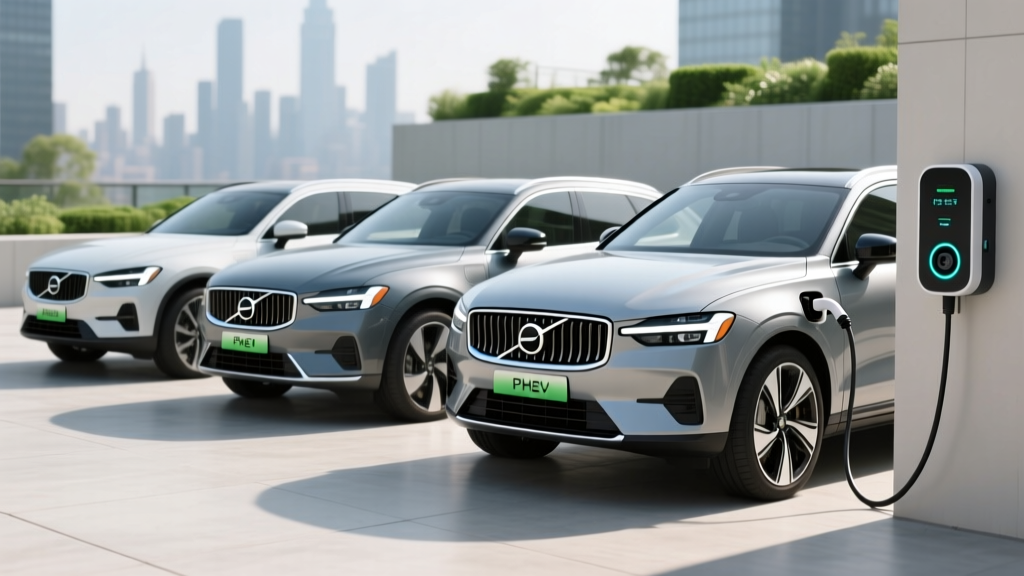
If you want Volvo safety and Scandinavian design but aren't ready to commit to a battery-electric vehicle, the brand's hybrid SUV lineup offers a practical middle ground. For 2026, Volvo sells three SUVs with electrified powertrains: the compact XC40, midsize XC60, and three-row XC90. Each is available either as a Recharge plug-in hybrid (PHEV) with meaningful electric-only range or as a B5/B6 mild hybrid (HEV) that requires no plug. This guide breaks down every variant with exact EPA numbers, real-world expectations, and ownership costs so you can choose the right one.
Volvo's Hybrid Strategy: HEV vs PHEV Explained
Before diving into specific models, it's essential to understand the two distinct powertrain families Volvo offers. Confusing them is one of the most common mistakes shoppers make.
B5 / B6 Mild Hybrid (HEV)
- No plug required — charges via regenerative braking and the engine
- 48-volt system assists the gas engine for smoother stop/start and marginal efficiency gains
- Cannot drive on electric power alone at meaningful speeds
- Lower upfront cost; simpler ownership
- No federal EV tax credit eligibility
Recharge Plug-in Hybrid (PHEV)
- Plugs in to charge — uses a J1772 connector for Level 1 and Level 2 AC charging
- 18.8 kWh battery pack enables 30–41 miles of electric-only driving depending on model
- Gas engine takes over seamlessly when the battery is depleted
- Higher upfront cost but lower daily fuel/electricity cost for short commutes
- May qualify for partial or full §30D federal tax credit (varies by sourcing and income)
The mild-hybrid 48V system in the B5/B6 models recovers braking energy into a small buffer battery that powers ancillary systems and briefly assists acceleration. You'll never plug it in, and you won't see dramatic MPG gains — think of it as refinement rather than electrification. The Recharge PHEVs, by contrast, are genuine dual-powertrain vehicles that can operate as pure EVs for daily errands and as hybrids for road trips.
2026 Volvo XC60: Midsize Sweet Spot
The XC60 is Volvo's best-selling SUV globally and the most popular entry point into the Recharge PHEV lineup. For 2026, it's offered in both B5 mild-hybrid and T8 Recharge plug-in hybrid configurations.
| Spec | XC60 B5 AWD (HEV) | XC60 Recharge T8 AWD (PHEV) |
|---|---|---|
| Powertrain | 2.0L turbo I4 + 48V mild hybrid | 2.0L turbo I4 + rear electric motor |
| Combined Horsepower | 247 hp | 455 hp |
| 0–60 mph | 6.5 sec | 4.5 sec |
| Battery (usable) | ~0.5 kWh (48V buffer) | 18.8 kWh (NMC lithium-ion) |
| Electric-Only Range | N/A | 35 miles (EPA) |
| Total Combined Range | ~440 miles | ~470 miles (electric + gas) |
| EPA MPG (city / hwy / combined) | 23 / 29 / 25 | 28 combined (hybrid mode) / 63 MPGe (with charge) |
| Charging (AC) | N/A | 3.7 kW Level 2 — full charge ~5 hours |
| DC Fast Charging | N/A | Not supported |
| Base MSRP | $47,950 | $58,950 |
The 35-mile EPA electric-only range is enough to cover the average American's daily commute of roughly 30 miles round-trip, according to fueleconomy.gov data. In real-world testing, expect 28–32 miles on electric power in moderate temperatures with mixed driving, dropping to 22–26 miles in freezing weather due to cabin heating demands and reduced battery efficiency.
Charging the 18.8 kWh pack takes about 5 hours on a 240V Level 2 outlet at 3.7 kW. On a standard 120V household outlet (Level 1), plan for roughly 12–14 hours — essentially overnight. Volvo does not equip the XC60 Recharge with DC fast charging capability, which is a common limitation among PHEVs in this class.
2026 Volvo XC90: Three-Row Family Hauler
For families needing three rows, the XC90 Recharge delivers the same T8 plug-in hybrid powertrain in a larger package. The B5/B6 mild-hybrid variants remain available for buyers who want the space without the plug-in premium.
| Spec | XC90 B6 AWD (HEV) | XC90 Recharge T8 AWD (PHEV) |
|---|---|---|
| Powertrain | 2.0L turbo+supercharged I4 + 48V | 2.0L turbo I4 + rear electric motor |
| Combined Horsepower | 295 hp | 455 hp |
| 0–60 mph | 6.1 sec | 4.9 sec |
| Battery (usable) | ~0.5 kWh (48V buffer) | 18.8 kWh (NMC lithium-ion) |
| Electric-Only Range | N/A | 32 miles (EPA) |
| Total Combined Range | ~430 miles | ~460 miles |
| EPA MPG (city / hwy / combined) | 20 / 26 / 22 | 27 combined (hybrid) / 58 MPGe (with charge) |
| Charging (AC) | N/A | 3.7 kW Level 2 — full charge ~5 hours |
| DC Fast Charging | N/A | Not supported |
| Base MSRP | $59,250 | $72,350 |
The heavier XC90 sacrifices 3 miles of electric range compared to the XC60, landing at 32 miles EPA. Real-world highway driving at 70+ mph typically yields 25–28 electric miles. Once the battery depletes, the hybrid system returns a respectable 27 MPG combined — competitive for a 5,000-lb three-row SUV.
2026 Volvo XC40: Compact Hybrid Entry
The XC40 Recharge PHEV returns for 2026 alongside the mild-hybrid B5 variant. Notably, Volvo also sells the fully electric EX40 (formerly XC40 Recharge pure EV), which is a separate model — don't confuse the PHEV with the BEV at the dealership.
| Spec | XC40 B5 AWD (HEV) | XC40 Recharge T8 AWD (PHEV) |
|---|---|---|
| Powertrain | 2.0L turbo I4 + 48V mild hybrid | 2.0L turbo I4 + rear electric motor |
| Combined Horsepower | 247 hp | 455 hp |
| 0–60 mph | 6.2 sec | 4.7 sec |
| Battery (usable) | ~0.5 kWh (48V buffer) | 18.8 kWh (NMC lithium-ion) |
| Electric-Only Range | N/A | 41 miles (EPA) |
| Total Combined Range | ~420 miles | ~480 miles |
| EPA MPG (city / hwy / combined) | 23 / 30 / 26 | 30 combined (hybrid) / 68 MPGe (with charge) |
| Charging (AC) | N/A | 3.7 kW Level 2 — full charge ~5 hours |
| DC Fast Charging | N/A | Not supported |
| Base MSRP | $41,850 | $53,550 |
The lighter XC40 extracts the most from the 18.8 kWh pack, achieving 41 miles of EPA-rated electric range — the best in Volvo's PHEV lineup. In real-world city driving with frequent regenerative braking, some owners report stretching this to 43–45 miles in mild weather. Highway-only driving at 75 mph drops the figure to roughly 33–36 miles.
Fuel Economy Deep Dive: Real-World MPG vs EPA Stickers
| Model | EPA Combined MPG (HEV) | Real-World City (HEV) | Real-World Highway (HEV) | EPA Combined (PHEV, hybrid mode) | Real-World PHEV (hybrid mode) |
|---|---|---|---|---|---|
| XC40 | 26 MPG | 27–29 MPG | 25–27 MPG | 30 MPG | 28–32 MPG |
| XC60 | 25 MPG | 26–28 MPG | 24–26 MPG | 28 MPG | 26–30 MPG |
| XC90 | 22 MPG | 22–24 MPG | 21–23 MPG | 27 MPG | 25–28 MPG |
A key advantage of hybrid powertrains — both HEV and PHEV in hybrid mode — is that real-world city MPG often exceeds EPA estimates. Regenerative braking recaptures energy in stop-and-go traffic that gas-only vehicles waste as heat. Highway driving tells the opposite story: aerodynamic drag at 70+ mph reduces efficiency below the EPA combined figure, since the EPA test cycle weights city driving more heavily.
For PHEV owners who charge daily and commute within the electric-only range, the effective "MPG" is essentially infinite on most days — you're burning zero gasoline. The hybrid-mode MPG figures above apply only after the battery is depleted, such as on road trips.
Pricing, Tax Credits, and Total Cost of Ownership
The price gap between mild-hybrid and Recharge PHEV variants is significant — typically $10,000–$13,000. Here's what the math looks like before incentives:
- XC40: B5 at $41,850 vs Recharge at $53,550 (Δ $11,700)
- XC60: B5 at $47,950 vs Recharge at $58,950 (Δ $11,000)
- XC90: B6 at $59,250 vs Recharge at $72,350 (Δ $13,100)
Federal Tax Credit Eligibility (§30D)
For 2026, Volvo Recharge PHEVs may qualify for up to $7,500 under the IRS §30D Clean Vehicle Credit, but eligibility depends on several factors that change frequently:
- MSRP cap: SUVs must be priced at or below $80,000. The XC40 and XC60 Recharge clear this easily; loaded XC90 Recharge trims may exceed it.
- Buyer income cap: AGI must not exceed $150,000 (single), $225,000 (head of household), or $300,000 (joint).
- Battery sourcing: Critical minerals and battery components must meet phased-in domestic/free-trade-partner thresholds. Volvo has worked to localize sourcing, but verify current-year compliance on irs.gov before purchasing.
- Point-of-sale transfer: You can transfer the credit to the dealer at purchase to reduce your out-of-pocket cost immediately, rather than waiting to claim it on your tax return.
The mild-hybrid B5/B6 models do not qualify for any federal EV tax credit, as they lack sufficient battery capacity and plug-in capability.
If you qualify for the full $7,500 credit, the effective price premium of a Recharge PHEV over its mild-hybrid sibling drops to roughly $3,500–$5,600. At an electricity cost of $0.15/kWh and gasoline at $3.50/gallon, charging the 18.8 kWh battery costs about $2.82 for 35 miles of range — equivalent to $0.08/mile. The same distance in the B5 mild hybrid at 25 MPG costs $0.14/mile. For a 12,000-mile/year driver who charges daily, annual fuel savings can reach $600–$900, paying back the premium in 4–8 years before accounting for the tax credit's acceleration of that timeline.
Battery Warranty, Reliability, and Replacement Costs
Battery longevity is the top concern for hybrid buyers, and Volvo addresses it with robust coverage:
| Coverage | Term |
|---|---|
| Hybrid battery warranty | 8 years / 100,000 miles (whichever comes first) |
| Capacity retention threshold | 70% of original capacity during warranty period |
| Powertrain warranty | 4 years / 50,000 miles |
| Limited vehicle warranty | 4 years / 50,000 miles |
Volvo's 8-year/100,000-mile hybrid battery warranty is mandated by federal emissions warranty requirements for PZEV/AT-PZEV components and applies in all 50 states. If the battery degrades below 70% of its original 18.8 kWh capacity within that window, Volvo will repair or replace it at no cost.
In practice, Volvo's NMC lithium-ion PHEV batteries have shown modest degradation. Owner reports and industry data from sources like IIHS reliability studies suggest most T8 Recharge packs retain 88–93% capacity after 5 years of daily charging. The 18.8 kWh pack is relatively small and benefits from conservative buffer management — Volvo locks away roughly 2–3 kWh at the top and bottom of the state-of-charge window to reduce stress on the cells.
If a replacement is needed out of warranty, expect a cost between $8,000 and $12,000 including parts and labor for the PHEV traction battery. The 48V mild-hybrid buffer battery in B5/B6 models is far cheaper to replace — typically $800–$1,500 — but also far less likely to fail given its minimal cycling duty.
Volvo Hybrid SUVs vs Full EV vs Gas: Decision Framework
Choose a Volvo B5/B6 Mild Hybrid If:
- You have no access to home or workplace charging (apartment, street parking)
- You want Volvo safety and comfort with zero change to your refueling habits
- Your budget is tighter and you don't need the performance boost of the T8
- You drive mostly highway miles where hybrid advantages are smallest
Choose a Volvo Recharge PHEV If:
- You can install a Level 2 charger at home or have reliable workplace charging
- Your daily commute is under 35–40 miles (you'll rarely burn gas on weekdays)
- You take regular road trips where a pure EV's range and charging logistics are a concern
- You want 455 hp performance without the range trade-off of a full EV
- You qualify for the §30D tax credit, narrowing the price gap significantly
Choose a Full EV (Volvo EX90, EX40, or competitor) If:
- You have reliable Level 2 home charging and access to DC fast-charging corridors
- You want zero tailpipe emissions and minimal maintenance (no oil changes, no gas engine)
- Your daily driving is predictable and within 250–300 miles
- You want to fully exit the fossil-fuel ecosystem
The PHEV is the pragmatic bridge. You get electric commuting Monday through Friday and gas-powered freedom for weekend trips — no route planning around chargers, no cold-weather range panic on long drives. The trade-off is maintaining two powertrains: oil changes, spark plugs, and transmission fluid on the gas side, plus battery management on the electric side.
Volvo Recharge PHEV Pros
- 35–41 miles electric range covers most daily commutes
- 455 hp across all Recharge models — genuinely quick
- No range anxiety — gas engine provides 400+ total miles
- Potential $7,500 federal tax credit reduces effective price
- Top-tier safety ratings from NHTSA and IIHS
- Google Built-in infotainment with native navigation
Volvo Recharge PHEV Cons
- No DC fast charging — limited to 3.7 kW AC
- $10,000+ premium over mild-hybrid variants
- Two powertrains means more maintenance complexity long-term
- Smaller cargo space than non-hybrid competitors (battery packaging)
- Electric range drops significantly in cold weather (20–25% loss below 32°F)
- Touchscreen-heavy interior controls can distract while driving
Frequently Asked Questions
How many MPG do Volvo hybrid SUVs get?
The mild-hybrid B5/B6 models achieve 22–26 MPG combined depending on the model (XC90 lowest, XC40 highest). The Recharge PHEVs return 27–30 MPG combined in hybrid mode after the battery is depleted, plus 58–68 MPGe when factoring in electric-only driving with a full charge.
How far can a Volvo Recharge PHEV go on electric only?
The 2026 XC40 Recharge achieves 41 EPA-rated electric miles, the XC60 Recharge gets 35 miles, and the XC90 Recharge gets 32 miles. Real-world figures vary: expect 5–15% less in cold weather or sustained highway driving.
Do Volvo mild hybrids need to be plugged in?
No. The B5 and B6 mild-hybrid models charge their small 48-volt battery entirely through regenerative braking and the gas engine. There is no plug, no charging cable, and no electric-only driving mode. You refuel exclusively at gas stations.
Can Volvo Recharge PHEVs use DC fast chargers?
No. Volvo's current PHEV lineup supports only AC charging at up to 3.7 kW via a J1772 connector. A full charge on a Level 2 (240V) home charger takes approximately 5 hours. DC fast-charging infrastructure (CCS, NACS) is not compatible.
Is the Volvo hybrid battery reliable, and what does replacement cost?
Volvo's PHEV batteries are covered by an 8-year/100,000-mile warranty with a 70% capacity retention guarantee. Real-world data shows most packs retain 88–93% capacity after 5 years. Out-of-warranty replacement costs $8,000–$12,000 for the PHEV traction battery. The mild-hybrid 48V battery is far cheaper ($800–$1,500) and rarely requires replacement.
Do Volvo hybrid SUVs qualify for the federal tax credit?
The Recharge PHEV models may qualify for up to $7,500 under the §30D Clean Vehicle Credit, subject to buyer income limits ($150K single / $300K joint AGI), MSRP caps ($80,000 for SUVs), and battery critical-mineral sourcing requirements that change annually. Mild-hybrid B5/B6 models do not qualify. Always verify current eligibility on irs.gov before purchasing, and consult a tax professional for your specific situation.
Which Volvo hybrid SUV is the best value?
For most buyers, the XC60 Recharge offers the best balance: 35 miles of electric range, 455 hp, a manageable size, and a $58,950 starting price that falls well under the $80,000 MSRP cap for the federal tax credit. If you need three rows, the XC90 Recharge is the only plug-in option in Volvo's lineup. Budget-conscious buyers who lack home charging access should consider the XC40 B5 or XC60 B5 mild hybrids instead.