Volkswagen's 2026 Hybrid Lineup: What Buyers Need to Know
Volkswagen has historically leaned heavily into pure battery-electric vehicles with its ID. family, but for 2026, the automaker is recommitting to plug-in hybrids as a bridge for buyers who aren't ready to go fully electric. The result is a focused lineup of Volkswagen hybrids that pairs turbocharged gasoline engines with electric motors and larger battery packs than previous generations. If you've been searching for a VW that offers electric commuting without range anxiety on road trips, the current lineup deserves a closer look.
This guide breaks down the 2026 Volkswagen hybrid offerings — primarily the Tiguan eHybrid (plug-in hybrid SUV) and the ID.7 Tourer eHybrid (PHEV wagon, available in select markets) — with exact EPA fuel economy figures, electric-only range, battery specifications, pricing, and tax credit eligibility. We'll also clarify the difference between conventional hybrids and plug-in hybrids, since VW's strategy differs from competitors like Toyota who offer both.
HEV vs. PHEV: Understanding Volkswagen's Hybrid Strategy
Before evaluating specific models, it's essential to distinguish the two hybrid types, because Volkswagen's 2026 approach is distinct from most competitors:
| Feature | Conventional Hybrid (HEV) | Plug-In Hybrid (PHEV) |
|---|---|---|
| Plug-in charging? | No — charges via regenerative braking and engine | Yes — plug in to charge the larger battery |
| Battery size | 1–2 kWh (small buffer) | 13–26 kWh (usable) |
| Electric-only range | 0.5–2 miles at low speed | 25–50+ miles at highway speed |
| Gas engine role | Primary power source, assisted by motor | Backup/range extender; electric-first for daily driving |
| Federal tax credit | Not eligible (§30D requires plug-in) | Potentially eligible (depends on battery sourcing, MSRP, income) |
| VW 2026 availability | Mild-hybrid (e.g., 48V system in some models) | Tiguan eHybrid, Passat/ID.7 Tourer eHybrid (market-dependent) |
Unlike Toyota, which sells both HEV and PHEV versions of the RAV4, Volkswagen's 2026 US hybrid strategy centers almost entirely on plug-in hybrids. The Tiguan eHybrid is the headline model. VW does use 48-volt mild-hybrid systems in certain global powertrains, but these do not offer meaningful electric-only driving and are not what most buyers mean by "hybrid." If you're shopping Volkswagen hybrids in the US for 2026, you're essentially looking at PHEVs.
2026 Volkswagen Tiguan eHybrid: Specs, MPG & Electric Range
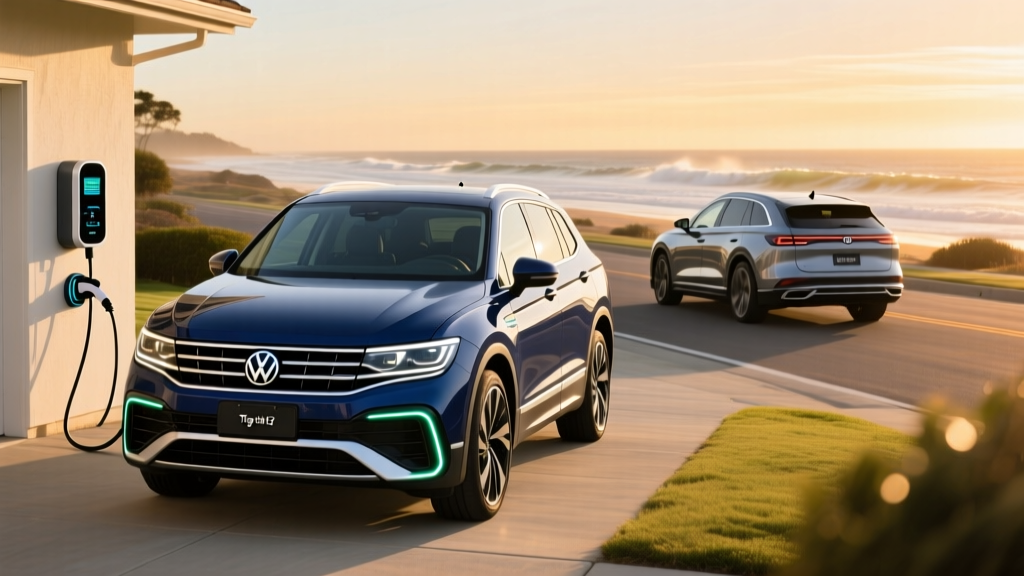
The redesigned Tiguan eHybrid is Volkswagen's most important plug-in hybrid for the US market. Built on the latest MQB evo platform, it carries a significantly larger battery than the outgoing Golf-based GTE models of previous years, targeting the daily commute on pure electric power while keeping the gas engine for longer trips.
| Specification | 2026 VW Tiguan eHybrid |
|---|---|
| Powertrain | 1.5L turbocharged I-4 + electric motor (PHEV) |
| Combined horsepower | ~245 hp (combined system output) |
| Battery capacity (usable) | ~19.7 kWh (NMC lithium-ion) |
| EPA electric-only range | ~35 miles (estimated) |
| EPA combined MPG (hybrid mode) | ~33 MPG combined (35 city / 31 highway est.) |
| MPGe (electric + gas combined) | ~80 MPGe (est.) |
| Total combined range | ~440 miles (electric + full gas tank) |
| Level 2 AC charging (onboard charger) | 3.6 kW (full charge ~5.5 hours on 240V) |
| DC fast charging | Not available |
| 0–60 mph | ~7.5 seconds (est.) |
| Drivetrain | Front-wheel drive (FWD) |
| Starting MSRP | ~$40,990 (SE R-Line Black eHybrid, est.) |
| Battery/powertrain warranty | 8 years / 100,000 miles |
Electric-Only Range: What the EPA Number Means in Practice
Real-World Expectation: 28–32 miles in mixed driving; 22–26 miles in cold weather (below 35°F) or sustained highway speeds above 70 mph. Preconditioning the cabin while plugged in preserves battery for driving.
The ~19.7 kWh usable battery is a significant step up from older VW PHEVs (the outgoing Golf GTE carried roughly 13 kWh usable). In practice, 35 EPA-rated miles covers the average American's one-way commute — fueleconomy.gov data suggests the median US commute is under 16 miles each way. That means most Tiguan eHybrid owners who charge at home overnight will burn zero gasoline on weekdays.
Fuel Economy: EPA vs. Real-World MPG
| Driving Scenario | EPA Estimate | Real-World Expectation |
|---|---|---|
| City (hybrid mode, battery depleted) | 35 MPG | 33–37 MPG (regen helps in stop-and-go) |
| Highway (hybrid mode, 70–75 mph) | 31 MPG | 28–32 MPG (aero drag reduces efficiency) |
| Combined | 33 MPG | 30–34 MPG |
| With daily home charging (effective) | N/A | 60–100+ MPG equivalent (gas used rarely) |
One advantage of plug-in hybrids over conventional gas cars: if you charge nightly, the gas engine may only run on road trips. Your effective fuel consumption could drop to a few gallons per month. But if you never plug in and drive the Tiguan eHybrid as a conventional hybrid, expect the EPA-rated 33 MPG combined — competitive with the Toyota RAV4 Hybrid (39 MPG combined) but lower due to the VW's heavier battery pack and turbocharged engine.
Charging the Tiguan eHybrid: Level 1, Level 2 & What You Need at Home
Unlike full battery-electric vehicles, the Tiguan eHybrid does not support DC fast charging. This is typical for PHEVs — the battery is small enough that Level 2 AC charging fills it overnight, and DC fast-charging hardware would add cost, weight, and complexity for minimal benefit.
| Charging Level | Power | Time (0–100%) | Miles of EV Range Added per Hour |
|---|---|---|---|
| Level 1 (120V household outlet) | ~1.4 kW | ~14 hours | ~6 miles/hr |
| Level 2 (240V, 16A) | 3.6 kW | ~5.5 hours | ~14 miles/hr |
| DC Fast Charging | N/A — not supported | N/A | N/A |
For most PHEV owners, a standard 120V outlet (Level 1) is actually sufficient. If you drive 30 miles per day and plug in when you get home, Level 1 will add roughly 35+ miles of range over 10–12 hours — enough to replenish a full day's electric driving. A Level 2 home charger is faster and more convenient, but a dedicated 240V circuit installation typically runs $500–$1,500 depending on your electrical panel's proximity to the parking spot. For a PHEV with a 19.7 kWh battery, this upgrade is optional, not essential.
Battery Longevity, Warranty & Replacement Cost
Battery durability is consistently the top concern for hybrid buyers. Volkswagen backs the Tiguan eHybrid's high-voltage battery with its standard electrified powertrain warranty:
Coverage threshold: Battery must retain at least 70% of original capacity. If degradation drops below this threshold within the warranty period, VW will repair or replace the battery at no cost.
Out-of-warranty replacement cost (estimated): $5,000–$8,000 for the high-voltage battery pack, plus labor. This figure is based on current PHEV battery replacement costs across the industry; VW-specific pricing may vary.
In practice, modern NMC lithium-ion PHEV batteries degrade slowly. Real-world data from earlier VW PHEVs (Golf GTE, Passat GTE) and comparable models from other manufacturers suggests 8–12% capacity loss over the first 5 years / 60,000 miles under normal use. The 70% retention threshold means the battery would need to lose nearly a third of its capacity to trigger a warranty claim — a scenario that's rare in moderate climates.
To maximize battery lifespan:
- Avoid keeping the battery at 100% SoC for extended periods — unplug shortly after reaching full charge, or use VW's charge scheduling feature to time completion near your departure.
- Use preconditioning (cabin heating/cooling while plugged in) rather than drawing from the battery for HVAC on cold mornings.
- Moderate fast-acceleration habits — sustained high-current draws accelerate cell degradation over time.
2026 Volkswagen ID.7 Tourer eHybrid (PHEV Wagon)
Volkswagen has also announced the ID.7 Tourer in plug-in hybrid form for select global markets. As of early 2026, US availability remains unconfirmed — VW has not listed this model on its US configurator. We're including it here because it represents VW's broader hybrid direction and may reach North America in a future model year.
| Specification | ID.7 Tourer eHybrid (Global/Preliminary) |
|---|---|
| Powertrain | 1.5L TSI evo2 turbo I-4 + electric motor |
| Combined system output | ~272 hp |
| Battery (usable) | ~25.7 kWh (NMC) |
| WLTP electric-only range | ~62 miles (WLTP; expect ~45–50 mi EPA equivalent) |
| DC fast charging | Up to 50 kW DC (0–80% in ~25 min) — a PHEV first for VW |
| Level 2 AC charging | 11 kW (full charge ~2.5 hours) |
| Status | Announced for Europe; US availability unconfirmed |
The ID.7 Tourer eHybrid is notable for offering DC fast charging on a PHEV — a rarity in the segment. With 50 kW DC capability, a depleted battery can reach 80% in roughly 25 minutes, making it viable for road-trip top-ups at rest stops. The larger ~25.7 kWh battery pushes electric-only range into territory where many daily drivers would rarely use gasoline. However, until VW confirms US specs and EPA testing, these figures remain preliminary. Note that WLTP range ratings (used in Europe) are typically 15–25% more optimistic than EPA ratings.
Federal Tax Credits & Pricing for Volkswagen PHEVs
Plug-in hybrids may qualify for the IRS §30D Clean Vehicle Credit, but eligibility is far from guaranteed. The rules for 2026 include several hurdles:
- MSRP cap: SUVs, vans, and pickups must be under $80,000 MSRP; sedans and wagons under $55,000. The Tiguan eHybrid (~$40,990) clears this threshold.
- Buyer income cap: Adjusted gross income must not exceed $150,000 (single), $225,000 (head of household), or $300,000 (joint filers).
- Battery sourcing requirements: A percentage of critical minerals and battery components must be sourced from the US or free-trade-agreement partners. These percentages increase annually, and VW's supply chain compliance for 2026 must be verified per VIN at fueleconomy.gov.
- Point-of-sale transfer: Eligible buyers can transfer the credit to the dealer at purchase, reducing the out-of-pocket price immediately — rather than waiting to claim it on their tax return.
- Final assembly: Vehicle must undergo final assembly in North America. Verify the specific Tiguan eHybrid VIN on the NHTSA VIN decoder.
Maximum credit: Up to $7,500, split between a $3,750 critical-minerals component and a $3,750 battery-components component. The Tiguan eHybrid may qualify for a partial or full credit depending on its battery supply chain — check the IRS's official qualifying vehicle list before purchasing, as eligibility can change mid-year.
Volkswagen also occasionally offers manufacturer incentives (lease cash, loyalty bonuses) that can stack with federal credits. Check VW's current offers page for model-specific deals.
Hybrid vs. PHEV vs. Full EV: Which Volkswagen Should You Buy?
- You can charge at home (even a 120V outlet works) and your daily driving is under 35 miles
- You take road trips several times a year and want zero range anxiety
- You live in an area with sparse DC fast-charging infrastructure
- You want an SUV with VW's driving dynamics but aren't ready for a full EV
- You have reliable Level 2 home charging and your daily driving is under 250 miles
- You want the lowest per-mile fuel cost (electricity vs. gasoline)
- You want minimal maintenance — no oil changes, no gas engine service
- You qualify for the full $7,500 federal tax credit on qualifying BEVs
- You cannot charge at home at all (no garage, no outlet access)
- You want maximum MPG without any plug-in behavior
- You prioritize proven long-term reliability data (Toyota's hybrid track record spans 25+ years)
Volkswagen does not currently sell a conventional (non-plug-in) hybrid in the US for 2026. If you specifically want a self-charging HEV without plug-in capability, you'll need to look at competitors like the Toyota RAV4 Hybrid (39 MPG combined, ~$33,000) or Hyundai Tucson Hybrid (38 MPG combined, ~$37,000). VW's hybrid bet is entirely on PHEVs.
Pros & Cons of the 2026 Volkswagen Tiguan eHybrid
Pros
- ~35 miles of electric-only range covers most daily commutes
- Larger 19.7 kWh battery than previous VW PHEVs — meaningful range improvement
- Competent 245 hp combined output; confident highway merging
- No range anxiety — gas engine for road trips
- Level 1 (120V) charging is sufficient for daily use
- 8-year/100,000-mile battery warranty
- Under the $80,000 MSRP cap for potential §30D tax credit
Cons
- No DC fast charging — long road trips rely on gas only
- 3.6 kW AC onboard charger is slow compared to competitors (Toyota offers 6.6 kW on RAV4 Prime)
- FWD only — no AWD eHybrid option (gas Tiguan offers 4Motion AWD)
- 33 MPG combined (hybrid mode) trails the RAV4 Hybrid's 39 MPG
- Tax credit eligibility uncertain due to battery sourcing rules
- Higher starting price than gas-only Tiguan (~$40,990 vs. ~$31,000)
Frequently Asked Questions
How many MPG does the 2026 Volkswagen Tiguan eHybrid get?
The Tiguan eHybrid is estimated at 35 MPG city, 31 MPG highway, and 33 MPG combined when operating in hybrid mode with a depleted battery. In real-world driving, city MPG may slightly exceed the EPA estimate thanks to regenerative braking, while sustained highway driving at 75+ mph may drop to 28–30 MPG. If you charge daily, your effective gasoline consumption could be near zero for weekday commuting.
How far can the Tiguan eHybrid go on electric only?
The EPA-estimated electric-only range is approximately 35 miles. In real-world conditions, expect 28–32 miles in moderate temperatures and mixed driving, dropping to 22–26 miles in cold weather or at sustained highway speeds. This range is sufficient for the majority of daily commutes when the vehicle is charged overnight.
Does the Volkswagen Tiguan eHybrid qualify for a federal tax credit?
It may qualify for up to $7,500 under the IRS §30D Clean Vehicle Credit, but eligibility depends on battery component and critical-mineral sourcing requirements, the buyer's income, and the vehicle's MSRP (must be under $80,000 for SUVs). The Tiguan eHybrid's MSRP clears the cap, but sourcing compliance must be verified per VIN at fueleconomy.gov before purchase. Consult a tax professional for personal eligibility.
Is the Volkswagen hybrid reliable? What does battery replacement cost?
VW's PHEV powertrains have proven generally reliable, with the high-voltage battery covered by an 8-year/100,000-mile warranty (70% capacity retention threshold). Real-world data from earlier VW PHEVs suggests moderate degradation of 8–12% over 5 years. Out-of-warranty battery replacement is estimated at $5,000–$8,000. The 1.5L TSI engine is a well-established VW powertrain with a strong service network.
Can I charge the Tiguan eHybrid at a public DC fast charger?
No. The Tiguan eHybrid does not have a DC fast-charging port. It charges via Level 1 (120V) or Level 2 (240V) AC charging only, using a J1772 connector (or NACS, depending on model-year adapter availability). This is standard for most PHEVs — the battery is small enough that overnight AC charging is sufficient.
Should I buy the Tiguan eHybrid or the fully electric VW ID.4?
If you can charge at home and your daily driving is under 250 miles, the ID.4 (EPA range ~275 miles, starting ~$39,995) offers lower running costs, zero tailpipe emissions, and less maintenance. If you regularly drive beyond EV range, live in a charging-desert area, or frequently tow, the Tiguan eHybrid provides the flexibility of a gas engine with electric-commute efficiency. The right choice depends on your charging access and driving patterns.