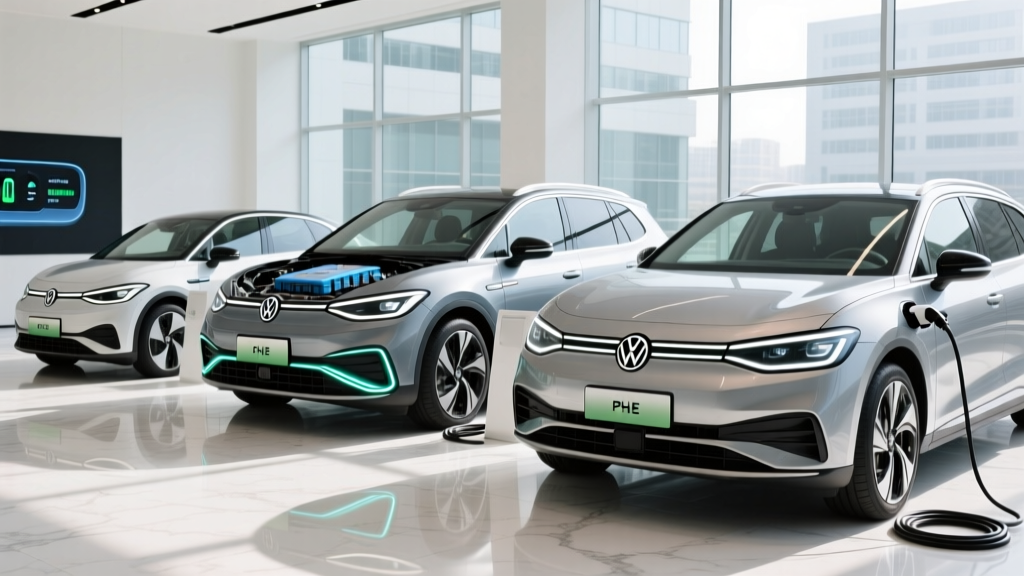
If you've been asking "does VW have a hybrid?" the answer in 2026 is yes — but with a major caveat. Volkswagen's electrified strategy in the United States has pivoted heavily toward battery-electric vehicles (the ID.4 and ID.7), leaving its hybrid offerings narrower than competitors like Toyota, Hyundai, or Ford. Still, there are plug-in hybrid (PHEV) options worth examining, and understanding what VW currently sells versus what it discontinued is essential before you walk into a dealership.
This guide covers every VW hybrid and PHEV available or announced for the 2026 model year, with exact EPA fuel economy figures, electric-only range, pricing, tax credit eligibility, and a clear framework for deciding whether a VW PHEV — or a full EV or conventional hybrid from another brand — is the right call for your driveway.
HEV vs PHEV: What Volkswagen Actually Sells in 2026
Before diving into specific models, it's critical to separate the two hybrid categories, because Volkswagen's U.S. lineup treats them very differently.
Conventional Hybrid (HEV) vs Plug-In Hybrid (PHEV)
| Feature | Conventional Hybrid (HEV) | Plug-In Hybrid (PHEV) |
|---|---|---|
| Plugs in? | No — charges via regenerative braking and engine | Yes — has a charge port for Level 1/Level 2 |
| Battery size | ~1–2 kWh (small buffer) | ~13–26 kWh (meaningful electric range) |
| Electric-only driving | Minimal — assists engine at low speeds | 20–45 miles typical on battery alone |
| Federal tax credit | Not eligible under §30D | Up to $7,500 if battery sourcing rules met |
| Best for | Drivers who can't charge at home | Drivers with home/workplace charging who want electric commutes + gas road trips |
Source: fueleconomy.gov
Here's the key takeaway: As of the 2026 model year, Volkswagen does not sell a conventional hybrid (HEV) in the United States. If you're looking for a Toyota Prius-style "fill it with gas and never plug it in" VW, it doesn't exist. What VW does offer are plug-in hybrids — specifically in the Tiguan and (in some markets) the Jetta nameplate. The previously available Golf GTE was discontinued in the U.S., and VW's American strategy has funneled most electrification investment into the ID. family of full battery-electric vehicles.
2026 Volkswagen Tiguan eHybrid: Specs, Range, and MPG
The 2026 Volkswagen Tiguan eHybrid (marketed in some regions as the Tiguan PHEV) is VW's primary plug-in hybrid offering for American buyers. Redesigned for this generation, it pairs a turbocharged 1.5-liter four-cylinder engine with an electric motor integrated into the transmission.
| Spec | Value |
|---|---|
| Powertrain | 1.5L turbo I4 + electric motor (6-speed DSG) |
| Combined system output | ~245 hp / 295 lb-ft torque |
| Battery capacity | ~19.7 kWh (usable ~17 kWh), NMC chemistry |
| EPA electric-only range | ~33 miles (estimated) |
| Total combined range | ~430 miles (gas + electric) |
| EPA MPG (gas, charge-sustaining) | ~35 city / 34 highway / 35 combined |
| MPGe (electric + gas combined) | ~80 MPGe |
| Level 2 AC charging | 3.6 kW onboard charger (~5 hours from empty) |
| DC fast charging | Not available |
| 0–60 mph | ~7.2 seconds |
| Base MSRP | ~$40,500 (SE R-Line eHybrid) |
| Battery warranty | 8 years / 100,000 miles (capacity retention ≥70%) |
Real-world MPG note: Plug-in hybrid fuel economy is heavily dependent on how often you charge. If you plug in nightly and your commute is under 33 miles round-trip, you may use almost zero gasoline for daily driving — effectively operating as an EV on weekdays. If you never plug in, the Tiguan eHybrid runs as a conventional hybrid at roughly 35 MPG combined, which is respectable for a compact SUV but trails the Toyota RAV4 Hybrid's 39–41 MPG combined.
What About a VW Jetta Hybrid or Golf GTE?
VW's hybrid history in the U.S. includes the Jetta Hybrid (discontinued after 2018) and the Golf GTE (sold in Europe but never widely offered stateside). For 2026, Volkswagen has not announced a U.S.-market Jetta PHEV or Golf GTE revival. The ID.4 (all-electric) and the updated Tiguan eHybrid are the core of VW's electrified American lineup.
If you specifically want a conventional hybrid sedan from VW — something that never plugs in and delivers 50+ MPG — you'll need to look at competitors. The Toyota Prius (57 MPG combined), Hyundai Elantra Hybrid (54 MPG combined), and Honda Accord Hybrid (48 MPG combined) all fill that role.
Charging the Tiguan eHybrid: What to Expect
The Tiguan eHybrid charges exclusively via AC power — Level 1 (120V household outlet) or Level 2 (240V home or public charger). There is no DC fast charging capability, which is typical for PHEVs in this class.
| Charging Level | Power (kW) | 0–100% Time | Practical Use Case |
|---|---|---|---|
| Level 1 (120V / 12A) | ~1.4 kW | ~12–14 hours | Overnight top-up if you drive <20 mi/day |
| Level 2 (240V / 16A) | 3.6 kW | ~5 hours | Full overnight charge; ideal daily setup |
| DC Fast Charge | N/A | N/A | Not supported on this vehicle |
Practical insight: A Level 2 home charger (roughly $500–$1,200 installed, depending on your electrical panel) is the sweet spot for PHEV ownership. You plug in when you get home, and by morning you have a full 33-mile electric buffer. Most PHEV owners who install Level 2 report using gasoline only on road trips longer than 40 miles.
Tax Credit Eligibility: Does the VW Tiguan eHybrid Qualify?
Under the IRS §30D Clean Vehicle Credit, plug-in hybrids can qualify for up to $7,500 — but only if they meet a web of requirements that change yearly. Here's the 2026 eligibility checklist:
- Battery capacity: Must be ≥7 kWh — the Tiguan eHybrid's ~19.7 kWh pack clears this easily.
- MSRP cap: SUVs must be ≤$80,000; sedans ≤$55,000. The Tiguan eHybrid at ~$40,500 qualifies.
- Buyer income cap: Modified AGI ≤$150,000 (single) / ≤$300,000 (joint). Check your tax situation.
- Critical minerals & battery component sourcing: A percentage of battery minerals must be sourced from the U.S. or FTA partners, and battery components must be manufactured/assembled in North America. This is the most volatile requirement — VW's supply chain sourcing for 2026 models should be verified at the point of purchase, as eligibility can shift mid-year.
- Point-of-sale transfer: As of 2024+, you can transfer the credit to the dealer for an immediate price reduction rather than waiting to claim it on your tax return.
Battery Longevity, Warranty, and Replacement Costs
VW PHEV Battery Warranty
Coverage: 8 years or 100,000 miles (whichever comes first)
Capacity retention threshold: VW warrants the high-voltage battery will retain at least 70% of its original usable capacity during the warranty period. If it drops below 70%, VW will repair or replace it at no cost.
What's covered: Defects, abnormal capacity loss, cell/module failures.
What's not covered: Damage from accidents, improper charging, or modifications.
Replacement cost if out of warranty: A PHEV battery pack replacement (19.7 kWh class) typically runs $5,000–$8,000 including labor at a VW dealer. This is substantially less than a full EV battery replacement ($12,000–$20,000+) because PHEV packs are smaller. However, modern NMC PHEV batteries are designed for 150,000+ miles with proper care — most owners will trade the vehicle before needing a replacement.
Maximizing battery life: Avoid leaving the PHEV at 100% state of charge in extreme heat for extended periods. Use scheduled charging features to time full charges close to your departure. PHEVs have smaller batteries than EVs, meaning they cycle more frequently — but the thermal management system and buffer zones (VW doesn't let you access the full 19.7 kWh) protect against accelerated degradation.
Hybrid vs PHEV vs Full EV: Which VW (or Competitor) Fits You?
Decision Framework
Choose the VW Tiguan eHybrid (PHEV) if:
- You have home or workplace Level 2 charging access
- Your daily commute is under ~35 miles round-trip (you'll run mostly on electricity)
- You want the option for gas-powered road trips without route-planning for chargers
- You want a compact SUV with VW's driving dynamics and interior quality
Choose a full EV (like the VW ID.4) if:
- You can charge at home and want to eliminate gasoline entirely
- Your daily driving is under 250 miles and you're comfortable with DC fast charging on road trips
- You want lower per-mile energy costs (~$0.04–$0.06/mile on home electricity vs. $0.12–$0.15/mile on gas)
Choose a conventional HEV (Toyota RAV4 Hybrid, Honda CR-V Hybrid) if:
- You cannot charge at home or work (apartment, street parking)
- You want maximum MPG without any plug-in behavior changes
- You want a proven, widely available hybrid with strong resale value
The honest reality: if you're cross-shopping based on "does VW have a hybrid" because you want a no-plug conventional hybrid, VW is not the brand for you in 2026. But if you're specifically interested in a PHEV — the best of both worlds for home-chargers — the Tiguan eHybrid is a competent, if not class-leading, option.
Pros and Cons: 2026 VW Tiguan eHybrid
✓ Pros
- 33-mile electric range covers most commutes gas-free
- Premium interior with VW's updated infotainment
- ~245 hp provides confident highway merging
- Qualifies for potential $7,500 federal tax credit (verify sourcing)
- 8-year/100,000-mile battery warranty
- No range anxiety — gas engine for long trips
✗ Cons
- No conventional HEV option — you must plug in to maximize value
- 3.6 kW AC charging is slow (no DC fast charge)
- 35 MPG gas-only mode trails RAV4 Hybrid (39–41 MPG)
- ~$40,500 starting price is steep vs. non-hybrid competitors
- Tax credit eligibility depends on volatile battery sourcing rules
- Limited VW PHEV lineup — no sedan or hatchback option
Frequently Asked Questions
How many MPG does the VW Tiguan eHybrid get?
When operating in gas-only (charge-sustaining) mode, the 2026 Tiguan eHybrid achieves an estimated 35 MPG combined (35 city / 34 highway). When factoring in electric-only driving, the combined rating is approximately 80 MPGe. Your real-world fuel consumption depends entirely on how often you plug in — owners who charge daily and commute under 33 miles may go weeks without visiting a gas station.
How far can the VW Tiguan eHybrid go on electric only?
The EPA-estimated electric-only range is approximately 33 miles. In real-world conditions — especially in cold weather (below 40°F) or at sustained highway speeds above 65 mph — expect that to drop to 25–28 miles. PHEV electric range is highly sensitive to temperature and driving style because the battery is smaller than a full EV's, leaving less buffer for losses.
Does VW make a hybrid that doesn't need to be plugged in?
Not in the U.S. market for 2026. Volkswagen discontinued its conventional hybrid offerings (like the Jetta Hybrid) years ago and has focused on PHEVs and full EVs. If you need a no-plug hybrid, look at the Toyota RAV4 Hybrid, Honda CR-V Hybrid, Hyundai Tucson Hybrid, or Ford Escape Hybrid.
Is the VW Tiguan eHybrid reliable? What about battery replacement cost?
VW's PHEV powertrain has been in use across European models for several generations, and the 1.5L turbo + electric motor combination is well-understood. The high-voltage battery is covered by an 8-year / 100,000-mile warranty with a 70% capacity retention guarantee. Out-of-warranty battery replacement runs approximately $5,000–$8,000, though most PHEV batteries last well beyond the warranty period with normal use.
Does the VW Tiguan eHybrid qualify for the $7,500 federal tax credit?
It may qualify under IRS §30D, as it meets the battery capacity (≥7 kWh) and MSRP (≤$80,000 for SUVs) requirements. However, the critical minerals and battery component sourcing rules are strict and change annually. Verify the specific VIN's eligibility at fueleconomy.gov before purchasing. You must also meet income caps ($150K single / $300K joint MAGI).
Should I buy the Tiguan eHybrid or the VW ID.4?
If you can charge at home and want zero gasoline, the ID.4 (EPA range ~275 miles, starting ~$39,735) is a more cost-effective daily driver with lower per-mile energy costs. Choose the Tiguan eHybrid if you need the flexibility of gas for long road trips, don't want to rely on public DC fast charging infrastructure, or live in an area with sparse EV charging networks. The PHEV is the bridge vehicle; the ID.4 is the full commitment.
Sources: fueleconomy.gov (EPA estimates), IRS §30D Clean Vehicle Credit, Volkswagen of America official specifications. All MPG and range figures are EPA estimates or manufacturer projections for the 2026 model year and may vary. Verify tax credit eligibility for your specific purchase.