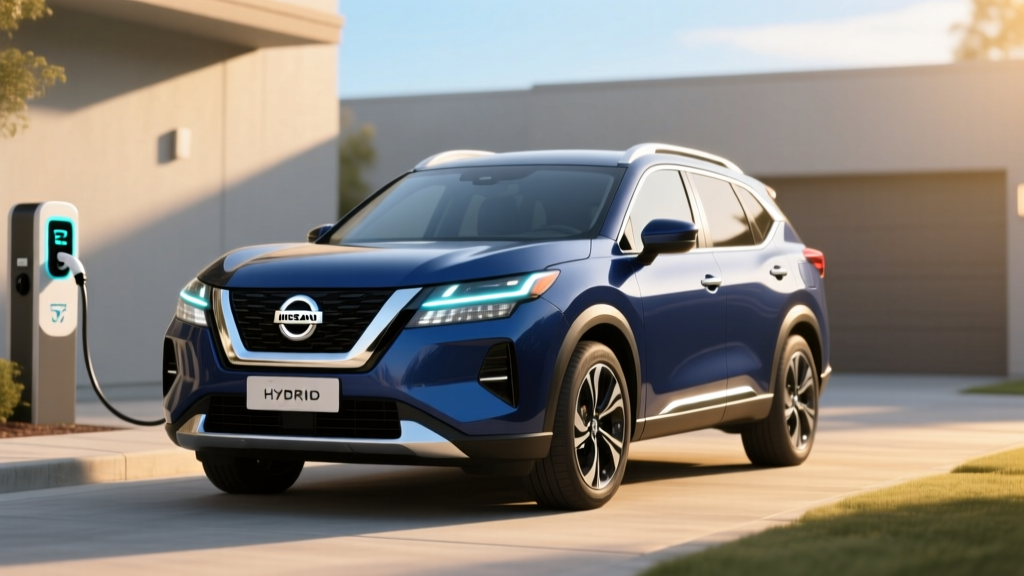
If you've been searching for a hybrid Nissan, the 2026 lineup centers on one model that dominates the brand's electrified strategy: the Nissan Rogue Hybrid. Nissan has doubled down on its e-Power and conventional hybrid systems rather than rushing into full battery-electric vehicles for every segment, and the result is a practical, fuel-efficient compact crossover that slots between a gas-only Rogue and a full EV like the Ariya.
This guide breaks down everything you need to know about Nissan's hybrid offerings in 2026 — EPA fuel economy, real-world MPG expectations, powertrain details, battery warranty, pricing, and whether a Nissan hybrid is the right choice versus a PHEV or full BEV.
2026 Nissan Rogue Hybrid: Quick Verdict
The 2026 Nissan Rogue Hybrid is a conventional hybrid electric vehicle (HEV) — meaning it does not plug in. It uses a gasoline engine paired with an electric motor and a small battery pack that recharges through regenerative braking and the engine itself. If you're looking for a Nissan with plug-in capability, you'll need to look at the Nissan Ariya (a full BEV) or wait for future PHEV announcements, as Nissan's current U.S. PHEV presence remains limited.
Powertrain: 1.5L VC-Turbo 3-cylinder + electric motor | Combined HP: 201 hp
EPA Combined MPG: 39 MPG | Drivetrain: FWD or AWD
Starting MSRP: ~$33,500 (S trim) | Federal Tax Credit: Not eligible (§30D requires plug-in)
Battery Warranty: 8 years / 100,000 miles
HEV vs PHEV vs EV: Understanding Nissan's Options
Before diving deeper, it's critical to understand the difference between Nissan's electrified options, because the ownership experience varies enormously:
| Feature | Nissan Rogue Hybrid (HEV) | Plug-in Hybrid (PHEV — e.g., competitor) | Nissan Ariya (BEV) |
|---|---|---|---|
| Plugs in? | No — self-charging | Yes — 120V or 240V | Yes — Level 2 or DC fast charge |
| Electric-only range | None (motor assists engine) | Typically 25–40 miles | 216–304 miles (EPA) |
| Fuel source | Gasoline only | Gasoline + electricity | Electricity only |
| Federal tax credit | Not eligible | Up to $7,500 (if eligible) | Up to $7,500 (if eligible) |
| Home charging needed? | No | Recommended for full benefit | Essential for daily use |
The Rogue Hybrid is ideal if you want better fuel economy without changing any habits — you fuel up at gas stations exactly as before. A PHEV gives you short electric-only commutes but requires access to a plug. A full EV like the Ariya eliminates gas entirely but demands home or reliable public charging infrastructure.
EPA Fuel Economy: How Many MPG Does the Nissan Rogue Hybrid Get?
Fuel economy is the headline reason buyers cross-shop the Nissan Rogue Hybrid against competitors like the Toyota RAV4 Hybrid and Honda CR-V Hybrid. Here are the official EPA estimates for the 2026 model year:
| Trim / Drivetrain | City MPG | Highway MPG | Combined MPG |
|---|---|---|---|
| Rogue Hybrid FWD | 40 | 38 | 39 |
| Rogue Hybrid AWD | 38 | 36 | 37 |
Hybrids typically exceed their EPA city estimates in stop-and-go traffic because regenerative braking recaptures energy that a gas car wastes as heat. In mixed suburban driving, expect the FWD Rogue Hybrid to deliver 38–42 MPG easily. Highway-only road trips at 75+ mph will pull figures closer to 33–35 MPG, since the electric motor contributes less at sustained high speeds. In cold weather (below 35°F), expect a 3–5 MPG dip due to cabin heating demands and reduced battery efficiency.
Compared to the gas-only Nissan Rogue (approximately 33 MPG combined for FWD), the hybrid saves roughly 5–6 MPG — which translates to about 80–100 fewer gallons per year for a driver covering 15,000 miles annually, or roughly $250–$350 in fuel savings at $3.50/gallon.
Powertrain and Performance Specs
The 2026 Rogue Hybrid pairs Nissan's variable-compression 1.5-liter VC-Turbo three-cylinder engine with an electric motor integrated into the transmission housing. Here's the full breakdown:
| Specification | Detail |
|---|---|
| Engine | 1.5L VC-Turbo DOHC 3-cylinder |
| Engine output | 163 hp / 184 lb-ft torque |
| Electric motor output | ~38 hp (assist) |
| Combined system output | 201 hp |
| Transmission | Xtronic CVT |
| Hybrid battery | ~1.0 kWh lithium-ion (self-charging, no plug) |
| 0–60 mph | ~7.5 seconds (est.) |
| Drivetrain | FWD standard; AWD available |
| Towing capacity | 1,000 lbs (not rated for heavy towing) |
The hybrid system prioritizes smooth low-speed acceleration and fuel efficiency over outright performance. The electric motor fills in torque at low RPMs, eliminating the turbo lag that the gas-only Rogue sometimes exhibits from a stop. In practice, the Rogue Hybrid feels responsive in city driving but doesn't transform into a sporty crossover — it's tuned for comfort and efficiency.
Pricing, Trims, and Tax Credit Eligibility
The 2026 Nissan Rogue Hybrid is available across multiple trim levels. Pricing below reflects estimated MSRP at launch:
| Trim | MSRP (FWD) | MSRP (AWD) |
|---|---|---|
| S | $33,500 | $35,000 |
| SV | $36,000 | $37,500 |
| SL | $39,500 | $41,000 |
| Platinum | $42,500 | $44,000 |
The Nissan Rogue Hybrid is a conventional HEV — it does not plug in. Under current IRS §30D rules, the federal clean vehicle credit (up to $7,500) is available only for plug-in electric vehicles (PHEVs and BEVs) that meet battery-sourcing, MSRP, and buyer-income requirements. The Rogue Hybrid does not qualify. Some states may offer small rebates for hybrids — check your state's energy office or AFDC incentive database for local programs.
Battery Warranty, Reliability, and Replacement Cost
Hybrid battery longevity is one of the most common concerns among first-time hybrid buyers. Here's what Nissan provides:
Nissan covers the Rogue Hybrid's lithium-ion battery pack for 8 years or 100,000 miles, whichever comes first. In California-emission states (CARB states), hybrid-system coverage extends to 10 years or 150,000 miles. The warranty covers battery capacity loss below a specified threshold and defects in hybrid-system components including the inverter and electric motor.
In real-world terms, modern hybrid batteries from major manufacturers have proven remarkably durable. Toyota's hybrid batteries routinely last 150,000–200,000+ miles, and Nissan's lithium-ion hybrid packs are engineered for similar longevity. The Rogue Hybrid's battery is small (~1.0 kWh) and never fully charged or fully depleted — the system maintains a state of charge between roughly 40–80%, which dramatically reduces stress on the cells.
Battery replacement cost: If the hybrid battery does require replacement outside warranty, expect a range of $2,000–$4,000 for the battery pack itself, plus $500–$1,000 in labor. However, this is a relatively rare event within the first 10–15 years of ownership. Refurbished and aftermarket hybrid batteries are increasingly available at lower cost.
For broader reliability, Nissan's 1.5L VC-Turbo engine has been in production since 2019 and has accumulated a solid track record. The hybrid system adds fewer moving parts than a conventional automatic transmission — regenerative braking also reduces wear on the friction brakes, meaning brake pads often last 80,000+ miles.
Who Should Buy a Hybrid Nissan — and Who Shouldn't?
✓ Choose the Rogue Hybrid If
- You want better MPG without plugging in or changing habits
- You live in an apartment or lack home charging access
- Your commute involves heavy stop-and-go traffic (where hybrids shine)
- You want a compact SUV with AWD and strong cargo space (~36 cu ft)
- You plan to own the vehicle 8–12 years and want proven reliability
✗ Look Elsewhere If
- You want electric-only driving for short commutes (consider a PHEV like the Toyota RAV4 Prime)
- You want the $7,500 federal tax credit (requires a plug-in vehicle)
- You have reliable home charging and want to eliminate gas entirely (consider the Nissan Ariya BEV)
- You need heavy towing capacity (the hybrid is rated for only 1,000 lbs)
- You prioritize sporty driving dynamics over fuel efficiency
Hybrid Nissan (Rogue Hybrid): Best for drivers who want fuel savings with zero lifestyle changes. No plug, no range anxiety, no charging apps. Pay at the pump, just less often.
PHEV (e.g., RAV4 Prime, Tucson PHEV): Best for drivers with home charging and short commutes (under 35 miles). You'll run on electricity most weekdays and use gas only for longer trips. Eligible for up to $7,500 federal credit.
Full EV (e.g., Nissan Ariya): Best for drivers with reliable home Level 2 charging who want to eliminate gas entirely. Higher upfront cost, lowest per-mile energy cost, and eligible for federal tax credits. Requires planning for road trips.
Nissan's Hybrid Future: What's Next Beyond the Rogue?
Nissan has signaled plans to expand its e-Power hybrid system — a series-hybrid architecture where the gasoline engine never directly drives the wheels and instead acts solely as a generator for the electric motor — to additional models for the U.S. market. The e-Power system is already sold in Japan and Europe in models like the X-Trail and Note, delivering an EV-like driving feel without plug-in charging.
As of 2026, Nissan has not confirmed U.S. pricing or availability for e-Power beyond the Rogue Hybrid. If Nissan brings e-Power to additional crossovers or sedans, expect similar HEV architecture: no plug, strong low-end torque from the electric motor, and combined MPG in the high 30s to low 40s. We'll update this guide as Nissan makes official announcements.
Frequently Asked Questions
How many MPG does the Nissan Rogue Hybrid get in real-world driving?
The EPA rates the FWD Rogue Hybrid at 40 city / 38 highway / 39 combined MPG. In real-world suburban driving with mixed stops and moderate highway use, owners typically report 38–42 MPG. Highway-only trips at 75+ mph will yield closer to 33–35 MPG. Cold weather can reduce figures by 3–5 MPG.
Does the Nissan Rogue Hybrid need to be plugged in?
No. The Rogue Hybrid is a conventional HEV. Its small battery recharges automatically through regenerative braking and the gasoline engine. You never plug it in — you simply refuel at gas stations as normal.
Does any Nissan hybrid qualify for the federal tax credit?
No. Under current IRS §30D rules, the federal clean vehicle credit applies only to plug-in vehicles (PHEVs and BEVs). Conventional hybrids like the Rogue Hybrid are not eligible. The Nissan Ariya (a full BEV) may qualify depending on your income, the vehicle's MSRP, and battery-sourcing requirements — check IRS.gov for current eligibility details.
How long will the Nissan hybrid battery last?
Nissan warranties the hybrid battery for 8 years / 100,000 miles (10 years / 150,000 miles in CARB states). In practice, modern hybrid batteries frequently last 150,000–200,000+ miles. The Rogue Hybrid's small battery operates in a narrow state-of-charge window (never fully full, never fully empty), which significantly extends cell life.
What does it cost to replace a Nissan hybrid battery?
Out-of-warranty hybrid battery replacement typically costs $2,000–$4,000 for the pack, plus $500–$1,000 in labor. Refurbished options may be available for less. However, hybrid battery failure within the first 15 years of normal ownership is uncommon based on industry-wide data from major manufacturers.
Is the Nissan Rogue Hybrid better than the Toyota RAV4 Hybrid?
The RAV4 Hybrid holds a slight EPA advantage at 41 MPG combined (vs. the Rogue Hybrid's 39 MPG FWD) and has a longer track record as a hybrid. The Rogue Hybrid competes with a more refined interior at higher trims, a competitive starting price, and Nissan's ProPILOT Assist driver-assistance system. Test-driving both back-to-back is the best way to decide — the differences are incremental, not dramatic.
Does Nissan make a plug-in hybrid (PHEV)?
As of 2026, Nissan does not offer a plug-in hybrid in the U.S. market. The brand's electrified U.S. lineup consists of the Rogue Hybrid (HEV) and the Ariya (full BEV). If plug-in hybrid capability is a priority, competitors like the Toyota RAV4 Prime, Hyundai Tucson PHEV, and Ford Escape PHEV are strong alternatives in the compact SUV segment.