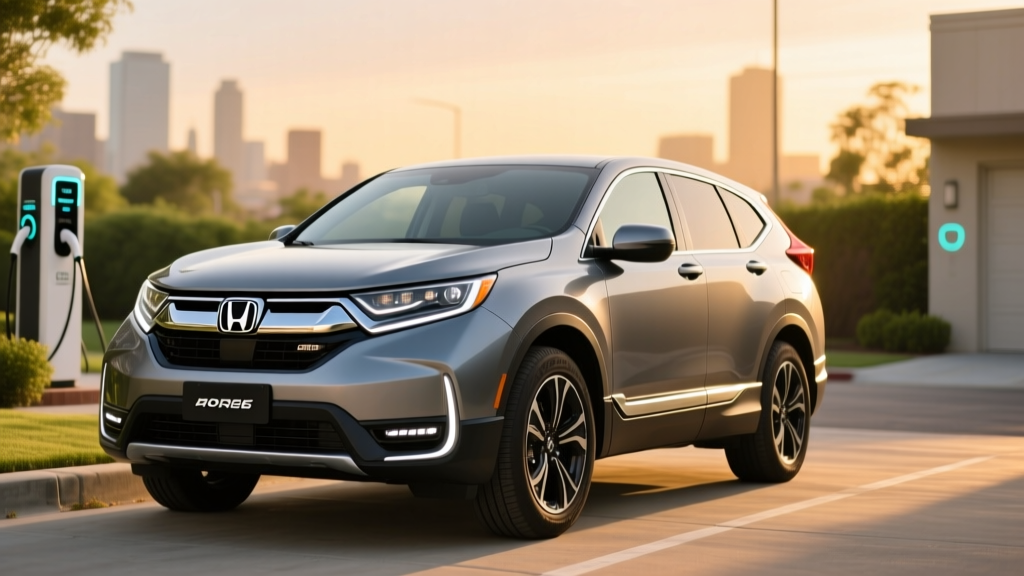
If you are searching for a used Honda CR-V Hybrid for sale, you are likely weighing fuel savings against the higher upfront cost of electrification. The CR-V Hybrid has been one of the best-selling hybrid compact SUVs in the U.S. for good reason: it delivers excellent city fuel economy, a spacious cabin, and Honda's reputation for long-term reliability — without ever needing to be plugged in. But with multiple model years on the used market, varying trim levels, and the newer CR-V e:PHEV (plug-in variant) now available overseas, buyers need clarity on exactly what they are getting.
This guide covers the conventional hybrid (HEV) models you will actually find at U.S. dealerships, the powertrain specs, real-world MPG versus EPA estimates, battery longevity, and how the CR-V Hybrid stacks up against plug-in hybrids and full battery-electric vehicles for different driving lifestyles.
HEV vs PHEV: What the CR-V Hybrid Actually Is
Critical distinction before you shop: The Honda CR-V Hybrid sold in the United States is a conventional hybrid (HEV), not a plug-in hybrid (PHEV). This means:
- No plug, no charging cord. The small lithium-ion battery recharges entirely through regenerative braking and the gasoline engine.
- No electric-only driving range beyond very low-speed, short-distance creep (under ~1 mile at parking-lot speeds).
- No federal tax credit under IRS §30D, which applies only to plug-in vehicles with sufficient battery capacity.
Honda has offered a CR-V e:PHEV (plug-in) in China and Europe with a ~17 kWh battery and roughly 37 miles of electric-only range (WLTP), but as of 2026, Honda does not sell a PHEV CR-V in the U.S. market. If you see a listing advertising a "CR-V plug-in hybrid," verify it is not a mislabeled standard HEV or a grey-market import.
Fuel Economy: EPA Ratings and Real-World MPG
The primary reason buyers seek out a used Honda CR-V Hybrid is fuel economy. Here is what the EPA rates across recent model years, sourced from fueleconomy.gov:
| Model Year | Drivetrain | City MPG | Highway MPG | Combined MPG |
|---|---|---|---|---|
| 2023–2025 | AWD (Sport/Sport Touring) | 40 | 34 | 37 |
| 2023–2025 | FWD (Sport, where available) | 43 | 36 | 40 |
| 2020–2022 | AWD (all trims) | 40 | 35 | 38 |
| 2018–2019 | FWD | 34 | 31 | 33 |
| 2018–2019 | AWD | 32 | 29 | 31 |
Real-World MPG: What Owners Actually Report
Hybrids typically exceed their EPA city estimates in stop-and-go traffic because regenerative braking recovers energy that a gas car wastes as heat. On the highway, where regen opportunities are fewer and aerodynamic drag dominates, real-world MPG often falls slightly below the EPA highway sticker.
For the 2023+ CR-V Hybrid AWD, expect:
- City driving: 38–44 MPG (many owners report beating the 40 MPG EPA city figure in warm weather)
- Highway driving (70+ mph): 30–33 MPG (below the 34 EPA highway rating)
- Cold weather (below 32°F): 30–34 MPG combined (engine runs more often for cabin heat and battery conditioning)
- Combined mixed driving: 35–39 MPG in typical year-round conditions
If your commute is primarily urban or suburban with frequent stops, the CR-V Hybrid will reward you with numbers at or above the EPA sticker. If you drive 80% highway miles, a clean-diesel or a highly efficient gas car might close the gap — though few match the CR-V's combined utility.
Powertrain Specs: Engine, Motors, and Horsepower
| Specification | 2023–2025 CR-V Hybrid | 2020–2022 CR-V Hybrid |
|---|---|---|
| Engine | 2.0L Atkinson-cycle 4-cyl | 2.0L Atkinson-cycle 4-cyl |
| Electric Motors | Two-motor system (drive + generator) | Two-motor system (drive + generator) |
| Combined System HP | 204 hp | 212 hp |
| Combined Torque | 247 lb-ft (motor) | 232 lb-ft (motor) |
| Transmission | e-CVT (no traditional gears) | e-CVT |
| Drivetrain | AWD standard (Sport trims); FWD available | AWD standard |
| 0–60 mph | ~7.6 seconds | ~7.5 seconds |
| Towing Capacity | 1,000 lbs | 1,000 lbs |
Honda's two-motor hybrid system operates primarily in electric-drive mode at low and moderate speeds, with the gasoline engine acting as a generator. At highway speeds, a lock-up clutch connects the engine directly to the wheels for efficiency. The result is smooth, responsive acceleration around town and acceptable highway passing power — though the 204 hp figure means this is no performance SUV.
Battery Warranty, Lifespan, and Replacement Cost
Honda Hybrid Battery Warranty:
- 2023+ models: 8 years / 100,000 miles (federal emissions warranty); 10 years / 150,000 miles in CARB states (CA, CO, CT, ME, MD, MA, NJ, NY, OR, RI, VT, WA)
- 2020–2022 models: 8 years / 100,000 miles nationwide; 10 years / 150,000 miles in CARB states
- Capacity threshold: Honda covers the battery if it falls below approximately 60–70% of original capacity (exact threshold varies by model year — confirm with your dealer)
How Long Do CR-V Hybrid Batteries Last?
Honda's hybrid batteries are lithium-ion packs, typically around 1.3–1.9 kWh in usable capacity (far smaller than a PHEV or BEV). Because the battery is small and the system never fully depletes or fully charges it (a built-in buffer protects longevity), degradation is slow. Based on owner reports and industry data:
- Expected lifespan: 12–15 years or 150,000–200,000+ miles before significant capacity loss
- Real-world failure rate: Low — Honda's hybrid system has proven durable across the Accord Hybrid, Insight, and CR-V Hybrid lineups
- Replacement cost (out of warranty): $2,000–$4,000 for the battery pack, plus $500–$1,000 labor. Some independent hybrid specialists offer refurbished packs for $1,500–$2,500.
For context, a conventional gas car's transmission replacement often costs $3,000–$5,000. The hybrid battery is not the financial liability many buyers fear — especially when most used CR-V Hybrids for sale will still carry some portion of the original 8–10 year warranty.
What to Check on a Used CR-V Hybrid
When evaluating a used Honda CR-V Hybrid for sale, request the following:
- Battery health report: A Honda dealer can pull a State of Health (SoH) reading from the hybrid system diagnostics.
- Warranty transfer status: Honda's hybrid battery warranty transfers to subsequent owners automatically — no paperwork required.
- Maintenance records: The hybrid system requires no special maintenance, but confirm regular oil changes (the gas engine still needs them) and brake fluid flushes.
- 12V battery condition: Like all modern cars, the CR-V Hybrid has a separate 12V auxiliary battery that can fail independently of the hybrid pack. Replacement runs $150–$250.
Pricing: What a Used CR-V Hybrid Costs in 2026
Used CR-V Hybrid pricing varies significantly by model year, mileage, trim, and region. Based on current market data for early 2026:
| Model Year Range | Typical Mileage | Price Range (Private/Dealer) | Key Notes |
|---|---|---|---|
| 2023–2025 | 5,000–30,000 mi | $31,000–$40,000 | Sport Touring commands premium; near-new inventory |
| 2020–2022 | 25,000–60,000 mi | $24,000–$32,000 | Sweet spot for value; most still under powertrain warranty |
| 2018–2019 | 50,000–90,000 mi | $18,000–$24,000 | Older hybrid system (lower MPG); verify battery SoH |
The 2023 redesign brought a more refined interior, updated Honda Sensing safety suite, and slightly improved fuel economy for FWD trims. If budget allows, the 2023+ models offer the best long-term ownership experience. However, the 2020–2022 generation remains an excellent value — particularly EX-L and Touring trims with under 50,000 miles, which often retain most of their original hybrid battery warranty.
Does the CR-V Hybrid Qualify for Any Tax Credit?
No. The conventional CR-V Hybrid (HEV) does not qualify for the federal §30D Clean Vehicle Credit. IRS rules require a plug-in vehicle with a battery capacity of at least 7 kWh and the ability to charge from an external source. The CR-V Hybrid's ~1.3 kWh battery and lack of a charge port make it ineligible.
Some states offer rebates for conventional hybrids, but these are increasingly rare as incentive programs shift toward PHEVs and BEVs. Check your state's energy or environmental agency website for current programs — but do not count on a credit at purchase.
CR-V Hybrid vs PHEV vs Full EV: Which Fits You?
Choose the CR-V Hybrid (HEV) If:
- You cannot charge at home (apartment, street parking, no garage outlet)
- You take frequent long road trips and don't want to plan around charging stops
- You want lower fuel costs without changing your driving or fueling habits at all
- Your budget is under $35,000 and you need a proven, reliable compact SUV
- You drive 12,000–15,000 miles/year in mixed city/highway conditions
Consider a PHEV Instead If:
- You can install a Level 2 home charger and your daily commute is under 30–40 miles
- You want electric-only driving for daily errands but gas flexibility for road trips
- You want to qualify for the federal tax credit (up to $7,500, subject to income, MSRP caps, and battery sourcing rules per IRS §30D guidelines)
- Models like the Toyota RAV4 Prime (42 mi electric range) or Hyundai Tucson PHEV (33 mi) fit your needs
CR-V Hybrid Pros
- 37–40 MPG combined EPA; often exceeded in city driving
- No charging infrastructure needed whatsoever
- Strong reliability record; hybrid battery lasts 150K+ miles
- Spacious cargo area (36.3 cu ft behind rear seats on 2023+)
- Honda Sensing ADAS standard on all recent trims
- Smooth, quiet low-speed electric driving feel
CR-V Hybrid Cons
- No electric-only range for emissions-free commuting
- Highway MPG drops to ~30–33 at 75+ mph
- No federal tax credit eligibility
- 1,000-lb towing limit (less than some gas competitors)
- CVT drone under hard acceleration
- AWD system is reactive, not for serious off-road use
Ownership Costs: Fuel Savings vs Gas CR-V
At 37 MPG combined (AWD) versus the gas CR-V AWD's 28 MPG combined, the hybrid saves roughly 9 MPG. Over 15,000 miles per year at $3.40/gallon:
- Gas CR-V AWD: ~536 gallons/year = $1,822/year
- CR-V Hybrid AWD: ~405 gallons/year = $1,378/year
- Annual fuel savings: ~$444/year
- 5-year fuel savings: ~$2,220
The hybrid typically carries a $1,500–$2,500 price premium over an equivalently trimmed gas CR-V on the used market. At ~$444/year in fuel savings, the payback period is roughly 4–5 years — after which the savings are pure profit. Factor in potentially lower maintenance (regenerative braking extends pad life; no traditional transmission to service) and the hybrid's total cost of ownership advantage grows.
Where to Find a Used Honda CR-V Hybrid for Sale
The CR-V Hybrid has been a high-volume seller since 2020, so inventory is plentiful. Focus your search on:
- Honda Certified Pre-Owned (CPO): Extends the powertrain warranty to 7 years/100,000 miles from the original in-service date. Worth the ~$1,000–$1,500 premium over a non-CPO listing.
- Major used-car platforms: Autotrader, CarGurus, and Cars.com allow filtering by "Hybrid" powertrain. Set alerts for your target year and trim.
- Local Honda dealers: Many trade-ins from lease returns land here. Ask the used-car manager to notify you when a hybrid CR-V arrives — they move quickly.
- Private sellers: Often $1,500–$3,000 cheaper than dealer listings, but invest $150–$200 in a pre-purchase inspection by a Honda-certified technician who can check hybrid battery SoH.
Prioritize 2023+ Sport and Sport Touring trims if you want the newest hybrid system, wireless Apple CarPlay/Android Auto, and the full Honda Sensing 2.0 suite (including traffic jam assist and improved lane-centering). The 2020–2022 EX-L and Touring remain excellent picks if leather and premium audio matter more than the latest tech.
Frequently Asked Questions
How many MPG does the used Honda CR-V Hybrid get in real-world driving?
The 2023–2025 CR-V Hybrid AWD is EPA-rated at 40 city / 34 highway / 37 combined. In real-world mixed driving, most owners report 35–39 MPG combined year-round, with city mileage often exceeding 40 MPG in warm weather and highway mileage dropping to 30–33 MPG at speeds above 70 mph. Cold weather reduces combined MPG to roughly 30–34.
Does the Honda CR-V Hybrid need to be plugged in?
No. The CR-V Hybrid is a conventional hybrid (HEV), not a plug-in hybrid. Its small battery charges entirely through regenerative braking and the gasoline engine. You fuel it exactly like a regular gas car — there is no charge port, no cord, and no electric-only driving range to manage.
Is the Honda CR-V Hybrid reliable, and what does a battery replacement cost?
Yes. Honda's two-motor hybrid system has proven highly reliable across multiple model lines. The hybrid battery is warrantied for 8 years/100,000 miles (10 years/150,000 miles in CARB states), and real-world data shows these batteries commonly last 150,000–200,000+ miles. Out-of-warranty replacement costs $2,000–$4,000 for the pack plus labor — comparable to a transmission replacement on a conventional vehicle.
Does a used Honda CR-V Hybrid qualify for a federal tax credit?
No. The federal §30D Clean Vehicle Credit applies only to plug-in electric vehicles (PHEVs and BEVs) with battery capacities of at least 7 kWh and external charging capability. The CR-V Hybrid's ~1.3 kWh battery and lack of a plug make it ineligible. Some states may offer small hybrid rebates, but these are uncommon in 2026.
Should I buy the CR-V Hybrid or wait for a plug-in version?
Honda has not announced a U.S.-market CR-V PHEV as of 2026. If plug-in capability is essential for your commute, look at the Toyota RAV4 Prime (42 miles electric-only, EPA-rated), Hyundai Tucson PHEV (33 miles), or Ford Escape PHEV (37 miles). If you simply want excellent fuel economy without plug-in logistics, the CR-V Hybrid remains one of the strongest choices in the segment — and there is no benefit to waiting for a PHEV variant that may never arrive in the U.S.
What is the difference between the 2020–2022 and 2023+ CR-V Hybrid?
The 2023 redesign moved to Honda's newer two-motor hybrid system with a slightly downsized engine (204 hp vs 212 hp but more torque), a stiffer platform, a larger touchscreen, updated Honda Sensing 2.0 safety features, and improved cabin insulation. The 2023+ models also offer FWD on lower trims (43/36/40 MPG), while AWD became standard on Sport and Sport Touring. Both generations are excellent; the 2023+ is more refined, while the 2020–2022 offers better used-market value.
How does the CR-V Hybrid compare to a full EV like the Tesla Model Y or Hyundai Ioniq 5?
A full EV eliminates fuel costs entirely (electricity at ~$0.04–$0.06/mile vs gasoline at ~$0.12–$0.14/mile for the hybrid), offers stronger acceleration, and qualifies for the federal tax credit if bought new. However, EVs require home charging access, cost $5,000–$15,000 more upfront, and add planning complexity for road trips over 250 miles. The CR-V Hybrid is the pragmatic choice for buyers without home charging, those who regularly drive 400+ mile routes, or anyone who wants electrified efficiency without lifestyle changes.
Sources: U.S. EPA Fuel Economy Guide, IRS §30D Clean Vehicle Credit, Honda Automobiles press information.