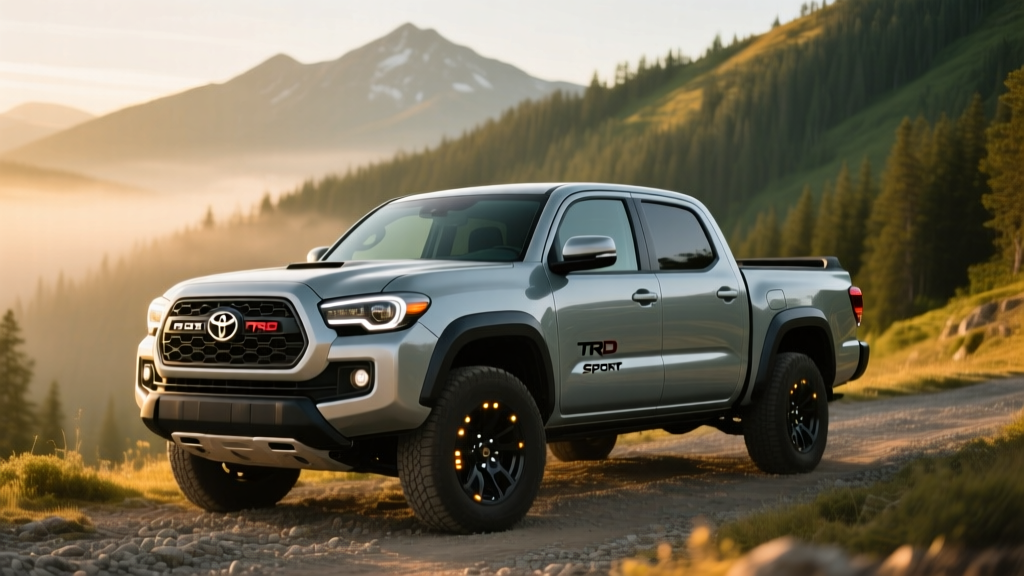
Quick Verdict: The Tacoma Hybrid TRD Sport at a Glance
The 2025 Toyota Tacoma Hybrid TRD Sport pairs a turbocharged 2.4-liter four-cylinder with a 48-horsepower electric motor integrated into an eight-speed automatic transmission, yielding a combined 326 horsepower and 465 lb-ft of torque. Unlike a plug-in hybrid (PHEV), this is a conventional hybrid electric vehicle (HEV) — it recovers energy through regenerative braking and the gasoline engine, never requiring you to plug in. The TRD Sport trim sits in the middle-upper tier of the Tacoma i-FORCE MAX lineup, adding sport-tuned suspension, 20-inch alloy wheels, and a hood scoop, while returning EPA-estimated fuel economy that beats its non-hybrid siblings in city driving.
| Specification | Value |
|---|---|
| Powertrain | 2.4L turbo I-4 + electric motor (i-FORCE MAX) |
| Combined Horsepower | 326 hp |
| Combined Torque | 465 lb-ft |
| Transmission | 8-speed automatic |
| Drivetrain (TRD Sport 4x4) | Part-time 4WD |
| EPA Fuel Economy (4x4) | 23 city / 24 highway / 23 combined MPG |
| Hybrid Battery | ~1.87 kWh, nickel-metal hydride (NiMH) |
| Towing Capacity | Up to 6,000 lbs (properly equipped) |
| 0–60 mph (est.) | ~6.5 seconds |
| Starting MSRP (TRD Sport 4x4) | ~$47,995 (before destination) |
| Federal EV Tax Credit | Not eligible (HEV, not PHEV/BEV) |
HEV vs PHEV: Why the Tacoma Hybrid Doesn't Plug In
Shoppers researching the Tacoma Hybrid often ask whether they need a home charger. The answer is no. Toyota's i-FORCE MAX system is a conventional hybrid (HEV), meaning the small battery recharges exclusively through regenerative braking and the gas engine. There is no charge port, no electric-only driving range, and no Level 1 or Level 2 charging to worry about.
| Feature | HEV (Tacoma Hybrid) | PHEV (e.g., RAV4 Prime) | BEV (e.g., Rivian R1T) |
|---|---|---|---|
| Plug-in charging required? | No | Yes | Yes |
| Electric-only range | None (motor assists only) | 20–42 mi typical | 200–400+ mi |
| Gasoline engine | Yes (primary) | Yes (backup + primary) | No |
| Federal §30D tax credit | Not eligible | Eligible if battery ≥7 kWh & sourcing rules met | Eligible up to $7,500 (rules vary) |
| Home charger needed | No | Recommended (Level 2) | Essential (Level 2) |
If you want electric-only commuting in a Toyota truck-adjacent package, the RAV4 Prime PHEV (42 miles of EV range) is the closest alternative in Toyota's lineup — though it's an SUV, not a pickup.
Fuel Economy: EPA Estimates and Real-World MPG
| Configuration | City MPG | Highway MPG | Combined MPG |
|---|---|---|---|
| i-FORCE MAX 4x2 (Double Cab) | 24 | 27 | 25 |
| i-FORCE MAX 4x4 (TRD Sport) | 23 | 24 | 23 |
| Non-hybrid 2.4T 4x4 (baseline) | 20 | 24 | 21 |
Source: fueleconomy.gov
Real-World MPG: What to Expect Beyond the Sticker
The EPA rates the Tacoma Hybrid TRD Sport 4x4 at 23 MPG combined, but real-world results depend heavily on driving conditions:
- City driving: Hybrids shine here. Expect 24–26 MPG in stop-and-go traffic, where regenerative braking recaptures energy and the electric motor handles low-speed acceleration. Some owners report exceeding the EPA city estimate by 1–3 MPG on urban commutes.
- Highway cruising: At 70–80 mph, the turbo engine does most of the work alone. Expect 22–24 MPG on flat interstates, roughly matching the EPA highway figure.
- Towing and hauling: When pulling a 4,000–5,000 lb trailer, fuel economy drops significantly — anticipate 13–16 MPG depending on terrain and wind. This is typical for any midsize truck under load.
- Cold weather: Below freezing, the engine runs more often to maintain cabin heat and battery temperature, reducing city MPG by roughly 1–2 MPG.
Compared to the non-hybrid 2.4T Tacoma 4x4 (21 MPG combined), the i-FORCE MAX saves roughly 2 MPG combined — translating to about 100 fewer gallons over 15,000 miles of annual driving, or roughly $300–$350 per year at $3.50/gallon.
Powertrain Deep Dive: The i-FORCE MAX System
The i-FORCE MAX hybrid system is Toyota's performance-oriented truck powertrain, not an efficiency-first design like the Prius hybrid. Here's how it works:
- 2.4L turbocharged inline-4: Produces 278 hp and 317 lb-ft of torque on its own.
- Electric motor-generator: Sandwiched between the engine and the 8-speed automatic, contributing 48 hp and 184 lb-ft.
- Combined output: 326 hp and 465 lb-ft — more torque than the previous-generation Tacoma's V6.
- NiMH battery pack: Approximately 1.87 kWh, mounted under the rear seat. This is a small, self-charging battery designed for burst assist, not sustained electric driving.
The electric motor fills in the torque gap before the turbo spools up, eliminating the lag common to turbocharged engines. The result is immediate off-the-line response — Toyota estimates 0–60 mph in roughly 6.5 seconds for 4x4 models, making it the quickest Tacoma in the lineup.
Pricing, Trims, and Tax Credit Eligibility
The 2025 Tacoma Hybrid is available exclusively in higher trims. Here's the approximate pricing landscape:
| Trim | Approx. MSRP (incl. destination) |
|---|---|
| TRD Off-Road | ~$47,500 |
| TRD Sport | ~$49,500 |
| Limited | ~$57,000 |
| TRD Pro | ~$65,000 |
Pricing varies by dealer and options. Confirm with your local Toyota dealer.
Does the Tacoma Hybrid Qualify for a Federal Tax Credit?
No. The IRS §30D Clean Vehicle Credit applies only to plug-in electric vehicles (BEVs and PHEVs with battery capacity ≥7 kWh). Because the Tacoma Hybrid is a conventional HEV with a ~1.87 kWh battery and no plug-in capability, it does not qualify for the federal credit of up to $7,500. There is currently no federal tax incentive specifically for conventional hybrids.
Some states offer rebates or reduced registration fees for hybrids — check your state's energy office or Alternative Fuels Data Center for local programs.
Battery Warranty, Reliability, and Replacement Costs
Toyota Hybrid Battery Coverage
- Hybrid Battery Warranty: 10 years / 150,000 miles (whichever comes first), applicable to all 2025 Toyota hybrids sold in the U.S.
- Hybrid System Components: 8 years / 100,000 miles (inverter, control module, etc.)
- Powertrain Warranty: 5 years / 60,000 miles
How Long Will the Tacoma Hybrid Battery Last?
Toyota's NiMH hybrid batteries have a strong longevity track record. Data from the Prius and RAV4 Hybrid platforms — which use similar chemistry and charge/discharge profiles — shows most hybrid batteries lasting 150,000–200,000+ miles before significant degradation. The Tacoma's system is relatively mild: the battery never fully charges or fully depletes, staying in a narrow state-of-charge window that minimizes stress.
Battery Replacement Cost
If the hybrid battery fails outside warranty, replacement costs typically range from $2,500 to $4,000 (parts and labor) at a Toyota dealer. Third-party refurbishment shops offer reconditioned NiMH packs for $1,500–$2,500. Given the 10-year/150,000-mile warranty and Toyota's historical reliability, most original owners will never face this expense.
Who Should Choose the Tacoma Hybrid (and Who Shouldn't)
Choose the Tacoma Hybrid TRD Sport if:
- You want a midsize pickup with strong torque for towing (up to 6,000 lbs) and quicker acceleration than a standard turbo four-cylinder.
- Your driving is primarily city or suburban, where hybrid regenerative braking delivers the best MPG gains.
- You don't have access to home or workplace charging and don't want to rely on public charging infrastructure.
- You plan to own the truck 8–10+ years and value Toyota's long-term reliability reputation and 10-year hybrid battery warranty.
Consider a PHEV or BEV Instead if:
- You want electric-only commuting (look at the RAV4 Prime or a BEV like the Ford F-150 Lightning or Rivian R1T).
- You want to claim the $7,500 federal tax credit (requires a qualifying PHEV or BEV — see IRS §30D guidelines).
- You drive fewer than 30 miles round-trip daily and have home charging — a PHEV could eliminate gasoline use on most days.
Stick With the Non-Hybrid Tacoma if:
- You're budget-sensitive and the ~$3,000–$4,000 hybrid premium over the base turbo doesn't justify the 2 MPG gain for your mileage.
- You primarily drive highway miles at steady speed, where the hybrid advantage is minimal.
Pros
- 465 lb-ft of torque with immediate electric-motor response
- No plug-in charging required — fuel and go
- 23 MPG combined (4x4) beats the non-hybrid by ~2 MPG
- 10-year / 150,000-mile hybrid battery warranty
- 6,000-lb towing capacity maintained
- TRD Sport suspension tuned for on-road comfort
Cons
- No federal tax credit eligibility
- Hybrid premium adds ~$3,000+ vs non-hybrid trims
- 20-inch wheels on TRD Sport reduce off-road compliance
- MPG gains modest on highway-heavy commutes
- NiMH battery (not lithium-ion) — proven but older chemistry
- Fuel economy drops sharply when towing (13–16 MPG)
Frequently Asked Questions
How many MPG does the 2025 Toyota Tacoma Hybrid TRD Sport get?
The EPA rates the 2025 Tacoma Hybrid TRD Sport 4x4 at 23 city / 24 highway / 23 combined MPG. In real-world city driving with frequent stops, owners often see 24–26 MPG thanks to regenerative braking. Highway-only driving at 75+ mph may return 21–23 MPG. Towing drops economy to 13–16 MPG depending on load.
Is the Tacoma Hybrid a plug-in hybrid?
No. The 2025 Tacoma Hybrid is a conventional hybrid (HEV), not a plug-in hybrid (PHEV). It has no charge port and cannot drive on electric power alone. The small ~1.87 kWh NiMH battery charges itself through regenerative braking and the gasoline engine. If you want a Toyota PHEV, the RAV4 Prime offers 42 miles of electric-only range.
Does the 2025 Tacoma Hybrid qualify for the $7,500 federal tax credit?
No. The IRS §30D Clean Vehicle Credit requires a vehicle to be a plug-in electric vehicle (BEV or PHEV) with a battery capacity of at least 7 kWh. The Tacoma Hybrid's ~1.87 kWh battery and lack of a charge port make it ineligible. No federal tax credit currently exists for conventional hybrids. Check your state's incentives at the Alternative Fuels Data Center.
How reliable is the Tacoma Hybrid battery, and what does replacement cost?
Toyota covers the hybrid battery for 10 years or 150,000 miles. Based on Toyota's long history with NiMH hybrid systems (Prius, Camry Hybrid, RAV4 Hybrid), most batteries last 150,000–200,000+ miles without failure. If replacement is needed out of warranty, expect $2,500–$4,000 at a dealer or $1,500–$2,500 from a third-party refurbisher.
Hybrid vs PHEV vs EV — which truck is right for me?
Choose the Tacoma Hybrid (HEV) if you want better fuel economy without changing your refueling habits — just fill up at any gas station. Choose a PHEV (like the upcoming electrified trucks or the RAV4 Prime SUV) if you have home charging and a short commute that could run on electricity alone most days. Choose a BEV (like the F-150 Lightning or Rivian R1T) if you want zero tailpipe emissions, lower per-mile fuel costs, and have reliable home charging. Each step toward full electrification requires more charging infrastructure but offers greater per-mile savings.
How much does the hybrid system add to the Tacoma's price?
The i-FORCE MAX hybrid powertrain is standard on TRD Sport and above for 2025, so there's no standalone hybrid upcharge within those trims. However, compared to the base non-hybrid SR5 4x4 (~$40,000), the TRD Sport Hybrid starts roughly $8,000–$9,000 higher — though this includes the trim upgrade (sport suspension, 20-inch wheels, technology package) in addition to the hybrid system itself.
Can the Tacoma Hybrid run on electric power alone?
No. Unlike a PHEV, the Tacoma Hybrid cannot propel itself on electric power alone at any meaningful speed or distance. The electric motor assists the gasoline engine during acceleration and low-load conditions, but the gas engine is always the primary power source. There is no EV mode button or electric-only driving capability.