The Toyota Tacoma has long been America's best-selling midsize pickup, but the introduction of the i-FORCE MAX hybrid powertrain changed the conversation for truck buyers who also care about fuel costs. If you've been searching for the hybrid Tacoma MPG numbers to decide whether the hybrid is worth the premium over the standard turbo four-cylinder, you're in the right place. This guide breaks down every fuel-economy figure, real-world expectation, powertrain detail, and ownership cost you need to make an informed decision on the 2026 Toyota Tacoma Hybrid.
2026 Tacoma Hybrid MPG: EPA Ratings by Trim and Drivetrain
The 2026 Toyota Tacoma Hybrid uses Toyota's i-FORCE MAX powertrain — a turbocharged 2.4-liter four-cylinder engine paired with an electric motor integrated into the transmission bell housing. Unlike the previous V6 Tacoma, this hybrid setup delivers substantially more torque while improving efficiency. Here's the EPA-rated fuel economy breakdown across trims and drivetrain configurations:
| Trim / Drivetrain | City MPG | Highway MPG | Combined MPG |
|---|---|---|---|
| TRD Sport (4x2) | 23 | 27 | 24 |
| TRD Off-Road (4x4) | 22 | 25 | 23 |
| Limited (4x4) | 21 | 24 | 22 |
| TRD Pro (4x4) | 21 | 23 | 22 |
For comparison, the non-hybrid i-FORCE (turbo 2.4L without the electric motor) returns 20 city / 26 highway / 22 combined in 4x2 form. The hybrid's advantage is most pronounced in city driving and stop-and-go traffic, where the electric motor handles low-speed propulsion and regenerative braking recovers energy that would otherwise be lost.
HEV vs. PHEV: The Tacoma Hybrid Is a Conventional Hybrid — Not Plug-In
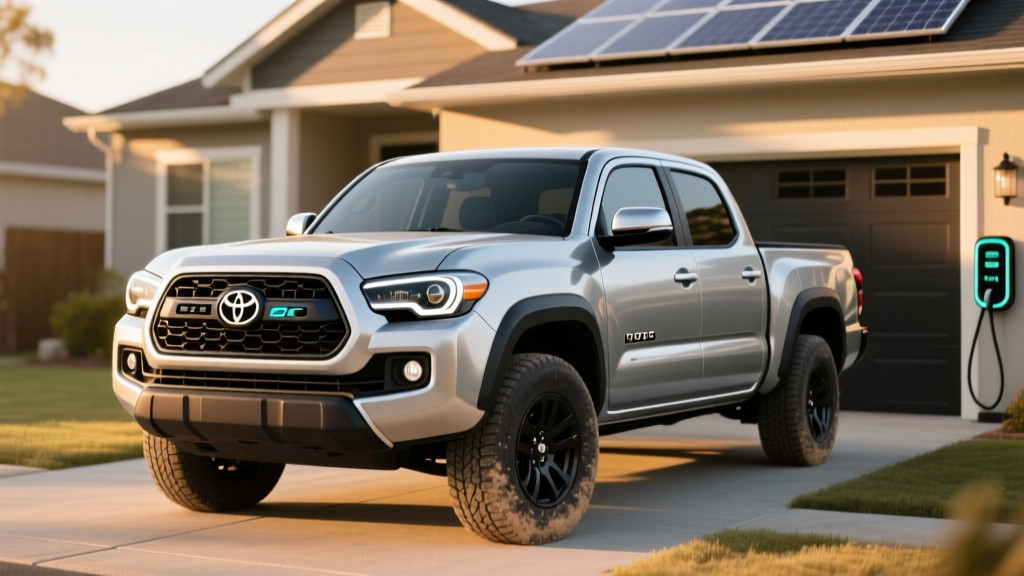
This is a critical distinction that catches many shoppers off guard. The Tacoma i-FORCE MAX is a conventional hybrid (HEV), not a plug-in hybrid (PHEV). There is no charging port, no electric-only driving range, and no need to plug it in. The small battery pack charges exclusively through regenerative braking and the gasoline engine.
| Feature | HEV (Tacoma i-FORCE MAX) | PHEV (e.g., RAV4 Prime) |
|---|---|---|
| Plug-in charging | No — self-charging | Yes — requires plug-in |
| Electric-only range | None (motor assists engine) | 25–42 miles typical |
| Battery size | ~1.8 kWh (nickel-metal hydride) | 14–18 kWh (lithium-ion) |
| Federal tax credit (§30D) | Not eligible | Up to $7,500 (if eligible) |
| Best for | Drivers without home charging access | Drivers with home charging & short commutes |
Toyota has not announced a PHEV variant of the Tacoma as of early 2026. If you need electric-only commuting capability in a Toyota truck, you'll need to look at full EVs like the upcoming electric Tacoma (announced, no firm release date) or consider the Ford Maverick PHEV concept. For now, the Tacoma Hybrid is strictly an HEV.
i-FORCE MAX Powertrain: Specs, Horsepower, and How It Works
The i-FORCE MAX powertrain is the heart of the Tacoma Hybrid's efficiency and performance story. Here are the exact numbers:
| Specification | Value |
|---|---|
| Engine | 2.4L turbocharged inline-4 |
| Electric motor | Permanent-magnet synchronous (integrated in 8-speed auto) |
| Combined horsepower | 326 HP |
| Combined torque | 465 lb-ft |
| Transmission | 8-speed automatic |
| Battery type | NiMH (nickel-metal hydride), ~1.8 kWh |
| 0–60 MPH | ~6.5 seconds (4x4) |
| Max towing capacity | 6,000 lbs (varies by trim) |
| Max payload | ~1,700 lbs (varies by trim) |
The 465 lb-ft of torque is the headline figure — it arrives at low RPM thanks to the electric motor, making the Tacoma Hybrid feel significantly more responsive than the non-hybrid i-FORCE (which produces 243 lb-ft). This torque advantage is especially useful for towing, merging onto highways, and low-speed off-road crawling where precise throttle control matters.
The hybrid system operates in several modes seamlessly: EV mode at very low speeds (under ~15 MPH for brief distances in parking lots), engine-only mode at steady highway cruising, and combined engine + motor mode during acceleration. The driver doesn't select modes manually in most trims — the powertrain management handles it automatically.
Pricing: 2026 Tacoma Hybrid MSRP by Trim
The i-FORCE MAX hybrid powertrain is available on several Tacoma trims, though it's not offered on the base SR or SR5. Here's the 2026 MSRP breakdown:
| Trim | Drivetrain | MSRP (incl. destination) |
|---|---|---|
| TRD Sport | 4x2 | $41,995 |
| TRD Off-Road | 4x4 | $44,495 |
| Limited | 4x4 | $52,595 |
| TRD Pro | 4x4 | $65,975 |
The hybrid premium over the equivalent non-hybrid i-FORCE trim is approximately $2,500–$3,000 depending on configuration. Whether that premium pays for itself depends on your annual mileage and fuel costs.
Tax Credits and Incentives: Does the Tacoma Hybrid Qualify?
This is where many hybrid shoppers encounter disappointment. Under current IRS §30D rules, the Toyota Tacoma Hybrid (HEV) does not qualify for the federal clean vehicle tax credit. The §30D credit of up to $7,500 applies only to battery electric vehicles (BEVs) and plug-in hybrids (PHEVs) that meet battery-sourcing, critical-minerals, MSRP, and buyer-income requirements. Conventional hybrids are excluded.
- Federal §30D credit: Not eligible (HEV, not PHEV or BEV)
- Federal alternative fuel vehicle credit: Not applicable
- State incentives: A handful of states offer rebates for HEVs, but these are increasingly rare and often have income or price caps. Check your state energy office or AFDC incentive database for current programs.
- Manufacturer incentives: Toyota occasionally offers cash-back or low-APR financing on Tacoma trims — check Toyota.com for current offers.
If a federal tax credit is a dealbreaker for your truck purchase, you'll need to look at full-electric pickups like the Ford F-150 Lightning or Rivian R1T (subject to their own eligibility constraints under current IRS §30D rules).
Battery Warranty, Reliability, and Replacement Cost
Hybrid battery longevity is consistently the top concern for first-time hybrid buyers. Here's what you need to know about the Tacoma i-FORCE MAX:
• Hybrid battery: 10 years / 150,000 miles (whichever comes first)
• Hybrid system components (inverter, motor, control module): 8 years / 100,000 miles
• Basic vehicle warranty: 3 years / 36,000 miles
• Powertrain warranty: 5 years / 60,000 miles
• Source: Toyota Warranty Guide
The Tacoma's NiMH hybrid battery is much smaller and less stressed than the lithium-ion packs in full EVs. Toyota has decades of hybrid battery reliability data from the Prius, Camry Hybrid, and RAV4 Hybrid — NiMH packs routinely last 150,000–200,000+ miles with minimal degradation.
Replacement cost if out of warranty: A Tacoma hybrid battery replacement is estimated at $2,000–$3,500 (parts + labor) based on comparable Toyota hybrid systems. This is dramatically less than a full EV battery replacement ($8,000–$20,000+). Individual hybrid system components like the inverter can run $1,500–$2,500 if they fail outside warranty.
Toyota's hybrid reliability track record is among the strongest in the industry. The Tacoma consistently earns above-average reliability ratings from Consumer Reports, and the i-FORCE MAX powertrain shares architecture with the proven RAV4 Hybrid and Highlander Hybrid systems, albeit with truck-specific tuning.
Tacoma Hybrid vs. Gas Tacoma vs. Full-EV Trucks: Which Fits You?
Choose the Tacoma Hybrid if:
- You tow or haul regularly and need the 465 lb-ft torque advantage
- You drive primarily in city/suburban traffic where hybrid efficiency shines
- You lack access to home or workplace EV charging
- You want a midsize truck with better fuel economy than the gas version without changing your habits
- You plan to own the truck 8+ years (warranty covers the hybrid system)
Look at a full EV truck instead if:
- You have reliable Level 2 home charging and your daily driving is under 250 miles
- You want to qualify for the up-to-$7,500 federal tax credit
- You want near-zero routine maintenance (no oil changes, fewer moving parts)
- You prioritize the lowest per-mile fuel cost (electricity vs. gasoline)
- You're open to a full-size truck (F-150 Lightning, Silverado EV) since no midsize EV pickup is widely available yet
The gas-only Tacoma i-FORCE makes sense if your budget is tight, you primarily drive highway miles (where the hybrid advantage narrows), or you're buying a base SR/SR5 trim where the hybrid isn't offered. The non-hybrid 2.4L turbo is still a strong engine — the hybrid simply adds low-end torque and modest city MPG gains.
Frequently Asked Questions
How many MPG does the hybrid Tacoma get?
The 2026 Tacoma Hybrid (i-FORCE MAX) gets 22–23 city / 24–27 highway / 22–24 combined MPG depending on trim and drivetrain. The 4x2 TRD Sport achieves the highest rating at 23/27/24. In real-world city driving with regenerative braking, many owners report 25+ MPG.
Does the Tacoma Hybrid need to be plugged in?
No. The Tacoma i-FORCE MAX is a conventional hybrid (HEV), not a plug-in hybrid. It charges its own small battery through regenerative braking and the gasoline engine. There is no charging port and no electric-only driving range.
Is the Tacoma Hybrid reliable?
Toyota's hybrid systems have an extensive reliability track record spanning 25+ years since the original Prius. The Tacoma's hybrid battery is covered for 10 years/150,000 miles, and NiMH packs commonly exceed 200,000 miles. The i-FORCE MAX shares architecture with proven Toyota hybrid systems in the RAV4 and Highlander.
What does it cost to replace the Tacoma Hybrid battery?
Out-of-warranty hybrid battery replacement is estimated at $2,000–$3,500 including labor. However, most Tacoma Hybrid owners will never need a replacement — the battery is covered under Toyota's 10-year/150,000-mile hybrid warranty, and NiMH chemistry is extremely durable.
Does the Tacoma Hybrid qualify for any tax credit?
No. Under current IRS §30D rules, conventional hybrids (HEVs) do not qualify for the federal clean vehicle tax credit. Only battery electric vehicles (BEVs) and plug-in hybrids (PHEVs) are eligible, subject to MSRP caps, buyer income limits, and battery-sourcing requirements. Some states may offer minor HEV incentives — check your local programs.
Can the Tacoma Hybrid drive on electric power alone?
Only at very low speeds (under ~15 MPH) for short distances, such as creeping through a parking lot. The electric motor primarily assists the gasoline engine rather than replacing it. There is no meaningful electric-only range — this is by design in a conventional hybrid.
Is the hybrid Tacoma worth the extra cost over the gas model?
Strictly on fuel savings, the ~$2,500–$3,000 hybrid premium takes 14–16 years to recoup at average mileage. However, the hybrid's 465 lb-ft of torque (vs. 243 lb-ft on the non-hybrid), smoother stop-start behavior, and potentially stronger resale value make it a compelling upgrade for buyers who value performance and refinement alongside efficiency.