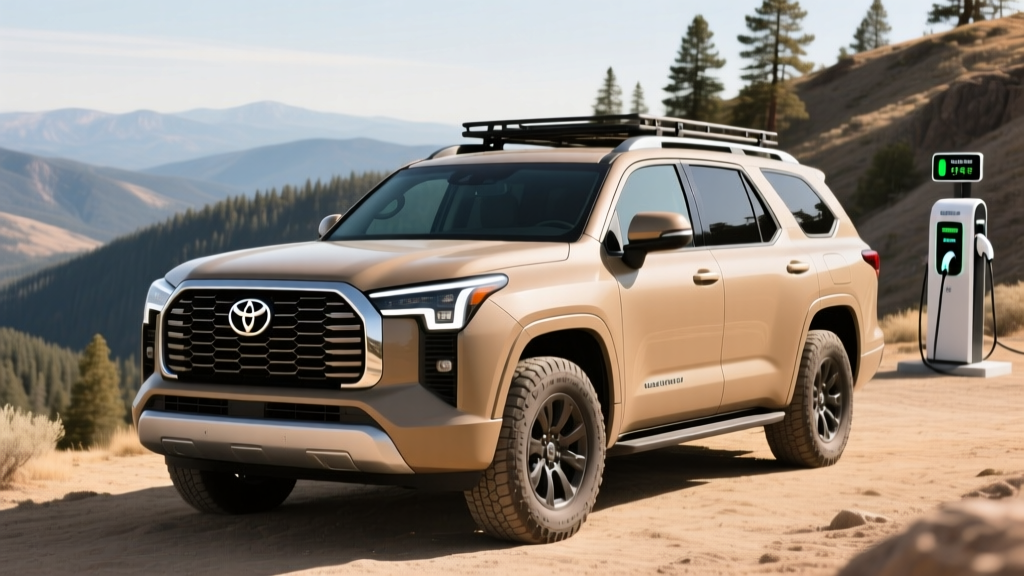
The Toyota Sequoia has been a full-size, body-on-frame SUV with a hybrid-only powertrain since its third-generation redesign. For 2026, every Sequoia rolls off the line as a hybrid electric vehicle (HEV)—there is no gas-only version and no plug-in hybrid (PHEV) variant. If you've been searching for a hybrid Sequoia, you're looking at one of the most capable three-row SUVs on the market, but one that comes with specific trade-offs worth understanding before you sign the paperwork.
This guide breaks down the 2026 Sequoia's fuel economy, powertrain, pricing, battery longevity, and how it stacks up against full-electric alternatives like the Rivian R1S or the upcoming electric large SUVs from legacy automakers.
HEV vs. PHEV: What the Sequoia Actually Is
Before we get into the numbers, it's critical to clarify what type of hybrid the Sequoia is—and isn't.
| Feature | Conventional Hybrid (HEV) | Plug-In Hybrid (PHEV) |
|---|---|---|
| Plugs in to charge? | No — charges via regenerative braking and engine | Yes — has a larger battery you charge externally |
| Electric-only range | ~1 mile or less at very low speeds | 20–50+ miles typical |
| Battery size | 1–2 kWh (small buffer) | 12–30+ kWh |
| Federal tax credit (§30D) | Not eligible | Up to $7,500 if requirements met |
| Toyota Sequoia? | Yes — this is what the Sequoia is | No Sequoia PHEV exists |
The Sequoia is a conventional hybrid (HEV). You never plug it in. Its small battery pack charges through regenerative braking and the gasoline engine. This means zero electric-only driving range of any meaningful distance, but also zero range anxiety and no dependence on charging infrastructure.
2026 Sequoia Hybrid MPG: EPA Ratings and Real-World Economy
The Sequoia uses Toyota's i-FORCE MAX twin-turbo V6 hybrid powertrain across every trim. Fuel economy varies slightly depending on whether you choose rear-wheel drive (RWD) or four-wheel drive (4WD).
| Drivetrain | City MPG | Highway MPG | Combined MPG |
|---|---|---|---|
| RWD (SR5, Limited) | 21 | 24 | 22 |
| 4WD (SR5, Limited, Platinum, TRD Pro, Capstone) | 19 | 22 | 20 |
Source: EPA Fuel Economy Guide (fueleconomy.gov)
Real-World MPG vs. EPA Sticker
In our experience and consistent owner reports, the Sequoia hybrid tends to meet or slightly exceed its EPA city rating thanks to Toyota's hybrid system leveraging regenerative braking and electric-motor assist in stop-and-go traffic. City drivers commonly report 21–23 MPG in the 4WD model.
Highway driving is a different story. At sustained speeds above 70 mph, expect the 4WD Sequoia to return 18–20 MPG—below the EPA highway estimate. The boxy aerodynamics and 6,000+ lb curb work against it on the open road. If your commute is mostly highway, a smaller crossover hybrid will deliver better real-world numbers.
Towing impact: When towing near its 9,000–9,520 lb max capacity, fuel economy drops to roughly 10–13 MPG depending on trailer weight and terrain. This is typical for the class but worth budgeting for if you tow frequently.
i-FORCE MAX Powertrain: Specs and Performance
Every 2026 Sequoia uses the same powertrain—no engine choices, no smaller option. Here's what's under the hood:
| Specification | Detail |
|---|---|
| Engine | 3.4L twin-turbo V6 (V35A-FTS) |
| Electric motor | Integrated motor-generator between engine and transmission |
| Combined horsepower | 437 hp |
| Combined torque | 583 lb-ft |
| Transmission | 10-speed automatic |
| 0–60 mph | ~5.6 seconds (4WD) |
| Max towing capacity | Up to 9,520 lbs (RWD SR5) |
| Hybrid battery | ~1.87 kWh nickel-metal hydride (NiMH) |
| Curb weight | ~5,900–6,200 lbs depending on trim |
The electric motor fills in the torque gap at low RPMs before the turbos spool up, giving the Sequoia strong off-the-line acceleration that feels more like a V8 than a turbo six. The hybrid system is seamless—most drivers never notice the electric assist engaging or the engine shutting off at stops.
2026 Sequoia Pricing by Trim
The Sequoia sits at the top of Toyota's SUV lineup, and pricing reflects that. Here's where each trim lands for the 2026 model year:
| Trim | Drivetrain | Starting MSRP |
|---|---|---|
| SR5 | RWD | ~$62,175 |
| SR5 | 4WD | ~$64,175 |
| Limited | 4WD | ~$69,500 |
| Platinum | 4WD | ~$76,500 |
| TRD Pro | 4WD | ~$80,500 |
| Capstone | 4WD | ~$83,500 |
Prices are approximate base MSRPs including destination charge. Options and packages add to these figures. Check Toyota's official Sequoia page for current build-and-price data.
Does the Hybrid Sequoia Qualify for a Federal Tax Credit?
No. The Sequoia is a conventional hybrid (HEV), not a plug-in hybrid or battery electric vehicle. Under current IRS §30D rules, only PHEVs and BEVs with sufficient battery capacity qualify for the federal clean vehicle credit (up to $7,500). The Sequoia's ~1.87 kWh battery is far below the 7 kWh minimum threshold.
Some states offer modest incentives for conventional hybrids, but these are uncommon and typically small ($250–$1,000). Check your state's energy office or department of environmental quality for current programs. Toyota's hybrid system does, however, deliver fuel savings that partially offset the higher purchase price over time—more on that below.
Battery Warranty, Longevity, and Replacement Cost
Hybrid battery reliability is one of the most common concerns buyers raise. Toyota has the longest track record of any automaker with hybrid technology (the Prius launched in 1997), and the data is reassuring.
2026 Sequoia Hybrid Battery Warranty
- Hybrid battery warranty: 10 years / 150,000 miles (whichever comes first)
- Hybrid system components: 8 years / 100,000 miles
- Powertrain warranty: 5 years / 60,000 miles
- Basic warranty: 3 years / 36,000 miles
Toyota's hybrid battery warranty is among the best in the industry. The 10-year/150,000-mile coverage applies in all 50 states.
How Long Does the Sequoia Hybrid Battery Actually Last?
Toyota's NiMH hybrid batteries in the Sequoia and Tundra platform are designed to last the life of the vehicle. Real-world data from Toyota's hybrid trucks and SUVs (including the Tundra Hybrid and previous Sequoia generations) suggests these batteries routinely exceed 150,000–200,000 miles without significant degradation. The small 1.87 kWh pack operates within a narrow state-of-charge window (roughly 40–80%), which dramatically reduces stress on the cells.
Battery Replacement Cost
If the hybrid battery does need replacement out of warranty, expect to pay between $3,000 and $5,000 for a new OEM battery pack including labor. Refurbished or reconditioned packs are available for $1,500–$2,500. This is far less than a full EV battery replacement ($10,000–$25,000+) because the Sequoia's hybrid battery is small and relatively simple.
For context, Toyota Prius taxi fleets have logged 300,000+ miles on original hybrid batteries. The Sequoia's system uses similar technology with robust thermal management.
Sequoia Hybrid vs. Full EV vs. Gas SUV: Which Fits You?
Choose the Hybrid Sequoia If:
- You need three rows, serious towing capacity (9,000+ lbs), and 4WD capability
- You don't have reliable home or workplace charging access
- You frequently drive in rural areas or regions with sparse charging infrastructure
- You want better fuel economy than a gas-only large SUV without changing your refueling habits
- You tow a boat, camper, or horse trailer regularly
Choose a Full EV (Rivian R1S, etc.) If:
- You can install a Level 2 home charger and your daily driving is under 300 miles
- You want zero tailpipe emissions and lower per-mile "fuel" cost
- You don't need to tow more than ~7,500 lbs
- You qualify for the $7,500 federal tax credit and want to offset a higher purchase price
Choose a Gas-Only SUV (Chevy Tahoe, Ford Expedition) If:
- Upfront purchase price is your primary concern (gas models start $5,000–$10,000 lower)
- You're indifferent to fuel economy and plan to keep the vehicle a short time
- You want maximum aftermarket and service-center availability in remote areas
5-Year Fuel Cost Comparison
To put the Sequoia's hybrid advantage in context, here's a rough 5-year fuel cost estimate assuming 15,000 miles/year and $3.50/gallon regular unleaded:
| Vehicle | Combined MPG | 5-Year Fuel Cost (est.) |
|---|---|---|
| Toyota Sequoia 4WD (Hybrid) | 20 | ~$13,125 |
| Chevrolet Tahoe 5.3L V8 (Gas) | 16 | ~$16,406 |
| Ford Expedition 3.5L EcoBoost (Gas) | 18 | ~$14,583 |
The Sequoia saves roughly $1,400–$3,300 over five years compared to gas-only competitors. That doesn't fully close the Sequoia's price premium, but combined with stronger resale value (Toyota large SUVs hold value exceptionally well), the total cost of ownership becomes competitive.
Pros and Cons of the 2026 Sequoia Hybrid
Pros
- 437 hp and 583 lb-ft — strong acceleration for a 6,000-lb SUV
- Up to 9,520 lbs towing capacity — best in the hybrid large-SUV segment
- 10-year/150,000-mile hybrid battery warranty
- Toyota reliability reputation and strong resale value
- No plug-in required — zero charging infrastructure dependency
- Standard Toyota Safety Sense 2.5 (adaptive cruise, lane-keeping, auto emergency braking)
Cons
- Highway MPG drops below EPA estimate at sustained 75+ mph speeds
- No PHEV option — cannot drive on electric-only power
- Starting MSRP above $62,000; loaded Capstone exceeds $85,000
- No federal tax credit eligibility
- Third-row space is tighter than the Tahoe/Expedition
- Fuel economy while towing drops to 10–13 MPG
Frequently Asked Questions
How many MPG does the hybrid Sequoia get?
The 2026 Sequoia 4WD is EPA-rated at 19 city / 22 highway / 20 combined MPG. The RWD model achieves 21 city / 24 highway / 22 combined. Real-world city driving often matches or slightly exceeds the EPA estimate; highway driving at 75+ mph typically returns 18–20 MPG in the 4WD model.
Does the Toyota Sequoia come as a plug-in hybrid?
No. As of 2026, Toyota does not offer a Sequoia PHEV. Every Sequoia is a conventional hybrid (HEV) that does not plug in. Toyota's PHEV lineup includes the RAV4 Prime and Prius Prime, but the Sequoia has not received a plug-in variant. Toyota has not announced a Sequoia PHEV for upcoming model years.
Is the Sequoia hybrid reliable, and what does battery replacement cost?
Toyota's hybrid systems have an extensive reliability record spanning 25+ years. The Sequoia's hybrid battery is covered by a 10-year/150,000-mile warranty. Out-of-warranty replacement runs $3,000–$5,000 for an OEM pack. Based on data from Toyota's hybrid truck platform, these batteries commonly last 150,000–200,000+ miles.
Does the Sequoia hybrid qualify for any tax credit?
The Sequoia does not qualify for the federal §30D clean vehicle credit, which requires a minimum 7 kWh battery and plug-in capability. The Sequoia's ~1.87 kWh battery and HEV architecture make it ineligible. Some states may offer small hybrid incentives—check your state energy office for current programs.
How does the Sequoia hybrid compare to the Tundra hybrid?
Both use the same i-FORCE MAX 3.4L twin-turbo V6 hybrid powertrain producing 437 hp and 583 lb-ft. The Sequoia is the SUV counterpart to the Tundra pickup, sharing the TNGA-F body-on-frame platform. Fuel economy is similar (19–22 MPG combined depending on configuration), and both carry the same 10-year hybrid battery warranty.
Can the Sequoia hybrid run on electric power alone?
Only at very low speeds (under ~15 mph) for extremely short distances, such as creeping through a parking lot. The battery is too small for meaningful electric-only driving. The hybrid system's purpose is to assist the gasoline engine and recover energy during braking—not to replace it.