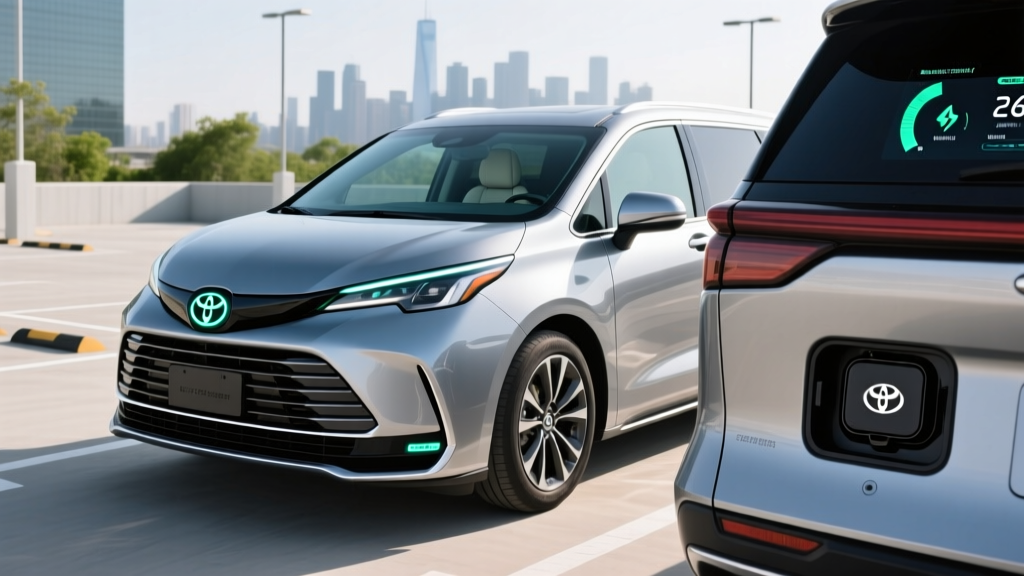
Few vehicles highlight the gap between buyer expectation and manufacturer strategy quite like the Toyota Sienna plug-in hybrid — or more precisely, the absence of one. As of the 2026 model year, Toyota continues to sell the Sienna exclusively as a conventional hybrid electric vehicle (HEV). There is no factory plug-in hybrid (PHEV) Sienna available in the United States. Yet monthly searches for a "Toyota Sienna plug-in hybrid" persist, driven by the popularity of the RAV4 Prime and the growing appetite for PHEV minivans that can handle school runs on electricity alone.
This guide breaks down exactly what the 2026 Sienna HEV delivers, why Toyota has resisted a plug-in variant, what a Sienna PHEV would need to look like based on Toyota's own PHEV architecture, and whether you should wait, cross-shop, or buy the hybrid now.
2026 Toyota Sienna Hybrid: The Powertrain You Can Actually Buy
The 2026 Toyota Sienna is powered by a 2.5-liter four-cylinder engine paired with Toyota's fourth-generation hybrid system. Front-wheel-drive (FWD) models use two electric motors; all-wheel-drive (AWD) trims add a third motor on the rear axle. The result is a combined 245 horsepower — adequate for a minivan prioritizing efficiency over acceleration.
| Spec | Value |
|---|---|
| Powertrain | 2.5L I4 + 2 motors (FWD) / 3 motors (AWD) |
| Combined Horsepower | 245 hp |
| Hybrid Battery | 1.9 kWh (sealed NiMH, not plug-in) |
| EPA MPG (FWD Combined) | 36 MPG |
| EPA City / Highway (FWD) | 36 city / 36 highway |
| EPA MPG (AWD Combined) | 35 MPG |
| 0–60 mph | ~7.2 seconds |
| Towing Capacity | 3,500 lbs |
| Cargo Volume (behind 3rd row) | 33.5 cu ft |
| Base MSRP (LE FWD) | ~$39,485 |
| Top Trim MSRP (Platinum AWD) | ~$55,660 |
The Sienna's 1.9 kWh nickel-metal hydride (NiMH) battery is small by electrified-vehicle standards — it exists to buffer regenerative braking energy and assist the gasoline engine, not to drive the vehicle on electricity alone for meaningful distances. You will see brief EV-mode operation at low speeds in parking lots, typically under 1 mile, but this is not plug-in electric range.
HEV vs PHEV: What's the Difference?
| Feature | HEV (Sienna Hybrid) | PHEV (e.g., RAV4 Prime) |
|---|---|---|
| Plug-in Charging | No — self-charging via regen & engine | Yes — plug in to charge battery |
| Battery Size | ~1–2 kWh | ~13–20 kWh |
| Electric-Only Range | < 1 mile (low speed only) | 25–45+ miles (highway-capable) |
| Federal Tax Credit (§30D) | Not eligible | Up to $7,500 (if requirements met) |
| Home Charging Needed | No | Yes (Level 1 or Level 2) |
| Gasoline Engine | Yes — primary power source | Yes — kicks in after battery depletes |
Fuel Economy: Real-World MPG vs EPA Sticker
The EPA rates the 2026 Sienna FWD at 36 MPG combined (36 city / 36 highway). AWD trims drop slightly to 35 MPG combined. According to fueleconomy.gov, these numbers are among the best in the minivan segment, where the Chrysler Pacifica Hybrid (PHEV) rates 30 MPG combined once its electric range is depleted and the Honda Odyssey sits at 22 MPG combined.
| Drivetrain | City | Highway | Combined |
|---|---|---|---|
| FWD | 36 MPG | 36 MPG | 36 MPG |
| AWD | 35 MPG | 35 MPG | 35 MPG |
Real-world note: Toyota hybrids frequently exceed EPA city estimates in stop-and-go driving because regenerative braking recovers more energy at lower speeds. Owners commonly report 37–40 MPG in urban conditions. Highway driving at sustained 75+ mph tends to return 32–34 MPG, as aerodynamic drag dominates and the engine carries more load. Cold weather can reduce fuel economy by 5–10% due to increased engine idling for cabin heat and reduced battery efficiency.
Why There's No Toyota Sienna Plug-In Hybrid (Yet)
Toyota has a proven PHEV platform in the RAV4 Prime (42 miles electric-only range, 94 MPGe) and the Prius Prime (44 miles electric range). So why hasn't the company applied that architecture to the Sienna? Three factors explain the gap:
- Battery packaging: A PHEV needs a 13–18 kWh battery pack. In the Sienna's low-floor minivan architecture, finding space for that mass without sacrificing cargo volume, seating for eight, or ground clearance is an engineering challenge — especially with the AWD rear motor already occupying under-floor space.
- Cost and pricing: The Sienna already starts near $39,500. Adding a PHEV powertrain (larger battery, onboard charger, charge port, upgraded thermal management) would push the base price well past $45,000, narrowing the value proposition against the Chrysler Pacifica PHEV.
- Toyota's electrification pivot: Toyota has signaled its next-generation minivan updates may lean toward full battery-electric (BEV) platforms rather than PHEV retrofits, aligning with the company's expanding bZ-series EV lineup.
The Chrysler Pacifica PHEV remains the only plug-in hybrid minivan sold in the U.S. as of 2026. It offers 32 miles of electric-only range, 82 MPGe, and a 16 kWh battery — but at a starting price above $50,000 and with no AWD option.
What a Sienna PHEV Would Need: Speculative Benchmark
If Toyota were to introduce a Sienna PHEV, we can extrapolate plausible specs from the RAV4 Prime and the Sienna's existing HEV architecture:
| Spec | RAV4 Prime (Benchmark) | Sienna PHEV (Estimated) |
|---|---|---|
| Battery | 18.1 kWh (NMC lithium-ion) | ~16–20 kWh |
| Electric-Only Range | 42 miles (EPA) | ~30–38 miles |
| Combined HP | 302 hp | ~260–300 hp |
| Level 2 Charge Time | ~2.5 hours (6.6 kW) | ~2.5–4 hours |
| DC Fast Charge | No | Unlikely (Toyota PHEVs lack DCFC) |
| MPGe (Electric Mode) | 94 MPGe | ~80–90 MPGe |
These are estimates based on the heavier, less aerodynamic Sienna platform. Nothing here is confirmed by Toyota, and the company has not announced a Sienna PHEV for any upcoming model year.
Hybrid vs PHEV vs EV: Which Minivan Fits Your Life?
Decision Framework
Choose the Sienna HEV if:
- You don't have reliable home charging access (apartment, street parking)
- You want maximum cargo and passenger space with no compromises
- Your annual mileage is high (15,000+ miles) and you want proven 36 MPG without plugging in
- You want AWD availability — no PHEV minivan offers AWD
- Budget matters: the Sienna LE starts ~$10,000 less than the Pacifica PHEV
Choose the Chrysler Pacifica PHEV if:
- You have Level 2 home charging and a daily commute under 30 miles
- You want to run school runs and errands on electricity most days
- You qualify for the §30D federal tax credit (up to $7,500, subject to income and sourcing rules)
- You don't need AWD
Consider a full EV (e.g., Kia EV9, Tesla Model X) if:
- You have home charging and rarely drive more than 250 miles in a day
- You want zero tailpipe emissions and the lowest per-mile fuel cost
- You're willing to accept current limitations in minivan-format EV availability
Pricing, Tax Credits, and Ownership Costs
The 2026 Sienna HEV starts at approximately $39,485 (LE FWD) and tops out near $55,660 (Platinum AWD). Because it is a conventional hybrid — not a plug-in — the Sienna does not qualify for the federal §30D new clean vehicle tax credit. That credit, worth up to $7,500, applies only to plug-in electric vehicles (PHEVs and BEVs) that meet battery sourcing, critical mineral, MSRP cap, and buyer income requirements outlined by the IRS.
Some states offer their own hybrid incentives, though these vary widely and change frequently. Check your state's energy office or department of revenue for current programs.
| Cost Factor | Sienna HEV (36 MPG) | Pacifica PHEV (30 MPG gas / 32 mi EV) | Honda Odyssey (22 MPG) |
|---|---|---|---|
| Base MSRP | $39,485 | $50,995 | $39,635 |
| Federal Tax Credit | $0 | Up to $7,500* | $0 |
| Est. Fuel Cost (5 yr / 75k mi) | ~$5,400 | ~$3,800** | ~$8,800 |
| Est. Maintenance (5 yr) | ~$2,800 | ~$3,200 | ~$3,500 |
| Effective 5-Yr Cost (est.) | ~$47,685 | ~$50,495 | ~$51,935 |
* §30D eligibility depends on income caps ($150k single / $300k joint), MSRP cap ($80k for vans/SUVs), and battery sourcing. Confirm with a tax professional. ** Assumes 70% of daily miles within electric range and regular home charging.
Battery Warranty, Reliability, and Replacement Cost
Toyota Hybrid Battery Warranty
Toyota covers the Sienna's hybrid battery with a 10-year / 150,000-mile warranty (whichever comes first) across all 50 states. This applies to the hybrid system battery and related components. Earlier Toyota hybrids (pre-2020) carried an 8-year/100,000-mile warranty; the extension to 10/150k reflects Toyota's confidence in its NiMH and lithium-ion hybrid packs.
Toyota's hybrid battery track record is among the strongest in the industry. The Prius, now in its third decade, has demonstrated that NiMH hybrid batteries routinely last 150,000–200,000+ miles before significant degradation. The Sienna's 1.9 kWh pack is small and conservatively managed — it never fully charges or discharges, which extends cell life considerably.
Replacement cost: If the hybrid battery does fail outside warranty, a Toyota dealer replacement typically runs $2,500–$4,000 including labor. Independent hybrid specialists often offer refurbished packs for $1,500–$2,500. This is far less than a full EV battery replacement, which can exceed $10,000–$15,000.
The Sienna consistently earns strong reliability marks. IIHS has named recent model years a Top Safety Pick when equipped with the optional front crash prevention system, and NHTSA has awarded it 5-star overall safety ratings.
Pros — 2026 Sienna HEV
- 36 MPG combined — best-in-class for minivans
- Available AWD (no PHEV minivan offers this)
- Standard 8-passenger seating with generous cargo space
- 10-year / 150k-mile hybrid battery warranty
- No charging infrastructure required
- Proven Toyota hybrid reliability
- Strong resale value
Cons — 2026 Sienna HEV
- No plug-in hybrid option exists
- No electric-only driving for commutes
- Not eligible for §30D federal tax credit
- 245 hp feels modest for a loaded minivan on highway merges
- Infotainment interface lags behind competitors
- AWD reduces MPG only marginally but adds ~$2,000 to price
Frequently Asked Questions
How many MPG does the Toyota Sienna hybrid get?
The 2026 Sienna FWD is EPA-rated at 36 MPG combined (36 city / 36 highway). AWD models rate 35 MPG combined. In real-world city driving, many owners report 37–40 MPG thanks to regenerative braking. Highway driving at 75+ mph typically returns 32–34 MPG.
Is there a Toyota Sienna plug-in hybrid for 2026?
No. As of the 2026 model year, Toyota does not offer a plug-in hybrid Sienna. The Sienna is available exclusively as a conventional hybrid (HEV). The only PHEV minivan available in the U.S. is the Chrysler Pacifica Hybrid, which offers 32 miles of electric-only range.
Does the Toyota Sienna qualify for any federal tax credit?
No. The §30D federal clean vehicle tax credit applies only to plug-in electric vehicles (PHEVs and BEVs). Because the Sienna is a conventional hybrid that cannot be plugged in, it is not eligible. Some states may offer separate hybrid incentives — check your state's energy office.
How long will the Sienna hybrid battery last, and what does replacement cost?
Toyota's hybrid batteries are designed to last the life of the vehicle. The Sienna's hybrid battery is warrantied for 10 years or 150,000 miles. Based on Prius data, these packs commonly reach 150,000–200,000+ miles. Out-of-warranty replacement costs $2,500–$4,000 at a dealer, or $1,500–$2,500 for a refurbished pack from an independent shop.
Should I wait for a Sienna PHEV or buy the HEV now?
Toyota has not announced a Sienna PHEV for any upcoming model year. If you need a plug-in hybrid minivan today, the Chrysler Pacifica PHEV is your only option. If AWD, lower pricing, or proven long-term reliability are priorities, the Sienna HEV is a strong buy now — and its 36 MPG combined is difficult to beat in any minivan, plug-in or otherwise.
Can I convert the Sienna hybrid to a plug-in hybrid?
No practical or certified aftermarket PHEV conversion exists for the Sienna. The hybrid system is deeply integrated with the powertrain control module, transmission, and battery management system. Any modification would void the powertrain warranty and likely violate emissions certification. This is not a feasible path.
Sources: fueleconomy.gov (EPA ratings), Toyota Motor Corporation (manufacturer specifications), IRS §30D Clean Vehicle Credit (tax credit rules). Specifications and pricing reflect 2026 model year data available at time of publication. Always verify current pricing, incentives, and eligibility with your dealer and tax professional.