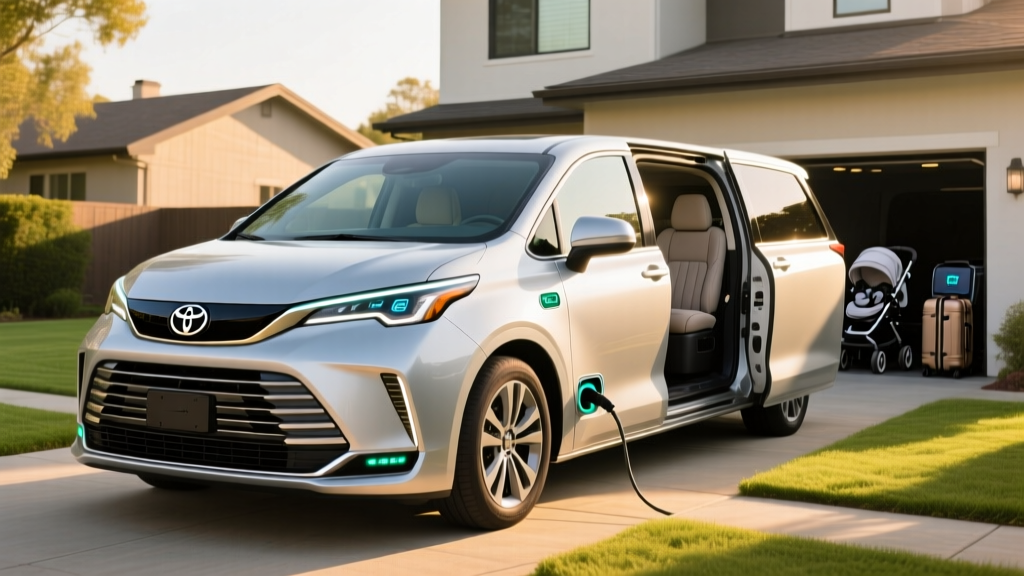
If you've searched for a hybrid van Toyota and found slim pickings, you're not alone. The Toyota Sienna remains the only hybrid-only minivan on the US market — a distinction it has held since its full redesign for the 2021 model year. For 2026, Toyota continues the Sienna's fourth-generation formula: a 2.5-liter four-cylinder paired with Toyota's hybrid synergy drive, standard on every trim. No gas-only variant exists. No plug-in hybrid version is offered. Just one powertrain, one hybrid system, and a fuel-economy story that makes this van a compelling alternative to both three-row SUVs and full battery-electric vehicles.
This guide covers everything a family buyer needs to know: EPA and real-world MPG, the hybrid powertrain under the floor, pricing across trims, tax-credit eligibility (or the lack thereof), battery longevity, and whether the Sienna hybrid is the right call versus a plug-in hybrid SUV or a full EV.
2026 Toyota Sienna Hybrid: Powertrain and Performance Specs
The 2026 Sienna uses Toyota's fourth-generation hybrid system. A 2.5-liter Atkinson-cycle inline-four gasoline engine pairs with two electric motor-generators through a planetary gearset (eCVT). Front-wheel-drive models use the two front motors; all-wheel-drive (AWD) trims add a third, rear-mounted electric motor that provides up to 50 kW of rear-axle torque — no mechanical driveshaft connects the front and rear axles.
| Spec | Value |
|---|---|
| Engine | 2.5L 4-cyl Atkinson cycle |
| Combined System Horsepower | 245 hp (FWD & AWD) |
| Gas Engine Output | 189 hp / 176 lb-ft |
| Front Electric Motor | 134 hp (100 kW) |
| Rear Electric Motor (AWD) | 54 hp (40 kW) — up to 50 kW peak |
| Transmission | eCVT (planetary gearset) |
| Drivetrain | FWD standard; electronic AWD available |
| Traction Battery | ~1.9 kWh (sealed NiMH) |
| 0–60 mph | ~7.1 seconds (FWD) |
| Towing Capacity | 3,500 lbs (with tow prep package) |
| Seating | 7 or 8 passengers (trim-dependent) |
| Cargo Volume (behind 3rd row) | 33.5 cu ft |
| Max Cargo (seats folded) | 101.0 cu ft |
At 245 combined horsepower, the Sienna is not quick by sport-sedan standards, but it's adequate for merging and highway passing with a full load. The eCVT eliminates shift shock, and the electric motor's instant torque makes around-town driving feel more responsive than the horsepower figure suggests. The AWD system engages automatically when slip is detected and does not require driver input — it's a traction aid, not an off-road system.
Fuel Economy: EPA Ratings and Real-World MPG
The Sienna's headline number is fuel economy. Here is the official EPA breakdown per fueleconomy.gov:
| Drivetrain | City MPG | Highway MPG | Combined MPG |
|---|---|---|---|
| FWD (LE, XLE) | 36 | 36 | 36 |
| AWD (all trims) | 35 | 36 | 35 |
For context, the closest non-hybrid competitor — the Honda Odyssey — returns an EPA 22 MPG combined. That's a 13–14 MPG gap. At 15,000 miles per year and $3.50/gallon, the Sienna saves roughly $600–$750 annually in fuel costs over a conventional minivan.
HEV vs. PHEV vs. EV: Which Powertrain Fits Your Family?
The Sienna is a conventional hybrid electric vehicle (HEV) — sometimes called a "self-charging hybrid." It has no plug, no charging port, and no meaningful electric-only range. The small ~1.9 kWh nickel-metal-hydride (NiMH) battery recharges through regenerative braking and the gasoline engine. You fuel it like any other car; the hybrid system simply makes that fuel go further.
Here is how the Sienna HEV stacks up against the other electrified options in the three-row family-vehicle segment:
| Factor | HEV (Sienna) | PHEV (e.g., Chrysler Pacifica Hybrid) | BEV (e.g., Kia EV9) |
|---|---|---|---|
| Plug-in Required? | No | Yes (for EV range) | Yes |
| Electric-Only Range | ~1 mile (low speed) | 32 miles (EPA) | 270–300+ miles |
| Combined MPG / MPGe | 35–36 MPG | 30 MPG (gas) / 82 MPGe (elec) | 89–97 MPGe |
| Home Charging Needed? | No | Recommended (Level 2) | Essential (Level 2) |
| Federal Tax Credit (§30D) | Not eligible | Up to $7,500 (if eligible) | Up to $7,500 (if eligible) |
| Starting MSRP (2026) | ~$38,500 | ~$51,000 | ~$56,000 |
| Best For | No home charger; simplicity | Short commutes + road trips | Home charging + low running cost |
The Sienna HEV wins on simplicity and entry price. You never think about charging — you just drive. The trade-off is that you can't do school-dropoff or grocery runs on electricity alone, and you don't qualify for the federal §30D clean-vehicle tax credit, which is reserved for plug-in hybrids and battery-electric vehicles with sufficient battery capacity.
Pricing, Trims, and Tax-Credit Eligibility
The 2026 Sienna is offered across five core trims. Pricing below reflects MSRP before destination charges:
| Trim | MSRP (FWD) | MSRP (AWD) | Key Features |
|---|---|---|---|
| LE | $38,585 | $39,345 | 8-passenger, Toyota Safety Sense 3.0, 8" touchscreen |
| XLE | $42,585 | $43,345 | SofTex seats, power liftgate, 7-passenger option |
| XSE | $44,585 | $45,345 | Sport-tuned suspension, 20" wheels, black accents |
| Limited | $49,085 | $49,845 | Leather, 12.3" display, JBL audio, HUD |
| Platinum | $53,585 | $54,345 | 360° camera, heated/ventilated 2nd row, digital rearview mirror |
Does the Toyota Sienna Hybrid Qualify for a Federal Tax Credit?
No. The Sienna is a conventional HEV with a battery far too small to meet the §30D minimum capacity requirement (7 kWh for plug-in vehicles). The federal clean-vehicle credit applies only to PHEVs and BEVs that meet battery-capacity, critical-mineral sourcing, MSRP cap, and buyer income-limit thresholds. The Sienna does not qualify for any federal purchase incentive.
Some states offer their own hybrid incentives — for example, certain utility rebates or state clean-fuel programs — but these vary by jurisdiction and change frequently. Check your state's energy office or utility provider for current programs. A tax professional can confirm whether any local incentives apply to your situation.
Hybrid Battery Longevity, Warranty, and Replacement Cost
Hybrid battery anxiety is the number-one concern among first-time hybrid buyers. Here are the facts specific to the Sienna:
The Sienna uses a nickel-metal-hydride (NiMH) traction battery — not the lithium-ion chemistry found in most EVs and PHEVs. NiMH is a mature, well-understood technology that Toyota has refined over more than 25 years of hybrid production (dating to the 1997 Prius). These batteries are not designed for large energy storage; they buffer regenerative-braking energy and assist acceleration in short bursts.
How Long Will the Sienna Hybrid Battery Last?
Based on Toyota's long track record with NiMH hybrid batteries (the Prius, Highlander Hybrid, and Camry Hybrid all use similar chemistry), most Sienna hybrid batteries will outlast the 10-year warranty period without significant degradation. Real-world data from earlier Toyota hybrids shows many NiMH packs lasting 150,000–200,000+ miles. The battery is not stressed the way an EV's large lithium-ion pack is — it operates within a narrow state-of-charge window (roughly 40–80%), which dramatically reduces cycle wear.
What Does a Sienna Hybrid Battery Replacement Cost?
If the battery does fail outside of warranty, a new OEM replacement hybrid battery for the Sienna typically costs $3,000–$4,500 including parts and labor at a Toyota dealer. Third-party rebuilt or reconditioned NiMH modules are available for $1,500–$2,500 installed. This is a fraction of EV battery replacement costs (which can exceed $10,000–$20,000) because the Sienna's pack is small (~1.9 kWh) and the chemistry is inexpensive.
Reliability, Safety, and Ownership Costs
The Sienna benefits from Toyota's reputation for hybrid powertrain reliability. The 2.5L Atkinson-cycle engine is under-stressed (it makes just 189 hp in a vehicle that weighs ~4,600 lbs), the eCVT has no friction bands or clutch packs to wear, and the NiMH battery is proven. According to IIHS, the Sienna has earned top safety ratings in crash testing, and Toyota Safety Sense 3.0 (standard on all trims) includes adaptive cruise control, lane-tracing assist, pre-collision braking with pedestrian detection, and automatic high beams.
Note: Toyota Safety Sense is a Level 2 driver-assistance system per SAE automation definitions. It can steer, accelerate, and brake under certain conditions, but the driver must remain fully engaged and keep hands on the wheel at all times. It is not a self-driving system.
Five-Year Ownership Cost Snapshot
| Category | Estimated Cost |
|---|---|
| Fuel (36 MPG combined, $3.50/gal avg) | ~$7,290 |
| Insurance (national avg, minivan class) | ~$8,500–$10,000 |
| Maintenance (oil, tires, brakes, cabin filter) | ~$2,800–$3,500 |
| Depreciation (est. 45% over 5 years) | ~$19,000–$21,000 |
| Estimated 5-Year Total | ~$37,500–$41,800 |
Compared to a gas-only minivan getting 22 MPG combined, the Sienna saves roughly $3,500–$3,800 in fuel over five years and 75,000 miles. Regenerative braking also reduces brake-pad wear — many Toyota hybrid owners report original brake pads lasting 80,000+ miles.
Pros, Cons, and Who Should Buy the Sienna Hybrid Van
Pros
- Class-leading 35–36 MPG combined — no minivan comes close
- No plug required — zero change to refueling habits
- Available electronic AWD (rare in the minivan segment)
- Proven 25-year Toyota hybrid track record; 10-yr battery warranty
- Spacious 101 cu ft max cargo; 7- or 8-passenger seating
- Standard Toyota Safety Sense 3.0 on every trim
- 3,500-lb towing (adequate for small trailers and boat rigs)
Cons
- No federal tax credit (HEV — not eligible under §30D)
- 245 hp feels modest when fully loaded on highway grades
- No plug-in hybrid option for electric-only commuting
- Infotainment system lags behind rivals in responsiveness
- Second-row seats don't fold into the floor (must be removed for max cargo)
- AWD system is traction-only — not for off-road or deep snow
- Platinum trim pushes past $54,000 MSRP
Choose the Toyota Sienna Hybrid If:
- You need a true minivan (sliding doors, low step-in, three usable rows) and want the best fuel economy available.
- You don't have access to home Level 2 charging and don't want to rely on public infrastructure.
- You prioritize long-term reliability and low maintenance over cutting-edge infotainment or acceleration.
- You drive 15,000+ miles per year and want to minimize fuel spend without going full EV.
Look Elsewhere If:
- You want electric-only commuting — consider the Chrysler Pacifica PHEV (32 mi EV range) or a three-row EV like the Kia EV9.
- You need the federal $7,500 tax credit to make the math work — the Sienna HEV doesn't qualify.
- You regularly tow more than 3,500 lbs — look at body-on-frame SUVs.
Frequently Asked Questions
How many MPG does the Toyota Sienna hybrid van get?
The 2026 Sienna FWD earns an EPA 36 MPG city / 36 highway / 36 combined. AWD models rate at 35/36/35. Real-world results typically range from 33 MPG (highway-heavy, cold climate) to 40 MPG (city-heavy, moderate climate). Per fueleconomy.gov, the Sienna is the most fuel-efficient minivan sold in the US.
Is the Toyota Sienna a plug-in hybrid?
No. The Sienna is a conventional hybrid (HEV). It has no charging port and cannot be plugged in. The hybrid battery recharges through regenerative braking and the gasoline engine. Toyota does not currently offer a plug-in hybrid Sienna, and no PHEV variant has been announced for the 2026 model year.
Can the Sienna hybrid drive on electric power alone?
Only at very low speeds (under ~25 mph) for very short distances (under 1 mile) on flat ground with a charged hybrid battery. This is not a meaningful electric-only range — it's a maneuvering assist for parking lots and driveways. If electric-only commuting is a priority, you need a PHEV or BEV.
Is the Toyota Sienna hybrid reliable?
Toyota's hybrid powertrains have an exceptional reliability record spanning 25+ years of production. The eCVT has fewer wear components than a conventional automatic, and the NiMH battery is proven to last 150,000+ miles in most cases. Toyota backs the hybrid battery and system with a 10-year/150,000-mile warranty across all states.
What does it cost to replace the Sienna hybrid battery?
An OEM replacement NiMH hybrid battery runs $3,000–$4,500 installed at a Toyota dealer. Reconditioned aftermarket packs are available for $1,500–$2,500. Most Sienna hybrid batteries last well beyond the 10-year warranty period, so replacement during typical ownership is uncommon.
Does the Toyota Sienna hybrid qualify for any tax credit?
The Sienna HEV does not qualify for the federal §30D clean-vehicle tax credit, which requires a minimum 7 kWh battery and plug-in capability. Some state or utility-level incentives may apply to hybrids — check your local programs. The IRS publishes current credit rules at irs.gov.
How does the Sienna hybrid compare to the Honda Odyssey?
The Odyssey is gas-only and rates at 22 MPG combined — 13–14 MPG less than the Sienna. Over five years and 75,000 miles, the Sienna saves approximately $3,500+ in fuel. The Odyssey has a slight edge in second-row flexibility (Magic Slide seats) and a more powerful V6 (280 hp), but the Sienna counters with available AWD, lower running costs, and a hybrid powertrain warranty that the Odyssey's conventional drivetrain can't match in coverage duration.